
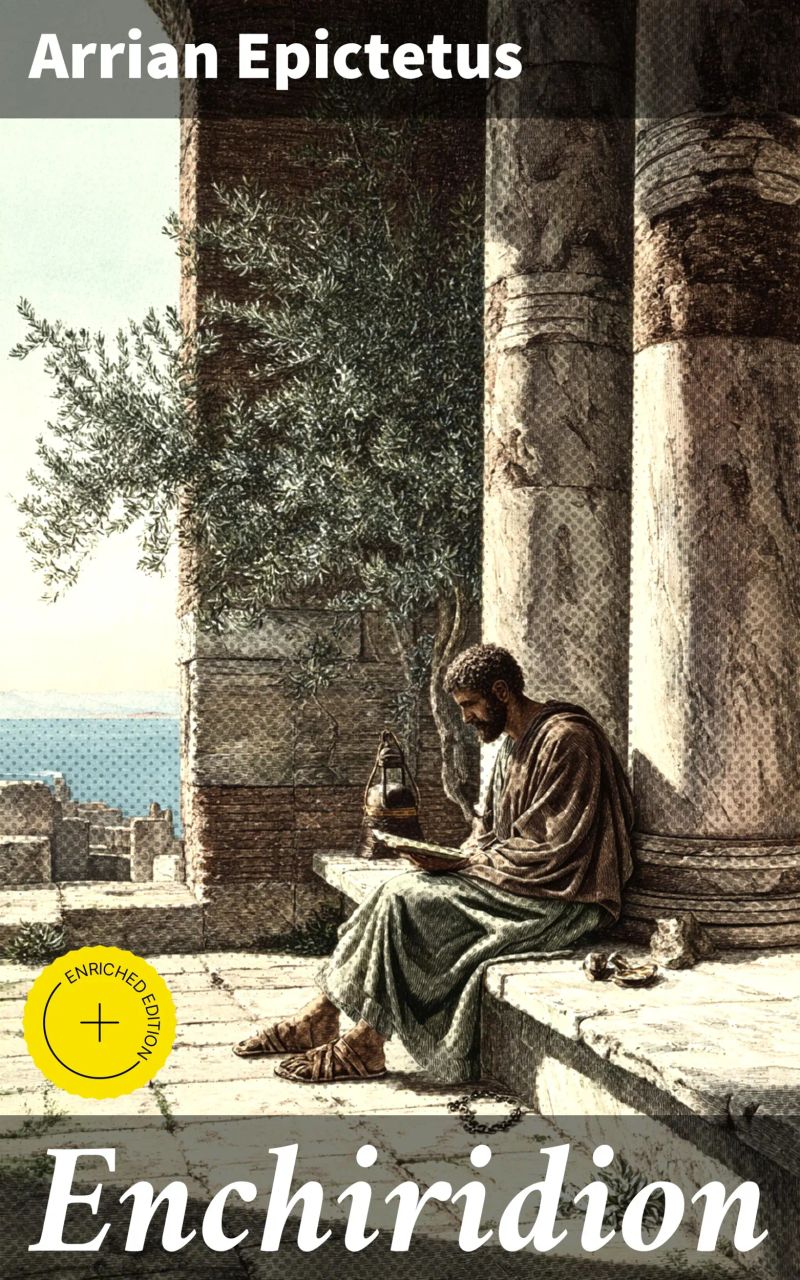
Enchiridion
Enriched edition. Including The Discourses of Epictetus & FragmentsBy Arrian Epictetus


Length18h 4m
About this audiobook
Arrian's "Enchiridion" is a seminal text in Stoic philosophy, serving as a concise manual for living a virtuous and resilient life. Written in a clear, direct prose style, this work distills the teachings of the Cynic philosopher Epictetus, emphasizing the importance of inner moral fortitude over external circumstances. Arrian's interpretation reflects the cultural context of the Roman Empire, where Stoicism became a guiding principle for many leaders and citizens seeking to navigate the complexities of life amidst political and social upheaval. Born into a world of privilege and military command, Arrian was not only a philosopher but also a respected historian and military leader. His education under Epictetus profoundly shaped his worldview, inspiring him to preserve and disseminate the principles of Stoicism. The "Enchiridion" encapsulates Epictetus's core teachings, offering insights into the nature of human agency, the significance of self-discipline, and the pursuit of wisdom, all of which resonate with Arrian's life experiences and intellectual pursuits. This text is highly recommended for anyone interested in philosophy, ethics, or personal development. Arrian's accessible interpretation of Epictetus makes the "Enchiridion" an essential read for both scholars and laypeople alike, reminding us that the path to serenity lies in mastering our responses to life's inevitable adversities.
In this enriched edition, we have carefully created added value for your reading experience:
- A succinct Introduction situates the work's timeless appeal and themes.
- The Synopsis outlines the central plot, highlighting key developments without spoiling critical twists.
- A detailed Historical Context immerses you in the era's events and influences that shaped the writing.
- An Author Biography reveals milestones in the author's life, illuminating the personal insights behind the text.
- A thorough Analysis dissects symbols, motifs, and character arcs to unearth underlying meanings.
- Reflection questions prompt you to engage personally with the work's messages, connecting them to modern life.
- Hand‐picked Memorable Quotes shine a spotlight on moments of literary brilliance.
- Interactive footnotes clarify unusual references, historical allusions, and archaic phrases for an effortless, more informed read.
Audiobook details
Rating★★★★ 4.3 (49.2K)
Includes Goodreads, Amazon, LibraryThing, StoryGraph
GenrePhilosophy
Length18 hrs 4 mins
Narrated byListen with 1,000+ voices
FormateBook with Audio
Publish dateDec 1, 2023
LanguageEnglish
Table of contents
1Introduction
2Introduction
3Synopsis (Selection)
4Historical Context
5Author Biography
Show all chaptersShow less
6Introduction
7Enchiridion, or the Manual
8Enchiridion of Epictetus
9Discourses, as reported by Arrian
10Book 1
11I. Of the things which are under our control and not under our control
12II. How may a man preserve his proper character upon every occasion?
13III. From the thesis that God is the father of mankind how may one proceed to the consequences?
14IV. Of progress
15V. Against the Academics1
16VI. Of providence
17VII. Of the use of equivocal premisses, hypothetical arguments and the like
18VIII. That the reasoning faculties, in the case of the uneducated, are not free from error
19IX. How from the thesis that we are akin to God may a man proceed to the consequences?
20X. To those who have set their hearts on preferment at Rome
21XI. Of family affection
22XII. Of contentment
23XIII. How may each several thing be done acceptably to the gods?
24XIV. That the Deity oversees all men
25XV. What does philosophy profess?
26XVI. Of providence
27XVII. That the art of reasoning is indispensable
28XVIII. That we ought not to be angry with the erring
29XIX. How ought we to bear ourselves toward tyrants?
30XX. How the reasoning faculty contemplates itself
31XXI. To those who would be admired
32XXII. Of our preconceptions
33XXIII. In answer to Epicurus
34XXIV. How should we struggle against difficulties?
35XXV. Upon the same theme
36XXVI. What is the rule of life?
37XXVII. In how many ways do the external impressions arise, and what aids should we have ready at hand to deal with them?
38XXVIII. That we ought not to be angry with men; and what are the little things and the great among men?
39XXIX. Of steadfastness
40XXX. What aid ought we to have ready at hand in difficulties?
41Book 2
42I. That confidence does not conflict with caution
43II. On tranquillity
44III. To those who recommend persons to the philosophers
45IV. To the man who had once been caught in adultery
46V. How are magnanimity and carefulness compatible?
47VI. Of indifference in things
48VII. How should one employ Divination?
49VIII. What is the true nature of the good?
50IX. That although we are unable to fulfil the profession of a man, we adopt that of a philosopher
More from Arrian Epictetus

IlluminationsWalter Benjamin10h 12m4.4 (16.2K)$20 · $0.00

That Bird Has My WingsJarvis Jay Masters9h 49m4.4 (13.7K)$29 · $0.00

Tâo Teh KingLaozi2h 34m4.4 (230.9K)$2 · $0.00

SymposiumPlato3h 26m4.4 (97.9K)$1.20 · $0.00

Buddhist Boot CampTimber Hawkeye2h 39m4.4 (8.4K)$18 · $0.00
Enchiridion & The Discourses of Epictetus (Annotated)Arrian Epictetus18h 9m4.4 (3.5K)$2 · $0.00

The Meditations of the Emperor Marcus Aurelius AntoninusEmperor of Rome Marcus Aurelius5h 41m4.4 (1.8M)$1 · $0.00

Crime and PunishmentFyodor Dostoevsky23h 11m4.4 (1.3M)$12 · $0.00

MeditationsMarcus Aurelius5h 52m4.4 (433.7K)$1 · $0.00

Everyday DharmaSuneel Gupta5h 2m4.5 (761)$20 · $0.00

The Joyful Wisdom ("La Gaya Scienza")Friedrich Wilhelm Nietzsche11h 37m4.4 (26.6K)$1 · $0.00
The Art of LivingEpictetus, Sharon Lebell3h 16m4.4 (50.1K)$18 · $0.00
MeditationsEmperor Of Rome Marcus Aurelius7h 23m4.3 (477.5K)$1.20 · $0.00

The Imitation of ChristThomas à Kempis6h 27m4.3 (84.6K)$21 · $0.00

Sadhana: the realisation of lifeRabindranath Tagore3h 49m4.4 (8.6K)$6 · $0.00

SapiensYuval Noah Harari15h 18m4.3 (1.4M) · 1287$33 · $0.00

You BelongSebene Selassie8h 35m4.4 (2.7K)$26 · $0.00

The Song Celestial; Or, Bhagavad-Gîtâ (from the Mahâbhârata)Anonymous2h 18m4.4 (3.2K)$2 · $0.00

The KybalionThe Three Initiates3h 47m4.3 (58.7K)$20 · $0.00

Chuang Tzu: Mystic, Moralist, and Social ReformerZhuangzi14h 42m4.4 (1.2K)$1 · $0.00
You may also like
Mental ToughnessEric Holt1h 43m4.2 (268) Only with Ultra
UnlearnHumble the Poet3h 55m4.3 (4.5K)$20 · $0.00

The Fasting CureUpton Sinclair3h 46m4.2 (459)$2.30

The EnchiridionEpictetus0m4.4 (41.3K)$1 · $0.00
Liminal ThinkingDave Gray3h 10m4.1 (3.9K)$17

Health RevolutionMaria Borelius8h 58m4.0 (1.6K)$29 · $0.00

How to Not Always Be WorkingCody Cook-Parrott1h 58m3.6 (2.2K)$16 · $0.00

Truth Without ApologyAcharya Prashant6h 41m4.8 (2.2K)$18 · $0.00

What I Talk about When I Talk about RunningHaruki Murakami4h 24m4.0 (245.4K)$12

The Abundance BrainDanniel Silva3h 18m$1.80 · $0.00

Now What?Gary John Bishop4h 49m$20 · $0.00

No One’s Eulogy Mentions Their KPIsIsla T. Fairbanks2h 58m$4.10 · $0.00

Dating: How to Keep Your Stress Low and Spirits High While Dating (The Ultimate Formula for Finding, Dating and Keeping a Quality Man)Kenny Campbell2h 23m$3.50 · $0.00

The Book of KnowingGwendoline Smith1h 43m4.0 (857)$15

Profitable PostsJideon F Marques7h 34m$11 · $0.00

The Free FallPatricia Sabrina Wall4h 56m$12 · $0.00

Of the Conduct of the Understanding (Annotated)John Locke4h 52m4.4 (104)$0.99 · $0.00

With proper training to more energy and health: Muscles with brains and energy to enjoy! Avoid training mistakes, reduce your weaknesses and strengthen your physical and mental performance.Gerhard J. Mandalka4h 41m$20 · $0.00

Karate For BeginnersJose Clementino Barbosa1h 46m$7 · $0.00

How to Date Your WardrobeHeather Newberger1h3.3 (165)$13 · $0.00