
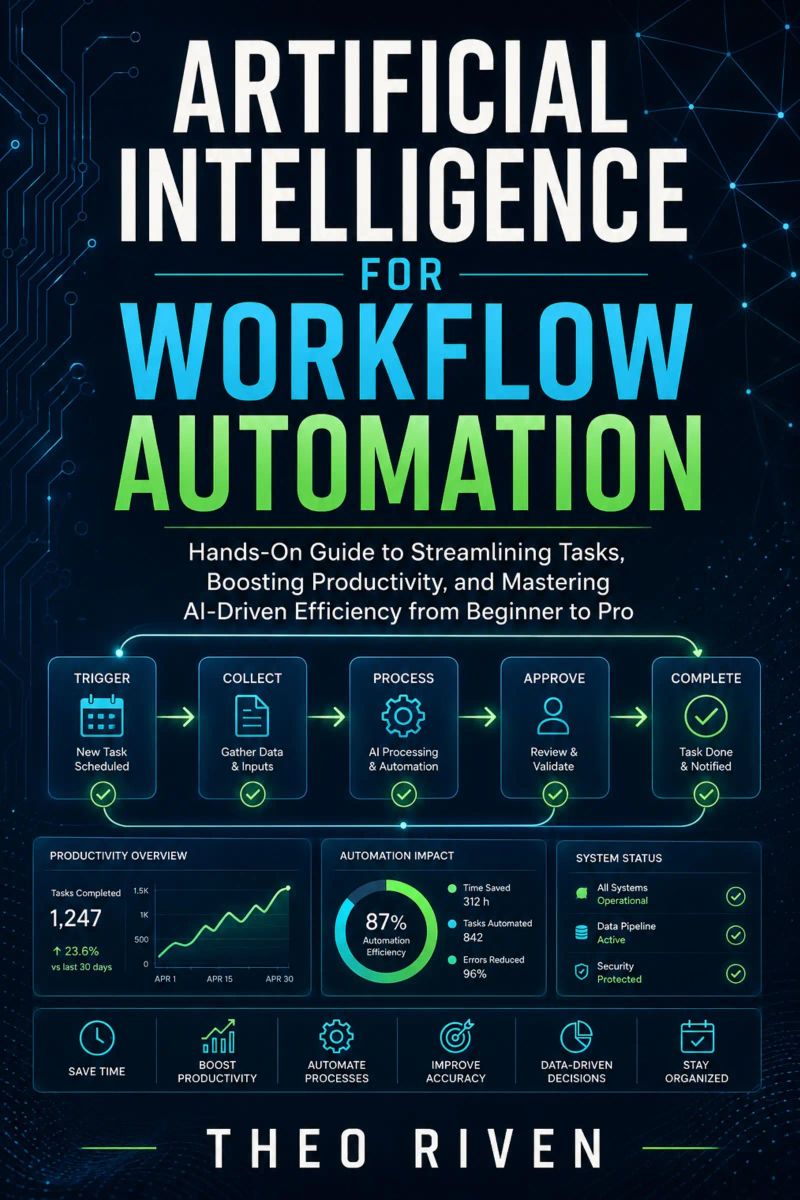
Artificial Intelligence for Workflow Automation
By Theo Riven


Length3h 24m
About this audiobook
Turn repetitive work into smart, efficient systems with the power of artificial intelligence and automation.
Artificial Intelligence for Workflow Automation is a practical guide for professionals, business owners, freelancers, teams, and beginners who want to use AI to save time, reduce manual tasks, and improve productivity. The book explains the foundations of artificial intelligence, machine learning, natural language processing, workflow design, and automation strategy in clear, accessible language.
Readers will learn how to identify workflow bottlenecks, design automated processes, connect tools, use no-code and low-code platforms, apply AI to repetitive tasks, and build scalable productivity systems. The book also explores real-world use cases involving business operations, data handling, reporting, task management, and intelligent process improvement.
Whether you are automating personal tasks or building business systems, this guide helps you understand how to use AI-driven automation to work faster, smarter, and more effectively.
Audiobook details
GenreTechnology
Length3 hrs 24 mins
Narrated byListen with 1,000+ voices
FormateBook with Audio
Publish dateJun 12, 2026
LanguageEnglish
Table of contents
1Chapter 1: Demystifying AI and Workflow Automation – Your Starting Line
2Introduction to AI and Workflow Automation
3What is AI? Breaking Down the Basics
4Machine Learning: Teaching Computers to Learn from Experience
5Neural Networks: The Brain-Like Structure Powering AI
Show all chaptersShow less
6Natural Language Processing: Making AI Understand Human Words
7Understanding Workflows in Everyday Work
8Why AI Automation Transforms Productivity
9Self-Assessment Quiz: Gauge Your Current Level
10Quick-Win Exercise: Mapping Your First Simple Workflow
11Real-World Applications and Actionable Steps
12Summary of Key Takeaways
13Exercises and Challenges for Practice
14Chapter 2: Building Blocks of Automation – No-Code Tools for Beginners
15Core Concepts of No-Code Automation: Triggers, Actions, and Conditions
16Triggers: The Starting Gun for Your Automation
17Actions: The Workhorses That Get Things Done
18Conditions: The Smart Decision-Makers
19Overview of No-Code Platforms: Zapier, Make.com, and Microsoft Power Automate
20Zapier: The App Connector King for Quick Wins
21Make.com: Visual Power for Complex Flows
22Microsoft Power Automate: Enterprise-Ready for Microsoft Users
23Step-by-Step Setup: Your First Automation – Email-to-Task Syncing
24Prerequisites
25Step 1: Create a New Zap (2 minutes)
26Step 2: Set Up the Trigger – Watch for New Emails (3 minutes)
27Step 3: Add the Action – Create Todoist Task (4 minutes)
28Step 4: Insert a Condition for Smarts (3 minutes)
29Step 5: Turn It On and Monitor (3 minutes)
30Troubleshooting Common Newbie Pitfalls
31Pitfall 1: Trigger Not Firing (Silent No-Starts)
32Pitfall 2: Actions Failing Mid-Way (Partial Executes)
33Pitfall 3: Conditions Too Rigid or Loose
34Pitfall 4: Performance and Cost Surprises
35Hands-On Project: Automate a Daily Report Generation
36Project Goal and Mapping
37Step 1: Trigger – Schedule Daily Run (5 minutes)
38Step 2: Pull and Process Data – Action 1: Lookup Spreadsheet (5 minutes)
39Step 3: Add Intelligence – Optional Condition and AI Summary (7 minutes)
40Step 4: Generate and Send Report – Actions 3-4: Create PDF and Email (8 minutes)
41Step 5: Refine and Deploy (5 minutes)
42Real-World Applications and Actionable Steps to Implement
43Summary of Key Takeaways
44Exercises and Challenges for Practice
45Chapter 3: Integrating AI into Basic Workflows – Smart Decisions Without Coding
46How AI Enhances Traditional Automation
47Predictive Triggers: Anticipating Events Before They Happen
48Sentiment Analysis: Reading Between the Lines
49Exploring Free AI APIs: Gateways to Intelligence
50OpenAI's GPT: Versatile Text Wizardry
More from Theo Riven

Operation PedestalMax Hastings12h 29m4.4 (5.2K)$29 · $0.00

When the Heavens Went on SaleAshlee Vance18h 20m4.4 (3K)$40 · $0.00
Everybody Has a Podcast (Except You)Justin McElroy, Travis McElroy, Griffin McElroy5h 9m4.3 (2.3K)$24 · $0.00

Hands of TimeRebecca Struthers8h 8m4.4 (1.3K)$26 · $0.00
Never Lost AgainBill Kilday10h 1m4.4 (805)$29 · $0.00
How the Internet HappenedBrian McCullough13h 28m4.3 (2.7K)$23 · $0.00
Collected Writings of Nikola TeslaNikola Tesla, Thomas Commerford Martin21h 50m4.3 (1.7K)$1 · $0.00

Just AspireAjai Chowdhry9h 13m4.4 (260)$29 · $0.00

The Little Book of AliensAdam Frank8h 20m4.3 (1.3K)$26 · $0.00
The inventions, researches and writings of Nikola Tesla (Annotated)Thomas Commerford Martin16h 59m4.3 (1.3K)$2 · $0.00

KargilV.P. Malik15h 18m4.3 (2K)$24 · $0.00
Experiments with Alternating CurrentsNikola Tesla9h 16m4.3 (874)$1.99 · $0.00

Fire on the HorizonTom Shroder, John Konrad8h 23m4.3 (858)$26 · $0.00

The Smell of Kerosene (Annotated)National Aeronautics and Space Administration, Donald L. Mallick, Peter W. Merlin11h 32m4.3 (523)$2 · $0.00

The Boy Who Harnessed the WindWilliam Kamkwamba, Bryan Mealer10h 5m4.2 (78.9K)$29 · $0.00

Across the Airless WildsEarl Swift10h 8m4.3 (1.3K)$29 · $0.00

Console WarsBlake J. Harris20h 41m4.2 (13.7K)$46 · $0.00
Improvised Munitions HandbookU.S. Department of Defense4h 49m4.3 (1.6K)$1.99 · $0.00
Escaping GravityLori Garver10h 54m4.2 (2.2K)$20 · $0.00

Wireless WarsJonathan Pelson8h 2m4.3 (418)$20 · $0.00
You may also like
Collected Writings of Nikola TeslaThomas Commerford Martin, Nikola Tesla19h 42m4.4 (2.8K)$1.99 · $0.00
ITIL Foundation Essentials ITIL 4 Edition - The ultimate revision guide, second editionClaire Agutter1h 12m4.2 (462)$27 · $0.00
AutonomyLawrence D. Burns, Christopher Shulgan11h 21m4.1 (1.1K)$29 · $0.00
Day Trading AttentionGary Vaynerchuk8h 25m4.3 (1.8K)$28 · $0.00
Introduction to AI and Machine LearningDisrupt.co.nz1h 23m$1.20 · $0.00
Build AI Agents with FlowiseCyrus Fontaine8h 1m$5
Neural Networks Without PythonPaloma Iqbal7h 29m$5 · $0.00

FAA PART 107 DRONE STUDY GUIDE 2026/2027Adrian Hartwell10h 49m$10
Giant Brains, or, Machines That ThinkEdmund Callis Berkeley9h 21m$2.30
The Electric SlidePacky McCormick4h 31m5.0 (12)Free
CLAUDE CODE MASTERY 2026Smart Alden6h 5m$8.50 · $0.00
Everyone’s Talking About AI, and I Don’t Know Where to Start - How to Use AI for Everyday Tasks, Check Its Answers, and Keep Thinking for YourselfMax Paradox4h 12m4.9 (18)$7.70 · $0.00

Master AiHenrique Xavier Oliveira2h 5m$6 · $0.00
Warehouse Logistic ManagementAnamelissa Montenegro Cordero, Andrés Castellanos Ramírez5h 31m$6 · $0.00

Artificial IntelligenceJ.C.Lesko2h 43m$15 · $0.00
Signal Processing for Electrical EngineersHelen Marchetti12h 6m$80
RepluggedSatnam Bains13h 47m$14 · $0.00
Robot RightsDavid J. Gunkel10h 58m4.1 (122)$23 · $0.00
Eft Investing: A Comprehensive Guide to Researching and Investing (The Intelligent Investor's Guide to Using Free Online Stock Screeners to Find Winning Stocks)Matthew Nagel2h 7m$3.50 · $0.00
The Artificial AuthorSimone Aliprandi7h 42m$15 · $0.00