
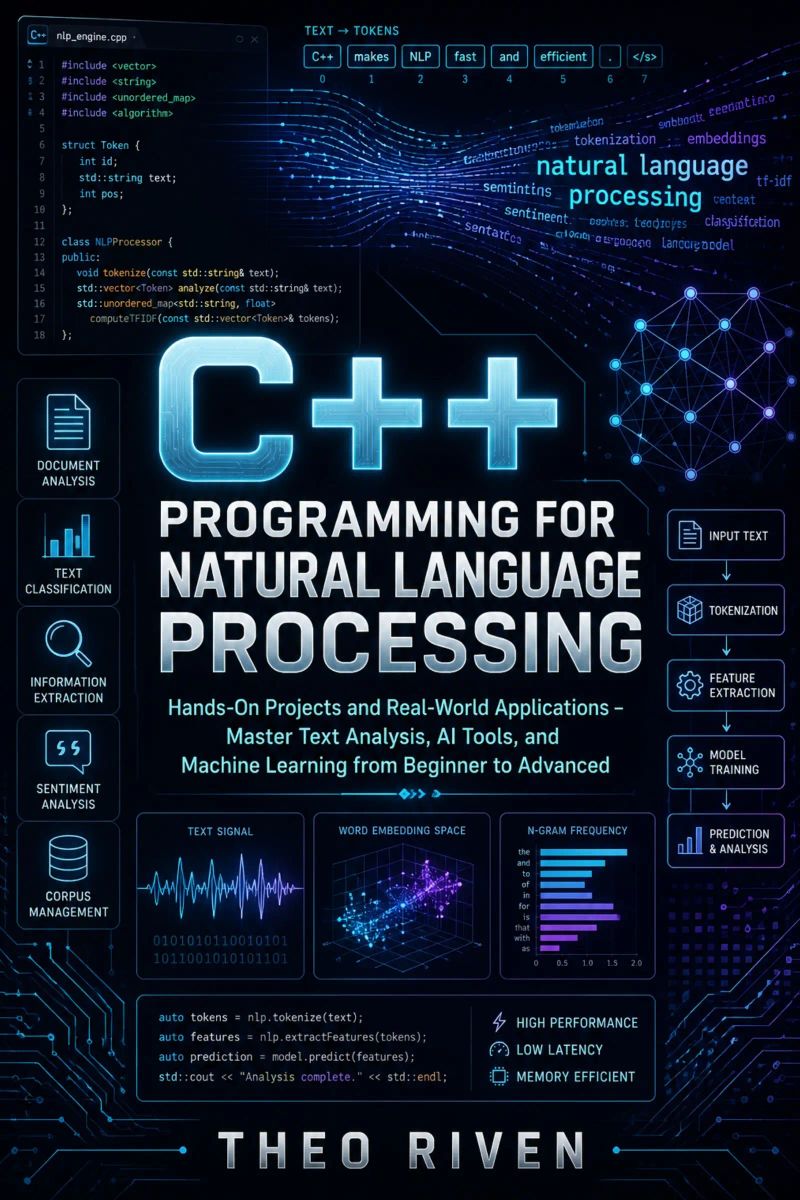
C++ Programming for Natural Language Processing
By Theo Riven


Length5h 5m
About this audiobook
Learn how to use the speed and power of C++ to build practical natural language processing applications.
C++ Programming for Natural Language Processing is a hands-on guide for readers who want to understand how modern text analysis, language processing, and AI-powered applications can be built with C++. Starting from beginner-friendly C++ foundations, this book introduces variables, control flow, functions, data structures, file handling, and essential programming concepts before moving into real-world NLP techniques.
Readers will explore text preprocessing, tokenization, pattern matching, sentiment analysis, machine learning concepts, language-focused algorithms, and practical projects that show how C++ can be used for fast and efficient text processing. The book is designed to help learners connect core programming knowledge with real NLP applications.
Whether you are a student, programmer, AI learner, or developer interested in high-performance language technology, this guide provides a clear path from C++ basics to practical natural language processing projects.
Audiobook details
GenreTechnology
Length5 hrs 5 mins
Narrated byListen with 1,000+ voices
FormateBook with Audio
Publish dateJun 12, 2026
LanguageEnglish
Table of contents
1Chapter 1: Introduction to C++ and the World of Natural Language Processing
2Why Choose C++ for NLP: Speed, Efficiency, and Real-Time Magic
3The Need for Speed in Text Processing
4Efficiency: Making Every Byte Count
5Real-Time Applications: Where NLP Meets the Moment
Show all chaptersShow less
6Overview of NLP Fundamentals: Text as Data, and Its Sneaky Challenges
7Text as Data: The Building Blocks
8Key NLP Tasks: From Basics to Insights
9Challenges in NLP: The Ambiguity Hurdle
10Setting Up Your Environment: Compilers, IDEs, and Essential Libraries
11Step 1: Install a Compiler – The Code Translator
12Step 2: Choose an IDE – Your Coding Command Center
13Step 3: Libraries – Boost for NLP Superpowers
14Hands-On: Building the "Hello NLP" Script – Your First Text Stats Analyzer
15Understanding the Script's Logic
16Step-by-Step Code Writing
17Extending with Boost (Optional First Taste)
18Real-World Applications: From Everyday Tools to Industry Powerhouses
19Everyday Wins: Personal Productivity Boosters
20Industry Heavy-Hitters: Speed Meets Scale
21Summary of Key Takeaways, Exercises, and Challenges
22Exercises for Practice
23Challenges to Level Up
24Chapter 2: C++ Basics: Variables, Control Flow, and Your First Programs
25Data Types: The Flavors of Your Ingredients
26Variables: Naming and Storing Your Data
27Operators: Mixing and Transforming Data
28Control Flow: Decisions and Repetition with Conditionals and Loops
29Loops: For and While – Repeating Tasks Efficiently
30Debugging Essentials and Common Pitfalls for Beginners
31Types of Errors
32Essential Debugging Tools
33Common Pitfalls and How to Avoid
34Hands-On: Writing Simple Programs and Building a Basic Word Counter
35Simple Program 1: Interactive Text Validator
36Simple Program 2: Repeated Input Processor
37Culminating Exercise: Basic Word Counter
38Real-World Applications: Text Processing in Everyday and Pro Tools
39Everyday: Personal Text Tools
40Pro: Industry-Scale Text Handling
41Summary of Key Takeaways, Exercises, and Challenges
42Exercises for Practice
43Challenges to Level Up
44Chapter 3: Functions, Pointers, and Modular Code Design
45Defining and Calling Functions: Breaking Code into Reusable Pieces
46What Are Functions? The Basics
47Calling Functions: Passing Arguments
48Pass-by-Value vs. Pass-by-Reference: How Data Flows In and Out
49Introduction to Pointers, Dynamic Memory, and Arrays: Flexible Data Handling
50Pointers: Addressing Memory Like Street Addresses
More from Theo Riven
JavaScript Programming for Mobile App DevelopmentTheo Riven4h 34m$5
Artificial Intelligence for Quantum Machine LearningTheo Riven4h 25m$5

Artificial Intelligence for Business StrategyTheo Riven3h 11m$5
Artificial Intelligence for Cloud ComputingTheo Riven3h 59m$5
Artificial Intelligence for Prompt EngineeringTheo Riven4h 17m4.8 (11)$5
Artificial Intelligence for IoT Development SubtitleTheo Riven3h 54m$5
JavaScript Programming for Blockchain DevelopmentTheo Riven4h 15m$5
Artificial Intelligence for Game DevelopmentTheo Riven4h 41m$5
Artificial Intelligence for Natural Language ProcessingTheo Riven3h 33m$5
Artificial Intelligence for Workflow AutomationTheo Riven3h 25m$5

The Honey BusMeredith May9h 31m4.4 (16.6K)$25 · $0.00

Collected Writings of Nikola TeslaThomas Commerford Martin, Nikola Tesla19h 42m4.4 (2.8K)$1.99 · $0.00

Operation PedestalMax Hastings12h 29m4.4 (5.2K)$29 · $0.00

When the Heavens Went on SaleAshlee Vance18h 20m4.4 (3K)$40 · $0.00

Everybody Has a Podcast (Except You)Justin McElroy, Travis McElroy, Griffin McElroy5h 9m4.3 (2.3K)$24 · $0.00

Hands of TimeRebecca Struthers8h 8m4.4 (1.3K)$26 · $0.00

Never Lost AgainBill Kilday10h 1m4.4 (805)$29 · $0.00

How the Internet HappenedBrian McCullough13h 28m4.3 (2.7K)$23 · $0.00

Collected Writings of Nikola TeslaNikola Tesla, Thomas Commerford Martin21h 50m4.3 (1.7K)$1 · $0.00

Just AspireAjai Chowdhry9h 13m4.4 (260)$29 · $0.00

The Little Book of AliensAdam Frank8h 20m4.3 (1.3K)$26 · $0.00

The inventions, researches and writings of Nikola Tesla (Annotated)Thomas Commerford Martin16h 59m4.3 (1.3K)$2 · $0.00

KargilV.P. Malik15h 18m4.3 (2K)$24 · $0.00

Experiments with Alternating CurrentsNikola Tesla9h 16m4.3 (874)$1.99 · $0.00

Fire on the HorizonTom Shroder, John Konrad8h 23m4.3 (858)$26 · $0.00

The Smell of Kerosene (Annotated)National Aeronautics and Space Administration, Donald L. Mallick, Peter W. Merlin11h 32m4.3 (523)$2 · $0.00

The Boy Who Harnessed the WindWilliam Kamkwamba, Bryan Mealer10h 5m4.2 (78.9K)$29 · $0.00

Across the Airless WildsEarl Swift10h 8m4.3 (1.3K)$29 · $0.00

Console WarsBlake J. Harris20h 41m4.2 (13.7K)$46 · $0.00

Improvised Munitions HandbookU.S. Department of Defense4h 49m4.3 (1.6K)$0.99 · $0.00
You may also like
Decoding DCFPenelope B. Wellington7h 36m$6.30 · $0.00
EFT Investing: A Comprehensive Guide to Understanding Real Estate Syndications Accredited Investor Banking (A Complete Guide to Options Trading Binary Options Stock Options Currency Index Options EFT)Charles Thompson2h 34m$3.50 · $0.00
Forallx - An Introduction to Formal LogicP.D. Magnus5h 23m3.6 (63)$1 · $0.00
C++ for 3D Game Development with Unreal EngineGideon Drake4h 13m$6
Concurrent Python with asyncioLena Iqbal7h 43m$5
Python That Does Your ChoresGreta Farrell7h 50m$5
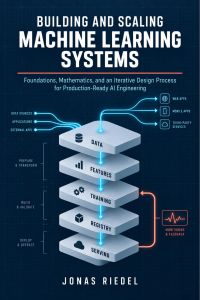
Building and Scaling Machine Learning SystemsJonas Riedel15h 6m$85
Artificial Intelligence for Quantum Machine LearningTheo Riven4h 25m$5
Artificial Intelligence for Cloud ComputingTheo Riven3h 59m$5

Cost Per Action CashAnthony Ekanem1h 7m$5 · $0.00
High-Performance Machine Learning in C++Lionel Eriksen7h 37m$5 · $0.00
Scaling Production-Ready AI WorkloadsKenji Watanuki14h 43m$80
Practical SQL; Query & Manage DatabaseStephen Hart5h 56m$7 · $0.00
From Raw Data to Real InsightVictor Fontaine7h 42m$5

The AI Advantage for LawyersMiles Draper3h 52m4.8 (10)$17
Confident Excel at WorkCurtis Brandt7h 28m$5 · $0.00
Craft Your First Game with C++ and Unreal Engine 5Bennett Halloran7h 10m$5 · $0.00
Leading in the Age of Artificial IntelligenceJasper Livingstone9h 35m$13
DCF BudgetingIsabella S. Lee8h 1m$6.30 · $0.00
Modern Data EngineeringOwen Fletcher7h 33m$6.50 · $0.00