
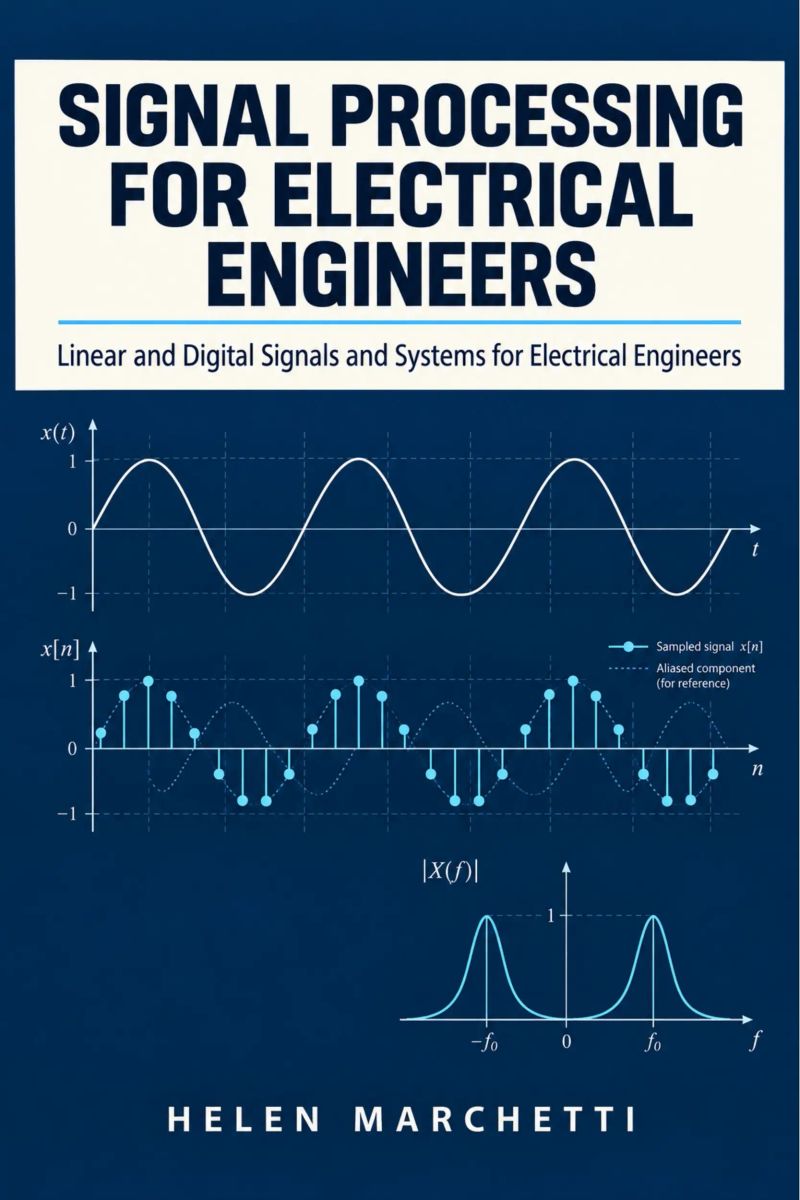
Signal Processing for Electrical Engineers
Linear and Digital Signals and Systems for Electrical EngineersBy Helen Marchetti


Length12h 5m
About this audiobook
Transforms feel arbitrary until you see what they measure. This book keeps the instrument in view.
Signal processing is often taught as a sequence of mathematical procedures, with the meaning of each transform left implicit. This book reverses that order. You begin by classifying signals and systems, then build convolution by hand in both continuous and discrete time, and decompose responses into zero-input and zero-state parts. Fourier series and transforms arrive as answers to real questions about frequency content, with line spectra, energy relations and the Gibbs phenomenon explained rather than asserted.
You then take sampling seriously: Nyquist limits, aliasing you can see, reconstruction and anti-alias filtering. Discrete chapters cover the discrete Fourier transform with windowing and leakage, fast algorithms, the z-transform, and FIR and IIR filter design with finite word length effects. Closing chapters handle noise, power spectral density and modulation. Throughout, the emphasis stays on what each tool measures and when it applies, so that the mathematics remains connected to the signals on the wire.
What you will learn
• Classify signals and systems, and test linearity, time invariance, causality and stability
• Build convolution by hand in continuous and discrete time, and interpret impulse responses
• Solve differential and difference equations, separating zero-input and zero-state responses
• Read Fourier series and transforms as frequency-content measurements, including line spectra, energy relations and the Gibbs phenomenon
• Apply the Laplace transform to system analysis and stability
• Handle sampling correctly: Nyquist limits, visible aliasing, reconstruction and anti-alias filtering
• Use the discrete Fourier transform with windowing and leakage control, and apply fast algorithms
• Work with the z-transform, and design FIR and IIR filters with finite word length effects in view
• Analyze random signals, noise, power spectral density and modulation in practical settings
For electrical engineering students and practising engineers working with sampled data, this book provides a coherent path from signal classification to filter design and noise analysis. If you need to understand not only how to compute a transform but what it tells you about a real signal, this treatment keeps the instrument in view from the first chapter to the last.
Audiobook details
GenreTechnology, Science and Nature
Length12 hrs 5 mins
Narrated byListen with 1,000+ voices
FormateBook with Audio
Publish dateSep 28, 2026
LanguageEnglish
Table of contents
1Foreword
2Preface
3About This Book
4Chapter 1: Signals and Their Operations
51.1 Continuous-Time and Discrete-Time Signals
Show all chaptersShow less
61.2 Signal Classification: Periodic, Aperiodic, Even and Odd
71.3 Energy, Power and Average Value
81.4 Time Shifting, Scaling and Reflection
91.5 Elementary Signal Models
101.6 Signal Operations on Sampled Records
11Chapter 2: Systems and Their Properties
122.1 Systems as Transformations
132.2 Linearity and Superposition
142.3 Time Invariance, Causality and Memory
152.4 Invertibility and Bounded-Input Bounded-Output Stability
162.5 A Classification Procedure and Worked Case
17Chapter 3: LTI Systems and Convolution
183.1 The Impulse Response and the Convolution Integral
193.2 Graphical and Analytic Evaluation
203.3 Discrete Convolution and Its Evaluation
213.4 Step Response, Interconnections and Stability Revisited
22Chapter 4: Differential and Difference Equations
234.1 Continuous-Time Differential Equation Models
244.2 Natural Response and Characteristic Modes
254.3 Zero-Input and Zero-State Decomposition
264.4 Difference Equations and Recursive Solution
274.5 Impulse Response from the Equation
28Chapter 5: Fourier Series
295.1 Periodic Signals and the Trigonometric Series
305.2 Exponential Form and Line Spectra
315.3 Symmetry Properties and Simplifications
325.4 Convergence and the Gibbs Phenomenon
335.5 Power Relations for Periodic Signals
34Chapter 6: The Continuous-Time Fourier Transform
356.1 From Series to Transform
366.2 Transform Properties and Pairs
376.3 Convolution and Multiplication in the Frequency Domain
386.4 Energy Spectral Density and Parseval’s Relation
39Chapter 7: The Laplace Transform
407.1 Definition, Region of Convergence and Uniqueness
417.2 The Unilateral Transform and Initial Conditions
427.3 Poles, Zeros and Transfer Functions
437.4 Inverse Transforms by Partial Fractions
447.5 System Response and Stability from the s-Plane
45Chapter 8: Sampling and Reconstruction
468.1 The Sampling Theorem and the Nyquist Condition
478.2 Aliasing in Time and Frequency
488.3 Ideal Reconstruction and the Zero-Order Hold
498.4 Anti-Alias Filtering and Practical Sampling Chains
50Chapter 9: Discrete-Time Fourier Analysis

LiftoffEric Berger9h 4m4.6 (9.5K)$29 · $0.00

The Honey BusMeredith May9h 31m4.4 (16.6K)$25 · $0.00
Collected Writings of Nikola TeslaThomas Commerford Martin, Nikola Tesla19h 42m4.4 (2.8K)$1.99 · $0.00

Operation PedestalMax Hastings12h 29m4.4 (5.2K)$29 · $0.00

When the Heavens Went on SaleAshlee Vance18h 20m4.4 (3K)$40 · $0.00

Everybody Has a Podcast (Except You)Justin McElroy, Travis McElroy, Griffin McElroy5h 9m4.3 (2.3K)$24 · $0.00

Hands of TimeRebecca Struthers8h 8m4.4 (1.3K)$26 · $0.00
Never Lost AgainBill Kilday10h 1m4.4 (805)$29 · $0.00
How the Internet HappenedBrian McCullough13h 28m4.3 (2.7K)$23 · $0.00

Collected Writings of Nikola TeslaNikola Tesla, Thomas Commerford Martin21h 50m4.3 (1.7K)$1 · $0.00

Just AspireAjai Chowdhry9h 13m4.4 (260)$29 · $0.00

The Little Book of AliensAdam Frank8h 20m4.3 (1.3K)$26 · $0.00
The inventions, researches and writings of Nikola Tesla (Annotated)Thomas Commerford Martin16h 59m4.3 (1.3K)$2 · $0.00

KargilV.P. Malik15h 18m4.3 (2K)$24 · $0.00
Experiments with Alternating CurrentsNikola Tesla9h 16m4.3 (874)$1.99 · $0.00

Fire on the HorizonTom Shroder, John Konrad8h 23m4.3 (858)$26 · $0.00

The Smell of Kerosene (Annotated)National Aeronautics and Space Administration, Donald L. Mallick, Peter W. Merlin11h 32m4.3 (523)$2 · $0.00

The Boy Who Harnessed the WindWilliam Kamkwamba, Bryan Mealer10h 5m4.2 (78.9K)$29 · $0.00

Across the Airless WildsEarl Swift10h 8m4.3 (1.3K)$29 · $0.00

Console WarsBlake J. Harris20h 41m4.2 (13.7K)$46 · $0.00

A Brief History of IntelligenceMax S. Bennett12h 18m4.6 (6.6K)$29 · $0.00
The Story of BirdsSteve Brusatte11h 49m4.6 (401)$29 · $0.00

Life On Earth 40th Anniversary EditionSir David Attenborough12h 27m4.6 (6.5K)$29 · $0.00

BeyondStephen Walker15h 39m4.6 (3.2K)$33 · $0.00
LiftoffEric Berger9h 4m4.6 (9.5K)$29 · $0.00
Black Earth WisdomLeah Penniman11h 54m4.6 (577)$8 · $0.00

Total Cat MojoJackson Galaxy10h 13m4.5 (8.4K)$23 · $0.00

My Life Among the UnderdogsTia Torres5h 51m4.5 (4K)$24 · $0.00

What It Takes to Save a LifeKwane Stewart6h4.6 (556)$24 · $0.00

Pastoral SongJames Rebanks8h 35m4.5 (12K)$26 · $0.00

How Stella Learned to TalkChristina Hunger7h4.5 (10.9K)$24 · $0.00

Craig & FredCraig Grossi8h 6m4.5 (9.6K)$26 · $0.00

Celebrating BirdsNatalia Rojas, Ana Maria Martinez6h 47m4.6 (330)$24 · $0.00

Saving JemimaJulie Zickefoose4h 59m4.5 (749)$20 · $0.00

Will's Red CoatTom Ryan8h 23m4.5 (2.3K)$26 · $0.00

Of Time and TurtlesSy Montgomery10h 34m4.5 (5K)$29 · $0.00

THE WOLF TRILOGY: Call of the Wild, White Fang & The Son of the WolfJack London17h 31m4.5 (2.4K)$1.99 · $0.00

Zen and the Art of Saving the PlanetThich Nhat Hanh9h 20m4.5 (3.9K)$29 · $0.00

BLACK BEAUTY (With Original Illustrations)Anna Sewell7h 31m4.5 (1.3K)$1.99 · $0.00

Bottle of LiesKatherine Eban14h 25m4.4 (12K)$33 · $0.00
You may also like
Collected Writings of Nikola TeslaThomas Commerford Martin, Nikola Tesla19h 42m4.4 (2.8K)$1.99 · $0.00
AutonomyLawrence D. Burns, Christopher Shulgan11h 21m4.1 (1.1K)$29 · $0.00
Tesla: The Problem of Increasing Human EnergyNikola Tesla5h 38m4.2 (1.9K)$1.99 · $0.00

12 BytesJeanette Winterson9h4.0 (2.5K)$20
ITIL Foundation Essentials ITIL 4 Edition - The ultimate revision guide, second editionClaire Agutter1h 12m4.2 (462)$27 · $0.00

The Highway Code UKDepartment for Transport3h 33m4.2 (36.6K)$11 · $0.00

Eft Investing: A Comprehensive Guide to Researching and Investing (The Intelligent Investor's Guide to Using Free Online Stock Screeners to Find Winning Stocks)Matthew Nagel2h 7m$3.50 · $0.00

Master AiHenrique Xavier Oliveira2h 5m$6 · $0.00
The Electric SlidePacky McCormick4h 31m5.0 (12)Free

Artificial IntelligenceJ.C.Lesko2h 43m$15 · $0.00

Edge-AI-Engineering Wie man Künstliche Intelligenz am Netzwerkrand Aufbaut, Bereitstellt und OptimiertSloane Garrett6h 33m$13 · $0.00

Artificial Intelligence for Workflow AutomationTheo Riven3h 25m$5
Giant Brains, or, Machines That ThinkEdmund Callis Berkeley9h 21m$2.30

DriverlessHod Lipson, Melba Kurman9h 57m3.9 (552)$20

The Artificial AuthorSimone Aliprandi7h 42m$15 · $0.00
The Future Ready OrganizationGyan Nagpal7h 44m4.3 (35)$26 · $0.00

No-Code AI AgentsVincent Abara7h 37m$5 · $0.00

Build with Agentic AIDaria Quill7h 21m$5

Automate Real Work with AILena Devlin7h 30m$5 · $0.00
Disturbance rejection control for bipedal robot walkersJaime Arcos Legarda4h 24m$7 · $0.00