
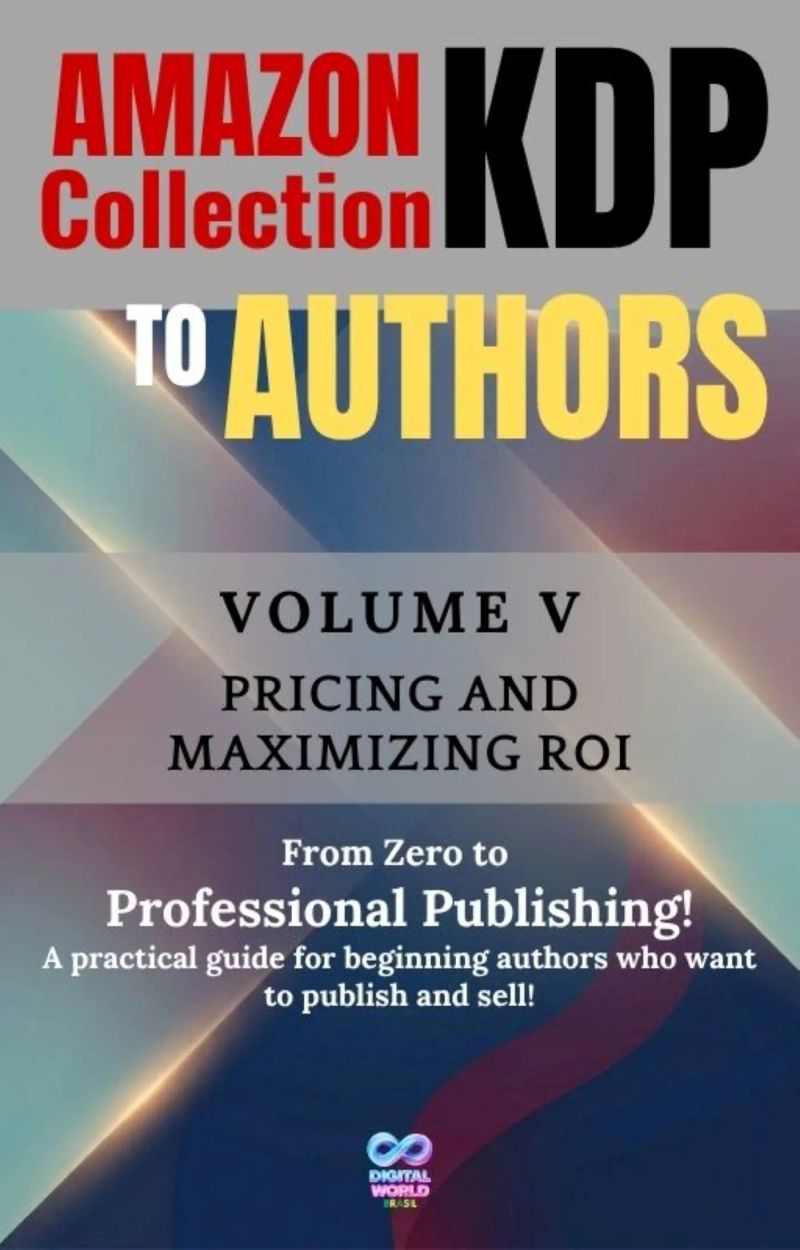
Amazon KDP Collection for Authors
Volume V -Pricing and maximizing ROIBy Digital World

Length3h 30m
About this audiobook
Amazon KDP for Authors: The Definitive Collection for Your Publishing Career
Writing a book is a talent; building a career as an author is a strategy. Welcome to the Amazon KDP for Authors collection, the practical and definitive guide for those who want to master Kindle Direct Publishing not just as a writer, but as a digital market strategist.
Throughout 8 volumes designed for fluid and applicable reading, you will go on a complete journey: from the initial draft to building a high-value global catalog. Forget abstract theories or complex manuals. This collection was designed to transform the independent author into a high-performance professional, capable of taking their project out of anonymity and positioning it as a reference in their chosen niche.
What you will build in each stage:
Volume I | Fundamentals and Ecosystem: The foundation of your business. Entrepreneurial mindset, research into profitable niches, and the strategic decisions that separate amateurs from best-sellers.
Volume II | Authority and Brand: How to create a magnetic presence. Impactful biographies, ethical strategies for reviews, and the use of anthologies to accelerate your reputation.
Volume III | Visibility and Algorithm: The engineering behind sales. Master Amazon SEO, long-tail keywords, and sustainable organic ranking.
Volume IV | Launch and Momentum: Create sales waves. Pre-sale strategies, intelligent use of KDP Select promotional tools, and how to maintain commercial momentum after launch.
Volume V | Monetization and Royalties: Maximize your return on investment (ROI). Dynamic pricing, mastering Kindle Unlimited, and optimizing content for earnings per page read (KENP).
Volume VI | Traffic and Growth: The engine of scale. Profit-focused Amazon Ads, affiliate programs, and how to attract qualified readers from external channels.
Volume VII | Catalog Engineering: Long-term vision. Series structuring, cross-selling techniques, and essential metrics to multiply the value of your work.
Volume VIII | Global Expansion: The world as your market. Strategic translation, audiobook creation, and the formula to transform your writing into high-value intellectual property.
The key features of this collection:
To ensure you move from theory to practice without hesitation, each chapter includes:
Official Guidelines: Strategies 100% aligned with Amazon's rules, guaranteeing the security of your business.
Editor's Insight: Precise warnings based on decades of experience, revealing the pitfalls that cost authors time and money.
Action Frameworks: Checklists, templates, and ready-to-use scripts for immediate application.
This collection is for you if:
You want your books to be found and read by a real audience.
You see writing as a sustainable business, not just a hobby.
You seek deep and structured knowledge, far from promises of "magic formulas".
You dream of building a legacy and generating passive income with your authorial catalog.
The journey of a successful independent author requires method and consistency. Your destiny—a solid career and the fulfillment of making a living from your writing—is within your reach.
Publish strategically. Build with clarity. Master it with Amazon KDP for Authors.
Audiobook details
GenreBiography and Memoir, Business and Economics
Length3 hrs 30 mins
Narrated byListen with 1,000+ voices
FormateBook with Audio
Publish dateApr 3, 2026
LanguageEnglish
Table of contents
1PRESENTATION OF THE KDP AMAZON COLLECTION FOR AUTHORS
656.3 History of Payment Per Page (KENP Rate) and Its Variations
2The Method: The Complete Training to Build a Publishing Business on Amazon
666.4 The Relationship Between Book Size, Engagement, and Revenue in KU
3The KDP Method
676.5 How Amazon Calculates Page Views (What Counts and What Doesn't)
4The Genesis of KDP AMAZON COLLECTION
686.6 Strategies to Maximize Page Count (Without Artificially Inflating)
5What is KDP Amazon?
696.7 Practical Example: Simulating Earnings in KU for Different Book Sizes
Show all chaptersShow less
6The Methodology: How This Collection Works
70Conclusion of Chapter 6
7For Whom Was This Collection Written?
71Chapter 7: Wide Distribution — The Benefits of Being on All Platforms
8The Student Journey: What to Expect
727.1 Main Platforms Beyond Amazon
9What is this collection not?
737.2 Aggregators: Draft2Digital, Smashwords, Babelcube
10A Note About the Authors and the Curatorship
747.3 Advantages of Wide Distribution
11PART 1: THE ART OF STRATEGIC PRICING
757.4 Disadvantages of Wide Distribution
12Monetization, Pricing, and ROI Maximization
767.5 The Challenge of Managing Multiple Platforms
13The Journey Continues: Where You Are and Where You're Going
777.6 Practical Example: An Author Who Sells Well Outside of Amazon
14What You Will Learn in This Volume
787.7 How to Decide: Broad Distribution or KDP Select?
15What Makes This Volume Different
79Conclusion of Chapter 7
16Exclusive Bonuses from Volume V
80Chapter 8: The Decision Framework — How to Choose the Best Path for Your Book
17For Whom Was This Volume Written?
818.1 Critical Decision Factors
18The Reader's Journey in Volume V
828.2 The "Book Size" Factor in the KU Decision
19One Last Word Before We Begin
838.3 The "Series" Factor — The Power of the First Book in KU
20Chapter 1: Price as a Strategic Variable — More Than a Number, A Value Statement
848.4 The "Niche" Factor — Which Genres Perform Best in Each Model
211.1 What the Price Says About Your Book
858.5 Testing: Try it for 90 Days and Evaluate the Results
221.2 The Psychology of Price: How the Reader Perceives Value
868.6 Practical Example: Two Authors, Two Models, both Successful
231.3 Low Price vs. High Price: Strategic Trade-offs
87Conclusion of Chapter 8
241.4 The 4 Objectives of Pricing: Volume, Profit, Positioning, Traction
88PART 3: OPTIMIZATION FOR KINDLE UNLIMITED
251.5 Practical Example: The Same Project, Different Strategies
89Chapter 9: The Engineering of KENP — How Payment Per Page Is Calculated
261.6 The First Step: Know Your Numbers
909.1 What is KENP and how does Amazon normalize pages?
27Conclusion of Chapter 1
919.2 Factors Influencing KENP Page Count
28Chapter 2: The Mathematics of Royalties — Understanding the Calculations in Minute Detail
929.3 Difference Between Pages in a Physical Book and KENP
292.1 The Two Royalty Options on KDP: 35% vs. 70%
939.4 How to Verify Your Book's KENP in the KDP Report
302.2 Calculation of Royalties for e-books: Price, Fees and Taxes
949.5 Strategies to Maximize Page Count (Without Artificially Inflating)
312.5 The KDP Calculation Tool: How to Use and Interpret It
959.6 Practical Example: Comparing KENP from Similar Books
322.6 Practical Example: Simulating Different Scenarios
969.7 The Importance of Quality in Page Counting
332.7 How the Exchange Rate Affects Your International Earnings
97Conclusion of Chapter 9
34Conclusion of Chapter 2
98Chapter 10: Optimizing Content for Retention and Maximum Page Views
35Chapter 3: Dynamic Pricing — How to Adjust Prices Throughout the Book Lifecycle
9910.1 The Relationship Between Withholding and Payment in KU
363.1 The Concept of Price Elasticity in Practice
10010.2 Book Structure That Keeps the Reader Engaged (Non-Fiction)
373.2 The Stages of the Book Life Cycle
10110.3 Book Structure That Keeps the Reader Engaged (Fiction)
383.3 Strategies by Phase: Penetration, Equilibrium, Premium
10210.4 The Power of the "Chapter Hook" to Prevent Dropouts
393.4 A/B Price Testing: How to Experiment Without Losing Sales
10310.5 Organizing Content for Continuous Reading (Non-Fiction)
403.5 Tools for Monitoring the Impact of Price Changes
10410.6 Rhythm and Variation in Fiction
413.6 Practical Example: The Price Journey of a Book from Launch to Maturity
10510.7 Practical Example: Before and After a Restructuring that Increased Retention
423.7 When NOT to Change the Price
106Conclusion of Chapter 10
43Conclusion of Chapter 3
107Chapter 11: Advanced Strategies for Kindle Unlimited
44Chapter 4: Value-Based Pricing — When and How to Charge More
10811.1 The Power of the Series in KU — How the First Book Feeds the Others
454.1 The Concept of Perceived Value and Its Relationship to Price
10911.2 Launch Timing to Maximize Exposure in KU
464.2 Factors that Increase Perceived Value
11011.3 Cross-Promotion Within KU — Promoting Your Books to KU Readers
474.3 How to Justify a Premium Price on the Sales Page
11111.4 Competitor Analysis in KU — What Best-Sellers Are Doing
484.4 Strategies for Niche Books and Specialized Content
11211.5 How to Use KDP Reports to Monitor Performance in KU
494.5 Practical Example: A Technical Guide Justifying a Price Twice as High
11311.6 Specific Pricing Strategies for the KU
504.6 When Low Prices Are the Right Strategy (and When They Are Not)
11411.7 Practical Example: An Author Who Built an Empire on UK with Series
51Conclusion of Chapter 4
115Conclusion of Chapter 11
52PART 2: THE DILEMMA OF EXCLUSIVITY — KDP SELECT VS. WIDE DISTRIBUTION
116Chapter 12: The ROI of Your Catalog — Measuring and Maximizing Total Return
53Chapter 5: KDP Select — What It Is and How the Exclusivity Program Works
11712.1 The Concept of ROI Applied to the Publishing Business
545.1 What is KDP Select?
11812.2 Calculating Return on Investment per Book
555.2 The Benefits of KDP Select
11912.4 Customer Lifetime Value (LTV) in the Catalog
565.3 The Counterpart: Exclusivity
12012.5 Strategies to Increase LTV: Series, Cross-Selling, Upselling
575.4 The 90-Day Period and Automatic Renewal
12112.6 Practical Example: The Complete Mathematics of a Bestselling Book
585.5 What Happens to Sales During Exclusivity?
122Conclusion of Chapter 12 and Volume V
595.6 Practical Example: A Month in the Life of a Book on KDP Select
123One last word from the editor.
605.7 When KDP Select Is NOT Worth It
124BONUS 1: Royalty Calculator — Interactive Spreadsheet
61Conclusion of Chapter 5
125BONUS 2: KDP Select Decision Framework — Quick Reference PDF
62Chapter 6: Kindle Unlimited (KU) — The Pay-per-Page Ecosystem
126BONUS 3: Kindle Unlimited Optimization Checklist
636.1 How Kindle Unlimited Works for the Reader and the Author
127BONUS 4: ROI Tracking Spreadsheet per Book
646.2 The KDP Select Global Fund and the KENP Calculation
Series


Amazon KDP Collection for AuthorsDigital World2h 58m$14

Amazon KDP Collection for AuthorsDigital World2h 54m$13

Amazon KDP Collection for Authors - Volume II - Building authority as an Amazon authorDigital World4h 8m$16

Amazon KDP Collection for Authors - Volume VII - Catalog management in Amazon KDPDigital World2h 57m$15

Amazon KDP Collection for Authors - Volume VI - Marketing for authors and trafficDigital World, Digital World3h 14m$15

Amazon KDP Collection for AuthorsDigital World3h 42m$16

Amazon KDP Collection for AuthorsDigital World2h 26m$15

Hybrid CarsDigital World1h 6m$9

The Power of SuperfoodsDigital World2h 14m$20
Creating a Successful Publishing Calendar to Optimize Results on Amazon KDPDigital World2h 26m$13

Secrets of E-commerce with ShopifyDigital World1h 4m$15

The Secret Revealed to Becoming an E-coachDigital World1h 29m$15

How to start an online coaching businessDigital World1h 3m$13

The car care manualDigital World1h 2m$9

Care you should take with your pet fishDigital World1h 20m$13

Pet BirdsDigital World2h 33m$11

Dog ObedienceDigital World38m$9

Fullness and Human DevelopmentDigital World2h 8m$15

Dislexia AdultaDigital World53m$10

Why Not Me? A Feeling of Millions (Hinglish)Unknown Author4h 8m5 (1)$20 · $0.00

Matters of the HeartJacinta Nampijinpa Price9h 35m$29 · $0.00

How to Test Negative for StupidJohn Kennedy8h 13m$28 · $0.00

Defying JihadEsther Ahmad8h 50m$20

Bad Fat Black GirlSesali Bowen6h 32m$24 · $0.00

Frederick Douglass: All 3 Memoirs in One VolumeFrederick Douglass42h 36m$1 · $0.00

Send MeMarty Skovlund, Joe Kent8h 10m$26 · $0.00

Ulysses S. Grant: Life of the Fearless General & Commander-in-Chief (Complete Edition - Volumes 1&2)Ulysses S. Grant30h 34m$2 · $0.00

Left for DeadEbony Canion5h 34m$17

Invisible StormJason Kander6h 48m$24 · $0.00

Forever BoyKate Swenson9h 27m$29 · $0.00

You Are Worth ItKyle Carpenter, Don Yaeger8h 53m$29 · $0.00

The Happiest Man on EarthEddie Jaku3h 48m$7 · $0.00

MotherlandJulia Ioffe17h 52m$40 · $0.00

Evidence Not SeenDarlene Deibler Rose11h 11m$29 · $0.00

A Bridge Not Too FarDeepak Ohri4h 55m$15

Where Cowards Go to DieBenjamin Sledge8h 42m$20 · $0.00

Will You Love Me?Cathy Glass9h 5m$29 · $0.00

Designing Terry Pratchett’s DiscworldPaul Kidby3h 52m$20 · $0.00

HostageEli Sharabi5h 25m5 (1)$24 · $0.00
Sales Success for the RookieSteve Lentini3h 49m$15
The Business of StoriesSusan Payton3h 58m$20 · $0.00
A Bridge Not Too FarDeepak Ohri4h 55m$15

AretéBrian Johnson19h 57m$35
Level UpRob Dial7h 42m$26 · $0.00

Hal Moore on LeadershipHarold G. Moore, Mike Guardia5h 6m$17
Basic Economics, Fifth EditionThomas Sowell28h 6m$40

The Goals ProgramZig Ziglar4h 34m$20

The Stocks & ETF Compass: A Guide to Wealth, High Standard of Living, and Secure Retirement through Intelligent Investment in the Stock Market and Passive Income – Including Starter GuideJens Hattermann4h 9m$20 · $0.00

Eat It!Jordan Syatt, Michael Vacanti4h 40m$20 · $0.00

Progress and Poverty, Volumes I and II (Annotated)Henry George20h 24m$2 · $0.00

Not Everything Counts but Everything Matters: The powerful and inspirational new book about leadership and achieving success from the visionary multi-premiership winning Panthers coachIvan Cleary6h 1m$24 · $0.00
Leads MachineFrancis Rodino6h 30m$27 · $0.00

CAPITAL (Complete 3 Volume Edition)Karl Marx111h 13m$2 · $0.00

BuildTony Fadell11h 5m$8 · $0.00
The Joys Of CompoundingGautam Baid17h 34m$18 · $0.00

The Entrepreneur Roller CoasterDarren Hardy7h 8m$17

The Law of Success in Sixteen LessonsNapoleon Hill1h 31m$2 · $0.00

Poor Charlie’s AlmanackGrover Gardener, Charles T. Munger13h 9m$18 · $0.00

The Ambuja StoryNarotam Sekhsaria13h 59m$33 · $0.00