
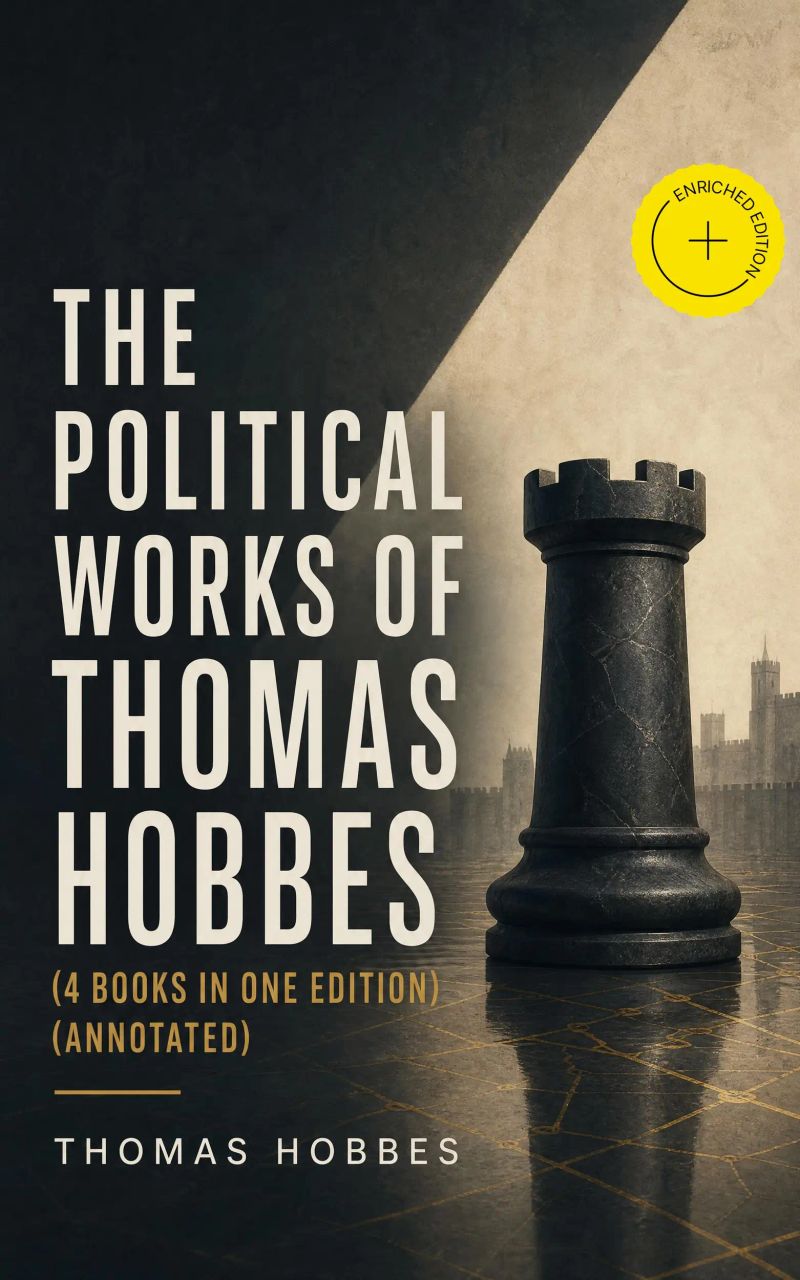
The Political Works of Thomas Hobbes (4 Books in One Edition) (Annotated)
Enriched Edition. Leviathan, On the Citizen, The Elements of Law & Behemoth: The Long ParliamentBy Thomas Hobbes


Length47h 18m
About this audiobook
The Political Works of Thomas Hobbes (4 Books in One Edition) gathers the central texts through which Hobbes fashioned one of the most formidable theories of sovereignty in early modern thought. Moving from human psychology and natural law to covenant, commonwealth, religion, and civil disorder, these works combine geometric rigor with stark, memorable prose. In the shadow of classical political philosophy and Reformation controversy, Hobbes recasts politics as a science of fear, reason, and authority. Thomas Hobbes (1588–1679) wrote amid the upheavals of the English Civil War, regicide, exile, and Restoration—events that profoundly shaped his suspicion of divided power and ideological zeal. Educated in humanist and scientific circles, acquainted with continental rationalism and the new mechanics, Hobbes sought to explain political obligation with the same clarity he admired in mathematics. His experiences of faction, war, and religious conflict gave urgency to his defense of an undivided sovereign. This edition is highly recommended for readers seeking the foundations of modern political theory in their most uncompromising form. Philosophers, historians, legal theorists, and serious general readers will find in Hobbes not merely an apologist for absolutism, but a penetrating analyst of security, liberty, fear, and the fragile artifice of civil peace.
This enriched edition has been carefully crafted to add value to your reading experience.
- A comprehensive Introduction outlines these selected works' unifying features, themes, or stylistic evolutions.
- The Author Biography highlights personal milestones and literary influences that shape the entire body of writing.
- A Historical Context section situates the works in their broader era—social currents, cultural trends, and key events that underpin their creation.
- A concise Synopsis (Selection) offers an accessible overview of the included texts, helping readers navigate plotlines and main ideas without revealing critical twists.
- A unified Analysis examines recurring motifs and stylistic hallmarks across the collection, tying the stories together while spotlighting the different work's strengths.
- Reflection questions inspire deeper contemplation of the author's overarching message, inviting readers to draw connections among different texts and relate them to modern contexts.
- Lastly, our hand‐picked Memorable Quotes distill pivotal lines and turning points, serving as touchstones for the collection's central themes.
Audiobook details
Rating★★★★★ 4.6 (12)
Includes Amazon
GenrePhilosophy
Length47 hrs 18 mins
Narrated byListen with 1,000+ voices
FormateBook with Audio
Publish dateDec 19, 2023
LanguageEnglish
Table of contents
1The Elements of Law, Natural and Politic (Annotated)
2The Elements of Law
3Chapter 1: The General Division of Man's Natural Faculties
4Chapter 2: The Cause of Sense
5Chapter 3: Of Imagination and the Kinds Thereof
Show all chaptersShow less
6Chapter 4: Of the Several Kinds of Discursion of the Mind
7Chapter 5: Of Names, Reasoning, and Discourse of the Tongue
8Chapter 6: Of a Knowledge, Opinion and Relief
9Chapter 7: Of Delight and Pain; Good and Evil
10Chapter 8: Of the Pleasures of the Senses; Of Honour
11Chapter 9: Of the Passions of the Mind
12Chapter 10: Of the Difference Between Men In These Discerning Faculty and the Cause
13Chapter 11: What Imaginations and Passions Men Have, at the Names of Things Supernatural
14Chapter 12: How by Deliberation From Passions Proceed Men's Actions
15Chapter 13: How by Language Men Work Upon Each Other's Minds
16Chapter 14: Of the Estate and Right of Nature
17Chapter 15: Of the Divesting Natural Right by Gift and Covenant
18Chapter 16: Some of the Laws of Nature
19Chapter 17: Other Laws of Nature
20Chapter 18: A Confirmation of the Same Out of The Word of God
21Chapter 19: Of the Necessity and Definition of a Body Politic
22Chapter 20: Of the Requisites to the Constitution of a Commonwealth
23Chapter 21: Of the Three Sorts of Commonwealth
24Chapter 22: Of the Power of Masters
25Chapter 23: Of the Power of Fathers, and of Patrimonial Kingdom
26Chapter 24: The Incommodities of Several Sorts of Government Compared
27Chapter 25: That Subjects are not Bound to Follow Their Private Judgments in Controversies of Religion
28Chapter 26: That Subjects are not bound to follow the Judgment of any Authorities in Controversies of Religion which is not Dependent on the Sovereign Power
29Chapter 27: Of the Causes of Rebellion
30Chapter 28: Of the Duty of Them That Have Sovereign Power
31Chapter 29: Of the Nature and Kinds of Laws
32De Cive (On the Citizen)
33Author's Preface
34Chapter I: Of the state of men without Civill Society
35Chapter II: Of the Law of Nature concerning Contracts
36Chapter III: Of the other Lawes of Nature
37Chapter IV: That the Law of Nature is a Divine Law
38Chapter V: Of the causes, and first begining of civill Government
39Chapter VI: Of the right of him, whether Counsell, or one Man onely, who hath the supreme power in the City
40Chapter VII: Of the three kindes of Government, Democracy, Aristocracy, Monarchie
41Chapter VIII: Of the Rights of Lords over their Servant
42Chapter IX: Of the right of Parents over their children and of hereditary Government
43Chapter X: A comparison between 3. kinds of government, according to their severall inconveniences
44Chapter XI: Places and Examples of Scripture of the Rights of Government agreeable to what hath been said before
45Chapter XII: Of the internal causes, tending to the dissolution of any Government
46Chapter XIII: Concerning the duties of them who bear Rule
47Chapter XIV: Of Lawes and Trespasses
48Chapter XV: Of the Kingdome of God, by Nature
49Chapter XVI: Of the Kingdome of God under the Old Covenant
50Chapter XVII: Of the Kingdome of God by the new Covenant
More from Thomas Hobbes

50 citations de Thomas HobbesThomas Hobbes9m$3 · $0.00

The Elements of Law, Natural and Politic (Annotated)Thomas Hobbes8h 6m4.0 (553)$2 · $0.00
The Collected Political Works: Leviathan + De Cive (On the Citizen) + The Elements of Law + Behemoth, or The Long Parliament (Annotated)Thomas Hobbes47h 20m$2 · $0.00

Leviathan (Annotated)Thomas Hobbes23h 35m$2 · $0.00

LeviathanThomas Hobbes22h3.9 (111.3K)$1 · $0.00

The Political Works of Thomas Hobbes (4 Books in One Edition)Thomas Hobbes48h 15m4.1 (12)$2 · $0.00

Leviathan (Summarized Edition)Thomas Hobbes5h 18m$2

Grundzüge der PhilosophieThomas Hobbes6h 47m4.4 (15)$1 · $0.00

Grundzüge der PhilosophieThomas Hobbes8h 23m4.0 (40)$2 · $0.00

LeviathanThomas Hobbes22h3.9 (65.7K)$2 · $0.00

Leviathan (Zusammengefasste Ausgabe)Thomas Hobbes5h 41m3.6 (22)$2

The Political Works of Thomas Hobbes (4 Books in One Edition)Thomas Hobbes48h 20m4.1 (12)$1.99 · $0.00
Grundzüge der Philosophie (Kommentiert)Thomas Hobbes8h 38m4.4 (12)$1 · $0.00

LEVIATHAN (Complete Edition)Thomas Hobbes23h 49m3.9 (69.8K)$1.99 · $0.00

LeviathanThomas Hobbes22h4.0 (64.5K)$12 · $0.00

LeviatánThomas Hobbes14h 52m3.9 (60.6K)$11 · $0.00

WitnessAriel Burger8h 1m4.6 (1.3K)$20 · $0.00
The Magic PresenceGodfré Ray King10h 21m4.6 (307)$1.20 · $0.00

The Art of LivingThich Nhat Hanh5h 1m4.5 (14.2K)$24 · $0.00
Moral Letters to LuciliusLucius Annaeus Seneca24h 26m4.5 (71.7K)$0.99 · $0.00

Lessons in TruthH. Emilie Cady3h 50m4.5 (2.4K)$20 · $0.00
The Discourses of EpictetusP. E. MATHESOM12h 47m4.4 (17.7K)$1.20 · $0.00

IlluminationsWalter Benjamin10h 12m4.4 (16.2K)$20 · $0.00

That Bird Has My WingsJarvis Jay Masters9h 49m4.4 (13.7K)$29 · $0.00

Tâo Teh KingLaozi2h 34m4.4 (230.9K)$2 · $0.00
SymposiumPlato3h 26m4.4 (97.9K)$1.20 · $0.00

Buddhist Boot CampTimber Hawkeye2h 39m4.4 (8.4K)$18 · $0.00
Enchiridion & The Discourses of Epictetus (Annotated)Arrian Epictetus18h 9m4.4 (3.5K)$2 · $0.00

The Meditations of the Emperor Marcus Aurelius AntoninusEmperor of Rome Marcus Aurelius5h 41m4.4 (1.8M)$1 · $0.00

Crime and PunishmentFyodor Dostoevsky23h 11m4.4 (1.3M)$12 · $0.00

MeditationsMarcus Aurelius5h 52m4.4 (433.7K)$1 · $0.00

Everyday DharmaSuneel Gupta5h 2m4.5 (761)$20 · $0.00

The Joyful Wisdom ("La Gaya Scienza")Friedrich Wilhelm Nietzsche11h 37m4.4 (26.6K)$1 · $0.00
The Art of LivingEpictetus, Sharon Lebell3h 16m4.4 (50.1K)$18 · $0.00
MeditationsEmperor Of Rome Marcus Aurelius7h 23m4.3 (477.5K)$1.20 · $0.00

The Imitation of ChristThomas à Kempis6h 27m4.3 (84.6K)$21 · $0.00
You may also like
LeviathanThomas Hobbes22h3.9 (111.3K)$1 · $0.00

A Conflict of VisionsThomas Sowell7h 8m4.4 (16K)$17

Heart of Darkness (Unabridged Deluxe Edition)Joseph Conrad28h 2m4.5 (276)$2 · $0.00
A TREATISE OF HUMAN NATURE ABCD24h 51m4.1 (19.3K)Free

Table TalkWilliam Hazlitt17h 32m4.1 (1.4K)$2 · $0.00

The Hour between Dog and WolfJohn Coates10h 30m4.0 (3.2K)$20

A Treatise Concerning the Principles of Human KnowledgeGeorge Berkeley3h 59m3.9 (5.1K)$1 · $0.00
The UnconsciousSigmund Freud, H. W. Chase40h 2m4.1 (2.9K)$1.99 · $0.00
Politics (Annotated)Aristotle12h4.2 (46.6K)$2 · $0.00

Sylvie and BrunoLewis Carroll7h 23m3.6 (2.9K)$2.30

Calm: The Magic of SleepMichael Acton Smith3h 17m4.0 (399)$18 · $0.00
On the Nature of ThingsTitus Lucretius Carus6h 16m4.2 (21.2K)Free

The Law and The PromiseNeville Goddard3h 43m4.5 (1.2K)$4.70 · $0.00

E. B. White on DogsE. B. White5h 36m4.3 (663)$17

Dream Psychology: Psychoanalysis for BeginnersSigmund Freud6h 47m3.9 (5.3K)$1 · $0.00

Strength and How to Obtain It (Annotated)Eugen Sandow4h 17m4.3 (1.4K)$2 · $0.00
On the SoulAristotle3h 25m4.1 (8K)$1.20 · $0.00
The Social ContractJean-Jacques Rousseau10h 49m3.9 (68.7K)$9 · $0.00

Wealth, Poverty, and PoliticsThomas Sowell8h 27m4.5 (7.8K)$20

Poems by Samuel Taylor Coleridge and William WordsworthSamuel Taylor Coleridge, William Wordsworth22h 23m4.1 (16.7K)$1.99 · $0.00