
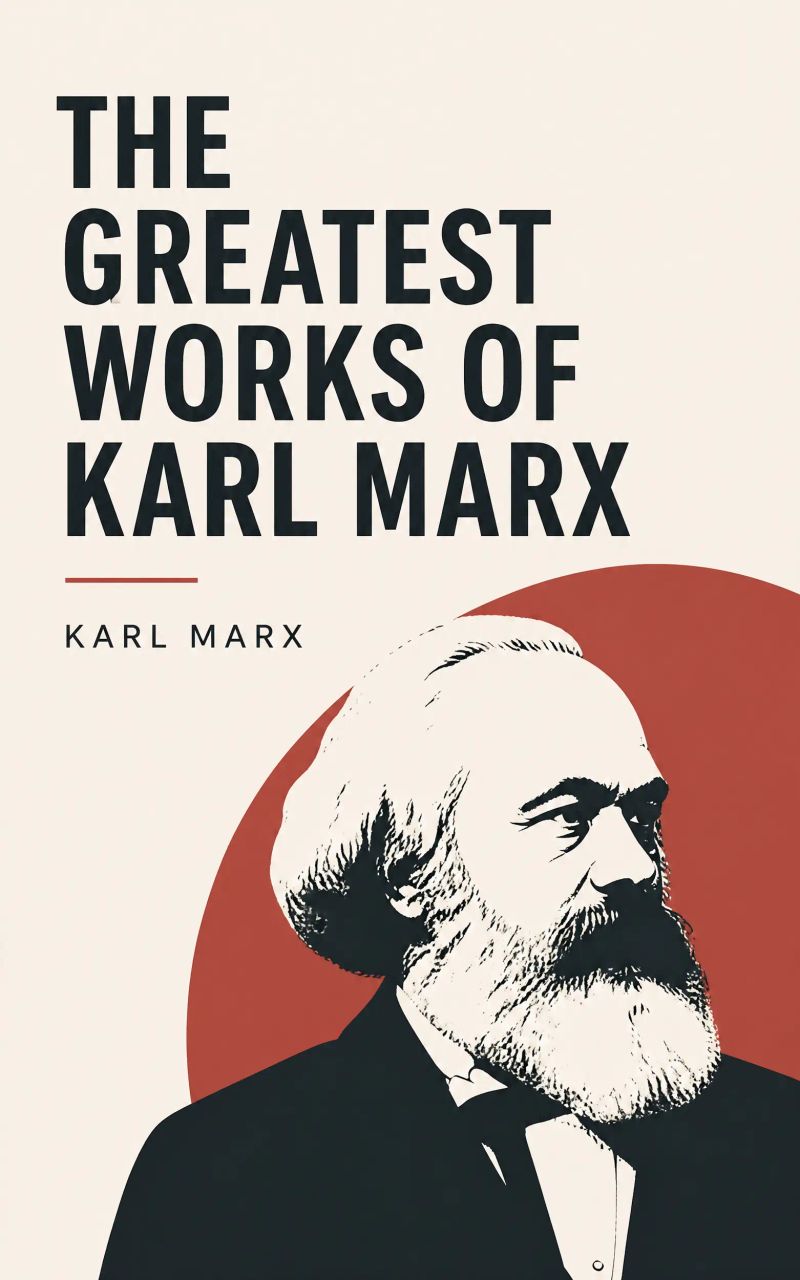
The Greatest Works of Karl Marx
Foundational Writings on Class Struggle, Historical Materialism, Alienated Labor, and the Critique of Political EconomyBy Karl Marx


Length127h 52m
About this audiobook
The Greatest Works of Karl Marx gathers the central writings through which Marx transformed modern social, political, and economic thought. Moving from philosophical critique to historical analysis and revolutionary polemic, the collection presents his examination of alienated labor, class conflict, commodity production, capital accumulation, and the social relations concealed within apparently neutral economic forms. Marx's style is at once analytic and combative: dense conceptual argument is sharpened by irony, historical illustration, and memorable aphorism. Read in the context of nineteenth-century industrialization, German idealism, classical political economy, and the emerging socialist movement, these works reveal a thinker seeking to unite interpretation of society with the possibility of changing it. Karl Marx (1818–1883) wrote amid the dislocations produced by industrial capitalism, when expanding factories, urban poverty, political repression, and mass labor movements challenged inherited ideas of progress and property. His intellectual formation combined Hegelian philosophy, French revolutionary politics, and the economic writings of Smith and Ricardo, while his collaboration with Friedrich Engels helped sustain a lifelong investigation into capitalism's historical development. Exile, journalism, political controversy, and organizing further shaped his insistence that theory must remain connected to material life and collective struggle. This volume is recommended to readers seeking both an introduction to Marx's vocabulary and a sustained encounter with the arguments that continue to influence sociology, political theory, economics, history, and cultural criticism. It rewards careful reading, especially when approached not as a collection of slogans but as a rigorous and historically situated critique of modern society.
Audiobook details
Rating★★★★ 4.4 (417)
Includes Amazon, Goodreads, StoryGraph
GenrePolitics and Government
Length127 hrs 52 mins
Narrated byListen with 1,000+ voices
FormateBook with Audio
Publish dateNov 21, 2023
LanguageEnglish
Table of contents
1THE BIRTH OF TRAGEDY (Classical Art vs. Nihilism) (Annotated)
2The Greatest Works of Karl Marx
3Political Works
4Manifesto of the Communist Party
5Preface
Show all chaptersShow less
6Manifesto of the Communist Party.
7I. Bourgeois and Proletarians.3
8II. Proletarians and Communists.
9III. Socialist and Communist Literature.
10IV. Position of the Communists in Relation to the Various Existing Opposition Parties.
11Theses on Feuerbach
12The Eighteenth Brumaire of Louis Napoleon
13Translator's Preface
14I
15II
16III
17IV
18V
19VI
20VII
21Secret Diplomatic History of The Eighteenth Century
22Chapter I
23Chapter II
24Chapter III
25Chapter IV
26Chapter V
27Chapter VI
28The Civil War in France
29Introduction
30The Begining of the Franco-Prussian War
31Prussian Occupation of France
32France Capitulates and the Government of Thiers
33Paris Workers' Revolution and Thiers' Reactionary Massacres
34The Paris Commune
35The Fall of Paris
36Critique of the Gotha Programme
37Foreword
38Letter to Bracke
39Part I
40Part II
41Part III
42Part IV
43Appendix
44Economic Works
45Wage-Labor and Capital (1847)
46Introduction
47Chapter 1 Preliminary
48Chapter 2 What Are Wages?
49Chapter 3 By What is the Price of a Commodity Determined?
50Chapter 4 By What Are Wages Determined?
The Communist ManifestoKarl Marx3h 25m3.9 (262.2K)$1.99 · $0.00

Die heilige FamilieKarl Marx10h 50m3.8 (1.9K)$2 · $0.00
The XVIII Brumaire of Louis BonaparteKarl Marx6h 21m4.4 (12.9K)$1.99 · $0.00

Karl Marx: Der achtzehnte Brumaire des Louis NapoleonKarl Marx6h 36m4.3 (16.1K)$1 · $0.00

Differenz der demokritischen und epikureischen NaturphilosophieKarl Marx2h 38m4.0 (1.2K)$2 · $0.00

Zur JudenfrageKarl Marx1h 48m3.5 (1.5K)$1 · $0.00

Lohn, Preis und ProfitKarl Marx4h 10m4.4 (4.4K)$1 · $0.00
THE COMMUNIST MANIFESTO & CAPITALKarl Marx98h 8m4.3 (29)$1.99 · $0.00
Das Kapital: Band 1-3Karl Marx91h 36m4.5 (3K)$2 · $0.00

Zweites KaiserreichKarl Marx15h 27m$1 · $0.00
The Process of Capitalist ProductionKarl Marx30h 4m4.4 (44.3K)$1.99 · $0.00
Lohnarbeit und KapitalKarl Marx1h 49m4.3 (5.6K)$1 · $0.00
CAPITAL (All 3 Books)Karl Marx92h 37m4.5 (16.5K)$2.99 · $0.00

Karl Marx: Zur Kritik der Hegelschen RechtsphilosophieKarl Marx9h 22m4.2 (1.2K)$1 · $0.00
The Process of Capitalist Production as a Whole (Capital Vol. III)Karl Marx41h 1m4.4 (2.2K)$1.99 · $0.00

Manifiesto ComunistaKarl Marx, Friederich Engels1h 57m3.9 (266.6K)$15 · $0.00
The Communist ManifestoKarl Marx1h 13m3.9 (240.6K)$3 · $0.00
Manifiesto comunistaKarl Marx, Friedrich Engels6h 9m3.9 (276.8K)$6
El Manifiesto ComunistaKarl Marx, Friedrich Engels2h 8m3.9 (273.3K)$0.99 · $0.00

Das allmächtige Kapital (Kommentiert)Karl Marx, Rosa Luxemburg, Max Weber116h 4m$1 · $0.00

The Gulag Archipelago Volume 3Aleksandr I. Solzhenitsyn21h 56m4.7 (8.9K)$46 · $0.00

MotherlandJulia Ioffe17h 52m4.7 (2.5K)$40 · $0.00

HostageEli Sharabi5h 25m4.6 (10.8K)$24 · $0.00

KrantikariSanjeev Sanyal11h 44m4.6 (1.3K)$16 · $0.00

Unbroken Bonds of BattleJohnny Joey Jones8h 31m4.6 (2.6K)$8 · $0.00

On Democracies and Death CultsDouglas Murray10h 38m4.6 (6.5K)$29 · $0.00

Balcony Over Jerusalem: A Middle East Memoir - Israel, Palestine and BeyondJohn Lyons12h 37m4.6 (1.4K)$33 · $0.00

RiggedMollie Hemingway12h 48m4.6 (4.2K)$23 · $0.00

SledgehammerDavid Friedman8h 21m4.7 (589)$26 · $0.00

Citizenship in a Republic (Annotated)Theodore Roosevelt2h 44m4.6 (1.4K)$2 · $0.00

No EscapeNury Turkel9h 30m4.6 (809)$28 · $0.00

Always FaithfulThomas Schueman, Zainullah Zaki12h 12m4.6 (977)$29 · $0.00

UnthinkableJamie Raskin15h 8m4.5 (9.3K)$8 · $0.00

My Fourth Time, We DrownedSally Hayden13h 59m4.6 (2.9K)$23 · $0.00

A Revolution of Common SenseScott Jennings9h 29m4.6 (528)$29 · $0.00

Statement From the Dock at the Rivonia TrialNelson Mandela2h 18m4.6 (1.3K)$1 · $0.00

Lessons from the EdgeMarie Yovanovitch17h 11m4.5 (5.9K)$40 · $0.00

To Rescue the American SpiritBret Baier10h 12m4.5 (2.7K)$8 · $0.00

StonewalledSharyl Attkisson15h 19m4.5 (4.3K)$33 · $0.00
The World According to Orwell: 1984 & Animal FarmGeorge Orwell15h 42m4.6 (1.1K)$1 · $0.00