
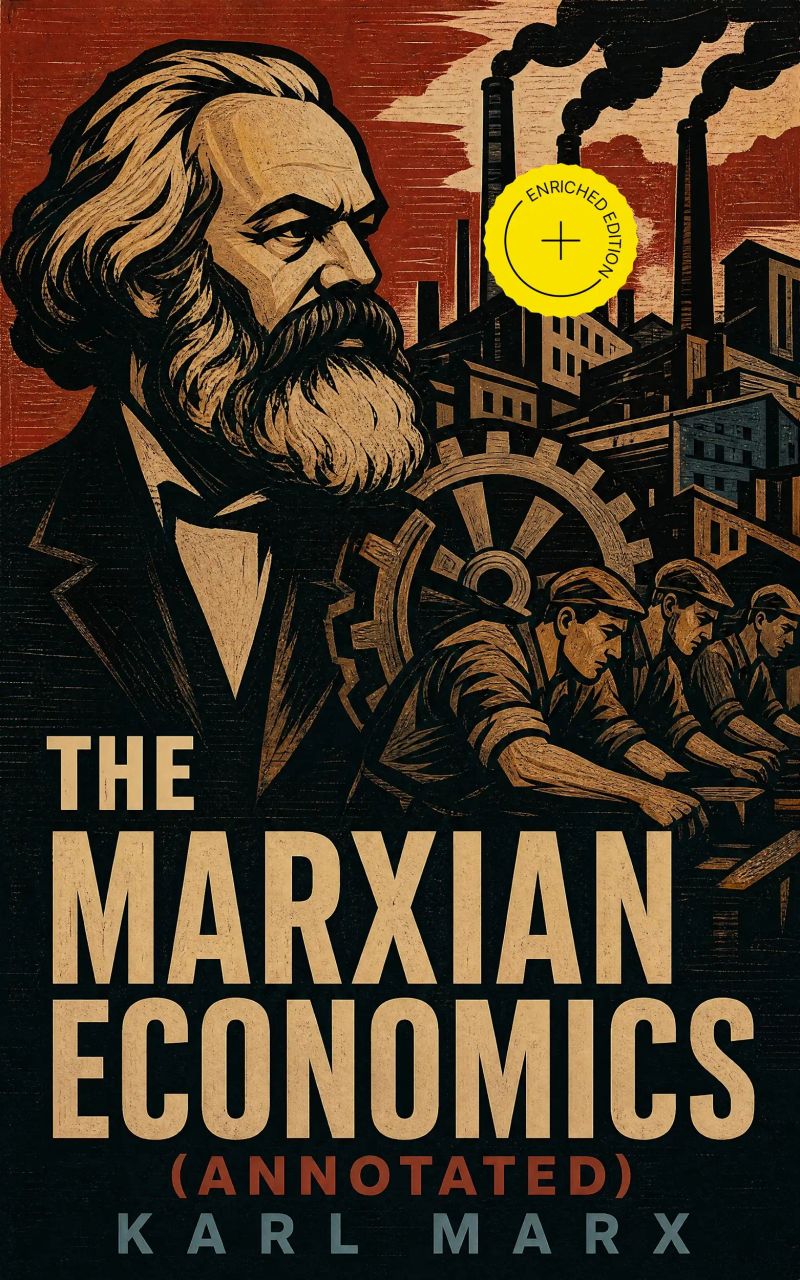
The Marxian Economics (Annotated)
Enriched Edition. Das Kapital, A Contribution to The Critique Of The Political Economy, Wage-Labor and Capital, Free Trade, Wages, Price and ProfitBy Karl Marx


Length114h 46m
About this audiobook
The Marxian Economics presents a rigorous anatomy of capitalist production, tracing how commodities, value, wages, profit, and accumulation arise from historically specific social relations. Its style is analytic and polemical, combining philosophical argument with empirical observation and a dialectical movement from appearances to underlying structures. Written against classical political economy, especially Smith and Ricardo, it redirects economic inquiry toward exploitation, surplus value, class conflict, and the recurring crises of industrial capitalism. Karl Marx, German philosopher, economist, and revolutionary socialist, wrote amid the upheavals of nineteenth-century Europe and during long exile in London. His journalism, political organizing, and collaboration with Friedrich Engels sharpened his attention to workers' conditions and the worldwide expansion of capital. Years of research in the British Museum enabled him to turn moral outrage into a systematic critique of economic laws that seemed natural but were, for him, historical and changeable. This volume is indispensable for readers seeking the foundations of socialist thought, modern critiques of inequality, and debates over labor, markets, and power. Demanding but rewarding, it suits students of economics, history, philosophy, and political theory who want more than technical models: a sweeping interpretation of capitalism's origins, dynamism, contradictions, and possible transformation.
This enriched edition has been carefully crafted to add value to your reading experience.
- A succinct Introduction situates the work's timeless appeal and themes.
- The Synopsis outlines the central plot, highlighting key developments without spoiling critical twists.
- A detailed Historical Context immerses you in the era's events and influences that shaped the writing.
- An Author Biography reveals milestones in the author's life, illuminating the personal insights behind the text.
- A thorough Analysis dissects symbols, motifs, and character arcs to unearth underlying meanings.
- Reflection questions prompt you to engage personally with the work's messages, connecting them to modern life.
- Hand‐picked Memorable Quotes shine a spotlight on moments of literary brilliance.
Audiobook details
Rating★★★★ 4.3 (18)
Includes Amazon
GenreBusiness and Economics
Length114 hrs 46 mins
Narrated byListen with 1,000+ voices
FormateBook with Audio
Publish dateMay 7, 2019
LanguageEnglish
Table of contents
1The Fireside Chats of Franklin Delano Roosevelt (Annotated)
2The Marxian Economics
3Wage-Labor and Capital (1847)
4Introduction
5Chapter 1 Preliminary
Show all chaptersShow less
6Chapter 2 What Are Wages?
7Chapter 3 By What is the Price of a Commodity Determined?
8Chapter 4 By What Are Wages Determined?
9Chapter 5 The Nature and Growth of Capital
10Chapter 6 Relation of Wage-labor to Capital
11Chapter 7 The General Law That Determines the Rise and Fall of Wages and Profits
12Chapter 8 The Interests of Capital and Wage-labor Are Diametrically Opposed -- Effect of Growth of Productive Capital on Wages
13Chapter 9 Effect of Capitalist Competition on the Capitalist Class, The Middle Class, and The Working Class
14Free Trade
15Wages, Price and Profit (1865)
16Preliminary
17I. Production and Wages
18II. Production, Wages, Profits
19III. Wages and Currency
20IV. Supply and Demand
21V. Wages and Prices
22VI. Value and Labour
23VII. Labouring Power
24VIII. Production of Surplus Value
25IX. Value of Labour
26X. Profit is Made by Selling a Commodity at its Value
27XI. The Different Parts into Which Surplus Value is Decomposed
28XII. General Relation of Profits, Wages and Prices
29XIII. Main Cases of Attempts at Raising Wages or Resisting Their Fall
30XIV. The Struggle Between Capital and Labour and its Results
31Capital
32Vol. 1 - The Process of Capitalist Production
33Author’s Preface: First German Edition
34Editor’s Preface: First English Translation
35Part 1 - Commodities and Money
361. Commodities
37I. The Two Factors of a Commodity: Use-Value and Value
38II. The Two-fold Character of the Labour Embodied in Commodities
39III. The Form of Value or Exchange-Value
40IV. The Fetishism of Commodities and the Secret Thereof
412. Exchange
423. Money, or the Circulation of Commodities
43I. The Measure of Values
44II. The Medium of Circulation
45III. Money
46Part 2 - Transformation of Money into Capital
474. The General Formula for Capital
485. Contradictions in the General Formula of Capital
496. The Buying and Selling of Labour-Power
50Part 3 - The Production of Absolute Surplus-Value
THE COMMUNIST MANIFESTO & CAPITALKarl Marx98h 8m4.3 (29)$1.99 · $0.00
Lohnarbeit und KapitalKarl Marx1h 49m4.3 (5.6K)$1 · $0.00
CAPITAL (All 3 Books)Karl Marx92h 37m4.5 (16.5K)$2.99 · $0.00

Manifiesto ComunistaKarl Marx, Friederich Engels1h 57m3.9 (266.6K)$15 · $0.00

The Communist ManifestoKarl Marx1h 13m3.9 (240.6K)$3 · $0.00

Differenz der demokritischen und epikureischen Naturphilosophie (Kommentiert)Karl Marx4h 16m3.8 (141)$1.50 · $0.00

Das Kapital (Kommentiert)Karl Marx96h 18m$1 · $0.00

Das Elend der Philosophie (Kommentiert)Karl Marx7h 51m3.9 (1.4K)$1 · $0.00

Karl Marx: Die deutsche Ideologie (Kommentiert)Karl Marx, Friedrich Engels28h 10m4.3 (1.7K)$1 · $0.00
Manifesto of the Communist Party (Annotated)Karl Marx3h 31m3.8 (381)$2 · $0.00

CAPITAL (Annotated)Karl Marx105h 33m$2 · $0.00

The Collected Works of Karl Marx (Annotated)Karl Marx134h 35m4.6 (321)$2 · $0.00

Zweites Kaiserreich (Kommentiert)Karl Marx15h 30m4.3 (26)$1 · $0.00

Zur Kritik der politischen Ökonomie (Kommentiert)Karl Marx10h 56m4.1 (3.9K)$1 · $0.00

Lohn, Preis und Profit (Kommentiert)Karl Marx4h 15m4.3 (2.4K)$1 · $0.00
Das Kapital: Band 1-3 (Kommentiert)Karl Marx93h 42m4.2 (1.4K)$1 · $0.00

Der Bürgerkrieg in Frankreich (Kommentiert)Karl Marx4h 57m4.3 (4.5K)$1 · $0.00

Zur Judenfrage (Kommentiert)Karl Marx3h 18m3.8 (3.9K)$1 · $0.00

Lohnarbeit und Kapital (Kommentiert)Karl Marx3h 32m$1 · $0.00

El Capital: tomo I (Anotado)Karl Marx42h$1.99 · $0.00

Never Split the DifferenceChris Voss, Tahl Raz8h 7m4.4 (277.7K)$26 · $0.00
The Intelligent Investor Rev Ed.Benjamin Graham17h 48m4.3 (191.5K)$40 · $0.00

The Hard Thing About Hard ThingsBen Horowitz7h 57m4.2 (134.3K)$26 · $0.00

Boundaries for LeadersHenry Cloud7h 36m4.3 (3.6K)$26 · $0.00

The Secret Door to SuccessFlorence Scovel Shinn2h 25m4.5 (2.1K)$1.20 · $0.00

This Is Going to HurtAdam Kay5h 47m4.4 (444.7K)$24 · $0.00

Big TrustShadé Zahrai, Fayçal Sekkouah8h 36m4.6 (406)$26 · $0.00
The Intelligent Investor Third EditionBenjamin Graham, Jason Zweig20h4.4 (156.6K)$46 · $0.00

Bottle of LiesKatherine Eban14h 25m4.4 (12K)$33 · $0.00

The Antiracist Business BookTrudi Lebrón6h 10m4.6 (275)$17 · $0.00

The FormulaJoshua Robinson, Jonathan Clegg10h 41m4.4 (6.9K)$29 · $0.00

Let Them LeadJohn U. Bacon7h 10m4.5 (1.4K)$24 · $0.00

Secrets of the Millionaire MindT. Harv Eker5h 11m4.4 (301.4K)$24 · $0.00

The Person You Mean to BeDolly Chugh9h 6m4.4 (7.2K)$29 · $0.00
BoundlessNick Kostov, Sean McLain9h 17m4.5 (1.1K)$29 · $0.00

Everyday DharmaSuneel Gupta5h 2m4.5 (761)$20 · $0.00

Let's Talk Mutual FundsMonika Halan7h 5m4.4 (2.4K)$16 · $0.00

Secret PowerDwight Lyman Moody3h 7m4.4 (1.4K)$1.20 · $0.00

The Law of Success in Sixteen LessonsNapoleon Hill2h 39m4.4 (17.2K)$2 · $0.00

Barbarians at the GateBryan Burrough, John Helyar3h 3m4.4 (52.7K)$18 · $0.00
You may also like
The Three Sources and Three Component Parts of MarxismVladimir Lenin17m4.2 (1.2K)$2 · $0.00
The Big Three in EconomicsMark Skousen9h 8m3.8 (1K)$20
FDR’s FollyJim Powell9h 27m4.0 (1.1K)$20

A Contribution to The Critique Of The Political Economy (Annotated)Karl Marx11h 7m4.0 (480)$1.99 · $0.00

The Despot’s ApprenticeBrian Klaas9h 22m4.3 (778)$20

Areopagitica John Milton1h 53m4.0 (4.1K)Free
Critique of the Gotha Programme (Annotated)Karl Marx2h 44m4.3 (12.1K)$1.99 · $0.00
Capital (Das Kapital)Karl Marx98h 11m4.4 (40.9K)$1.99 · $0.00
Capitalism and Freedom, Fortieth Anniversary EditionMilton Friedman, Rose D. Friedman7h 16m4.3 (40.3K)$17

The Painted WordTom Wolfe2h 6m3.9 (9.1K)$10

Socialism As It IsWilliam English Walling19h 6m$2 · $0.00
THE COMMUNIST MANIFESTO & CAPITALKarl Marx98h 8m4.3 (29)$1.99 · $0.00

Minerva's OwlHarold Adams Innis1h 38m$2 · $0.00

The English in the West Indies; Or, The Bow of UlyssesJames Anthony Froude11h 1m4.0 (29)$1 · $0.00

Books Condemned to be BurntJames Anson Farrer4h 35m$2.30

The News Coverage Of Jb And Globo About The Fall Of The Berlin Wall (1989) And The End Of Soviet Union (1991)Célio Azevedo2h 56m$8 · $0.00

DISSENTING BY DESIGNAlexander R. Whitmore5h 50m$6

Todo pasaHoracio Serrano11h 31m$12 · $0.00

Results and ProspectsLeon Trotsky5h 9m4.3 (196)$2 · $0.00

The Evolution of Steel: 3 Classic Books on Steel ManufacturingPhilip W. Bishop, Charles R. Walker, Fred H. Colvin, K. A. Juthe14h 54m$1.99 · $0.00