
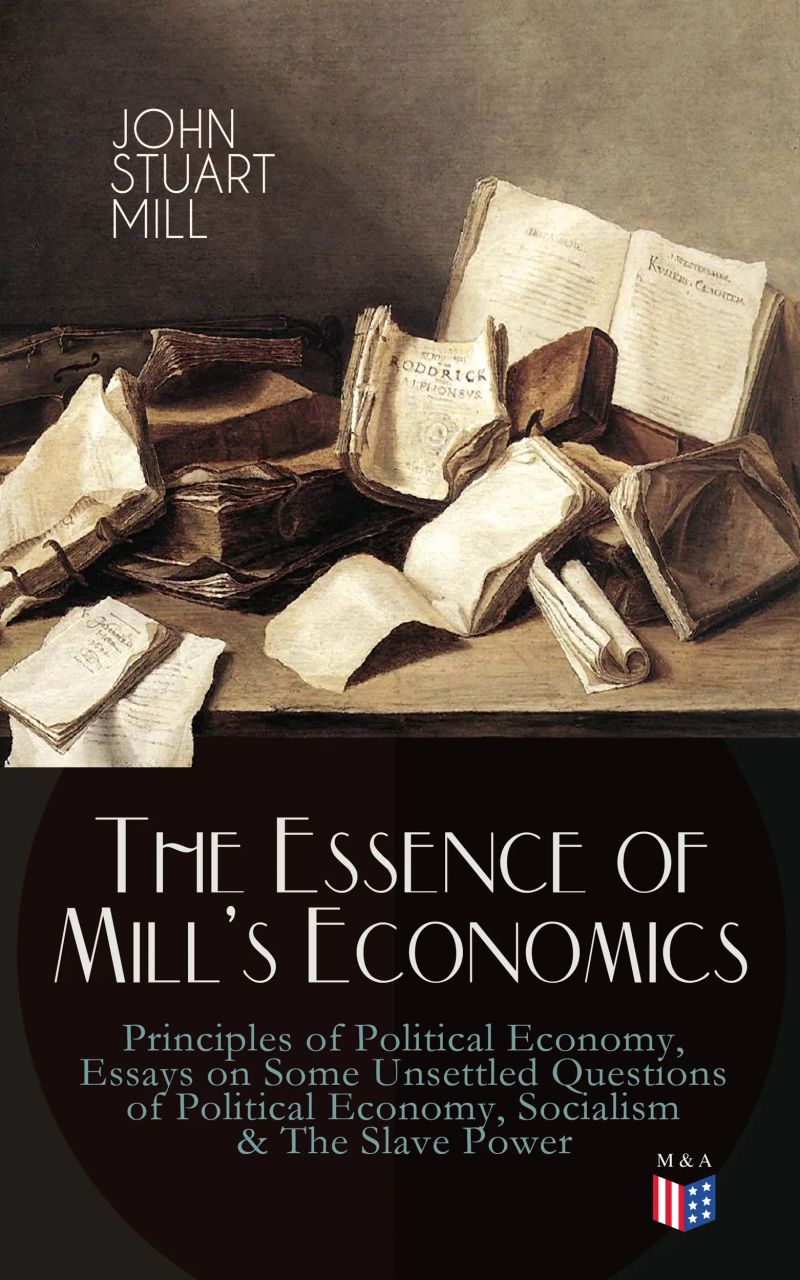
The Essence of Mill's Economics: Principles of Political Economy, Essays on Some Unsettled Questions of Political Economy, Socialism & The Slave Power
By John Stuart Mill


Length36h 51m
About this audiobook
This edition brings to you four outstanding works of John Stuart Mill, books which represent his economic philosophy in the best manner. In his work readers can observe his transformation from the supporter of free market to his acceptance of interventions in the economy, if there were sufficient utilitarian grounds. Alongside his economic philosophy Mill also discussed normative issues such as ideal systems of political economy, critiquing proposed systems such as communism and socialism.
Contents:
Principles of Political Economy
A Sketch Of The History Of Political Economy
Production
Distribution
Exchange
Influence Of The Progress Of Society On Production And Distribution
On The Influence Of Government
Essays on Some Unsettled Questions of Political Economy
Of the Laws of Interchange Between Nations; and the Distribution of the Gains of Commerce Among the Countries of the Commercial World
Of the Influence of Consumption on Production
On the Words Productive and Unproductive
On Profits, and Interest
On the Definition of Political Economy; and on the Method of Investigation Proper to It
Socialism
Socialist Objections to the Present Order of Society
The Socialist Objections to the Present Order of Society Examined
The Difficulties of Socialism
The Idea of Private Property Not Fixed but Variable
The Slave Power
Audiobook details
GenreBusiness and Economics, Politics and Government
Length36 hrs 51 mins
Narrated byListen with 1,000+ voices
FormateBook with Audio
Publish dateAug 26, 2017
LanguageEnglish
Table of contents
1The Essence of Mill’s Economics: Principles of Political Economy, Essays on Some Unsettled Questions of Political Economy, Socialism & The Slave Power
2Preface
3Introductory
4A Sketch Of The History Of Political Economy
5Books For Consultation
Show all chaptersShow less
6Preliminary Riarks
7Book I Production
8Chapter I Of The Requisites Of Production
91. The Requisites of Production are Two: Labor, and Appropriate Natural Objects
102. The Second Requisite of Production, Labor
113. Of Capital as a Requisite of Production
12Chapter II Of Unproductive Labor
131. Definition of Productive and Unproductive Labor
142. Productive and Unproductive Consumption
153. Distinction Between Labor for the Supply of Productive Consumption and Labor for the Supply of Unproductive Consumption
16Chapter III Of Capital
171. Capital is Wealth Appropriated to Reproductive Employment
182. More Capital Devoted to Production than Actually Employed in it
193. Examination of Cases Illustrative of the Idea of Capital
20Chapter IV Fundamental Propositions Respecting Capital
211. Industry is Limited by Capital
222. Increase of Capital gives Increased Employment to Labor, Without Assignable Bounds
233. Capital is the result of Saving, and all Capital is Consumed
244. Capital is kept up by Perpetual Reproduction, as shown by the Recovery of Countries from Devastation
255. Effects of Defraying Government Expenditure by Loans
266. Demand for Commodities is not Demand for Labor
27Chapter V On Circulating And Fixed Capital
281. Fixed and Circulating Capital
292. Increase of Fixed Capital, when, at the Expense of Circulating, might be Detrimental to the Laborers
303. — This seldom, if ever, occurs
31Chapter VI Of Causes Affecting The Efficiency Of Production
321. General Causes of Superior Productiveness
332. Combination and Division of Labor Increase Productiveness
343. Advantages of Division of Labor
354. Production on a Large and Production on a Small Scale
36Chapter VII Of The Law Of The Increase Of Labor
371. The Law of the Increase of Production Depends on those of Three Elements — Labor. Capital, and Land
382. The Law of Population
393. By what Checks the Increase of Population is Practically Limited
40Chapter VIII Of The Law Of The Increase Of Capital
411. Means for Saving in the Surplus above Necessaries
422. Motive for Saving in the Surplus above Necessaries
433. Examples of Deficiency in the Strength of this Desire
444. Examples of Excess of this Desire
45Chapter IX Of The Law Of The Increase Of Production From Land
461. The Law of Production from the Soil, a Law of Diminishing Return in Proportion to the Increased Application of Labor and Capital
472. Antagonist Principle to the Law of Diminishing Return; the Progress of Improvements in Production
483. — In Railways
494. — In Manufactures
505. Law Holds True of Mining

Ausgewählte philosophische SchriftenJohn Stuart Mill54h 51m$1 · $0.00

The Subjection of Women (Annotated)John Stuart Mill6h 2m4.1 (6.1K)$1.99 · $0.00

Sobre la libertadJohn Stuart Mill5h 23m4.2 (49.2K)$15 · $0.00
The Collected Works of John Stuart Mill (Annotated)John Stuart Mill139h 17m4.4 (12)$2 · $0.00

ON LIBERTY - The Philosophy of Individual Freedom (Annotated)John Stuart Mill, W. L. Courtney5h 58m$2 · $0.00

Die Hörigkeit der Frau (Kommentiert)John Stuart Mill7h 42m4.2 (11K)$1 · $0.00
A System of Logic, Ratiocinative and InductiveJohn Stuart Mill43h 17m3.8 (41)$1 · $0.00

La libertàJohn Stuart Mill5h 28m4.0 (45K)$2 · $0.00
JOHN STUART MILL - Ultimate Collection: Works on Philosophy, Politics & Economy (Including Memoirs & Essays)John Stuart Mill139h 21m$1 · $0.00
Inaugural address delivered to the University of St. Andrews, Feb. 1st 1867John Stuart Mill2h 25m4.2 (46)$1 · $0.00
John Stuart Mill: System der deduktiven und induktiven LogikJohn Stuart Mill52h 3m4.6 (11)$1 · $0.00
Auguste Comte and PositivismJohn Stuart Mill5h 18m3.8 (145)$2 · $0.00

Gesammelte philosophische WerkeJohn Stuart Mill55h 49m$1 · $0.00

Considerations on Representative GovernmentJohn Stuart Mill10h 13m4.1 (2.6K)$2 · $0.00

The Collected Works of John Stuart MillJohn Stuart Mill140h 11m$2 · $0.00

Die Hörigkeit der FrauJohn Stuart Mill6h 2m4.1 (341)$1 · $0.00

Über die FreiheitJohn Stuart Mill5h 52m4.1 (55.7K)$2 · $0.00
System der deduktiven und induktiven Logik (Kommentiert)John Stuart Mill51h 51m$1 · $0.00
JOHN STUART MILL - Ultimate Collection: Works on Philosophy, Politics & Economy (Including Memoirs & Essays) (Annotated)John Stuart Mill139h 17m4.5 (22)$0.99 · $0.00

Never Split the DifferenceChris Voss, Tahl Raz8h 7m4.4 (277.7K)$26 · $0.00
The Intelligent Investor Rev Ed.Benjamin Graham17h 48m4.3 (191.5K)$40 · $0.00
The Hard Thing About Hard ThingsBen Horowitz7h 57m4.2 (134.3K)$26 · $0.00
Boundaries for LeadersHenry Cloud7h 36m4.3 (3.6K)$26 · $0.00
The Joys Of CompoundingGautam Baid17h 34m4.5 (2.5K)$18 · $0.00
Basic EconomicsThomas Sowell18h 32m4.5 (29.3K)$28 · $0.00

Poor Charlie’s AlmanackGrover Gardener, Charles T. Munger13h 9m4.5 (24.7K)$18 · $0.00

The Ambuja StoryNarotam Sekhsaria13h 59m4.5 (830)$33 · $0.00

The Secret Door to SuccessFlorence Scovel Shinn2h 25m4.5 (2.1K)$1.20 · $0.00

This Is Going to HurtAdam Kay5h 47m4.4 (444.7K)$24 · $0.00

Big TrustShadé Zahrai, Fayçal Sekkouah8h 36m4.6 (406)$26 · $0.00
The Intelligent Investor Third EditionBenjamin Graham, Jason Zweig20h4.4 (156.6K)$46 · $0.00

Bottle of LiesKatherine Eban14h 25m4.4 (12K)$33 · $0.00

The Antiracist Business BookTrudi Lebrón6h 10m4.6 (275)$17 · $0.00
The FormulaJoshua Robinson, Jonathan Clegg10h 41m4.4 (6.9K)$29 · $0.00

Let Them LeadJohn U. Bacon7h 10m4.5 (1.4K)$24 · $0.00
Secrets of the Millionaire MindT. Harv Eker5h 11m4.4 (301.4K)$24 · $0.00

The Person You Mean to BeDolly Chugh9h 6m4.4 (7.2K)$29 · $0.00
BoundlessNick Kostov, Sean McLain9h 17m4.5 (1.1K)$29 · $0.00

Everyday DharmaSuneel Gupta5h 2m4.5 (761)$20 · $0.00

HostageEli Sharabi5h 25m4.6 (10.8K)$24 · $0.00

KrantikariSanjeev Sanyal11h 44m4.6 (1.3K)$16 · $0.00

Unbroken Bonds of BattleJohnny Joey Jones8h 31m4.6 (2.6K)$8 · $0.00

On Democracies and Death CultsDouglas Murray10h 38m4.6 (6.5K)$29 · $0.00

Balcony Over Jerusalem: A Middle East Memoir - Israel, Palestine and BeyondJohn Lyons12h 37m4.6 (1.4K)$33 · $0.00

RiggedMollie Hemingway12h 48m4.6 (4.2K)$23 · $0.00

SledgehammerDavid Friedman8h 21m4.7 (589)$26 · $0.00

Citizenship in a Republic (Annotated)Theodore Roosevelt2h 44m4.6 (1.4K)$2 · $0.00

No EscapeNury Turkel9h 30m4.6 (809)$28 · $0.00

Always FaithfulThomas Schueman, Zainullah Zaki12h 12m4.6 (977)$29 · $0.00

UnthinkableJamie Raskin15h 8m4.5 (9.3K)$8 · $0.00

My Fourth Time, We DrownedSally Hayden13h 59m4.6 (2.9K)$23 · $0.00

A Revolution of Common SenseScott Jennings9h 29m4.6 (528)$29 · $0.00

Statement From the Dock at the Rivonia TrialNelson Mandela2h 18m4.6 (1.3K)$1 · $0.00

Lessons from the EdgeMarie Yovanovitch17h 11m4.5 (5.9K)$40 · $0.00

To Rescue the American SpiritBret Baier10h 12m4.5 (2.7K)$8 · $0.00

StonewalledSharyl Attkisson15h 19m4.5 (4.3K)$33 · $0.00
The World According to Orwell: 1984 & Animal FarmGeorge Orwell15h 42m4.6 (1.1K)$1 · $0.00
Basic EconomicsThomas Sowell18h 32m4.5 (29.3K)$28 · $0.00

To Rescue the RepublicBret Baier, Catherine Whitney11h 42m4.5 (8.6K)$29 · $0.00
You may also like

Der StruwwelpeterHeinrich Hoffmann2m4.0 (20.2K)$2.30

CategoriesAristotle1h 34m4.0 (1.9K)$2.30

Competitive Dynamics Of Air Transport In Brazil: 2008-2014Luiz Fernando Abel4h 55m$18 · $0.00

The Washing Machine Has Seventeen Programs, and I Use One - How to Wash, Dry, and Care for Clothes Without Shrinking Sweaters, Dyeing Whites, or Studying Care Labels Like Ancient HieroglyphsMax Paradox6h 18m4.4 (131)$7.80 · $0.00
Volkswagen Transporters T4 Workshop ManualOwners Edition4m4.4 (42)$24 · $0.00

VegetarianNaumann & Göbel Verlag3h 23m4.4 (15)$5 · $0.00
The Book of CheeseWalter Warner Fisk, Charles Thom11h 9m4.4 (12)$2.30

On Generation and CorruptionAristotle2h 58m3.5 (307)$1.80 · $0.00
Play That Funky MusicBill Brown Jr.23m$2

Structural Reinforced Concrete AnalysisHugo Villalobos16h 2m$99

Welding, Composites, and Building MaterialsIvar Lundqvist15h 17m$70
Motor-Car Principles The Gasoline AutomobileRoger B. Whitman6h 2m$2.30

Musette in GBill Brown Jr.19m$2

I Just Wanna Make Love to YouBill Brown Jr.40m$4
Engineering Electromagnetics for Antennas and MicrowavesKarim Haddadi11h 22m$80

Prelude in Cm (Chopin)Bill Brown Jr.30m$2

History of SportsKenny Abdo17m$2
Basic Electrical Engineering for BeginnersAndreas Lindqvist9h 7m$45

How to Make Money Flipping Houses - How to Find Undervalued Properties, Control Renovation Costs, and Sell at the Right PriceJACK FLIPWELL4h 31m$7.70 · $0.00
HideawayBill Brown Jr.1h 20m$10