
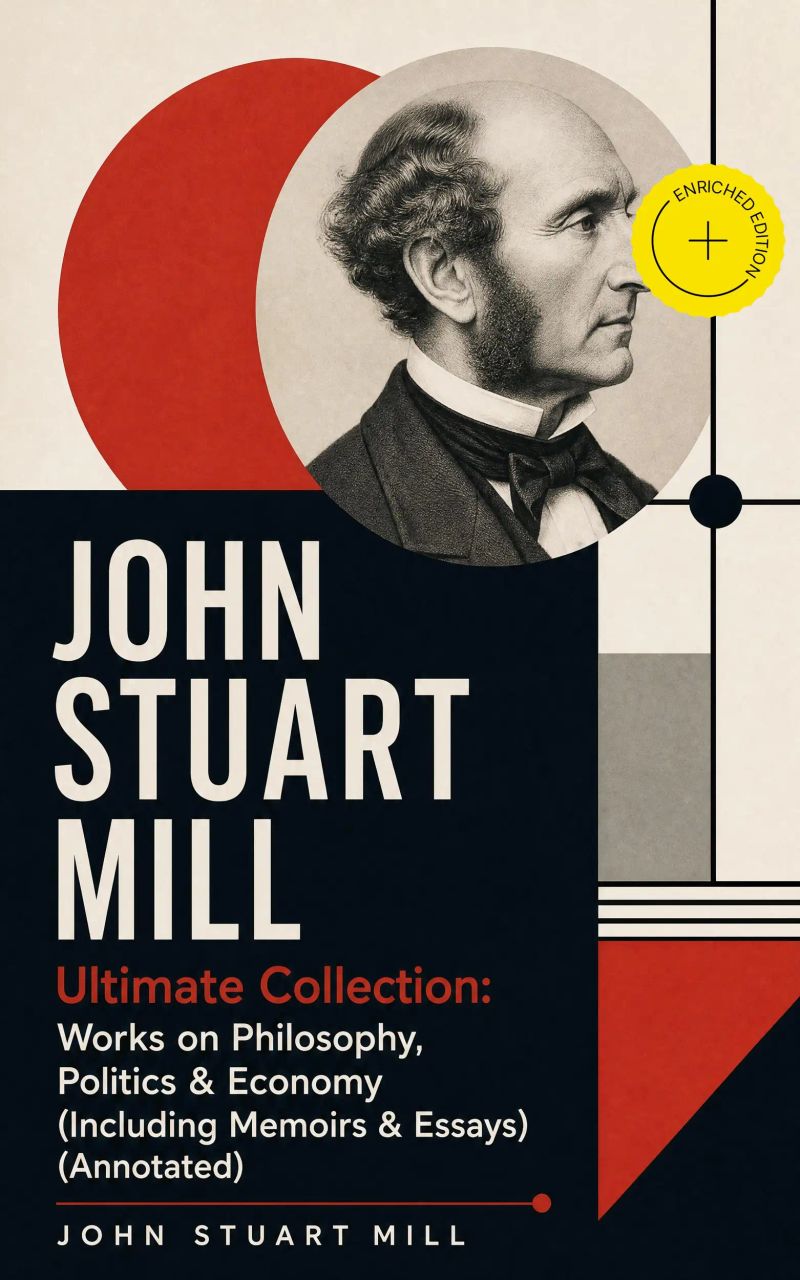
JOHN STUART MILL - Ultimate Collection: Works on Philosophy, Politics & Economy (Including Memoirs & Essays) (Annotated)
Enriched Edition. Liberty, Utilitarianism, and Social ReformBy John Stuart Mill


Length139h 16m
About this audiobook
This ultimate collection gathers John Stuart Mill's major writings in philosophy, politics, economics, autobiography, and criticism, presenting the breadth of one of Victorian Britain's most rigorous liberal minds. From arguments for individual liberty and representative government to reflections on utilitarian ethics, political economy, women's emancipation, and intellectual formation, the volume reveals Mill's distinctive style: lucid, analytical, humane, and patiently argumentative. Situated within nineteenth-century debates over industrial capitalism, democracy, empire, and reform, these works remain central to modern liberal thought. Mill (1806–1873) was shaped by an extraordinary education under his father, James Mill, and by the intellectual circle of Jeremy Bentham, yet his mature writings revise utilitarianism with deeper attention to character, culture, feeling, and freedom. His personal crisis, his partnership with Harriet Taylor Mill, and his parliamentary experience all informed his insistence that social progress depends upon both rational institutions and cultivated individuality. This collection is recommended for readers seeking not merely isolated classics, but the architecture of Mill's thought as a whole. Students of philosophy, politics, economics, history, and literature will find here a foundational archive of modern liberal inquiry, still provocative in its defense of liberty, equality, and disciplined public reason.
This enriched edition has been carefully crafted to add value to your reading experience.
- A comprehensive Introduction outlines these selected works' unifying features, themes, or stylistic evolutions.
- The Author Biography highlights personal milestones and literary influences that shape the entire body of writing.
- A Historical Context section situates the works in their broader era—social currents, cultural trends, and key events that underpin their creation.
- A concise Synopsis (Selection) offers an accessible overview of the included texts, helping readers navigate plotlines and main ideas without revealing critical twists.
- A unified Analysis examines recurring motifs and stylistic hallmarks across the collection, tying the stories together while spotlighting the different work's strengths.
- Reflection questions inspire deeper contemplation of the author's overarching message, inviting readers to draw connections among different texts and relate them to modern contexts.
- Lastly, our hand‐picked Memorable Quotes distill pivotal lines and turning points, serving as touchstones for the collection's central themes.
Audiobook details
Rating★★★★ 4.5 (22)
Includes Goodreads, Amazon
GenrePhilosophy
Length139 hrs 16 mins
Narrated byListen with 1,000+ voices
FormateBook with Audio
Publish dateDec 14, 2023
LanguageEnglish
Table of contents
1JOHN STUART MILL - Ultimate Collection: Works on Philosophy, Politics & Economy (Including Memoirs & Essays) (Annotated)
2Introduction
3Author Biography
4Historical Context
5Synopsis (Selection)
Show all chaptersShow less
6JOHN STUART MILL - Ultimate Collection: Works on Philosophy, Politics & Economy (Including Memoirs & Essays)
7Utilitarianism
8CHAPTER I GENERAL REMARKS
9CHAPTER II WHAT UTILITARIANISM IS
10CHAPTER III OF THE ULTIMATE SANCTION OF THE PRINCIPLE OF UTILITY
11CHAPTER IV OF WHAT SORT OF PROOF THE PRINCIPLE OF UTILITY IS SUSCEPTIBLE
12CHAPTER V ON THE CONNEXION BETWEEN JUSTICE AND UTILITY
13The Subjection of Women
14Chapter I
15Chapter II
16Chapter III
17Chapter IV
18On Liberty
19Preface
20I
21II
22III
23Chapter I Introductory
24Chapter II of the Liberty of Thought and Discussion
25Chapter III of Individuality, as One of the Elements of Well-being
26Chapter IV of the Limits to the Authority of Society Over the Individual
27Chapter V Applications
28Preface
29Introductory
30A Sketch Of The History Of Political Economy
31Books For Consultation
32Preliminary Remarks
33Book I Production
34Chapter I Of The Requisites Of Production
351. The Requisites of Production are Two: Labor, and Appropriate Natural Objects
362. The Second Requisite of Production, Labor
373. Of Capital as a Requisite of Production
38Chapter II Of Unproductive Labor
391. Definition of Productive and Unproductive Labor
402. Productive and Unproductive Consumption
413. Distinction Between Labor for the Supply of Productive Consumption and Labor for the Supply of Unproductive Consumption
42Chapter III Of Capital
431. Capital is Wealth Appropriated to Reproductive Employment
442. More Capital Devoted to Production than Actually Employed in it
453. Examination of Cases Illustrative of the Idea of Capital
46Chapter IV Fundamental Propositions Respecting Capital
471. Industry is Limited by Capital
482. Increase of Capital gives Increased Employment to Labor, Without Assignable Bounds
493. Capital is the result of Saving, and all Capital is Consumed
504. Capital is kept up by Perpetual Reproduction, as shown by the Recovery of Countries from Devastation
Ausgewählte philosophische SchriftenJohn Stuart Mill54h 51m$1 · $0.00

The Subjection of Women (Annotated)John Stuart Mill6h 2m4.1 (6.1K)$1.99 · $0.00

Sobre la libertadJohn Stuart Mill5h 23m4.2 (49.2K)$15 · $0.00

The Collected Works of John Stuart Mill (Annotated)John Stuart Mill139h 17m4.4 (12)$2 · $0.00
ON LIBERTY - The Philosophy of Individual Freedom (Annotated)John Stuart Mill, W. L. Courtney5h 58m$2 · $0.00

Die Hörigkeit der Frau (Kommentiert)John Stuart Mill7h 42m4.2 (11K)$1 · $0.00
A System of Logic, Ratiocinative and InductiveJohn Stuart Mill43h 17m3.8 (41)$1 · $0.00

La libertàJohn Stuart Mill5h 28m4.0 (45K)$2 · $0.00
JOHN STUART MILL - Ultimate Collection: Works on Philosophy, Politics & Economy (Including Memoirs & Essays)John Stuart Mill139h 21m$1 · $0.00
Inaugural address delivered to the University of St. Andrews, Feb. 1st 1867John Stuart Mill2h 25m4.2 (46)$1 · $0.00
John Stuart Mill: System der deduktiven und induktiven LogikJohn Stuart Mill52h 3m4.6 (11)$1 · $0.00
Auguste Comte and PositivismJohn Stuart Mill5h 18m3.8 (145)$2 · $0.00

Gesammelte philosophische WerkeJohn Stuart Mill55h 49m$1 · $0.00

Considerations on Representative GovernmentJohn Stuart Mill10h 13m4.1 (2.6K)$2 · $0.00

The Collected Works of John Stuart MillJohn Stuart Mill140h 11m$2 · $0.00

Die Hörigkeit der FrauJohn Stuart Mill6h 2m4.1 (341)$1 · $0.00

Über die FreiheitJohn Stuart Mill5h 52m4.1 (55.7K)$2 · $0.00
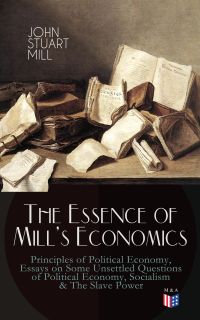
The Essence of Mill's Economics: Principles of Political Economy, Essays on Some Unsettled Questions of Political Economy, Socialism & The Slave PowerJohn Stuart Mill36h 52m$2 · $0.00
System der deduktiven und induktiven Logik (Kommentiert)John Stuart Mill51h 51m$1 · $0.00
The Art of LivingThich Nhat Hanh5h 1m4.5 (14.2K)$24 · $0.00
Moral Letters to LuciliusLucius Annaeus Seneca24h 26m4.5 (71.7K)$0.99 · $0.00

Lessons in TruthH. Emilie Cady3h 50m4.5 (2.4K)$20 · $0.00
Letters from a StoicSeneca6h 5m4.4 (80.4K)$6 · $0.00
The Discourses of EpictetusP. E. MATHESOM12h 47m4.4 (17.7K)$1.20 · $0.00
IlluminationsWalter Benjamin10h 12m4.4 (16.2K)$20 · $0.00
That Bird Has My WingsJarvis Jay Masters9h 49m4.4 (13.7K)$29 · $0.00

Tâo Teh KingLaozi2h 34m4.4 (230.9K)$2 · $0.00
SymposiumPlato3h 26m4.4 (97.9K)$1.20 · $0.00

Buddhist Boot CampTimber Hawkeye2h 39m4.4 (8.4K)$18 · $0.00
Enchiridion & The Discourses of Epictetus (Annotated)Arrian Epictetus18h 9m4.4 (3.5K)$2 · $0.00
The Meditations of the Emperor Marcus Aurelius AntoninusEmperor of Rome Marcus Aurelius5h 41m4.4 (1.8M)$1 · $0.00
Crime and PunishmentFyodor Dostoevsky23h 11m4.4 (1.3M)$12 · $0.00

MeditationsMarcus Aurelius5h 52m4.4 (433.7K)$1 · $0.00

Everyday DharmaSuneel Gupta5h 2m4.5 (761)$20 · $0.00

The Joyful Wisdom ("La Gaya Scienza")Friedrich Wilhelm Nietzsche11h 37m4.4 (26.6K)$1 · $0.00
The Art of LivingEpictetus, Sharon Lebell3h 16m4.4 (50.1K)$18 · $0.00
MeditationsEmperor Of Rome Marcus Aurelius7h 23m4.3 (477.5K)$1.20 · $0.00

The Imitation of ChristThomas à Kempis6h 27m4.3 (84.6K)$21 · $0.00

Sadhana: the realisation of lifeRabindranath Tagore3h 49m4.4 (8.6K)$6 · $0.00
You may also like
A Brief History of EqualityThomas Piketty8h 44m4.2 (4.1K)$20 · $0.00

Too Much GlueJason Lefebvre5m4.3 (2.3K)$5 · $0.00
The Proletarian Revolution and the Renegade KautskyVladimir Lenin4h 34m4.3 (1K)$0.99 · $0.00

The Humane EconomyWayne Pacelle12h 17m4.3 (579)$29 · $0.00
Scattered PoemsJack Kerouac51m3.9 (3.2K)$8
The Autobiography of Thomas JeffersonThomas Jefferson8h 32m4.0 (2.8K)$1.99 · $0.00
Opium Inc.Thomas Manuel9h 27m4.2 (263)$29 · $0.00
The Constitution of the United States and The Declaration of IndependenceDelegates of The Constitutional Convention1h 7m4.6 (12.3K)Free
MuchaPatrick Bade1h 12m4.1 (288)$8 · $0.00
The Wealth of Nations (Annotated)Adam Smith42h 48m4.2 (35.4K)$2 · $0.00
Economics in One LessonHenry Hazlitt6h 56m4.3 (34.5K)$17
Defending the Free MarketReverend Robert Sirico7h 12m4.4 (404)$20 · $0.00

The Politically Incorrect Guide to CommunismPaul Kengor PhD11h 44m4.4 (498)$20
On the Duty of Civil DisobedienceHenry David Thoreau1h 21m4.1 (29.2K)$2 · $0.00
Socialism: Utopian and Scientific (Annotated)Frederick Engels3h 29m4.3 (15K)$1.99 · $0.00

Letters on EnglandVoltaire4h 2m3.9 (3.6K)$0.60 · $0.00
The Wealth of NationsAdam Smith35h 14m4.1 (124.1K)$40
The Communist ManifestoKarl Marx, Friedrich Engels2h 13m3.9 (252.7K)$2 · $0.00
Capitalizing on LitecoinIsla L. Gallagher4h 21m$4.10 · $0.00

Constitution of the PhilippinesConstitutional Commission19m4.3 (126)$0.99 · $0.00