
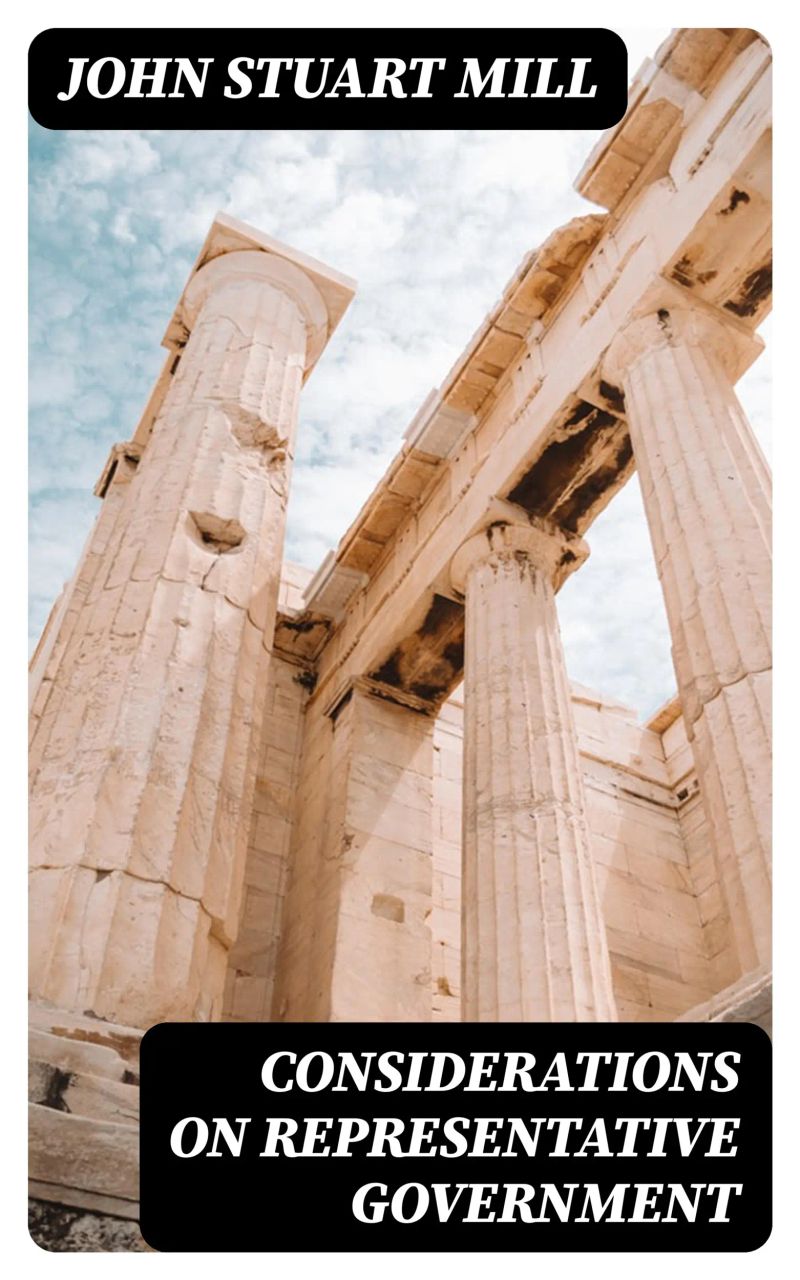
Considerations on Representative Government
By John Stuart Mill

Length10h 13m
About this audiobook
In "Considerations on Representative Government," John Stuart Mill presents a rigorous analysis of democratic structures and the principles underlying representative governance. Written during the mid-19th century, a time of burgeoning political reform, Mill employs a clear yet sophisticated prose style that synthesizes empirical observations with philosophical inquiry. He delineates the criteria for an effective government, examines the role of public opinion, and discusses the balance between liberty and authority, thus situating his arguments within the context of the Enlightenment's emphasis on rational discourse and individual rights. John Stuart Mill, a prominent philosopher and political economist, was deeply influenced by the liberal ideals of his father, James Mill, and the utilitarian principles of Jeremy Bentham. Educated in a rigorous intellectual environment, Mill's experiences with political activism, particularly his advocacy for women's suffrage and social reform, provided him with the practical insights needed to explore the complexities of governance in his work. His personal commitment to fostering a just society is evident throughout the text, providing a philosophical foundation for many modern democratic systems. This book is highly recommended for scholars, students, and anyone interested in the foundations of democratic theory. Mill's nuanced arguments remain relevant today, making it essential reading for those seeking to understand the challenges and benefits of representative government.
Audiobook details
Rating★★★★ 4.1 (2.6K)
Includes Goodreads, Amazon
GenrePolitics and Government
Length10 hrs 13 mins
Narrated byListen with 1,000+ voices
FormateBook with Audio
Publish dateAug 10, 2022
LanguageEnglish
Table of contents
1CONSIDERATIONS ON REPRESENTATIVE GOVERNMENT
2Preface
3Chapter I—To What Extent Forms of Government are a Matter of Choice.
4Chapter II—The Criterion of a Good Form of Government.
5Chapter III—That the ideally best Form of Government is Representative Government.
Show all chaptersShow less
6Chapter IV—Under what Social Conditions Representative Government is Inapplicable.
7Chapter V—Of the Proper Functions of Representative Bodies.
8Chapter VI—Of the Infirmities and Dangers to which Representative Government is Liable.
9Chapter VII—Of True and False Democracy; Representation of All, and Representation of the Majority only.
10Chapter VIII—Of the Extension of the Suffrage.
11Chapter IX—Should there be Two Stages of Election?
12Chapter X—Of the Mode of Voting.
13Chapter XI—Of the Duration of Parliaments.
14Chapter XII—Ought Pledges to be Required from Members of Parliament?
15Chapter XIII—Of a Second Chamber.
16Chapter XIV—Of the Executive in a Representative Government.
17Chapter XV—Of Local Representative Bodies.
18Chapter XVI—Of Nationality, as connected with Representative Government.
19Chapter XVII—Of Federal Representative Governments.
20Chapter XVIII—Of the Government of Dependencies by a Free State.

Ausgewählte philosophische SchriftenJohn Stuart Mill54h 51m$1 · $0.00

The Subjection of Women (Annotated)John Stuart Mill6h 2m4.1 (6.1K)$1.99 · $0.00

Sobre la libertadJohn Stuart Mill5h 23m4.2 (49.2K)$15 · $0.00

The Collected Works of John Stuart Mill (Annotated)John Stuart Mill139h 17m4.4 (12)$2 · $0.00

ON LIBERTY - The Philosophy of Individual Freedom (Annotated)John Stuart Mill, W. L. Courtney5h 58m$2 · $0.00

Die Hörigkeit der Frau (Kommentiert)John Stuart Mill7h 42m4.2 (11K)$1 · $0.00
A System of Logic, Ratiocinative and InductiveJohn Stuart Mill43h 17m3.8 (41)$1 · $0.00

La libertàJohn Stuart Mill5h 28m4.0 (45K)$2 · $0.00
JOHN STUART MILL - Ultimate Collection: Works on Philosophy, Politics & Economy (Including Memoirs & Essays)John Stuart Mill139h 21m$1 · $0.00
Inaugural address delivered to the University of St. Andrews, Feb. 1st 1867John Stuart Mill2h 25m4.2 (46)$1 · $0.00

John Stuart Mill: System der deduktiven und induktiven LogikJohn Stuart Mill52h 3m4.6 (11)$1 · $0.00
Auguste Comte and PositivismJohn Stuart Mill5h 18m3.8 (145)$2 · $0.00

Gesammelte philosophische WerkeJohn Stuart Mill55h 49m$1 · $0.00

The Collected Works of John Stuart MillJohn Stuart Mill140h 11m$2 · $0.00

Die Hörigkeit der FrauJohn Stuart Mill6h 2m4.1 (341)$1 · $0.00

Über die FreiheitJohn Stuart Mill5h 52m4.1 (55.7K)$2 · $0.00
The Essence of Mill's Economics: Principles of Political Economy, Essays on Some Unsettled Questions of Political Economy, Socialism & The Slave PowerJohn Stuart Mill36h 52m$2 · $0.00

System der deduktiven und induktiven Logik (Kommentiert)John Stuart Mill51h 51m$1 · $0.00
JOHN STUART MILL - Ultimate Collection: Works on Philosophy, Politics & Economy (Including Memoirs & Essays) (Annotated)John Stuart Mill139h 17m4.5 (22)$1.99 · $0.00

The Gulag Archipelago Volume 3Aleksandr I. Solzhenitsyn21h 56m4.7 (8.9K)$46 · $0.00

MotherlandJulia Ioffe17h 52m4.7 (2.5K)$40 · $0.00

HostageEli Sharabi5h 25m4.6 (10.8K)$24 · $0.00

KrantikariSanjeev Sanyal11h 44m4.6 (1.3K)$16 · $0.00

Unbroken Bonds of BattleJohnny Joey Jones8h 31m4.6 (2.6K)$8 · $0.00

On Democracies and Death CultsDouglas Murray10h 38m4.6 (6.5K)$29 · $0.00

Balcony Over Jerusalem: A Middle East Memoir - Israel, Palestine and BeyondJohn Lyons12h 37m4.6 (1.4K)$33 · $0.00
RiggedMollie Hemingway12h 48m4.6 (4.2K)$23 · $0.00

SledgehammerDavid Friedman8h 21m4.7 (589)$26 · $0.00

Citizenship in a Republic (Annotated)Theodore Roosevelt2h 44m4.6 (1.4K)$2 · $0.00

No EscapeNury Turkel9h 30m4.6 (809)$28 · $0.00

Always FaithfulThomas Schueman, Zainullah Zaki12h 12m4.6 (977)$29 · $0.00

UnthinkableJamie Raskin15h 8m4.5 (9.3K)$8 · $0.00

My Fourth Time, We DrownedSally Hayden13h 59m4.6 (2.9K)$23 · $0.00

A Revolution of Common SenseScott Jennings9h 29m4.6 (528)$29 · $0.00

Statement From the Dock at the Rivonia TrialNelson Mandela2h 18m4.6 (1.3K)$1 · $0.00

Lessons from the EdgeMarie Yovanovitch17h 11m4.5 (5.9K)$40 · $0.00

To Rescue the American SpiritBret Baier10h 12m4.5 (2.7K)$8 · $0.00

StonewalledSharyl Attkisson15h 19m4.5 (4.3K)$33 · $0.00
The World According to Orwell: 1984 & Animal FarmGeorge Orwell15h 42m4.6 (1.1K)$1 · $0.00
You may also like
Human ErrorsNathan H. Lents7h 38m4.0 (7.1K)$26 · $0.00
Is There Really a Human Race?Jamie Lee Curtis3m4.2 (3.1K)$4 · $0.00
Categories (Κατηγορίαι)Aristotle1h 24m4.0 (1.9K)$2 · $0.00

Ethics (Annotated)Immanuel Kant23h 21m4.0 (1.2K)$1.99 · $0.00
CategoriesAristotle1h 34m4.0 (2K)$1.20 · $0.00

Roget's Thesaurus of English Words and PhrasesPeter Mark Roget26h 5m4.2 (617)Free

How to Make Money Flipping Reclaimed Building Materials - How to Identify Valuable Materials, Recover Them Safely, Prepare Them, and Resell for ProfitJACK FLIPWELL1h 55m$7.80 · $0.00

Japanese for Absolute BeginnersAnya Lewis3h 29m$47 · $0.00

Practical Blogging for EverybodyAnthony Ekanem48m$4 · $0.00
Side Hustle: Build Extra Streams of Income, Earn Beyond Your Paycheck (The Honest Guide to Finding the Right Side Hustle for Your Skills, Goals and Lifestyle)Michael Browne1h 43m$3.50 · $0.00
Professor Elibius and the hoursRicardo Garay5m$5 · $0.00

Esthetician Exam Study GuideMarie Peterson8h 41m$13

Researches on Cellulose, 1895-1900C. F. Cross, E. J. Bevan4h 56m$2 · $0.00

I am learning Mandarin ChineseJM Gardner3h 57m$18 · $0.00

I am learning Caribbean CreoleJM Gardner4h 14m$18 · $0.00

Animals with JobsJulie Murray11m$1

Self-Employed Tax Guide 2027Imad Muratspahic4h 6m$7.90 · $0.00

The escape of the giant earthwormsSilvia Strufaldi3m$5 · $0.00
The Unreality of Time (Annotated)John McTaggart Ellis McTaggart1h 45m$2 · $0.00

Diary Of A Man Forced By His Boss To Visit The New Funan MallRICE media11m4.1 (21)$6 · $0.00