
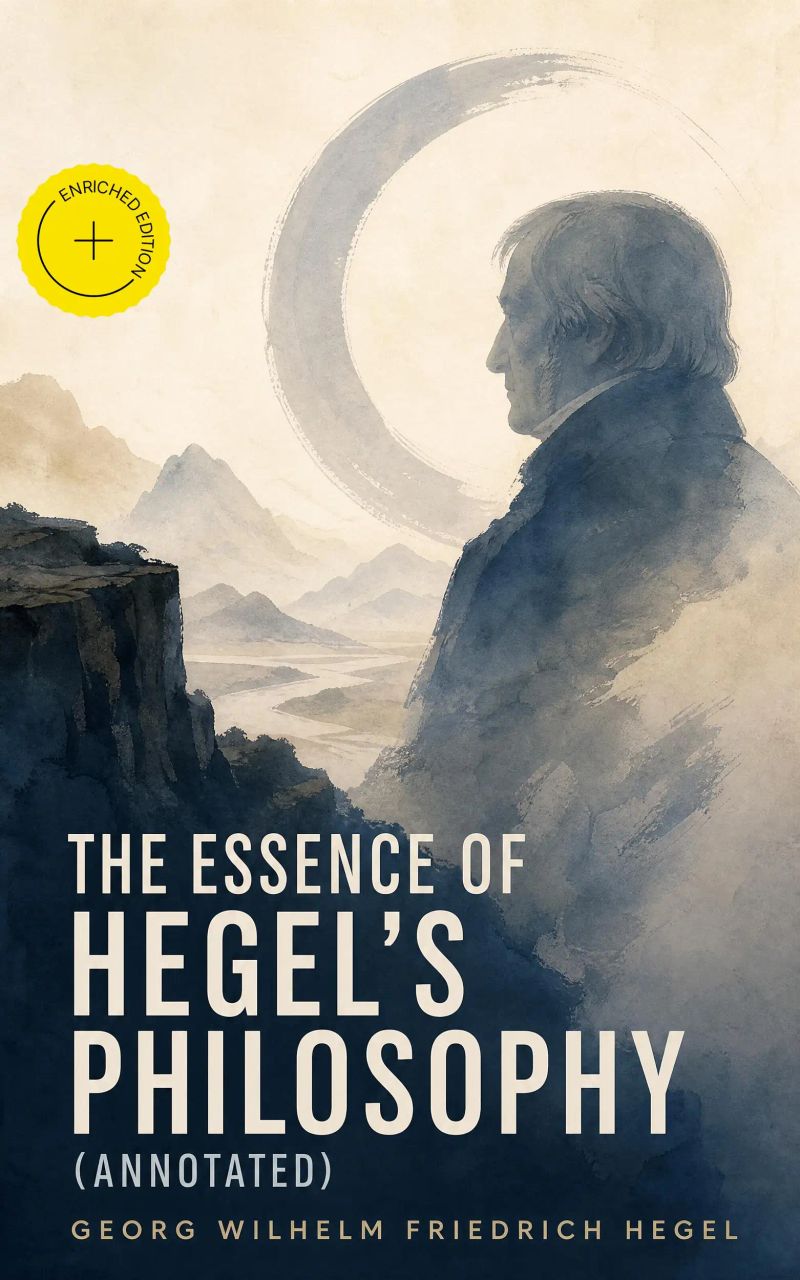
The Essence of Hegel's Philosophy (Annotated)
Enriched Edition. Phenomenology of Mind, Philosophy of Mind, Aesthetics, The Criticism of Hegle's Work and Hegelianism by Schopenhauer & Nietzsche, BiographyBy Georg Wilhelm Friedrich Hegel


Length243h 1m
About this audiobook
The Essence of Hegel's Philosophy presents a concentrated pathway into the central architecture of Hegelian thought: dialectic, spirit, freedom, history, and the unfolding of reason in the world. Written in a rigorous, aphoristic, and systematically layered style, the work belongs to the high tradition of German Idealism, yet reaches beyond it by transforming metaphysics into a philosophy of historical development. Its arguments illuminate the movement from abstract thought to concrete self-consciousness, making visible Hegel's ambition to reconcile logic, nature, society, and culture within one comprehensive vision. Georg Wilhelm Friedrich Hegel (1770–1831), formed by the intellectual aftermath of Kant, the French Revolution, and Romantic debates over freedom and community, sought to understand modernity as a rational process rather than a mere succession of events. His experiences as theologian, educator, journalist, and professor shaped a philosophy deeply concerned with institutions, ethical life, and the historical realization of human liberty. This book is recommended to readers seeking a demanding but rewarding encounter with one of philosophy's most influential minds. It will especially benefit students of metaphysics, political theory, theology, and intellectual history who wish to grasp why Hegel remains indispensable to modern thought.
This enriched edition has been carefully crafted to add value to your reading experience.
- A succinct Introduction situates the work's timeless appeal and themes.
- The Synopsis outlines the central plot, highlighting key developments without spoiling critical twists.
- A detailed Historical Context immerses you in the era's events and influences that shaped the writing.
- A thorough Analysis dissects symbols, motifs, and character arcs to unearth underlying meanings.
- Reflection questions prompt you to engage personally with the work's messages, connecting them to modern life.
Audiobook details
GenrePhilosophy
Length243 hrs 1 min
Narrated byListen with 1,000+ voices
FormateBook with Audio
Publish dateApr 26, 2019
LanguageEnglish
Table of contents
1The Essence of Hegel's Philosophy (Annotated)
2Introduction
3Historical Context
4Synopsis (Selection)
5Introduction
Show all chaptersShow less
6The Life and Work of Georg Wilhelm Friedrich Hegel
7Books
8The Phenomenology of Mind
9Preface: On Scientific Knowledge
10Introduction
11A. Consciousness
12II. Perception: Or Things and Their Deceptiveness
13III. Force and the Understanding-The World of Appearance and the Supersensible World
14B. Self-Consciousness
15A. Independence and Dependence of Self-Consciousness Lordship and Bondage
16B. Freedom of Self-Consciousness Stoicism: Scepticism: The Unhappy Consciousness
17C. Free Concrete Mind
18V. Reason’s Certainty and Reason’s Truth
19A. Observation as a Process of Reason
20a. Observation of Nature
21b. Observation of Self-Consciousness in its Pure Form and in its Relation to External Reality — Logical and Psychological Laws
22c. Observation of the Relation of Self-Consciousness To its Immediate Actuality — Physiognomy and Phrenology.
23B. The Realization of Rational Self-Consciousness Through its Own Activity
24a. Pleasure and Necessity
25b. The Law of the Heart, and the Frenzy Of Self-Conceit
26c. Virtue and the Course of the World
27C. Individuality, which Takes Itself to Be Real In and for Itself
28a. Society as a Herd of Individuals: Deceit: "Actual Fact"
29b. Reason as Lawgiver
30c. Reason as Testing Laws
31VI. Spirit
32A. Objective Spirit — The Ethical Order
33a. The Ethical World: Law Human and Divine: Man and Woman
34b. Ethical Action. Knowledge, Human and Divine. Guilt and Destiny
35c. The Condition of Right or Legal Status
36B. Spirit in Self-Estrangement — The Discipline Of Culture
37i. The World of Spirit in Self-Estrangement
38ii. Enlightenment
39iii. Absolute Freedom and Terror
40C. Spirit in the Condition of Being Certain of Itself: Morality
41a. The Moral View of the World
42b. Dissemblance
43c. Conscience: The “Beautiful Soul”: Evil and the Forgiveness of it
44VII. Religion
45A. Natural Religion
46a. God as Light
47b. Plants and Animals as Objects of Religion
48c. The Artificer
49B. Religion in the Form of Art
50a. The Abstract Work of Art
Hegel - Premium Collection (Annotated)Georg Wilhelm Friedrich Hegel242h 8m$2 · $0.00
Science of Logic (Annotated)Georg Wilhelm Friedrich Hegel17h 57m$2 · $0.00
The Greatest Works of G.W.F. Hegel (Annotated)Georg Wilhelm Friedrich Hegel244h 13m$2 · $0.00
The Essential Works of Georg Wilhelm Friedrich Hegel (Annotated)Georg Wilhelm Friedrich Hegel242h 56m$2 · $0.00
The Phenomenology of Mind (Annotated)Georg Wilhelm Friedrich Hegel28h 2m$3 · $0.00
The Philosophy of Fine Art (Vol. 1-3) (Annotated)Georg Wilhelm Friedrich Hegel71h 16m$2 · $0.00

Hegel: The Science of LogicGeorg Wilhelm Friedrich Hegel17h 39m$1 · $0.00

The Greatest Works of G.W.F. HegelGeorg Wilhelm Friedrich Hegel242h 7m$1 · $0.00
Hegel's Philosophy of MindGeorg Wilhelm Friedrich Hegel14h 28m$1 · $0.00

Science of LogicGeorg Wilhelm Friedrich Hegel17h 39m$1 · $0.00
The Introduction to Hegel's Philosophy of Fine ArtsGeorg Wilhelm Friedrich Hegel8h 26m$1 · $0.00

Science of Logic (Summarized Edition)Georg Wilhelm Friedrich Hegel3h 43m$2
Hegel: Lectures on PhilosophyGeorg Wilhelm Friedrich Hegel86h 27m$2 · $0.00
The Essence of Hegel's PhilosophyGeorg Wilhelm Friedrich Hegel243h 17m$2 · $0.00
Wissenschaft der Logik (Kommentiert)Georg Wilhelm Friedrich Hegel39h 16m$1 · $0.00
The Logic of HegelGeorg Wilhelm Friedrich Hegel13h 29m$1 · $0.00
Hegel's Phenomenology of Mind (Annotated)Georg Wilhelm Friedrich Hegel27h 55m$2 · $0.00
The Essence of Hegel's PhilosophyGeorg Wilhelm Friedrich Hegel240h 53m$2 · $0.00
The Philosophy of Hegel: Collected WorksGeorg Wilhelm Friedrich Hegel244h 38m$2 · $0.00

The Phenomenology of Mind (Summarized Edition)Georg Wilhelm Friedrich Hegel5h 57m$2

WitnessAriel Burger8h 1m$20 · $0.00

Feeling Is The SecretNeville Goddard44m5.0 (1)$2 · $0.00

The Way to a Beautiful WorldJames Norbury44m$9 · $0.00
The Practicing StoicWard Farnsworth9h 56m$20

The Complete Essays of Montaigne (Annotated)Michel de Montaigne46h 47m$0.99 · $0.00
Moral Letters to LuciliusLucius Annaeus Seneca25h 24m$2 · $0.00
THE THREE CRITIQUES: The Critique of Pure Reason, The Critique of Practical Reason & The Critique of JudgmentImmanuel Kant46h 10m$1 · $0.00
The LawFrédéric Bastiat2h 7m$10

IlluminationsWalter Benjamin10h 12m$20 · $0.00

That Bird Has My WingsJarvis Jay Masters9h 49m$29 · $0.00

Tâo Teh KingLaozi2h 34m$2 · $0.00

Buddhist Boot CampTimber Hawkeye2h 39m$18 · $0.00
The DhammapadaFriedrich Max Müller1h 30m$15
Change Your MindRJ Spina7h 5m$17
Enchiridion & The Discourses of Epictetus (Annotated)Arrian Epictetus18h 9m$2 · $0.00

SUMMA THEOLOGICAThomas Aquinas285h 28m$1 · $0.00

The Meditations of the Emperor Marcus Aurelius AntoninusEmperor of Rome Marcus Aurelius5h 41m$1 · $0.00

Crime and PunishmentFyodor Dostoevsky23h 11m$12 · $0.00

MeditationsMarcus Aurelius5h 52m$1 · $0.00

Tao Te ChingLao Tzu1h 25m$2 · $0.00
You may also like

If the Oceans Were InkCarla Power12h 35m$20 · $0.00
The Essence of Hegel's PhilosophyGeorg Wilhelm Friedrich Hegel240h 53m$2 · $0.00

Englisch lernen Audio - Die besten Stadttouren in LondonSpotlight Verlag59m$12

The Negotiator in You: In LifeJoshua N. Weiss PhD36m$3

The Four Books of Confucianism (Annotated)Mencius, Anonymous13h 47m$2 · $0.00

A Room of One's OwnVirginia Woolf5h 5m$20
What the CEO Really Wants From YouR. Gopalakrishnan6h 9m$24 · $0.00
The Philosophy of Hegel: Collected WorksGeorg Wilhelm Friedrich Hegel244h 38m$2 · $0.00
The Analects of ConfuciusAnonymous4h 2m$1 · $0.00

A Crooked MileOliver Onions8h 2m$2 · $0.00

The BridegroomHa Jin6h 54m$17 · $0.00

The Research MagnificentH. G. Wells13h 51m$2 · $0.00
The Education of Henry AdamsHenry Adams19h 28m$30

KlimtJane Rogoyska, Patrick Bade1h 23m$13.50 · $0.00

India: A Million Mutinies NowV. S. Naipaul24h 46m$30
What Becomes a Legend MostPhilip Gefter22h 51m$46 · $0.00
PersuadableAl Pittampalli7h 3m$24 · $0.00

The Great Learning (Unabridged) (Annotated)Confucius2h 6m$2 · $0.00

My American DiaryClare Sheridan7h 19m$2 · $0.00

Japanese Plays and PlayfellowsOsman Edwards8h 54m$2 · $0.00