
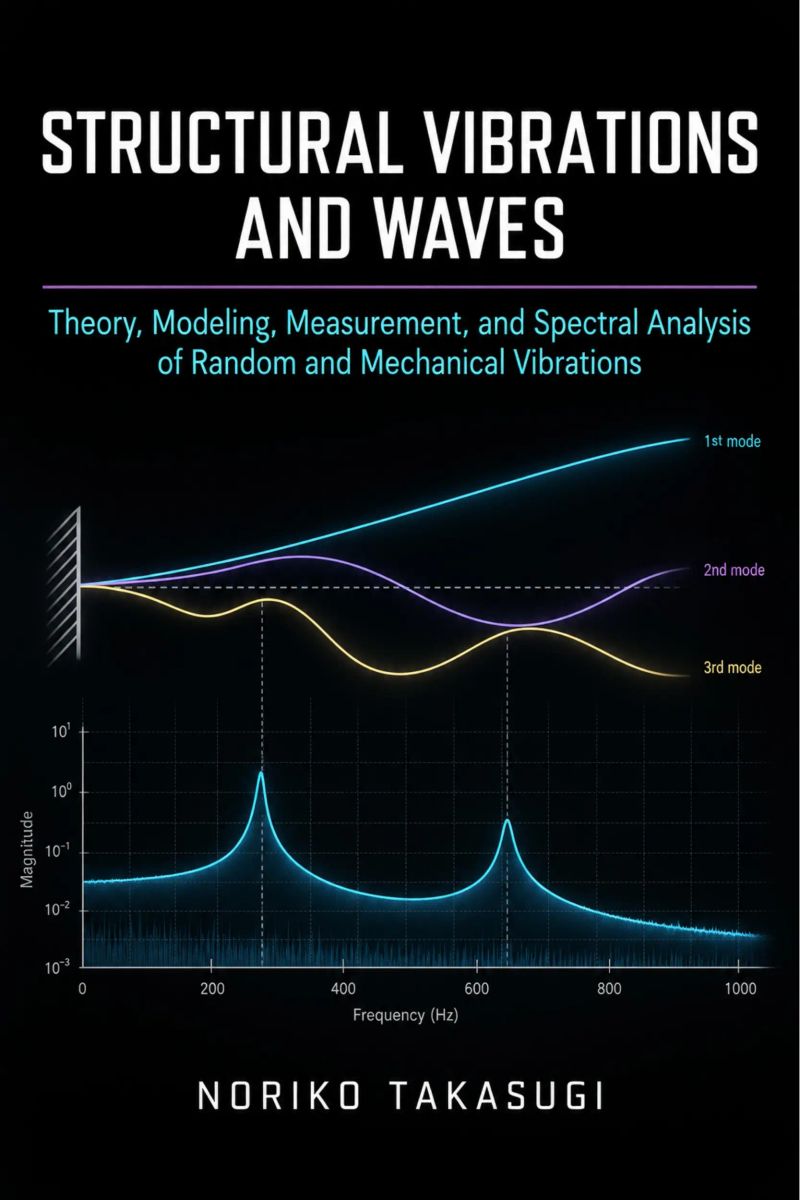
Structural Vibrations and Waves
Theory, Modeling, Measurement, and Spectral Analysis of Random and Mechanical VibrationsBy Noriko Takasugi

Length13h 58m
About this audiobook
A structure does not care whether you modelled it as a lumped mass or a continuum; it responds at the frequencies it has.
This book takes you from a single spring and mass to measured spectra on real hardware without breaking that chain. You will derive frequency response functions and extract damping from half-power bandwidth, design isolators against transmissibility targets, tune a mass damper, assemble and solve multi-degree-of-freedom systems in modal coordinates, and handle beams, plates and dispersive bending waves. Random vibration then gives you power spectral density, root-mean-square response and fatigue damage estimation, followed by the spectral analysis choices — sampling, windows, averaging — that decide whether your measurement means anything. Closing coverage includes modal testing and active control.
For graduate students, structural dynamicists and test engineers, the treatment balances theory, modeling, measurement and spectral analysis so that each concept connects directly to the next. Derivations are presented with enough detail to follow by hand, while numerical methods and finite element vibration are introduced where they become necessary. The result is a coherent path from first principles to practical implementation.
What you will learn:
• Derive the free vibration response of single-degree-of-freedom systems and identify natural frequency and damping ratio from physical parameters.
• Extract damping from half-power bandwidth and interpret frequency response functions for harmonic excitation.
• Design vibration isolators against transmissibility targets and analyze base excitation and unbalance.
• Tune a mass damper and solve two-degree-of-freedom systems for absorber performance.
• Assemble and solve multi-degree-of-freedom systems in modal coordinates, including numerical methods and finite element vibration.
• Model continuous systems, beams and plates, and analyze dispersive bending waves in structures.
• Estimate random vibration response using power spectral density, root-mean-square values and fatigue damage.
• Make spectral analysis choices — sampling, windows, averaging — that determine measurement validity.
• Apply modal testing and active control techniques to real hardware.
This book is for graduate students, structural dynamicists and test engineers who need a rigorous yet practical treatment of mechanical vibrations, from theory and modeling to measurement and spectral analysis.
Audiobook details
GenreTechnology, Science and Nature
Length13 hrs 58 mins
Narrated byListen with 1,000+ voices
FormateBook with Audio
Publish dateSep 28, 2026
LanguageEnglish
Table of contents
1Structural Vibrations and Waves
2Foreword
3Preface
4About This Book
5Chapter 1: Free Vibration of Single-Degree-of-Freedom Systems
Show all chaptersShow less
61.1 From Real Hardware to a Lumped Model
71.2 The Equation of Motion by Newton’s Second Law
81.3 Energy Methods and Rayleigh’s Principle
91.4 Equivalent Stiffness of Real Components
101.5 Equivalent Mass and Real Components
111.6 Natural Frequency, Static Deflection and Design Checks
12Chapter 2: Damping
132.1 Viscous Damping and the Damped Equation of Motion
142.2 Logarithmic Decrement and Decay Envelopes
152.3 Coulomb Damping and Dry Friction
162.4 Structural and Material Damping
172.5 Measuring Damping and Choosing a Model
18Chapter 3: Harmonic Excitation and Frequency Response
193.1 Response to Harmonic Force
203.2 Frequency Response Functions and Complex Notation
213.3 Resonance, Quality Factor and Half-Power Bandwidth
223.4 Phase Behavior and Nyquist Plots
233.5 Transients, Beating and Sweep-Rate Effects
24Chapter 4: Base Excitation, Unbalance and Isolation
254.1 Response to Base Motion and Transmissibility
264.2 Force Transmissibility and Isolator Selection
274.3 Rotating Unbalance and Whirling of Shafts
284.4 Isolator Types and Practical Selection
29Chapter 5: Transient and Shock Response
305.1 Impulse Response and the Convolution Integral
315.2 Step, Ramp and Pulse Inputs
325.3 Shock Response Spectra
335.4 Design for Drop, Pyroshock and Specified Shock
34Chapter 6: Two-Degree-of-Freedom Systems and Absorbers
356.1 Coupled Equations and the Two-Mass System
366.2 Mode Shapes and Normal Coordinates
376.3 The Undamped Vibration Absorber
386.4 The Damped Absorber and Optimum Tuning
39Chapter 7: Multi-Degree-of-Freedom Systems
407.1 Mass and Stiffness Matrices for Lumped Systems
417.2 The Eigenvalue Problem and Orthogonality
427.3 Modal Superposition and Modal Coordinates
437.4 Proportional and Non-Proportional Damping
44Chapter 8: Numerical Methods and Finite Element Vibration
458.1 Element Mass and Stiffness Matrices
468.2 Assembly, Boundary Conditions and Eigen-Solvers
478.3 Model Reduction and Substructuring
488.4 Mesh, Boundary Conditions and Correlation with Test
49Chapter 9: Continuous Systems
509.1 The Wave Equation for Strings and Axial Bars

Hands of TimeRebecca Struthers8h 8m4.4 (1.3K)$26 · $0.00

Never Lost AgainBill Kilday10h 1m4.4 (805)$29 · $0.00

How the Internet HappenedBrian McCullough13h 28m4.3 (2.7K)$23 · $0.00

Collected Writings of Nikola TeslaNikola Tesla, Thomas Commerford Martin21h 50m4.3 (1.7K)$1 · $0.00

Just AspireAjai Chowdhry9h 13m4.4 (260)$29 · $0.00

The Little Book of AliensAdam Frank8h 20m4.3 (1.3K)$26 · $0.00

The inventions, researches and writings of Nikola Tesla (Annotated)Thomas Commerford Martin16h 59m4.3 (1.3K)$2 · $0.00

KargilV.P. Malik15h 18m4.3 (2K)$24 · $0.00

Experiments with Alternating CurrentsNikola Tesla9h 6m4.3 (874)$1 · $0.00

Fire on the HorizonTom Shroder, John Konrad8h 23m4.3 (858)$26 · $0.00

The Smell of Kerosene (Annotated)National Aeronautics and Space Administration, Donald L. Mallick, Peter W. Merlin11h 32m4.3 (523)$2 · $0.00

The Boy Who Harnessed the WindWilliam Kamkwamba, Bryan Mealer10h 5m4.2 (78.9K)$29 · $0.00

Across the Airless WildsEarl Swift10h 8m4.3 (1.3K)$29 · $0.00

Console WarsBlake J. Harris20h 41m4.2 (13.7K)$46 · $0.00

Improvised Munitions HandbookU.S. Department of Defense4h 49m4.3 (1.6K)$1.99 · $0.00

Escaping GravityLori Garver10h 54m4.2 (2.2K)$20 · $0.00

Wireless WarsJonathan Pelson8h 2m4.3 (418)$20 · $0.00

Let There Be WaterSeth M. Siegel8h 36m4.2 (2.3K)$20 · $0.00

The PerfectionistsSimon Winchester11h 46m4.2 (9.9K)$29 · $0.00

Rethinking NarcissismDr. Craig Malkin6h 7m4.2 (3.4K)$24 · $0.00

A Brief History of IntelligenceMax S. Bennett12h 18m4.6 (6.6K)$29 · $0.00

The Story of BirdsSteve Brusatte11h 49m4.6 (401)$29 · $0.00

My Life Among the UnderdogsTia Torres5h 51m4.5 (4K)$24 · $0.00

What It Takes to Save a LifeKwane Stewart6h4.6 (556)$24 · $0.00

Pastoral SongJames Rebanks8h 35m4.5 (12K)$26 · $0.00

How Stella Learned to TalkChristina Hunger7h4.5 (10.9K)$24 · $0.00

Craig & FredCraig Grossi8h 6m4.5 (9.6K)$26 · $0.00

Celebrating BirdsNatalia Rojas, Ana Maria Martinez6h 47m4.6 (330)$24 · $0.00

Saving JemimaJulie Zickefoose4h 59m4.5 (749)$20 · $0.00

Will's Red CoatTom Ryan8h 23m4.5 (2.3K)$26 · $0.00

Of Time and TurtlesSy Montgomery10h 34m4.5 (5K)$29 · $0.00

Zen and the Art of Saving the PlanetThich Nhat Hanh9h 20m4.5 (3.9K)$29 · $0.00

Bottle of LiesKatherine Eban14h 25m4.4 (12K)$33 · $0.00
IngrainedCallum Robinson8h 10m4.5 (1.1K)$26 · $0.00

The Lion Tracker's Guide To LifeBoyd Varty3h 1m4.4 (4.8K)$18 · $0.00

Born for LoveBruce D. Perry, Maia Szalavitz11h 42m4.4 (4K)$29 · $0.00

The Mountains of California (With Original Drawings & Photographs) (Annotated)John Muir11h 35m4.5 (1.1K)$2 · $0.00

The New GuysMeredith Bagby16h 50m4.4 (1.2K)$40 · $0.00

Blue PasturesMary Oliver3h 23m4.4 (3.8K)$18 · $0.00

The Rise and Reign of the MammalsSteve Brusatte13h 26m4.4 (11.1K)$33 · $0.00
You may also like

A Color Notation (Annotated)A. H. Munsell3h 42m4.4 (107)$2 · $0.00

One Thousand and One Initial LettersOwen Jones43m4.0 (91)$1 · $0.00

Dictionary of the Chinook Jargon, or, Trade Language of OregonGeorge Gibbs1h 54m4.4 (24)$1 · $0.00

Cooking Made EasyNaumann & Göbel Verlag3h 18m4.6 (10)$5 · $0.00

The Radio Amateur's Hand Book (Annotated)A. Frederick Collins5h 22m4.3 (12)$2 · $0.00

Materials Science and Engineering PrinciplesViktor Lindqvist15h 33m$95

Ladder Logic with Studio 5000Pavel Novotny14h 54m$85

How to Make Money Flipping Fitness Equipment - How to Source Bulky Gear Below Market Value, Refurbish It, and Profit from Local DemandJACK FLIPWELL8h 23m$7.90 · $0.00

ARE 5.0 Architect Registration Exam Study GuideMarie Peterson10h 1m$10

Workbook IntermediateElza Lima4h 16m$16 · $0.00

English DemystifiedChris Fitzgerald51m$10 · $0.00

Omnibuses and cabsHenry Charles Moore5h 45m$1 · $0.00

Master Portuguese For Everyday Conversations!Mohamed Elshenawy4h 39m$26 · $0.00

Low-carb Dieting Secrets!Fernando Moreira2m$5 · $0.00

Ultimate Guide To Cupcakes 175 Selected Simply Delicious Recipes With Decorating IdeasJideon F Marques5h 58m$10 · $0.00

Chats on Old MiniaturesJ. J. Foster4h 44m$2 · $0.00

The Kitchen From A To Z (and The Z For Zing! So Delicious!)Betty Crocker2h 24m$7 · $0.00

A Manual of Photographic Chemistry, Including the Practice of the Collodion ProcessT. Frederick Hardwich10h 28m$1 · $0.00

Making Money Online: Lets Get StartedDaniele Moreira34m$6 · $0.00

Manual of Library CataloguingJohn Henry Quinn5h 3m$1 · $0.00