
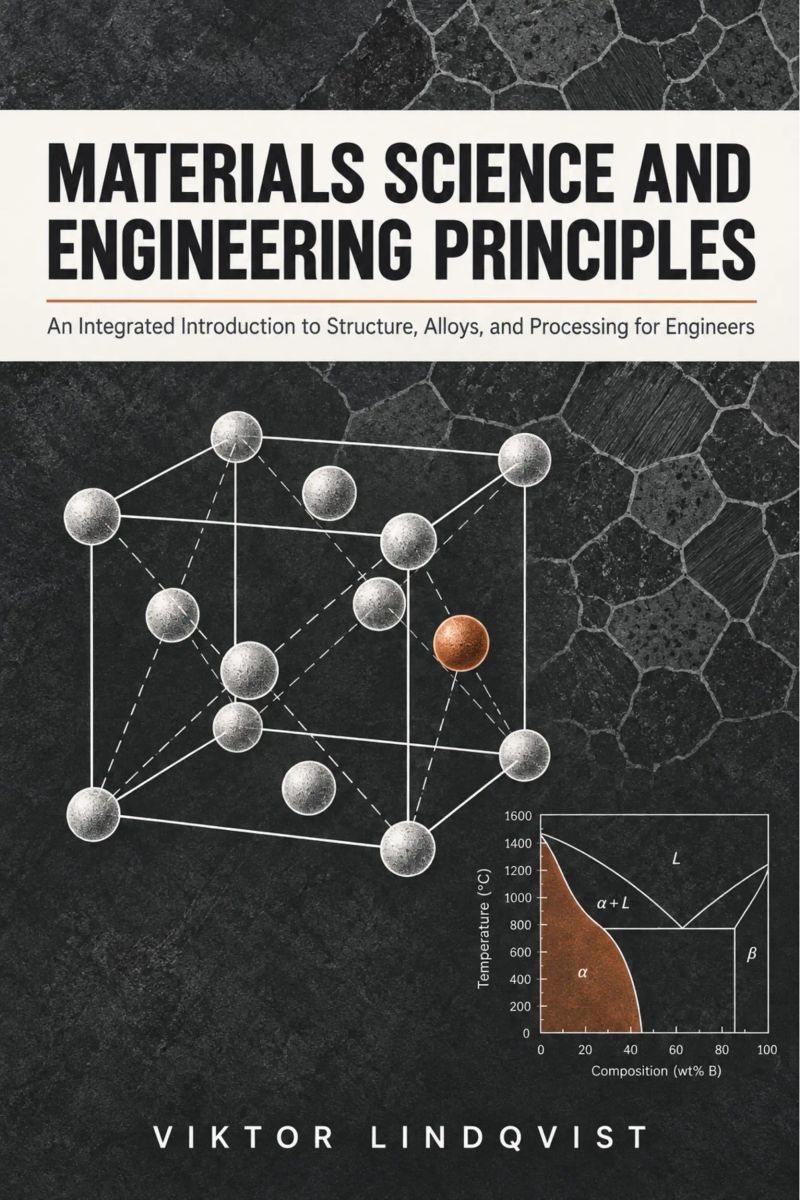
Materials Science and Engineering Principles
An Integrated Introduction to Structure, Alloys, and Processing for EngineersBy Viktor Lindqvist


Length15h 32m
About this audiobook
Structure decides everything. This book keeps that connection in view from the first bond to the final material selection.
Why does quenched steel crack, and annealed copper bend forever? Because the arrangement of atoms, defects, and phases controls every property an engineer can measure. Materials Science and Engineering Principles builds that understanding as one continuous argument rather than a catalogue of facts. You begin with atomic bonding, crystal structures, and crystallography, then examine imperfections and diffusion before using dislocations to explain yielding, work hardening, and every strengthening mechanism in real use.
The middle of the book turns theory into practice. You read phase diagrams with the lever rule, take the iron-carbon system through transformation curves into practical heat treatment, and follow the same logic into cast irons, aluminium alloys, ceramics, glasses, polymers, and composites. Failure chapters cover fracture toughness, fatigue crack growth, and creep, while the closing chapters address corrosion mechanisms, protection methods, and a structured procedure for choosing a material and its process together. Worked numbers appear throughout, from diffusion depths to laminate stiffness, so the equations stay tied to components you can picture.
What you will learn
• How atomic bonding and crystal structure set the stage for every later property
• How point, line, and planar defects control real material behaviour
• How diffusion drives processes from carburising to sintering
• How dislocations explain yielding, work hardening, and strengthening mechanisms
• How to read phase diagrams and apply the lever rule with confidence
• How iron-carbon transformation curves translate into practical heat treatment
• How fracture toughness, fatigue crack growth, and creep lead to failure
• How ceramics, glasses, polymers, and composites differ in structure and processing
• How to select a material and its manufacturing process as one integrated decision
Written for engineering undergraduates and design engineers specifying materials, this book assumes only introductory chemistry and mechanics. Each chapter connects structure to processing to performance, giving you the reasoning to predict behaviour instead of memorising tables. Whether you are preparing for a materials course, supporting a design project, or returning to the subject from industry, the integrated approach helps you choose alloys, treatments, and processes with evidence rather than habit.
Audiobook details
GenreTechnology
Length15 hrs 32 mins
Narrated byListen with 1,000+ voices
FormateBook with Audio
Publish dateSep 27, 2026
LanguageEnglish
Table of contents
1Foreword
2Preface
3About This Book
4Chapter 1: Atomic Bonding and the Structure of Solids
51.1 The Nature of Interatomic Bonds
Show all chaptersShow less
61.2 Primary Bonding: Ionic, Covalent and Metallic
71.3 Secondary Bonding and Mixed Bond Character
81.4 Bond Type and the Properties It Controls
91.5 From Atoms to Engineering Materials
10Chapter 2: Crystal Structures and Crystallography
112.1 Lattice, Basis and Unit Cells
122.2 Metallic Crystal Structures and Packing Factors
132.3 Crystallographic Directions and Planes
142.4 Planar and Linear Density, and Polymorphism
152.5 X-Ray Diffraction and Phase Identification
16Chapter 3: Imperfections in Solids
173.1 Point Defects and Equilibrium Vacancy Concentration
183.2 Solid Solutions and Composition Measures
193.3 Dislocations and Their Motion
203.4 Stacking Faults, Twin Boundaries and Grain Boundaries
213.5 Microscopy and Microstructural Observation
22Chapter 4: Diffusion
234.1 Diffusion Mechanisms and Fick’s First Law
244.2 Fick’s Second Law and Transient Diffusion
254.3 Temperature Dependence and Diffusion Paths
264.4 Diffusion-Controlled Processing
27Chapter 5: Mechanical Properties
285.1 Stress, Strain and the Tensile Test
295.2 True Stress, True Strain and Ductility
305.3 Elastic Properties and Their Anisotropy
315.4 Hardness and Its Relations to Strength
325.5 Impact Toughness and the Ductile-to-Brittle Transition
33Chapter 6: Strengthening Mechanisms
346.1 Grain Boundary Strengthening
356.2 Solid Solution Hardening
366.3 Strain Hardening and the Dislocation Density Relation
376.4 Recovery, Recrystallization and Grain Growth
386.5 Precipitation Hardening and Age Hardening
39Chapter 7: Failure
407.1 Ductile and Brittle Fracture
417.2 Fracture Toughness and Design Against Fracture
427.3 Fatigue: Initiation, Life and Crack Growth
437.4 Creep and Life Prediction
44Chapter 8: Phase Diagrams
458.1 Solubility Limits, Phases and the Gibbs Phase Rule
468.2 Binary Isomorphous and Eutectic Systems, and the Lever Rule
478.3 Peritectic and Other Invariant Reactions
488.4 The Iron-Iron Carbide Diagram
49Chapter 9: Phase Transformations and Heat Treatment
509.1 Nucleation and Growth Kinetics

Hands of TimeRebecca Struthers8h 8m4.4 (1.3K)$26 · $0.00

Never Lost AgainBill Kilday10h 1m4.4 (805)$29 · $0.00

How the Internet HappenedBrian McCullough13h 28m4.3 (2.7K)$23 · $0.00

Collected Writings of Nikola TeslaNikola Tesla, Thomas Commerford Martin21h 50m4.3 (1.7K)$1 · $0.00

Just AspireAjai Chowdhry9h 13m4.4 (260)$29 · $0.00

The Little Book of AliensAdam Frank8h 20m4.3 (1.3K)$26 · $0.00

The inventions, researches and writings of Nikola Tesla (Annotated)Thomas Commerford Martin16h 59m4.3 (1.3K)$2 · $0.00

KargilV.P. Malik15h 18m4.3 (2K)$24 · $0.00

Experiments with Alternating CurrentsNikola Tesla9h 6m4.3 (874)$1 · $0.00

Fire on the HorizonTom Shroder, John Konrad8h 23m4.3 (858)$26 · $0.00

The Smell of Kerosene (Annotated)National Aeronautics and Space Administration, Donald L. Mallick, Peter W. Merlin11h 32m4.3 (523)$2 · $0.00

The Boy Who Harnessed the WindWilliam Kamkwamba, Bryan Mealer10h 5m4.2 (78.9K)$29 · $0.00

Across the Airless WildsEarl Swift10h 8m4.3 (1.3K)$29 · $0.00

Console WarsBlake J. Harris20h 41m4.2 (13.7K)$46 · $0.00

Improvised Munitions HandbookU.S. Department of Defense4h 49m4.3 (1.6K)$1.99 · $0.00

Escaping GravityLori Garver10h 54m4.2 (2.2K)$20 · $0.00

Wireless WarsJonathan Pelson8h 2m4.3 (418)$20 · $0.00

Let There Be WaterSeth M. Siegel8h 36m4.2 (2.3K)$20 · $0.00

The PerfectionistsSimon Winchester11h 46m4.2 (9.9K)$29 · $0.00

Rethinking NarcissismDr. Craig Malkin6h 7m4.2 (3.4K)$24 · $0.00
You may also like

I am learning PunjabiJM Gardner3h 55m4.4 (113)$18 · $0.00

Triple Your Personal ProductivitySteve Pavlina13m4.0 (158)$4 · $0.00

Structural Vibrations and WavesNoriko Takasugi13h 58m$90

Ladder Logic with Studio 5000Pavel Novotny14h 54m$85

How to Make Money Flipping Fitness Equipment - How to Source Bulky Gear Below Market Value, Refurbish It, and Profit from Local DemandJACK FLIPWELL8h 23m$7.90 · $0.00

ARE 5.0 Architect Registration Exam Study GuideMarie Peterson10h 1m$10

Workbook IntermediateElza Lima4h 16m$16 · $0.00

The Story of Paper-makingFrank O. Butler3h 17m$2 · $0.00

An Introduction to Machine Drawing and DesignDavid Allan Low3h 13m$2 · $0.00

Gas Burners Old and NewOwen Merriman3h 1m$2 · $0.00

A complete guide drawing to for children aged 5-10Liliana Grisa, Matteo Viganò16m$9 · $0.00

The Silversmith's Handbook (Annotated)George E. Gee5h 19m$2 · $0.00

Disc GolfHarper B. Montgomery2h 50m$2.30 · $0.00

SoftballMarcus B. Cole31m$2.30 · $0.00

Activity-Based Budgeting UncoveredLuna Z. Rainstorm9h 38m$6.40 · $0.00
An Interactive In-Depth Study Guide to The Audacity ExperimentVere Bates1m$10.50 · $0.00

AP Chemistry Exam Study GuideMarie Peterson8h 41m$10

AP Physics 1 Exam Study GuideMarie Peterson9h 31m$10
Competitive Programming in C++Tessa Larkin7h 44m$5 · $0.00

Arduino Electronics with CMarisol Vasquez7h 17m$5 · $0.00