
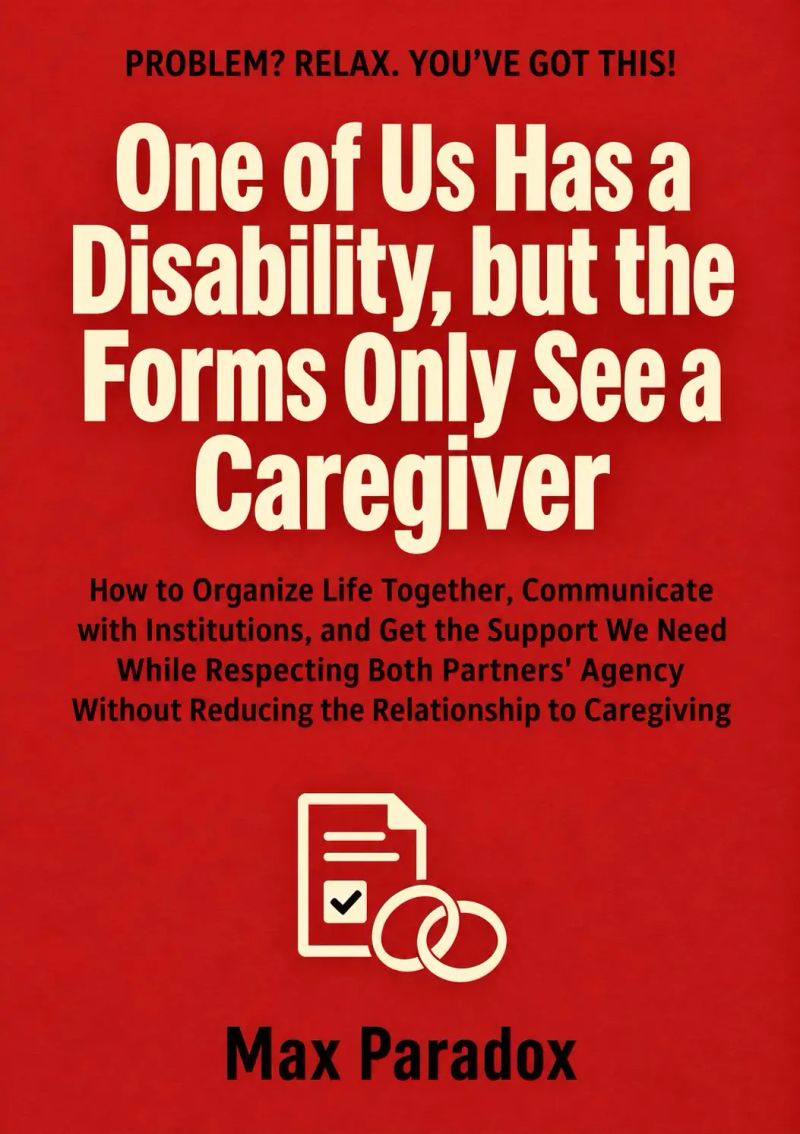
One of Us Has a Disability, but the Forms Only See a Caregiver - How to Organize Life Together, Communicate with Institutions, and Get the Support We Need While Respecting Both Partners' Agency Without Reducing the Relationship to Caregiving
By Max Paradox


Length6h 46m
About this audiobook
You're partners in life. Unfortunately, the paperwork has decided that one of you is a caregiver and the other is a full-time responsibility. Apparently, love now requires an administrative job title.
When one partner has a disability, everyday life can involve additional planning, practical assistance, inaccessible services, and conversations with institutions that seem determined to misunderstand your relationship.
One person is addressed as the caregiver. The other becomes the person being cared for. Somewhere between the appointments, forms, and endless phone calls, two independent personalities risk disappearing behind a convenient pair of labels.
But your relationship is not a care facility. And neither of you signed up to become the permanent administrator of somebody else's existence.
In One of Us Has a Disability, but the Forms Only See a Caregiver, Max Paradox tackles the practical and emotional challenges of organizing life together while respecting both partners' agency, preferences, responsibilities, and personal ambitions.
With sharp observational humor, realistic examples, and down-to-earth guidance, this book explores how couples can manage necessary support without allowing assistance to turn into control or ordinary partnership into an endless administrative assignment.
Inside, you'll discover how to:
Distinguish helpful assistance from making decisions on someone else's behalf.
Communicate with healthcare providers, public institutions, and service organizations without allowing one partner's voice to disappear.
Share household responsibilities and financial decisions while respecting different abilities and resources.
Establish personal boundaries without treating every disagreement as a failure of love.
Find and organize outside support without inviting your entire extended family to manage your private life.
Make your home and everyday routines more accessible and practical.
Navigate changing support needs, unexpected disruptions, and situations where the usual arrangements stop working.
Recognize the difference between genuine safety concerns and unnecessary restrictions on independence.
Protect privacy, personal freedom, friendships, careers, and ambitions.
Keep your relationship meaningful beyond appointments, paperwork, and practical responsibilities.
This is not a book promising that a positive attitude will make inaccessible buildings accessible or that excellent communication will persuade every institution to cooperate.
Real life contains financial limits, unavailable services, confusing procedures, exhaustion, and problems that no amount of determination can magically remove.
Instead, you'll find useful ways to identify the real problem, ask better questions, make informed decisions, and recognize when professional or external assistance is necessary.
The book also challenges two persistent assumptions: that receiving support means surrendering independence, and that loving someone means providing unlimited assistance without ever needing a break.
Both partners matter. Both have a right to personal goals, boundaries, privacy, and a life that includes something more interesting than discussing next week's appointments.
Whether you live with a disability, support a partner, or want to understand relationships involving disability more thoughtfully, this guide offers practical insight without pity, heroic stereotypes, or unrealistic promises.
Because one of you may need assistance, but neither of you should become a supporting character in your own relationship.
And if the next form still insists that one of you is simply "the caregiver," at least you'll know that a drop-down menu is not qualified to define your love life.
This publication was prepared using tools that support the creative process, including artificial intelligence solutions. The final concept, structure and editing are the responsibility of the author.
Audiobook details
GenreHealth and Wellness, Self-Help
Length6 hrs 46 mins
Narrated byListen with 1,000+ voices
FormateBook with Audio
Publish dateNov 9, 2026
LanguageEnglish
Table of contents
1INTRO
2Chapter 1 - When Your Relationship Disappears Behind the Word "Caregiver"
3Chapter 2 - Two Adults, Two Opinions, and the Right to Make Your Own Decisions
4Chapter 3 - The Form That Knows Your Relationship Better Than You Do
5Chapter 4 - The Full-Time Hero Who Never Applied for the Job
Show all chaptersShow less
6Chapter 5 - Saying No Without Saying I Don't Love You
7Chapter 6 - Help From Outside: Useful Support Without a Family Management Committee
8Chapter 7 - When Money Starts Making Decisions for Both of You
9Chapter 8 - A Relationship Is Not a Waiting Room
10Chapter 9 - Two People, One Appointment, and the Art of Being Heard
11Chapter 10 - When the Answer Is No, but Nobody Explains the Question
12Chapter 11 - A Home for Two, Not an Obstacle Course with Decorative Cushions
13Chapter 12 - When Tuesday Refuses to Follow the Plan
14Chapter 13 - In the Exam Room, You Are a Couple, but Only One of You Is the Patient
15Chapter 14 - Careers, Ambitions, and Why Disability Does Not Write Your Résumé
16Chapter 15 - Safe, but According to Whom? When Care and Independence Pull in Different Directions
17Chapter 16 - When Help Becomes Control: Recognizing the Line That Must Not Be Crossed
18Chapter 17 - When Both of You Need Help and the Support System Has Gone Missing
19Chapter 18 - Keeping Good Arrangements Alive After the Enthusiasm Wears Off
20Chapter 19 - You Are Not Responsible for Educating the Entire World
21Chapter 20 - Two People, One Life, and No Box for Everything That Matters

Mam dyplom z innego kraju, a tutaj zaczynam od „Proszę przynieść” - Jak przygotować dokumenty, rozpoznać właściwą ścieżkę uznawania kwalifikacji i zaplanować etapy wejścia do zawodu ze wsparciem odpowiednich instytucji bez wysyłania tego samego komplMax Paradox6h 10m$5.10

I Reported an Irregularity and Suddenly I'm the Problem - How to Organize Documentation, Protect Confidentiality, and Choose Independent Help After Reporting Irregularities in an Organization Without Having to Handle the Entire Investigation AloneMax Paradox6h 51m$5.10
I Work Shifts, but My Family Lives in a Different Time Zone - How to Plan Household Chores, Stay Connected, and Recover Around a Changing Shift Schedule, and Negotiate the Working Conditions You Need Without Comparing Your Week to a Nine-to-Five JobMax Paradox6h 31m$5.10
Someone Got Something in My Name, and I Wasn't Even in the Store - How to Organize Your Response to Suspected Identity Theft, Preserve Evidence and Manage Communications with Institutions, and Track the Case Without Repeating Everything to Every HelpMax Paradox6h 33m$5.10

Mam sąsiada z innego kraju i więcej obaw niż wspólnych słów - Jak nawiązywać zwyczajne kontakty, uzgadniać sprawy budynku i sprawdzać własne założenia w wielokulturowym sąsiedztwie bez robienia z różnicy pochodzenia gotowego konfliktuMax Paradox6h 9m$5.10

Ktoś wziął coś na moje nazwisko, a ja nawet nie byłem w sklepie - Jak uporządkować działania po podejrzeniu kradzieży tożsamości, zabezpieczać dowody i kontakt z instytucjami oraz śledzić sprawę bez chaotycznego powtarzania wszystkiego każdej infolinMax Paradox5h 53m$5.10

I Want to Sell My Own Food, Not Collect Inspection Surprises - How to Prepare Questions for the Right Authorities, Plan Costs, Organize a Small Food Business, and Verify Requirements Before Launch Without Treating a Family Recipe as a Complete BusineMax Paradox6h 45m$5.10

I'm the Only One Without a Partner on the Family Vacation - How to Agree on the Destination, Costs, and Responsibilities in a Group Made Up Mostly of Couples and Families, and Plan Your Own Part Without Becoming the Unpaid Helper or the Permanent RolMax Paradox6h 30m$5.10

We're a Couple, But We Don't Want to Live Together - How to Build an Intentional Relationship Across Two Homes, Share Time and Responsibility, and Talk to Others Without Treating One Address as the Only Proof of CommitmentMax Paradox6h 42m$5.10

Ktoś chce kupić moją firmę, a ja nie wiem, co właściwie sprzedaję - Jak przygotować dane i pytania do doradców, rozumieć etapy rozmów oraz porównywać warunki wyjścia z małego biznesu bez mylenia pierwszej oferty z gotowym przelewemMax Paradox6h 19m4.9 (29)$5.10

The City Is Changing, but My Neighborhood Missed the Consultations - How to Check Local Plans, Take Part in Public Consultations, and Build Well-Founded Arguments About Public Space Instead of Finding Out Only After the Fence Goes UpMax Paradox6h 51m$5.10

Internet sprzedaje moje prace, chociaż mnie nikt nie pytał - Jak dokumentować nieuprawnione wykorzystanie własnych materiałów, porządkować zasady licencjonowania i dobierać pomoc specjalistyczną bez samodzielnego ścigania całego internetuMax Paradox6h 10m$5.10

Someone Close to Me Is Getting Sober, but I'm Still Living on High Alert - How to Work With Available Professional Support to Clarify Your Boundaries, Rebuild Everyday Agreements, and Return Responsibility to the Person in Recovery Without Taking OveMax Paradox6h 34m$5.10

Jestem jedyną osobą bez partnera na rodzinnych wakacjach - Jak uzgadniać miejsce, koszty i podział obowiązków w grupie złożonej głównie z par i rodzin oraz organizować własny udział bez przyjmowania roli darmowego pomocnika i wiecznego dostawianego łMax Paradox6h 23m$5.10

Miasto się zmienia, a moje osiedle nie było na konsultacjach - Jak sprawdzać lokalne plany, uczestniczyć w konsultacjach i zbierać rzeczowe argumenty w sprawach przestrzeni publicznej bez dowiadywania się o wszystkim dopiero po ustawieniu płotuMax Paradox6h 21m$5.10

I Have an ROD Allotment and Run a Tiny Country with a Garden Shed - How to Organize the Season, Manage Water and Expenses, Share Responsibility for the Plot, and Check the Rules Before the First DisputeMax Paradox6h 28m$5.10

Faktura jest po terminie, a klient nadal pisze „Już puszczam” - Jak porządkować należności, dokumentować ustalenia i stopniować działania z pomocą odpowiednich specjalistów bez finansowania działalności klienta własną cierpliwościąMax Paradox6h 13m$5.10

I Want to Help by Donating Things, but Nobody Needs My Old Printer - How to Check What Organizations and Recipients Actually Need, Prepare Useful Donations, and Plan the Handover Without Passing the Costs of Your Own Decluttering on to OthersMax Paradox6h 42m$5.10

Chcemy pomóc sąsiadce, ale nie wiemy, kto ma klucze - Jak za zgodą zainteresowanych zorganizować sąsiedzką sieć drobnej pomocy, ustalić kontakty i odpowiedzialności oraz chronić prywatność bez improwizowanego sztabu opiekiMax Paradox6h$5.10

The Lost VoiceGreta Morgan8h 30m4.7 (285)$26 · $0.00

Healthy Kids, Happy KidsElisa Song14h 18m4.6 (760)$33 · $0.00

Eat It!Jordan Syatt, Michael Vacanti4h 40m4.6 (1.5K)$20 · $0.00

Consent Laid BareChanel Contos7h 11m4.5 (1.7K)$24 · $0.00

How to Make Disease DisappearRangan Chatterjee5h 26m4.5 (3.5K)$24 · $0.00

The Complete Herbal (Annotated)Nicholas Culpeper29h 8m4.5 (1.4K)$2 · $0.00

A Plague Upon Our HouseScott W. Atlas MD10h 37m4.5 (3.4K)$20 · $0.00

The Gift of TherapyIrvin Yalom7h 39m4.5 (38.8K)$26 · $0.00

EarlySarah DiGregorio9h 47m4.5 (1.3K)$29 · $0.00

Bottle of LiesKatherine Eban14h 25m4.4 (12K)$33 · $0.00
The 36-Hour DayNancy L. Mace, Peter V. Rabins17h 13m4.4 (9.2K)$28 · $0.00

FlooredSara Reardon10h 36m4.5 (1K)$29 · $0.00

Radical RemissionKelly A. Turner9h 26m4.4 (8.1K)$29 · $0.00

The Sinatra SolutionStephen T. Sinatra MD9h4.5 (899)$20 · $0.00

The Songaminute ManSimon McDermott6h 12m4.5 (280)$24 · $0.00

Sometimes BrilliantLarry Brilliant12h 27m4.5 (954)$29 · $0.00

Live Your LifeAmanda Kloots, Anna Kloots10h 54m4.4 (13.7K)$29 · $0.00

All in Her HeadElizabeth Comen13h 25m4.4 (18.2K)$33 · $0.00

The Wisdom of Your BodyHillary McBride9h 14m4.4 (6.7K)$29 · $0.00

The Alzheimer's SolutionDean Sherzai, Ayesha Sherzai9h 47m4.4 (1.9K)$29 · $0.00
Learning to PrayJames Martin13h 24m4.5 (3.4K)$33 · $0.00

Forever BoyKate Swenson9h 27m4.7 (5K)$29 · $0.00

You Are Worth ItKyle Carpenter, Don Yaeger8h 53m4.7 (4.8K)$29 · $0.00

The Happiest Man on EarthEddie Jaku3h 48m4.6 (178K)$7 · $0.00

Finding MeViola Davis9h 15m4.6 (256.4K)$29 · $0.00

Spiritual AnatomyDaaji Kamlesh D. Patel9h 47m4.7 (319)$29 · $0.00

The Dangerous Truth about Today’s MarijuanaLaura Stack CSP, MBA9h 57m4.7 (385)$20 · $0.00

The Gospel according to Spiritualism (Translated)Allan Kardec14h 39m4.6 (3.9K)$5.70 · $0.00

Birdie & HarlowTaylor Wolfe7h 50m4.6 (6.5K)$26 · $0.00

CrossroadsKaleb Dahlgren7h 56m4.6 (4.9K)$26 · $0.00

Life on the BridgeKaelynn Partlow5h 40m4.6 (1.1K)$24 · $0.00

Keep Your Love OnDanny Silk9h 4m4.6 (8.1K)$10 · $0.00

The Tao of Joy Every DayDerek Lin10h 24m4.6 (762)$20 · $0.00
UndividedVicky Beeching9h 2m4.6 (1.3K)$29 · $0.00

HE CAN WHO THINKS HE CAN & OTHER BOOKS ON SUCCESSOrison Swett Marden5h 54m4.6 (1.2K)$0.99 · $0.00
Level UpRob Dial7h 42m4.6 (3.3K)$26 · $0.00

Burn the HaystackJennie Young, PhD9h 30m4.6 (543)$29 · $0.00

ACRES OF DIAMONDS: Our Every-day Opportunities (Wisdom & Empowerment Series) (Annotated)Russell Conwell2h 26m4.6 (1K)$2 · $0.00

Good InsideBecky Kennedy9h 55m4.5 (59.3K)$29 · $0.00
The Lost VoiceGreta Morgan8h 30m4.7 (285)$26 · $0.00