
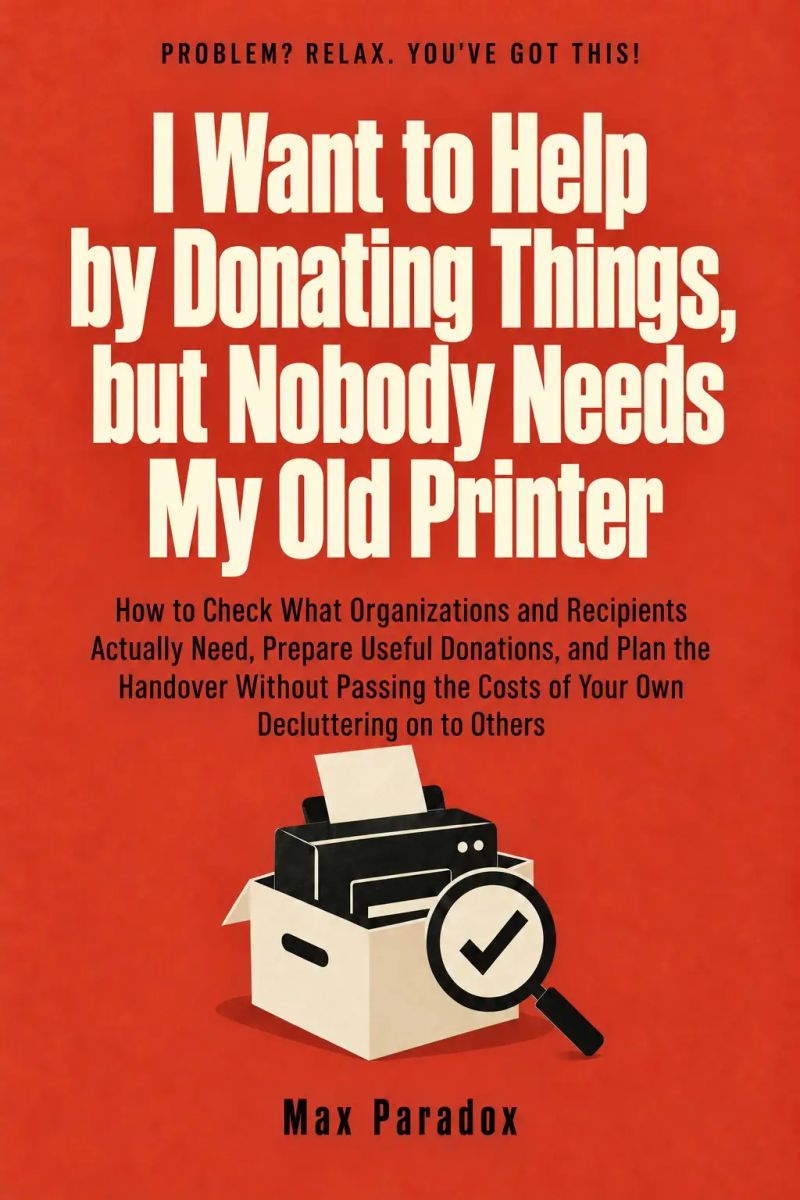
I Want to Help by Donating Things, but Nobody Needs My Old Printer - How to Check What Organizations and Recipients Actually Need, Prepare Useful Donations, and Plan the Handover Without Passing the Costs of Your Own Decluttering on to Others
By Max Paradox


Length6h 42m
About this audiobook
It starts with a perfectly innocent thought: Someone could use this. A few minutes later, you're standing beside an aging printer, three boxes of mystery cables, and a chair with one highly independent wheel, wondering which charity will be lucky enough to receive them.
Unfortunately, people and organizations don't necessarily need what happens to be taking up space in your home. A gift may be free to accept but expensive to transport, repair, store, operate, or eventually dispose of. Good intentions are wonderful. They are not, however, a substitute for working equipment, suitable supplies, or a place to put a twelve-foot cabinet.
In I Want to Help by Donating Things, but Nobody Needs My Old Printer, Max Paradox turns the familiar drama of decluttering with a charitable conscience into a practical, sharply funny guide to giving things away without making them somebody else's problem.
You'll learn how to discover what a recipient genuinely needs before offering a donation, distinguish useful secondhand goods from incomplete or unsuitable equipment, and choose the right destination. Sometimes that destination is a charity. Sometimes it's a neighbor, a specialist hobbyist, a resale channel, or an appropriate recycling service. An item doesn't acquire a humanitarian mission merely because you don't want it anymore.
The book follows the entire donation journey, from examining an object's condition and hidden running costs to writing an honest description, confirming acceptance, assembling coherent kits, and arranging safe collection or delivery. It explores why polite interest isn't a firm agreement, why a free machine can have remarkably expensive habits, and why six useful objects do not automatically become a useful set when placed in a decorative box.
Giving also creates awkward human situations. What happens when too many people want a limited number of items? When an organization declines your carefully prepared gift? When a donation fails, an emergency appeal changes overnight, or your helpful afternoon quietly turns into an unpaid permanent position? These chapters offer realistic ways to handle disappointment, privacy, fairness, boundaries, and changing needs without abandoning generosity or appointing yourself the Minister of Unwanted Household Objects.
You'll also discover why delivery photos aren't proof of impact, why last year's successful donation drive may be unnecessary this year, and how to build manageable habits that keep clutter from returning. There are practical explanations, recognizable situations, and humor directed at our peculiar excuses rather than the people who need assistance.
This isn't a lecture about owning fewer things or an instruction to donate everything you possess. You can keep meaningful belongings, sell valuable ones, and acknowledge when reuse is not realistic. The goal is to match appropriate objects with people who genuinely want and can use them, while respecting everyone's time, money, space, and dignity.
Your old printer may never become a community hero. Helping wisely is knowing when that's perfectly fine.
This publication was prepared using tools that support the creative process, including artificial intelligence solutions. The final concept, structure and editing are the responsibility of the author.
Audiobook details
GenrePsychology
Length6 hrs 42 mins
Narrated byListen with 1,000+ voices
FormateBook with Audio
Publish dateNov 9, 2026
LanguageEnglish
Table of contents
1INTRO
2Chapter 1 - Good Intentions Are Not a Delivery Service
3Chapter 2 - Stop Guessing What People Need
4Chapter 3 - It Still Works, So Why Doesn't Anybody Want It?
5Chapter 4 - The Donation Shortcut That Creates More Work Than It Saves
Show all chaptersShow less
6Chapter 5 - The Donation Drive That Collected Everything Except What Was Needed
7Chapter 6 - Too Valuable to Throw Away, Too Sentimental to Give Away
8Chapter 7 - Not Every Useful Thing Belongs at a Charity
9Chapter 8 - The Free Gift That Comes with Monthly Payments
10Chapter 9 - The Donation Description That Saves Everyone a Detective Investigation
11Chapter 10 - Interested Is Not the Same as Agreed
12Chapter 11 - Donations Don't Have Wings: How to Pack, Move, and Deliver Things Without Disaster
13Chapter 12 - Who Gets the Last One? Fair Donations Without a Contest of Hardship
14Chapter 13 - A Complete Gift: Why Five Useful Things Don't Always Make a Useful Kit
15Chapter 14 - Delivered Doesn't Mean Used: Finding Out Whether Your Donation Actually Helped
16Chapter 15 - When Help Is Urgent: Why a Crisis Is the Worst Time for Random Donations
17Chapter 16 - When a Donation Goes Wrong: Fixing the Problem Without Starting a Feud
18Chapter 17 - You Can't Save Every Item: Helping When Time, Money, and Patience Run Out
19Chapter 18 - Six Months Later, the Clutter Is Back: Making Responsible Giving a Habit
20Chapter 19 - We've Always Done It This Way: When a Good Donation Tradition Stops Being Useful
21Chapter 20 - You Don't Have to Rescue Every Object: Helping Wisely Without a Rulebook
Someone Got Something in My Name, and I Wasn't Even in the Store - How to Organize Your Response to Suspected Identity Theft, Preserve Evidence and Manage Communications with Institutions, and Track the Case Without Repeating Everything to Every HelpMax Paradox6h 33m$5.10

Mam sąsiada z innego kraju i więcej obaw niż wspólnych słów - Jak nawiązywać zwyczajne kontakty, uzgadniać sprawy budynku i sprawdzać własne założenia w wielokulturowym sąsiedztwie bez robienia z różnicy pochodzenia gotowego konfliktuMax Paradox6h 9m$5.10

Ktoś wziął coś na moje nazwisko, a ja nawet nie byłem w sklepie - Jak uporządkować działania po podejrzeniu kradzieży tożsamości, zabezpieczać dowody i kontakt z instytucjami oraz śledzić sprawę bez chaotycznego powtarzania wszystkiego każdej infolinMax Paradox5h 53m$5.10

I Want to Sell My Own Food, Not Collect Inspection Surprises - How to Prepare Questions for the Right Authorities, Plan Costs, Organize a Small Food Business, and Verify Requirements Before Launch Without Treating a Family Recipe as a Complete BusineMax Paradox6h 45m$5.10

I'm the Only One Without a Partner on the Family Vacation - How to Agree on the Destination, Costs, and Responsibilities in a Group Made Up Mostly of Couples and Families, and Plan Your Own Part Without Becoming the Unpaid Helper or the Permanent RolMax Paradox6h 30m$5.10

We're a Couple, But We Don't Want to Live Together - How to Build an Intentional Relationship Across Two Homes, Share Time and Responsibility, and Talk to Others Without Treating One Address as the Only Proof of CommitmentMax Paradox6h 42m$5.10

Ktoś chce kupić moją firmę, a ja nie wiem, co właściwie sprzedaję - Jak przygotować dane i pytania do doradców, rozumieć etapy rozmów oraz porównywać warunki wyjścia z małego biznesu bez mylenia pierwszej oferty z gotowym przelewemMax Paradox6h 19m$5.10

The City Is Changing, but My Neighborhood Missed the Consultations - How to Check Local Plans, Take Part in Public Consultations, and Build Well-Founded Arguments About Public Space Instead of Finding Out Only After the Fence Goes UpMax Paradox6h 51m$5.10

Internet sprzedaje moje prace, chociaż mnie nikt nie pytał - Jak dokumentować nieuprawnione wykorzystanie własnych materiałów, porządkować zasady licencjonowania i dobierać pomoc specjalistyczną bez samodzielnego ścigania całego internetuMax Paradox6h 10m$5.10

Someone Close to Me Is Getting Sober, but I'm Still Living on High Alert - How to Work With Available Professional Support to Clarify Your Boundaries, Rebuild Everyday Agreements, and Return Responsibility to the Person in Recovery Without Taking OveMax Paradox6h 34m$5.10

Jestem jedyną osobą bez partnera na rodzinnych wakacjach - Jak uzgadniać miejsce, koszty i podział obowiązków w grupie złożonej głównie z par i rodzin oraz organizować własny udział bez przyjmowania roli darmowego pomocnika i wiecznego dostawianego łMax Paradox6h 23m$5.10

Miasto się zmienia, a moje osiedle nie było na konsultacjach - Jak sprawdzać lokalne plany, uczestniczyć w konsultacjach i zbierać rzeczowe argumenty w sprawach przestrzeni publicznej bez dowiadywania się o wszystkim dopiero po ustawieniu płotuMax Paradox6h 21m$5.10

I Have an ROD Allotment and Run a Tiny Country with a Garden Shed - How to Organize the Season, Manage Water and Expenses, Share Responsibility for the Plot, and Check the Rules Before the First DisputeMax Paradox6h 28m$5.10

Faktura jest po terminie, a klient nadal pisze „Już puszczam” - Jak porządkować należności, dokumentować ustalenia i stopniować działania z pomocą odpowiednich specjalistów bez finansowania działalności klienta własną cierpliwościąMax Paradox6h 13m$5.10

Chcemy pomóc sąsiadce, ale nie wiemy, kto ma klucze - Jak za zgodą zainteresowanych zorganizować sąsiedzką sieć drobnej pomocy, ustalić kontakty i odpowiedzialności oraz chronić prywatność bez improwizowanego sztabu opiekiMax Paradox6h$5.10

A Customer Gave Me One Star, and Now My Whole Day Is One Star - How to Respond to Public Reviews, Separate Legitimate Complaints from Abuse, and Improve Customer Service Without Turning Your Business Profile into a Personal BattlegroundMax Paradox6h 49m$5.10

We Want Shared Tools, Not a Shared Fight Over the Drill - How to Organize Neighborhood Tool Sharing, Arrange Reservations and Repair Responsibilities, and Decide Whether Joint Purchases Are Worth It Without Creating a Library of Lost ItemsMax Paradox6h 24m$5.10

I Have a Neighbor from Another Country and More Worries Than Words We Share - How to Make Everyday Connections, Agree on Building Matters, and Question Your Own Assumptions in a Multicultural Neighborhood Without Turning Different Origins into an AutMax Paradox6h 31m$5.10

We Love Each Other, But We Experience Faith Differently - How to Talk About Religious Practices, Family Celebrations, and Raising Children as a Couple with Different Religious Beliefs Without Trying to Convert Your Partner Whenever an Important DecisMax Paradox6h 54m$5.10

Matters of the HeartJacinta Nampijinpa Price9h 35m4.8 (359)$29 · $0.00

Black AF HistoryMichael Harriot15h 43m4.7 (14.6K)$33 · $0.00

Bad Fat Black GirlSesali Bowen6h 32m4.7 (2.8K)$24 · $0.00

Invisible StormJason Kander6h 48m4.7 (3.2K)$24 · $0.00

I Am The StormJanice Dean9h4.6 (1.5K)$8 · $0.00

On Democracies and Death CultsDouglas Murray10h 38m4.6 (6.5K)$29 · $0.00

TerraformPropaganda5h 39m4.7 (594)$24 · $0.00

Southern Horrors: Lynch Law in All Its Phases (Annotated)Ida B. Wells-Barnett2h 44m4.6 (1.3K)$2 · $0.00

Hour of the HeartIrvin D. Yalom, Benjamin Yalom8h 19m4.6 (2.3K)$26 · $0.00

Braving the TruthRachel Held Evans11h 31m4.7 (359)$29 · $0.00
Level UpRob Dial7h 42m4.6 (3.3K)$26 · $0.00

As a JewSarah Hurwitz8h 36m4.6 (1.2K)$26 · $0.00

Saint Joan (Annotated)George Bernard Shaw6h 20m4.6 (1.2K)$1.20 · $0.00

Burn the HaystackJennie Young, PhD9h 30m4.6 (543)$29 · $0.00

Woman and the New Race (Annotated)Margaret Sanger6h 30m4.6 (1K)$1.99 · $0.00

Good InsideBecky Kennedy9h 55m4.5 (59.3K)$29 · $0.00

The Mis-Education of the NegroCarter Godwin Woodson5h 4m4.5 (29.4K)$1.20 · $0.00

Du Bois: EssaysW.E.B. Du Bois6h 22m4.6 (1.5K)$1 · $0.00

The North American Indian (Illustrated Edition)Edward S. Curtis, Frederick Webb Hodge5h 59m4.6 (1.4K)$2 · $0.00

Valley of the BirdtailAndrew Stobo Sniderman, Douglas Sanderson10h 1m4.6 (2.4K)$29 · $0.00