
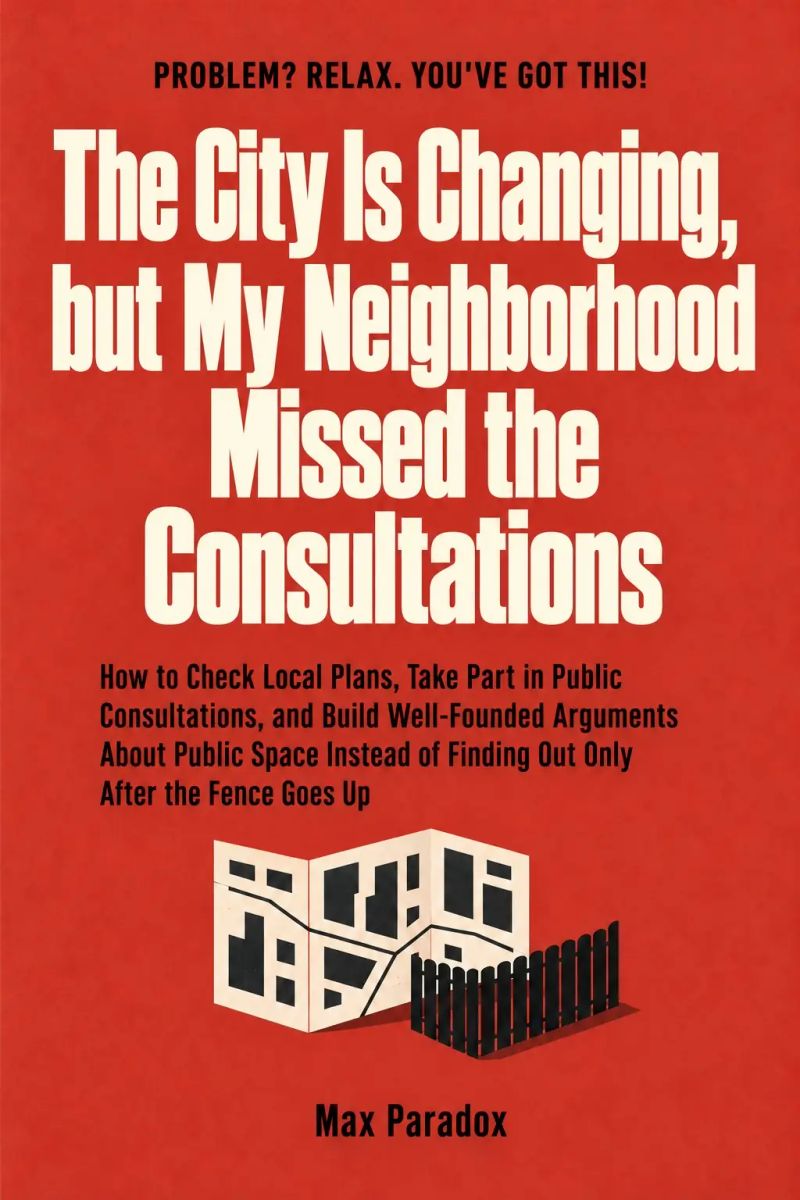
The City Is Changing, but My Neighborhood Missed the Consultations - How to Check Local Plans, Take Part in Public Consultations, and Build Well-Founded Arguments About Public Space Instead of Finding Out Only After the Fence Goes Up
By Max Paradox

Length6h 51m
About this audiobook
Your neighborhood is changing. Apparently, everyone received the memo except you.
One morning, you discover mysterious markings on the pavement. A week later, someone mentions a development proposal. Then a construction fence appears, and the neighborhood group erupts into an emergency discussion involving seventeen theories, three petitions, and a person who believes typing in capital letters constitutes legal representation.
Sound familiar?
In The City Is Changing, but My Neighborhood Missed the Consultations, Max Paradox takes you behind the confusing language of urban planning, local government decisions, and public consultations. With sharp observational humor and practical explanations, he shows you how to understand what is happening around you before your only remaining contribution is asking the excavator operator why nobody consulted you.
This is a guide for ordinary residents who care about their surroundings but have neither the time nor the ambition to become full-time municipal investigators.
You'll learn how to find relevant local plans, recognize the difference between an early proposal and an approved decision, and understand which documents actually matter. You'll discover how public consultations work, what questions to ask at meetings, and why delivering a passionate speech does not necessarily mean you've submitted a formal comment.
The book also explains how to turn frustration into a useful argument. Instead of announcing that a proposal will destroy the neighborhood, you'll learn to identify specific consequences, support concerns with appropriate evidence, and request changes that decision-makers can meaningfully consider.
You'll explore the practical side of public-space projects: reading design drawings without mistaking promotional images for promises, comparing alternative locations, understanding budget constraints, and collecting observations that reveal problems invisible on official maps.
And because neighborhood politics involves actual human beings, you'll also discover how to organize residents without creating a permanent committee dedicated to arguing about the committee itself.
What happens when the consultation deadline has passed? When an authority says the issue belongs to another department? When the construction machinery has already arrived? When neighbors have genuinely conflicting needs? The book examines these difficult situations without promising miraculous solutions or pretending that every disagreement can be settled through another petition.
You'll also learn how to check whether consultation influenced the final design, assess completed projects, recognize important early signals, and remain informed without spending every evening monitoring government websites.
This isn't a manual for defeating city hall. It's a practical, funny guide to becoming a more effective participant in decisions affecting the places you use every day.
You won't control every development, and you won't win every argument. But you can learn when to speak, what to ask, which evidence matters, and when an issue deserves your attention.
Because caring about your neighborhood shouldn't require sacrificing your entire life to a public consultation about pavement.
Know what's changing. Understand your options. Make your voice worth listening to.
This publication was prepared using tools that support the creative process, including artificial intelligence solutions. The final concept, structure and editing are the responsibility of the author.
Audiobook details
GenrePolitics and Government, Science and Nature
Length6 hrs 51 mins
Narrated byListen with 1,000+ voices
FormateBook with Audio
Publish dateNov 9, 2026
LanguageEnglish
Table of contents
1INTRO
2Chapter 1 - Your Neighborhood Has Plans of Its Own
3Chapter 2 - The Municipal Website Ate My Evening: Finding the Plans That Actually Matter
4Chapter 3 - Public Consultation: An Invitation to Speak, Not a Promise to Agree
5Chapter 4 - Two Thousand Signatures and Not One Usable Argument
Show all chaptersShow less
6Chapter 5 - The Rendering Is Beautiful. Unfortunately, People Have to Use the Place.
7Chapter 6 - Congratulations, You Founded a Neighborhood Committee. Now Please Don't Destroy It.
8Chapter 7 - The Deadline Was Yesterday: How to Stop Losing to the Calendar
9Chapter 8 - Not Our Department: Escaping the Bureaucratic Ping-Pong Championship
10Chapter 9 - From "This Is Outrageous" to a Comment Someone Can Actually Consider
11Chapter 10 - Three Options, One Budget, and a Room Full of People Who Know Best
12Chapter 11 - Evidence from the Pavement: How to Prove a Problem the Map Cannot See
13Chapter 12 - "There Is No Money": What It Really Takes to Fund a Good Idea
14Chapter 13 - We Came to Solve a Problem, Not Win an Argument
15Chapter 14 - "Partially Accepted": How to Find Out Whether Consultation Changed Anything
16Chapter 15 - The Excavators Have Arrived. Is It Really Too Late?
17Chapter 16 - Everybody Loves Public Space Until Somebody Else Uses It
18Chapter 17 - When Saving Your Neighborhood Starts Consuming Your Life
19Chapter 18 - After the Ribbon Cutting: Did the Improvement Actually Improve Anything?
20Chapter 19 - Before the Fence Goes Up: Building Your Own Early-Warning System
21Chapter 20 - Your City, Your Voice, and Your Actual Life

Someone Got Something in My Name, and I Wasn't Even in the Store - How to Organize Your Response to Suspected Identity Theft, Preserve Evidence and Manage Communications with Institutions, and Track the Case Without Repeating Everything to Every HelpMax Paradox6h 33m$5.10

Mam sąsiada z innego kraju i więcej obaw niż wspólnych słów - Jak nawiązywać zwyczajne kontakty, uzgadniać sprawy budynku i sprawdzać własne założenia w wielokulturowym sąsiedztwie bez robienia z różnicy pochodzenia gotowego konfliktuMax Paradox6h 9m$5.10

Ktoś wziął coś na moje nazwisko, a ja nawet nie byłem w sklepie - Jak uporządkować działania po podejrzeniu kradzieży tożsamości, zabezpieczać dowody i kontakt z instytucjami oraz śledzić sprawę bez chaotycznego powtarzania wszystkiego każdej infolinMax Paradox5h 53m$5.10

I Want to Sell My Own Food, Not Collect Inspection Surprises - How to Prepare Questions for the Right Authorities, Plan Costs, Organize a Small Food Business, and Verify Requirements Before Launch Without Treating a Family Recipe as a Complete BusineMax Paradox6h 45m$5.10

I'm the Only One Without a Partner on the Family Vacation - How to Agree on the Destination, Costs, and Responsibilities in a Group Made Up Mostly of Couples and Families, and Plan Your Own Part Without Becoming the Unpaid Helper or the Permanent RolMax Paradox6h 30m$5.10

We're a Couple, But We Don't Want to Live Together - How to Build an Intentional Relationship Across Two Homes, Share Time and Responsibility, and Talk to Others Without Treating One Address as the Only Proof of CommitmentMax Paradox6h 42m$5.10

Ktoś chce kupić moją firmę, a ja nie wiem, co właściwie sprzedaję - Jak przygotować dane i pytania do doradców, rozumieć etapy rozmów oraz porównywać warunki wyjścia z małego biznesu bez mylenia pierwszej oferty z gotowym przelewemMax Paradox6h 19m$5.10

Internet sprzedaje moje prace, chociaż mnie nikt nie pytał - Jak dokumentować nieuprawnione wykorzystanie własnych materiałów, porządkować zasady licencjonowania i dobierać pomoc specjalistyczną bez samodzielnego ścigania całego internetuMax Paradox6h 10m$5.10

Someone Close to Me Is Getting Sober, but I'm Still Living on High Alert - How to Work With Available Professional Support to Clarify Your Boundaries, Rebuild Everyday Agreements, and Return Responsibility to the Person in Recovery Without Taking OveMax Paradox6h 34m$5.10

Jestem jedyną osobą bez partnera na rodzinnych wakacjach - Jak uzgadniać miejsce, koszty i podział obowiązków w grupie złożonej głównie z par i rodzin oraz organizować własny udział bez przyjmowania roli darmowego pomocnika i wiecznego dostawianego łMax Paradox6h 23m$5.10

Miasto się zmienia, a moje osiedle nie było na konsultacjach - Jak sprawdzać lokalne plany, uczestniczyć w konsultacjach i zbierać rzeczowe argumenty w sprawach przestrzeni publicznej bez dowiadywania się o wszystkim dopiero po ustawieniu płotuMax Paradox6h 21m$5.10

I Have an ROD Allotment and Run a Tiny Country with a Garden Shed - How to Organize the Season, Manage Water and Expenses, Share Responsibility for the Plot, and Check the Rules Before the First DisputeMax Paradox6h 28m$5.10

Faktura jest po terminie, a klient nadal pisze „Już puszczam” - Jak porządkować należności, dokumentować ustalenia i stopniować działania z pomocą odpowiednich specjalistów bez finansowania działalności klienta własną cierpliwościąMax Paradox6h 13m$5.10
I Want to Help by Donating Things, but Nobody Needs My Old Printer - How to Check What Organizations and Recipients Actually Need, Prepare Useful Donations, and Plan the Handover Without Passing the Costs of Your Own Decluttering on to OthersMax Paradox6h 42m$5.10

Chcemy pomóc sąsiadce, ale nie wiemy, kto ma klucze - Jak za zgodą zainteresowanych zorganizować sąsiedzką sieć drobnej pomocy, ustalić kontakty i odpowiedzialności oraz chronić prywatność bez improwizowanego sztabu opiekiMax Paradox6h$5.10

A Customer Gave Me One Star, and Now My Whole Day Is One Star - How to Respond to Public Reviews, Separate Legitimate Complaints from Abuse, and Improve Customer Service Without Turning Your Business Profile into a Personal BattlegroundMax Paradox6h 49m$5.10
We Want Shared Tools, Not a Shared Fight Over the Drill - How to Organize Neighborhood Tool Sharing, Arrange Reservations and Repair Responsibilities, and Decide Whether Joint Purchases Are Worth It Without Creating a Library of Lost ItemsMax Paradox6h 24m$5.10
I Have a Neighbor from Another Country and More Worries Than Words We Share - How to Make Everyday Connections, Agree on Building Matters, and Question Your Own Assumptions in a Multicultural Neighborhood Without Turning Different Origins into an AutMax Paradox6h 31m$5.10

We Love Each Other, But We Experience Faith Differently - How to Talk About Religious Practices, Family Celebrations, and Raising Children as a Couple with Different Religious Beliefs Without Trying to Convert Your Partner Whenever an Important DecisMax Paradox6h 54m$5.10

Matters of the HeartJacinta Nampijinpa Price9h 35m4.8 (359)$29 · $0.00

How to Test Negative for StupidJohn Kennedy8h 13m4.7 (9.7K)$28 · $0.00

Black AF HistoryMichael Harriot15h 43m4.7 (14.6K)$33 · $0.00

The Gulag Archipelago Volume 3Aleksandr I. Solzhenitsyn21h 56m4.7 (8.9K)$46 · $0.00

MotherlandJulia Ioffe17h 52m4.7 (2.5K)$40 · $0.00

HostageEli Sharabi5h 25m4.6 (10.8K)$24 · $0.00
Days of Love and Rage: A Story of RevolutionAnand Gopal22h 36m4.7 (584)$34 · $0.00

KrantikariSanjeev Sanyal11h 44m4.6 (1.3K)$16 · $0.00

Unbroken Bonds of BattleJohnny Joey Jones8h 31m4.6 (2.6K)$8 · $0.00

On Democracies and Death CultsDouglas Murray10h 38m4.6 (6.5K)$29 · $0.00

Balcony Over Jerusalem: A Middle East Memoir - Israel, Palestine and BeyondJohn Lyons12h 37m4.6 (1.4K)$33 · $0.00

RiggedMollie Hemingway12h 48m4.6 (4.2K)$23 · $0.00

SledgehammerDavid Friedman8h 21m4.7 (589)$26 · $0.00

Citizenship in a Republic (Annotated)Theodore Roosevelt2h 44m4.6 (1.4K)$2 · $0.00

No EscapeNury Turkel9h 30m4.6 (809)$28 · $0.00

Always FaithfulThomas Schueman, Zainullah Zaki12h 12m4.6 (977)$29 · $0.00

UnthinkableJamie Raskin15h 8m4.5 (9.3K)$8 · $0.00

My Fourth Time, We DrownedSally Hayden13h 59m4.6 (2.9K)$23 · $0.00

A Revolution of Common SenseScott Jennings9h 29m4.6 (528)$29 · $0.00

Statement From the Dock at the Rivonia TrialNelson Mandela2h 18m4.6 (1.3K)$1 · $0.00

A Brief History of IntelligenceMax S. Bennett12h 18m4.6 (6.6K)$29 · $0.00

The Story of BirdsSteve Brusatte11h 49m4.6 (401)$29 · $0.00

Life On Earth 40th Anniversary EditionSir David Attenborough12h 27m4.6 (6.5K)$29 · $0.00

BeyondStephen Walker15h 39m4.6 (3.2K)$33 · $0.00

LiftoffEric Berger9h 4m4.6 (9.5K)$29 · $0.00

Black Earth WisdomLeah Penniman11h 54m4.6 (577)$8 · $0.00

Total Cat MojoJackson Galaxy10h 13m4.5 (8.4K)$23 · $0.00

My Life Among the UnderdogsTia Torres5h 51m4.5 (4K)$24 · $0.00

What It Takes to Save a LifeKwane Stewart6h4.6 (556)$24 · $0.00

Pastoral SongJames Rebanks8h 35m4.5 (12K)$26 · $0.00
How Stella Learned to TalkChristina Hunger7h4.5 (10.9K)$24 · $0.00

Craig & FredCraig Grossi8h 6m4.5 (9.6K)$26 · $0.00

Celebrating BirdsNatalia Rojas, Ana Maria Martinez6h 47m4.6 (330)$24 · $0.00

Saving JemimaJulie Zickefoose4h 59m4.5 (749)$20 · $0.00

Will's Red CoatTom Ryan8h 23m4.5 (2.3K)$26 · $0.00

Of Time and TurtlesSy Montgomery10h 34m4.5 (5K)$29 · $0.00

THE WOLF TRILOGY: Call of the Wild, White Fang & The Son of the WolfJack London17h 31m4.5 (2.4K)$0.99 · $0.00

Zen and the Art of Saving the PlanetThich Nhat Hanh9h 20m4.5 (3.9K)$29 · $0.00

BLACK BEAUTY (With Original Illustrations)Anna Sewell7h 31m4.5 (1.3K)$0.99 · $0.00

Bottle of LiesKatherine Eban14h 25m4.4 (12K)$33 · $0.00