
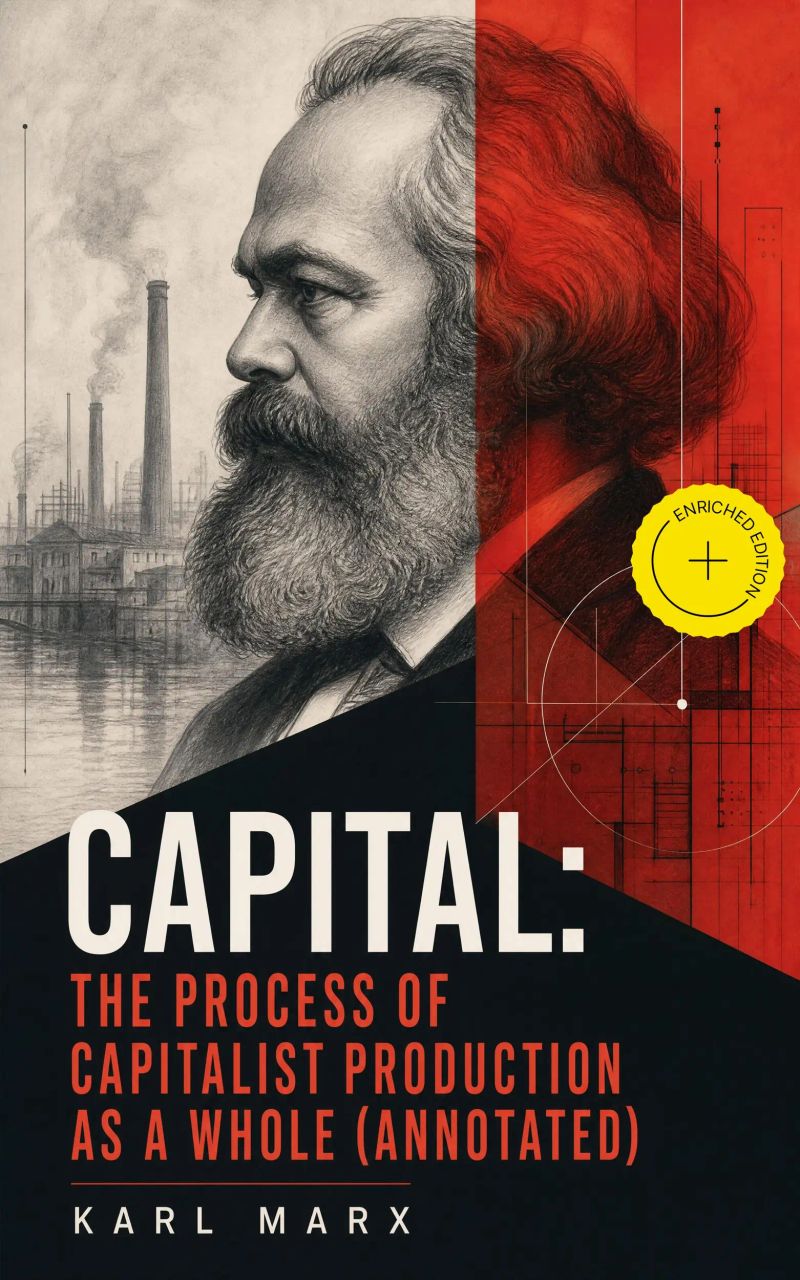
Capital: The Process of Capitalist Production as a Whole (Annotated)
Enriched Edition. Profit, Rent, Credit, and Crisis in the Critique of Political EconomyBy Karl Marx


Length39h 33m
About this audiobook
In Capital: The Process of Capitalist Production as a Whole, Karl Marx completes his systematic critique of political economy by moving from the hidden production of surplus value to the visible forms through which capitalism appears to itself: profit, interest, rent, credit, and crisis. Dense, dialectical, and relentlessly analytical, the work exposes how social relations between people assume the mystified form of relations between things. As the culminating volume of Capital, it belongs to the nineteenth-century tradition of classical political economy while decisively overturning its assumptions. Marx wrote from a life shaped by exile, journalism, revolutionary politics, and painstaking study in the British Museum reading room. His engagement with Adam Smith, David Ricardo, and the industrial capitalism of Victorian Britain enabled him to see capitalism not as a natural order, but as a historically specific system marked by exploitation, contradiction, and periodic breakdown. Edited posthumously by Friedrich Engels, the book bears traces of Marx's unfinished manuscripts yet preserves the force of his mature thought. This volume is indispensable for readers seeking to understand capitalism beyond market appearances. Economists, historians, political theorists, and serious general readers will find in it a demanding but profoundly illuminating account of how capitalist society organizes wealth, power, and crisis.
This enriched edition has been carefully crafted to add value to your reading experience.
- A succinct Introduction situates the work's timeless appeal and themes.
- The Synopsis outlines the central plot, highlighting key developments without spoiling critical twists.
- A detailed Historical Context immerses you in the era's events and influences that shaped the writing.
- An Author Biography reveals milestones in the author's life, illuminating the personal insights behind the text.
- A thorough Analysis dissects symbols, motifs, and character arcs to unearth underlying meanings.
- Reflection questions prompt you to engage personally with the work's messages, connecting them to modern life.
- Hand‐picked Memorable Quotes shine a spotlight on moments of literary brilliance.
- Interactive footnotes clarify unusual references, historical allusions, and archaic phrases for an effortless, more informed read.
Audiobook details
Rating★★★★ 4.5 (6.1K)
Includes Goodreads, Amazon
GenreBusiness and Economics
Length39 hrs 33 mins
Narrated byListen with 1,000+ voices
FormateBook with Audio
Publish dateMay 1, 2018
LanguageEnglish
Table of contents
1Introduction
2Part 1 - The Conversion Of Surplus-Value Into Profit And of the Rate Of Surplus-Value Into The Rate Of Profit.
31. Cost Price and Profit
42. The Rate of Profit
53. The Relation of the Rate of Profit to the Rate of Surplus-Value
Show all chaptersShow less
64. The Effect of the Turn-Over on the Rate of Profit
75. Economies in the Employment of Constant Capital
8I. General Economies.
9II. Economies in the conditions of labor at the expense of the laborers.
10III. Economies in the Generation of Power, Transmission of Power, and Buildings.
11IV. Utilisation of the Excrements of Production.
12V. Economies Due to Inventions.
136. The Effect of Fluctuations in Price
14I. Fluctuations in the Price of Raw Materials, and their Direct Effects on the Rate of Profit.
15II. Appreciation, Depreciation, Release, and Tie-up of Capital.
16III. General Illustration. The Cotton Crisis of 1861-1865.
177. Additional Remarks
18Part 2 - Conversion of Profit into Average Profit
198. Different Composition of Capitals
209. Average Rate of Profit and Transformation of the Values of Commodities into Prices Of Production
2110. Market Prices and Market Values. Surplus-Profit
2211. Effects of General Fluctuations of Wages on Prices of Production
2312. Some After Remarks
24I. Causes Implying a Variation of the Price of Production.
25II. Price of Production of Commodities of Average Composition.
26III. Fluctuations for which the Capitalist makes Allowance.
27Part 3 - The Law of the Falling Tendency of the Rate of Profit
2813. The Theory of the Law
2914. Counteracting Causes
30I. Raising the Intensity of Exploitation.
31II. Depression of Wages Below their Value.
32III. Cheapening of the Elements of Constant Capital.
33IV. Relative Overpopulation.
34V. Foreign Trade.
35VI. The Increase of Stock Capital.
3615. Unraveling the Internal Contradictions of the Law
37I. General Remarks.
38II. Conflict between the Expansion of Production and the Creation of Values.
39III. Surplus of Capital and Surplus of Population.
40IV. Supplementary Remarks.
41Part 4 - Transformation of Commodity-Capital and Money-Capital into Commercial Capital and Financial Capital
4216. Commercial Capital
4317. Commercial Profit
4418. The Turn-Over of Merchant's Capital
4519. Financial Capital
4620. Historical Data Concerning Merchants' Capital
47Part 5 - Division of Profit into Interest and Profits of Enterprise
4821. The Interest-Bearing Capital.
4922. Division of Profit. Rate of Interest. Natural Rate of Interest
5023. Interest and Profit of Enterprise

Manifiesto ComunistaKarl Marx, Friederich Engels1h 57m$15 · $0.00
The Communist ManifestoKarl Marx1h 13m$3 · $0.00

Differenz der demokritischen und epikureischen Naturphilosophie (Kommentiert)Karl Marx4h 16m3.8 (141)$1.50 · $0.00
Das Kapital (Kommentiert)Karl Marx96h 18m$1 · $0.00
Das Elend der Philosophie (Kommentiert)Karl Marx7h 51m3.9 (1.4K)$1 · $0.00
Karl Marx: Die deutsche Ideologie (Kommentiert)Karl Marx, Friedrich Engels28h 10m4.3 (1.7K)$1 · $0.00
Manifesto of the Communist Party (Annotated)Karl Marx3h 31m3.8 (381)$2 · $0.00

CAPITAL (Annotated)Karl Marx105h 33m$2 · $0.00
The Collected Works of Karl Marx (Annotated)Karl Marx134h 35m4.6 (321)$2 · $0.00

Zweites Kaiserreich (Kommentiert)Karl Marx15h 30m4.3 (26)$1 · $0.00

Zur Kritik der politischen Ökonomie (Kommentiert)Karl Marx10h 56m4.1 (3.9K)$1 · $0.00
Lohn, Preis und Profit (Kommentiert)Karl Marx4h 15m4.3 (2.4K)$1 · $0.00
Das Kapital: Band 1-3 (Kommentiert)Karl Marx93h 42m4.2 (1.4K)$1 · $0.00

Der Bürgerkrieg in Frankreich (Kommentiert)Karl Marx4h 57m4.3 (4.5K)$1 · $0.00

Zur Judenfrage (Kommentiert)Karl Marx3h 18m3.8 (3.9K)$1 · $0.00

Lohnarbeit und Kapital (Kommentiert)Karl Marx3h 32m$1 · $0.00

El Capital: tomo I (Anotado)Karl Marx42h$1.99 · $0.00
The Marxian Economics (Annotated)Karl Marx114h 47m4.3 (18)$2 · $0.00
Capital: The Process of Circulation of Capital (Annotated)Karl Marx23h 39m4.3 (18)$2 · $0.00
Ten Days That Shook the World (Annotated)Karl Marx17h 41m$2 · $0.00

Never Split the DifferenceChris Voss, Tahl Raz8h 7m4.4 (277.7K)$26 · $0.00
The Intelligent Investor Rev Ed.Benjamin Graham17h 48m4.3 (191.5K)$40 · $0.00

The Hard Thing About Hard ThingsBen Horowitz7h 57m4.2 (134.3K)$26 · $0.00
Boundaries for LeadersHenry Cloud7h 36m4.3 (3.6K)$26 · $0.00
The Joys Of CompoundingGautam Baid17h 34m4.5 (2.5K)$18 · $0.00
Basic EconomicsThomas Sowell18h 32m4.5 (29.3K)$28 · $0.00

Poor Charlie’s AlmanackGrover Gardener, Charles T. Munger13h 9m4.5 (24.7K)$18 · $0.00

The Ambuja StoryNarotam Sekhsaria13h 59m4.5 (830)$33 · $0.00

The Secret Door to SuccessFlorence Scovel Shinn2h 25m4.5 (2.1K)$1.20 · $0.00

This Is Going to HurtAdam Kay5h 47m4.4 (444.7K)$24 · $0.00

Big TrustShadé Zahrai, Fayçal Sekkouah8h 36m4.6 (406)$26 · $0.00
The Intelligent Investor Third EditionBenjamin Graham, Jason Zweig20h4.4 (156.6K)$46 · $0.00

Bottle of LiesKatherine Eban14h 25m4.4 (12K)$33 · $0.00

The Antiracist Business BookTrudi Lebrón6h 10m4.6 (275)$17 · $0.00

The FormulaJoshua Robinson, Jonathan Clegg10h 41m4.4 (6.9K)$29 · $0.00

Let Them LeadJohn U. Bacon7h 10m4.5 (1.4K)$24 · $0.00

Secrets of the Millionaire MindT. Harv Eker5h 11m4.4 (301.4K)$24 · $0.00

The Person You Mean to BeDolly Chugh9h 6m4.4 (7.2K)$29 · $0.00
BoundlessNick Kostov, Sean McLain9h 17m4.5 (1.1K)$29 · $0.00

Everyday DharmaSuneel Gupta5h 2m4.5 (761)$20 · $0.00
You may also like
The Politically Incorrect Guide to CommunismPaul Kengor PhD11h 44m4.4 (498)$20

The Condition of the Working-Class in England in 1844 with a Preface written in 1892Friedrich Engels11h 13m4.1 (5.8K)$1 · $0.00
The Capital & The Communist ManifestoKarl Marx111h 14m4.3 (2.7K)$1 · $0.00
Wages, Price and ProfitKarl Marx2h 18m4.3 (3.8K)$2 · $0.00

Abolition. Feminism. Now.Angela Y. Davis, Erica Meiners, Beth Richie, Gina Dent5h 4m4.5 (5.5K)$15

Progress and PovertyHenry George15h 38m4.3 (2K)$15 · $0.00
Defending the Free MarketReverend Robert Sirico7h 12m4.4 (404)$20 · $0.00

What Is Property?Pierre Joseph Proudhon13h 48m3.9 (1.9K)$15 · $0.00

Proposed Roads to FreedomBertrand Russell5h 53m4.1 (1.1K)$1.99 · $0.00
SocialismLudwig von Mises24h 8m4.5 (1.8K)$30
Capital (Das Kapital)Karl Marx111h 17m4.4 (40.9K)$2 · $0.00
Capitalism and Freedom, Fortieth Anniversary EditionMilton Friedman, Rose D. Friedman7h 16m4.3 (40.3K)$17

Fatal ConveniencesDarin Olien7h 52m4.0 (1.8K)$26 · $0.00
Wages, Price and ProfitKarl Marx2h 16m4.3 (3.8K)$4 · $0.00

The Servile StateHilaire Belloc4h 59m4.1 (1.3K)$1 · $0.00
The Communist ManifestoKarl Marx, Friedrich Engels45m3.9 (250.6K)$1 · $0.00
The Communist ManifestoKarl Marx1h 36m3.9 (239.6K)$5 · $0.00

The Benedict OptionRod Dreher8h 24m4.0 (9.9K)$20
FDR’s FollyJim Powell9h 27m4.0 (1.1K)$20

THE RIGHTS OF MAN: The French Revolution – Ideals, Arguments & MotivesThomas Paine11h 27m4.1 (26.5K)$2 · $0.00