
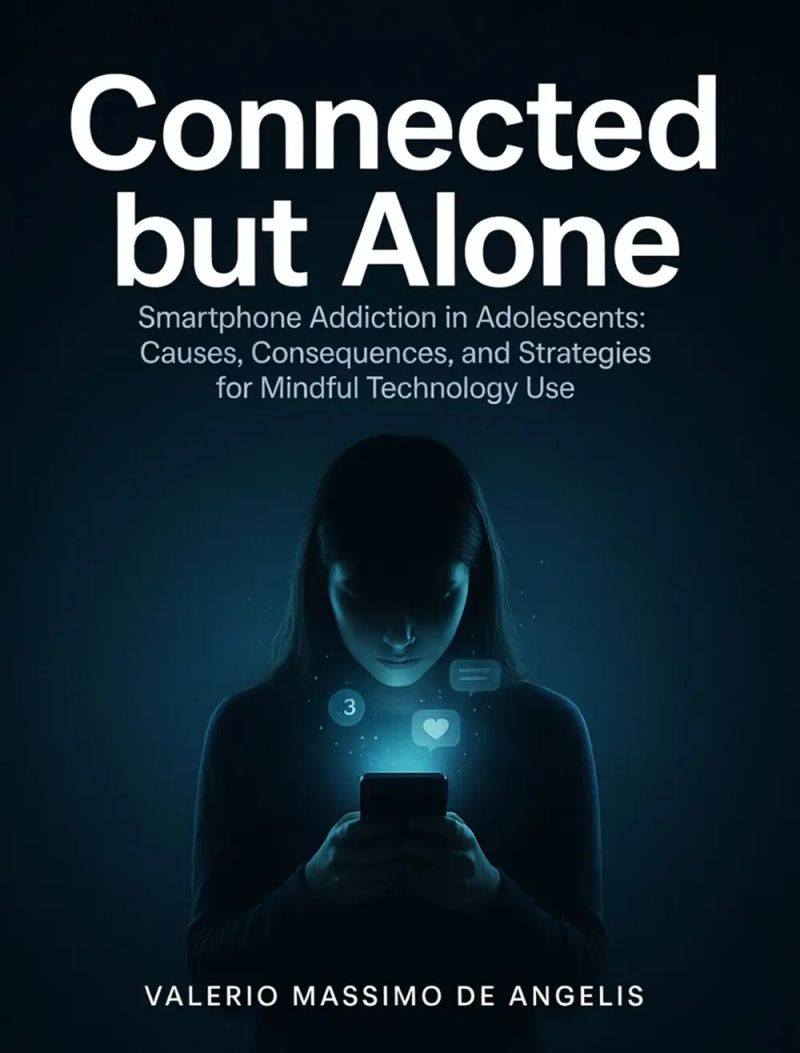
Audio only


Length1h 29m
About this audiobook
Connected but Alone is a clear and accessible guide to one of the most pressing issues in contemporary parenting and education: smartphone addiction among teenagers. Valerio Massimo De Angelis takes the reader on a comprehensive journey that begins with the origins of mobile technology and explores its concrete effects on sleep, mental health, academic performance, and family relationships. Written in simple yet rigorous language, the book analyzes phenomena such as FOMO, nomophobia, and cyberbullying, and then offers practical tools—from a guide to mindful technology use to self-assessment tools—aimed at parents, teachers, and educators, as well as teenagers themselves. This is not an indictment of the smartphone, but a call for awareness: understanding in order to make choices, and gaining knowledge to guide young people toward a healthier and more balanced relationship with technology.
An invaluable resource for anyone living or working with teenagers in the digital age.
Audiobook details
GenrePsychology
Length1 hr 29 mins
Narrated byListen with 1,000+ voices
FormateBook with Audio
Publish dateJul 14, 2026
LanguageEnglish
Table of contents
1Connected but Alone
2Foreword
3Introduction
4Chapter 1 -- The Birth of the Smartphone
5Chapter 2 -- Adolescence in the Digital Age
Show all chaptersShow less
6Chapter 3 -- What is smartphone addiction
7Chapter 4 -- How digital addiction develops
8Chapter 5 -- The Adolescent Brain and Technology
9Chapter 6 -- The role of social media
10Chapter 7 -- TikTok, Instagram and new forms of entertainment
11Chapter 8 -- FOMO: the fear of being left out
12Chapter 9 -- Nomophobia
13Chapter 10 -- Cyberbullying
14Chapter 11 -- Anxiety and Depression
15Chapter 12 -- The Effects on Sleep
16Chapter 13 -- The effects on physical health
17Chapter 14 -- Smartphones and Academic Performance
18Chapter 15 -- Family Relationships
19Chapter 16 -- Real-life friendships and virtual friendships
20Chapter 17 -- The role of video games on smartphones
21Chapter 18 -- The role of schools in prevention
22Chapter 19 -- The role of parents
23Chapter 20 -- Digital Education and Online Citizenship
24Chapter 21 -- Strategies for preventing addiction
25Chapter 22 -- The Value of Leisure Time
26Chapter 23 -- Other forms of digital addiction: streaming, messaging and binge-watching
27Chapter 24 -- The role of psychologists and mental health specialists
28Chapter 25 -- Digital self-monitoring tools: apps, screen time and parental controls
29Chapter 26 -- A brief self-assessment tool
30Chapter 27 -- A practical guide to the mindful use of technology
31Chapter 28 -- Testimonials and Experiences
32Chapter 29 -- The Future of Technology and Adolescents
33Chapter 30 -- Conclusions
34Key references
35Appendix -- Useful resources
36Acknowledgements
More from Valerio Massimo De Angelis

Connectés mais seulsValerio Massimo De Angelis1h 44m$4.70 · $0.00

Conectados, mas sozinhosValerio Massimo De Angelis1h 35m$4.70 · $0.00

Connessi ma SoliValerio Massimo De Angelis1h 38m$4.70 · $0.00

Conectados, pero solosValerio Massimo De Angelis1h 39m$4.70 · $0.00

Vernetzt, aber alleinValerio Massimo De Angelis1h 44m$4.70 · $0.00
What to Make of a LifeJim Collins13h 31m4.4 (793)$33 · $0.00

On Democracies and Death CultsDouglas Murray10h 38m4.6 (6.5K)$29 · $0.00

TerraformPropaganda5h 39m4.7 (594)$24 · $0.00

Southern Horrors: Lynch Law in All Its Phases (Annotated)Ida B. Wells-Barnett2h 44m4.6 (1.3K)$2 · $0.00

Hour of the HeartIrvin D. Yalom, Benjamin Yalom8h 19m4.6 (2.3K)$26 · $0.00
Braving the TruthRachel Held Evans11h 31m4.7 (359)$29 · $0.00
Level UpRob Dial7h 42m4.6 (3.3K)$26 · $0.00

As a JewSarah Hurwitz8h 36m4.6 (1.2K)$26 · $0.00

Saint Joan (Annotated)George Bernard Shaw6h 20m4.6 (1.2K)$1.20 · $0.00
Burn the HaystackJennie Young, PhD9h 30m4.6 (543)$29 · $0.00

Woman and the New Race (Annotated)Margaret Sanger6h 30m4.6 (1K)$1.99 · $0.00

Good InsideBecky Kennedy9h 55m4.5 (59.3K)$29 · $0.00

Du Bois: EssaysW.E.B. Du Bois6h 22m4.6 (1.5K)$1 · $0.00

The North American Indian (Illustrated Edition)Edward S. Curtis, Frederick Webb Hodge5h 59m4.6 (1.4K)$2 · $0.00

Valley of the BirdtailAndrew Stobo Sniderman, Douglas Sanderson10h 1m4.6 (2.4K)$29 · $0.00

Lies My Therapist Told MeGreg E. Gifford9h 3m4.6 (503)$29 · $0.00

Disturbed in Their NestsAlephonsion Deng, Judy A. Bernstein11h 22m4.6 (595)$23 · $0.00

No Name in the StreetJames Baldwin5h4.5 (8.5K)$20 · $0.00

My Bondage and My FreedomFrederick Douglass14h 12m4.5 (17.7K)$1.20 · $0.00

Magic SeasonWade Rouse6h 41m4.6 (855)$24 · $0.00
You may also like
To Siri with LoveJudith Newman5h 49m3.7 (3K)$24 · $0.00
You Are Not SpecialDavid McCullough, Jr.7h 57m3.6 (1.4K)$26 · $0.00
Brain InflamedKenneth Bock, MD8h 52m4.3 (308)$29 · $0.00
Eyes That Speak to the StarsJoanna Ho5m4.5 (3.5K)$4 · $0.00

Tiny Humans, Big EmotionsAlyssa Blask Campbell, Lauren Elizabeth Stauble10h 14m4.3 (6K)$29 · $0.00

Teach Your Children WellMadeline Levine10h 57m4.0 (1.8K)$29 · $0.00

Parents and Children (Annotated)Charlotte Mason9h 23m4.6 (988)$2 · $0.00
Building Resilience in Children and Teens, 4th edKenneth R. Ginsburg15h 10m4.4 (1.1K)$17 · $0.00

The Colored Girl BeautifulE. Azalia Hackley1h 25m4.2 (268)$1 · $0.00

The Big DisconnectCatherine Steiner-Adair, Teresa H. Barker10h 2m4.0 (2.4K)$29 · $0.00

Brain-Body ParentingMona Delahooke10h 15m4.4 (4.2K)$29 · $0.00

Boys & SexPeggy Orenstein7h 28m4.3 (8.6K)$24 · $0.00

The Montessori MethodMaria Montessori13h 3m4.3 (2.4K)$2.30

The Blessing of a Skinned KneeWendy Mogel PhD8h 17m4.4 (7.2K)$17
When We Become OursShannon Gibney, Nicole Chung, Mariama J. Lockington, Meredith Ireland, Mark Oshiro, Stefany Valentine, Eric Smith, Kelley Baker, MeMe Collier, Susan Harness, Lisa Nopachai, Matthew Salesses, Sun Yung Shin, Lisa Wool-Rim Sjöblom, Jenny Heijun Wills8h 47m4.2 (464)$29 · $0.00

The Crucial YearsSheryl Gonzalez Ziegler11h 56m$8 · $0.00

How to Raise Confident Kids in a World of DoubtAurora Brooks1h 20m$3.50 · $0.00

Tips for Instilling a Growth Mindset in Your ChildAurora Brooks1h 24m$3.50 · $0.00
Parents, Teachers, and Mental HealthJames E. Campbell MD4h 2m$15

The Rough Side of the MountainKeisha Lance Bottoms10h 6m4.4 (74)$29 · $0.00