
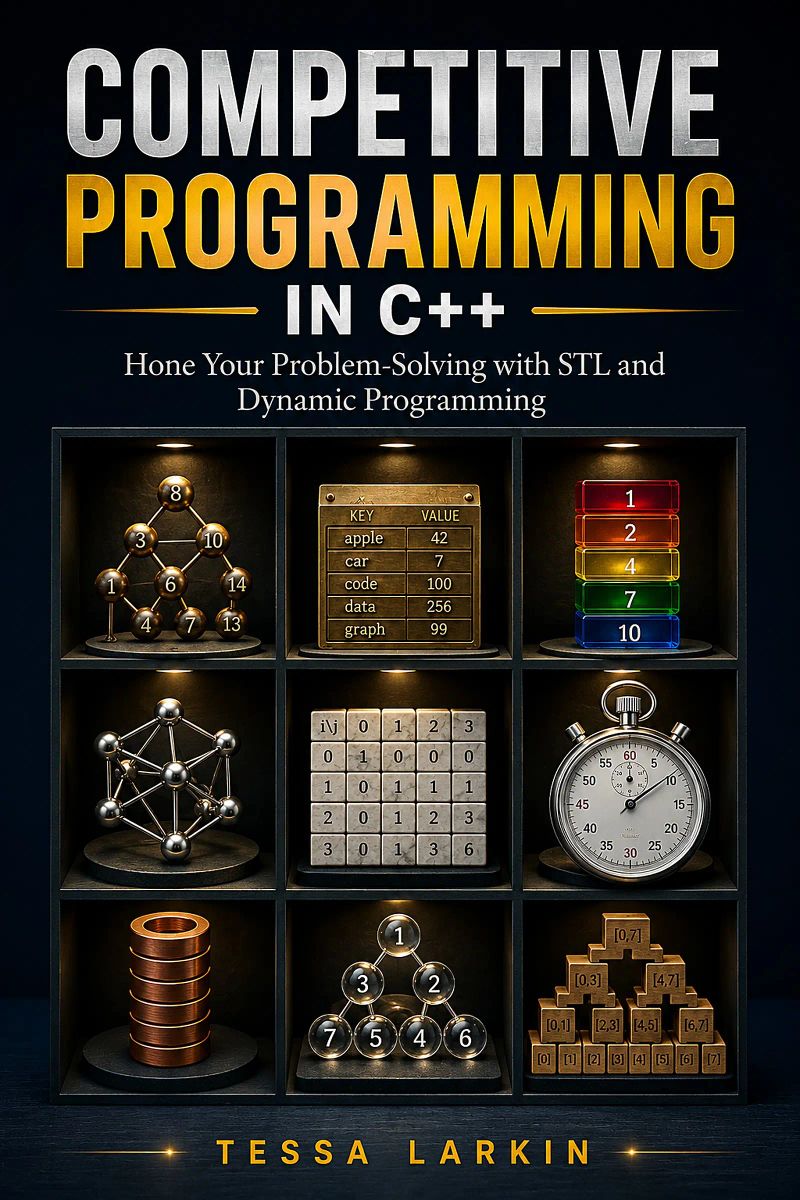
Competitive Programming in C++
Hone Your Problem-Solving with STL and Dynamic ProgrammingBy Tessa Larkin


Length7h 44m
About this audiobook
Master C++ competitive programming with the patterns, data structures, and optimizations top competitors rely on under time pressure. This hands-on guide covers C++ STL, advanced algorithms, and contest-specific techniques to solve problems faster. Whether you're a beginner or pro, learn to tackle coding challenges from Codeforces, AtCoder, and ICPC with confidence. Tessa Larkin delivers practical insights from real contests, making this a must-have for any programmer aiming to rank higher. Unlike other resources, this book focuses on time-efficient solutions and memory optimization, helping you debug and optimize code on the fly. You'll master dynamic programming, graph algorithms, and data structures like segment trees and Fenwick trees, all tailored for competitive programming. The book includes over 100 solved problems with step-by-step explanations, plus tips on input/output optimization and common pitfalls. By the end, you'll be able to solve medium to hard problems in minutes, not hours. Ideal for students, software engineers, and hobbyists preparing for interviews or contests. Compare this to the works of [placeholder] and [placeholder], who focus on theory—this book is pure practice.
What You'll Learn
Essential C++ STL containers and algorithms for speed
Dynamic programming patterns for complex problems
Graph algorithms: BFS, DFS, Dijkstra, Floyd-Warshall
Data structures: segment trees, Fenwick trees, tries
Optimization techniques: caching, bit manipulation, I/O
This book is your shortcut to competitive programming success. Get ready to solve faster and smarter.
Audiobook details
GenreTechnology
Length7 hrs 44 mins
Narrated byListen with 1,000+ voices
FormateBook with Audio
LanguageEnglish
Table of contents
1Preface
2Chapter 1 — Welcome to the Arena – Project Overview and Environment
3Chapter 2 — Complexity Analysis – The Foundation of Speed
4Chapter 3 — Fast I/O – The First Library Module
5Chapter 4 — STL Containers – Wrappers for Safety and Debug
Show all chaptersShow less
6Chapter 5 — Number Theory Toolkit – Modular Arithmetic and Primes
7Chapter 6 — Sorting, Searching, and Two Pointers – Common Patterns
8Chapter 7 — Greedy Algorithms – Simplicity that Wins
9Chapter 8 — Dynamic Programming – From Memoization to Bitmask
10Chapter 9 — Graph Algorithms – Navigate Any Network
11Chapter 10 — Advanced Data Structures – Segment Trees, Fenwick, DSU
12Chapter 11 — Advanced Techniques – Mo’s Algorithm, Meet-in-the-Middle
13Chapter 12 — String Algorithms – Hashing, KMP, and Trie
14Chapter 13 — Game Theory and Constructive Algorithms
15Chapter 14 — Geometry – Points, Lines, and Convex Hull
16Chapter 15 — Flow and Matching – Network Flows and Hungarian
17Chapter 16 — Interview-Focused Problem Patterns
18Chapter 17 — Debugging and Optimization – Profile Your Code
19Chapter 18 — Contest Strategy – Simulate Like a Pro
20Chapter 19 — Building Advanced Templates – Lazy Segment Tree and Sparse Table
21Chapter 20 — Final Project – Create a Custom Contest Submission Tool
22About the Author

Hands of TimeRebecca Struthers8h 8m4.4 (1.3K)$26 · $0.00
Never Lost AgainBill Kilday10h 1m4.4 (805)$29 · $0.00

How the Internet HappenedBrian McCullough13h 28m4.3 (2.7K)$23 · $0.00

Collected Writings of Nikola TeslaNikola Tesla, Thomas Commerford Martin21h 50m4.3 (1.7K)$1 · $0.00

Just AspireAjai Chowdhry9h 13m4.4 (260)$29 · $0.00

The Little Book of AliensAdam Frank8h 20m4.3 (1.3K)$26 · $0.00
The inventions, researches and writings of Nikola Tesla (Annotated)Thomas Commerford Martin16h 59m4.3 (1.3K)$2 · $0.00

KargilV.P. Malik15h 18m4.3 (2K)$24 · $0.00

Experiments with Alternating CurrentsNikola Tesla9h 6m4.3 (874)$1 · $0.00

Fire on the HorizonTom Shroder, John Konrad8h 23m4.3 (858)$26 · $0.00

The Smell of Kerosene (Annotated)National Aeronautics and Space Administration, Donald L. Mallick, Peter W. Merlin11h 32m4.3 (523)$2 · $0.00

The Boy Who Harnessed the WindWilliam Kamkwamba, Bryan Mealer10h 5m4.2 (78.9K)$29 · $0.00

Across the Airless WildsEarl Swift10h 8m4.3 (1.3K)$29 · $0.00

Console WarsBlake J. Harris20h 41m4.2 (13.7K)$46 · $0.00

Improvised Munitions HandbookU.S. Department of Defense4h 49m4.3 (1.6K)$1.99 · $0.00

Escaping GravityLori Garver10h 54m4.2 (2.2K)$20 · $0.00

Wireless WarsJonathan Pelson8h 2m4.3 (418)$20 · $0.00

Let There Be WaterSeth M. Siegel8h 36m4.2 (2.3K)$20 · $0.00
The PerfectionistsSimon Winchester11h 46m4.2 (9.9K)$29 · $0.00

Rethinking NarcissismDr. Craig Malkin6h 7m4.2 (3.4K)$24 · $0.00
You may also like

A Color Notation (Annotated)A. H. Munsell3h 42m4.4 (107)$2 · $0.00

One Thousand and One Initial LettersOwen Jones43m4.0 (91)$1 · $0.00

Dictionary of the Chinook Jargon, or, Trade Language of OregonGeorge Gibbs1h 54m4.4 (24)$1 · $0.00
Cooking Made EasyNaumann & Göbel Verlag3h 18m4.6 (10)$5 · $0.00

The Radio Amateur's Hand Book (Annotated)A. Frederick Collins5h 22m4.3 (12)$2 · $0.00
Structural Vibrations and WavesNoriko Takasugi13h 58m$90
Materials Science and Engineering PrinciplesViktor Lindqvist15h 33m$95
Ladder Logic with Studio 5000Pavel Novotny14h 54m$85

How to Make Money Flipping Fitness Equipment - How to Source Bulky Gear Below Market Value, Refurbish It, and Profit from Local DemandJACK FLIPWELL8h 23m$7.90 · $0.00

ARE 5.0 Architect Registration Exam Study GuideMarie Peterson10h 1m$10
Workbook IntermediateElza Lima4h 16m$16 · $0.00
A complete guide drawing to for children aged 5-10Liliana Grisa, Matteo Viganò16m$9 · $0.00
The Silversmith's Handbook (Annotated)George E. Gee5h 19m$2 · $0.00

Disc GolfHarper B. Montgomery2h 50m$2.30 · $0.00

SoftballMarcus B. Cole31m$2.30 · $0.00
Activity-Based Budgeting UncoveredLuna Z. Rainstorm9h 38m$6.40 · $0.00
An Interactive In-Depth Study Guide to The Audacity ExperimentVere Bates1m$10.50 · $0.00

AP Chemistry Exam Study GuideMarie Peterson8h 41m$10

AP Physics 1 Exam Study GuideMarie Peterson9h 31m$10
Arduino Electronics with CMarisol Vasquez7h 17m$5 · $0.00