
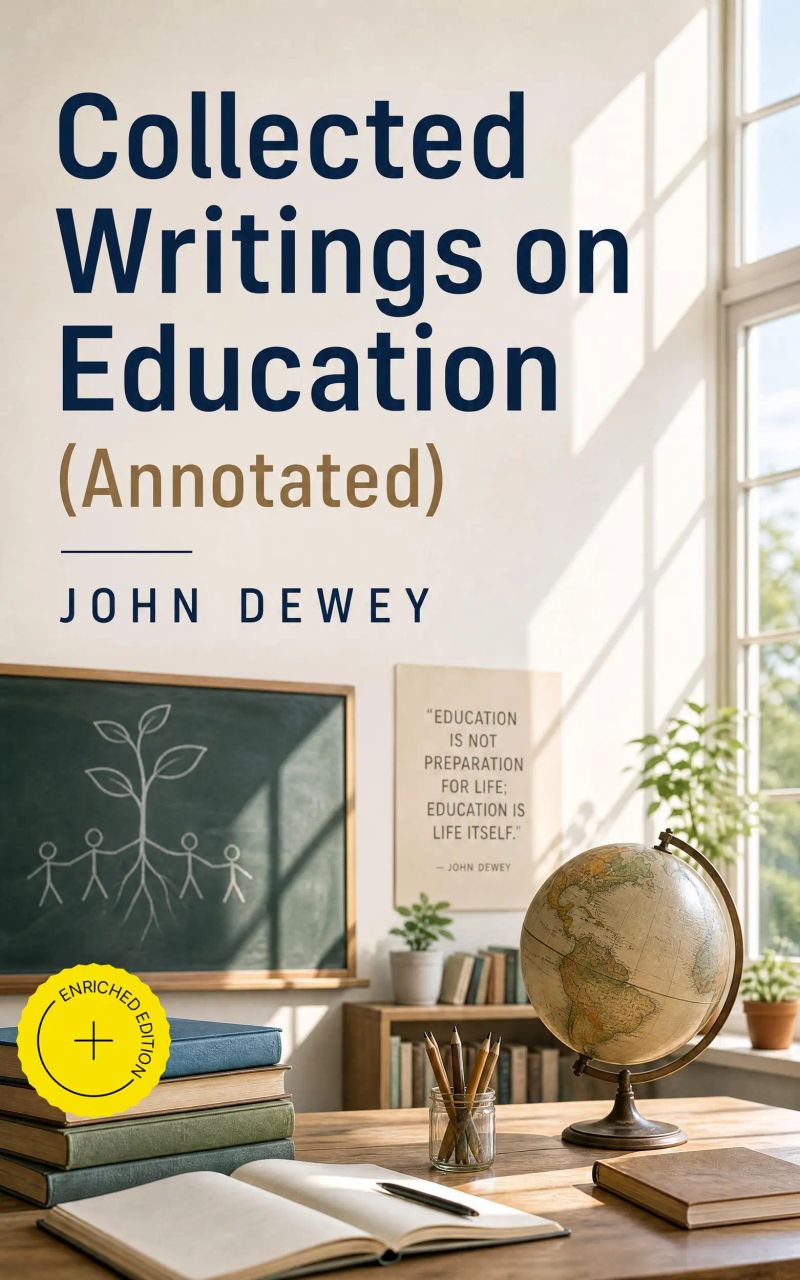
Collected Writings on Education (Annotated)
Enriched Edition. My Pedagogic Creed + The School and Society + The Child and the Curriculum + Moral Principles in Education + Interest and Effort in Education + Democracy and EducationBy John Dewey


Length24h 16m
About this audiobook
Collected Writings on Education gathers John Dewey's major reflections on schooling, democracy, experience, and social reform, presenting education not as rote transmission but as an active reconstruction of life. Written in Dewey's lucid, argumentative, and pragmatist style, these essays and lectures belong to the progressive education movement of the late nineteenth and early twentieth centuries, when industrialization, mass democracy, and new psychology demanded a rethinking of the classroom as a civic and experiential community. Dewey, one of America's most influential philosophers, developed his educational thought from his broader pragmatism: ideas must be tested in lived practice, and knowledge grows through inquiry. His work at the University of Chicago Laboratory School, along with his engagement with philosophy, psychology, and democratic theory, shaped his conviction that schools should cultivate reflective intelligence, cooperation, and participation rather than passive obedience. This collection is essential for readers seeking the foundations of modern educational theory. Teachers, historians, philosophers, and policy thinkers will find in Dewey a demanding but humane guide to schooling as a moral and democratic enterprise, still urgently relevant to debates over curriculum, citizenship, and the purposes of learning.
This enriched edition has been carefully crafted to add value to your reading experience.
- A comprehensive Introduction outlines these selected works' unifying features, themes, or stylistic evolutions.
- The Author Biography highlights personal milestones and literary influences that shape the entire body of writing.
- A Historical Context section situates the works in their broader era—social currents, cultural trends, and key events that underpin their creation.
- A concise Synopsis (Selection) offers an accessible overview of the included texts, helping readers navigate plotlines and main ideas without revealing critical twists.
- A unified Analysis examines recurring motifs and stylistic hallmarks across the collection, tying the stories together while spotlighting the different work's strengths.
- Reflection questions inspire deeper contemplation of the author's overarching message, inviting readers to draw connections among different texts and relate them to modern contexts.
- Lastly, our hand‐picked Memorable Quotes distill pivotal lines and turning points, serving as touchstones for the collection's central themes.
Audiobook details
GenreEducation and Learning
Length24 hrs 16 mins
Narrated byListen with 1,000+ voices
FormateBook with Audio
Publish dateNov 10, 2013
LanguageEnglish
Table of contents
1Of the Conduct of the Understanding (Annotated)
2Collected Writings on Education: My Pedagogic Creed + The School and Society + The Child and the Curriculum + Moral Principles in Education + Interest and Effort in Education + Democracy and Education
3My Pedagogic Creed
4ARTICLE ONE. WHAT EDUCATION IS
5ARTICLE TWO. WHAT THE SCHOOL IS
Show all chaptersShow less
6ARTICLE THREE. THE SUBJECT-MATTER OF EDUCATION
7ARTICLE FOUR. THE NATURE OF METHOD
8ARTICLE FIVE. THE SCHOOL AND SOCIAL PROGRESS
9The School and Society
10Author’s Note
11Author’s Note to Second Edition
12I The School and Social Progress
13II The School and the Life of the Child
14III Waste in Education
15IV The Psychology of Elementary Education
16V Froebel’s Educational Principles
17VI The Psychology of Occupations
18VII The Development of Attention
19VIII The Aim of History in Elementary Education
20Three Years of the University Elementary School
21The Child and the Curriculum
22Moral Principles in Education
23INTRODUCTION
24I THE MORAL PURPOSE OF THE SCHOOL
25II THE MORAL TRAINING GIVEN BY THE SCHOOL COMMUNITY
26III THE MORAL TRAINING FROM METHODS OF INSTRUCTION
27IV THE SOCIAL NATURE OF THE COURSE OF STUDY
28V THE PSYCHOLOGICAL ASPECT OF MORAL EDUCATION
29RIVERSIDE EDUCATIONAL MONOGRAPHS
30Interest and Effort in Education
31I UNIFIED VERSUS DIVIDED ACTIVITY
32II INTEREST AS DIRECT AND INDIRECT
33III EFFORT, THINKING, AND MOTIVATION
34IV TYPES OF EDUCATIVE INTEREST
35V THE PLACE OF INTEREST IN THE THEORY OF EDUCATION
36Democracy and Education
37Chapter One: Education as a Necessity of Life
38Chapter Two: Education as a Social Function
39Chapter Three: Education as Direction
40Chapter Four: Education as Growth
41Chapter Five: Preparation, Unfolding, and Formal Discipline
42Chapter Six: Education as Conservative and Progressive
43Chapter Seven: The Democratic Conception in Education
44Chapter Eight: Aims in Education
45Chapter Nine: Natural Development and Social Efficiency as Aims
46Chapter Ten: Interest and Discipline
47Chapter Eleven: Experience and Thinking
48Chapter Twelve: Thinking in Education
49Chapter Thirteen: The Nature of Method
50Chapter Fourteen: The Nature of Subject Matter

Shaping Tomorrow's Education: John Dewey's Edition - 9 Books in One VolumeJohn Dewey33h 43m$1.99 · $0.00
The Schools of Utopia + Schools of To-morrow (Illustrated Edition)John Dewey8h 54m$1.99 · $0.00
The Logic of Human Mind, Self-Awareness & Way We ThinkJohn Dewey40h 51m$1.99 · $0.00
The Universal Compass for EducatorsJohn Dewey19h 11m$1.99 · $0.00
The Logic of Human Mind & Other WorksJohn Dewey40h 53m$1.99 · $0.00

The Schools of Utopia & Schools of To-morrow (Illustrated)John Dewey8h 56m3.9 (167)$1.99 · $0.00
Democracy and Education & Other Writings (A Collected Edition)John Dewey25h 20m4.1 (12.5K)$1.99 · $0.00
John Dewey - Ultimate Collection: 40+ Works on Psychology, Education, Philosophy & PoliticsJohn Dewey168h 47m$1.99 · $0.00

The Principles of Education We Lack InJohn Dewey33h 45m$1.99 · $0.00

China, Japan and U.S.A: The Geopolitical AnalysisJohn Dewey8h 57m3.4 (12)$1.99 · $0.00
The Logic of ThoughtJohn Dewey52h 28m$1.99 · $0.00

China, Japan and the USA (Annotated)John Dewey8h 57m$1.99 · $0.00

The Essential John Dewey: 20+ Books in One EditionJohn Dewey87h 20m$0.99 · $0.00

The Collected Works of John Dewey (Annotated)John Dewey168h 46m4.5 (36)$2 · $0.00

PSYCHOLOGY & SOCIAL PRACTICE – Premium Collection (Annotated)John Dewey40h 49m$2 · $0.00

China, Japan and the U.S.A (Annotated)John Dewey8h 54m3.8 (12)$2 · $0.00
EXPERIENCE AND EDUCATION – Premium Edition (Including Democracy & Education) (Annotated)John Dewey19h 17m4.6 (1K)$2 · $0.00

Reconstruction in PhilosophyJohn Dewey6h 43m4.0 (690)$1 · $0.00
The Collected Works of John DeweyJohn Dewey168h 59m4.1 (45)$1 · $0.00
A Brief History of IntelligenceMax S. Bennett12h 18m4.6 (6.6K)$29 · $0.00

HomeschooledStefan Merrill Block7h 10m3.6 (18.5K)$28 · $0.00

WitnessAriel Burger8h 1m4.6 (1.3K)$20 · $0.00

EducationEllen G. White9h 41m4.6 (1.5K)$2 · $0.00

Parents and Children (Annotated)Charlotte Mason9h 23m4.6 (988)$2 · $0.00

Children Under FireJohn Woodrow Cox10h 17m4.5 (1.6K)$29 · $0.00

The State Must ProvideAdam Harris7h 15m4.5 (775)$24 · $0.00

The Call of the Wild and FreeAinsley Arment9h 7m4.4 (21.2K)$29 · $0.00
The Freelance WayRobert Vlach19h 48m4.5 (528)$40 · $0.00

Race to the BottomLuke Rosiak9h 20m4.5 (600)$29 · $0.00

They Came for the SchoolsMike Hixenbaugh9h 5m4.5 (2.6K)$8 · $0.00

Find Me UnafraidKennedy Odede, Jessica Posner11h 11m4.5 (2.7K)$29 · $0.00

Asking for ItKate Harding8h 55m4.4 (5.3K)$20 · $0.00
Defining Moments in Black HistoryDick Gregory7h 37m4.4 (6K)$26 · $0.00

The Emerald Tablets of Thoth the AtlanteanMaurice Doreal3h 4m4.4 (8.8K)$6 · $0.00

Learning AmericaLuma Mufleh6h 37m4.4 (564)$24 · $0.00
Math-ishJo Boaler7h 21m4.4 (588)$24 · $0.00

Daddy-Long-LegsJean Webster12h 18m4.2 (91K)$1.99 · $0.00
It Worked For MeColin Powell7h 42m4.3 (9.8K)$26 · $0.00

Little SoldiersLenora Chu11h 30m4.3 (3.1K)$29 · $0.00
You may also like

Dr. Montessori's Own HandbookMaria Montessori2h 43m4.2 (1.6K)$2.30
How We ThinkJohn Dewey8h 52m4.0 (1.6K)$22 · $0.00
ArticulateRachel Kolb10h 35m4.3 (481)$29 · $0.00

Biographia Literaria (Annotated)Samuel Taylor Coleridge13h 15m3.8 (1K)$1.99 · $0.00

Dr. Montessori's Own HandbookMaria Montessori2h 42m4.3 (1.3K)$10 · $0.00
Dear BoyParis Rosenthal, Jason B. Rosenthal4m4.5 (3.8K)$4 · $0.00
Some Thoughts Concerning EducationJohn Locke9h 17m3.9 (5.3K)$1 · $0.00
Words without MusicPhilip Glass15h 5m4.3 (7.4K)$23
My Weird School: Talent Show Mix-UpDan Gutman7m4.1 (351)$4 · $0.00

Daring to DreamElijah C.3h 22m$6.40 · $0.00

Primary HandworkElla Victoria Dobbs1h 57m$2 · $0.00
John Dewey: The Philosophy of EducationJohn Dewey32h 38m3.9 (325)$2 · $0.00

The Diary of a Japanese Convert (Annotated)Uchimura Kanzo6h 54m3.4 (10)$2 · $0.00

SuccessSteve Pavlina2h 9m4.2 (25)$10 · $0.00
10 Minutes to Better Mental HealthLee David, Debbie Brewin10h 12m4.1 (45)$20

The Montessori Elementary Material (Annotated)Maria Montessori13h 10m$2 · $0.00
8 Shortcuts to Desire and MotivationSteve Pavlina26m$4 · $0.00

JAY SHETTY BIOGRAPHYJason C. Turner2h 39m$8.50 · $0.00
Confused GirlGiovanna Silvestre8h 15m4.1 (87)$23

Growing up FunElijah C.4h 11m$6.40 · $0.00