
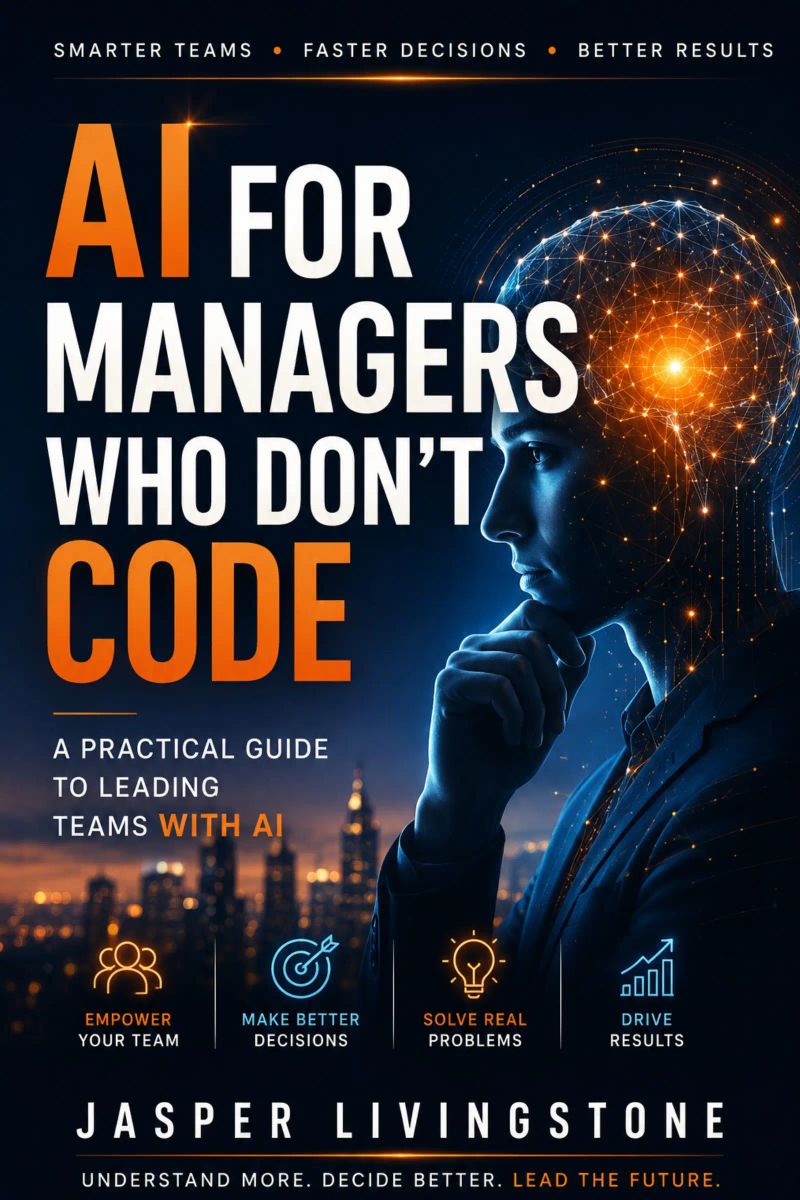
AI For Managers Who Don’t Code
A practical guide to leading teams with AIBy Jasper Livingstone


Length7h 17m
About this audiobook
AI is changing how teams work, make decisions, solve problems, and get things done. For managers, the challenge is no longer whether AI will affect their work. The challenge is knowing how to lead when AI becomes part of everyday business.
AI For Managers Who Don’t Code is a practical guide for managers, team leaders, department heads, project managers, and business professionals who want to use AI effectively without learning programming or becoming technical experts.
This book focuses on what managers need most: understanding what AI does well, recognizing where it adds business value, deciding which tasks should involve AI, and helping teams adopt new ways of working without losing human judgment, accountability, or trust.
You will learn how to identify practical AI opportunities within your team, use generative AI for common management activities, evaluate AI tools, redesign workflows, review AI-generated work, and measure whether AI is producing meaningful results. You will also learn how to handle common risks involving inaccurate outputs, confidential information, privacy, security, bias, governance, and overreliance on technology.
The book also prepares you for the next stage of workplace AI. As organizations move from simple AI assistants toward copilots, AI agents, and automated workflows, managers will need to decide how much authority AI should receive, where human approval remains necessary, and who remains accountable for the outcome.
Throughout the book, technical concepts are explained through clear business examples. There is no coding, complex mathematics, or unnecessary technical language. The focus stays on leadership, people, processes, decisions, and measurable business value.
AI For Managers Who Don’t Code will help you answer one of the most important management questions of the AI era: What should people do, what should AI do, and what should people and AI do together?
You do not need to build AI to lead in an AI-enabled organization. You need the judgment, confidence, and management skills to put it to work responsibly and effectively.
Audiobook details
GenreBusiness and Economics
Length7 hrs 17 mins
Narrated byListen with 1,000+ voices
FormateBook with Audio
Publish dateAug 26, 2026
LanguageEnglish
Table of contents
1Chapter 1: The Manager’s New Role in an AI Workplace
2Why AI Changes the Manager’s Job
3What Managers Need to Know About AI
4Deciding What People and AI Should Do
5Leading People Through AI Adoption
Show all chaptersShow less
6The Core Capabilities of an AI-Ready Manager
7Chapter 2: AI in Plain Business Language
8What AI Means in Business
9Five Common Types of AI Work
10Why AI Can Be Wrong
11Data, Context, and Instructions
12Questions Managers Should Ask
13Chapter 3: Finding Valuable AI Opportunities in Your Team’s Work
14Start with the Work, Not the Tool
15Map the Main Types of Team Activities
16Assess Business Value and Practical Feasibility
17Decide What AI Should Do and What People Should Own
18Prioritize Opportunities for a Focused Pilot
19Chapter 4: Choosing the Right AI Tools
20Start with the Business Problem
21Match the Tool to the Work
22Evaluate Quality and Reliability
23Check Integration, Security, and Privacy
24Compare Total Cost and Vendor Support
25Run a Small Pilot and Make the Decision
26Chapter 5: Working Effectively with Generative AI
27Treating Generative AI as a Work Partner
28Giving Clear Instructions That Produce Useful Results
29Providing Context Without Losing Control of Information
30Improving Results Through Iteration and Review
31Choosing Useful Applications and Setting Sensible Limits
32Chapter 6: Designing Human and AI Workflows
33Map the Workflow Before Adding AI
34Assign Work According to Strengths
35Design Review Points That Actually Work
36Build Ownership, Controls, and Exceptions
37Test, Measure, and Improve the Workflow
38Chapter 7: Accuracy, Hallucinations, and Human Review
39Why Fluent AI Output Can Be Wrong
40Match Review to the Risk
41Build Verification into the Workflow
42Give People Clear Review Responsibilities
43Create a Practical Accuracy Culture
44Chapter 8: Protecting Data, Privacy, and Confidential Information
45Understand What Information Needs Protection
46Use Approved Tools and Accounts
47Create Clear Rules for Everyday AI Use
48Manage Access, Sharing, and Human Responsibility
49Build a Culture of Responsible Protection
50Chapter 9: Leading People Through AI Change
The Everyday AlgorithmJasper Livingstone7h 41m$9

The Independent Senior's AI GuideJasper Livingstone5h 59m$9

AI Without The AnxietyJasper Livingstone4h 54m$10
Understanding AI For Everyday ImpactJasper Livingstone4h 7m$9

Transforming Your PotentialJasper Livingstone3h 45m$9

Mega LivingJasper Livingstone3h 18m$9

The Evolution Of AIJasper Livingstone10h 56m$9

Calm StrengthJasper Livingstone6h 27m$9

Clear Thinking With AIJasper Livingstone4h 59m$10

Unlock Your Intelligent EdgeJasper Livingstone4h 20m$10

Adapting To AIJasper Livingstone6h 29m$10
Unlocking AI For Everyday UseJasper Livingstone6h 4m$9
Embracing AI At WorkJasper Livingstone6h 37m$9

Beyond Closed DoorsJasper Livingstone7h 10m$7

AI-Proof Your Career: Navigating the Future with ConfidenceJasper Livingstone7h 11m$6.90

Mastering Your Attitude: A Guide to Navigating Life's UncertaintiesJasper Livingstone6h 57m4.0 (366)$9

Transforming Yourself: The Catalyst for ChangeJasper Livingstone10h 30m$13

The Attitude AdvantageJasper Livingstone9h 38m4.0 (1.5K)$7

Freedom from ControlJasper Livingstone7h 38m$9

Never Split the DifferenceChris Voss, Tahl Raz8h 7m4.4 (277.7K)$26 · $0.00

The Intelligent Investor Rev Ed.Benjamin Graham17h 48m4.3 (191.5K)$40 · $0.00
The Hard Thing About Hard ThingsBen Horowitz7h 57m4.2 (134.3K)$26 · $0.00

Boundaries for LeadersHenry Cloud7h 36m4.3 (3.6K)$26 · $0.00

Eat It!Jordan Syatt, Michael Vacanti4h 40m4.6 (1.5K)$20 · $0.00

Progress and Poverty, Volumes I and II (Annotated)Henry George19h 21m4.6 (574)$0.99 · $0.00

Not Everything Counts but Everything Matters: The powerful and inspirational new book about leadership and achieving success from the visionary multi-premiership winning Panthers coachIvan Cleary6h 1m4.6 (680)$24 · $0.00

BuildTony Fadell11h 5m4.5 (14.3K)$8 · $0.00

The Joys Of CompoundingGautam Baid17h 34m4.5 (2.5K)$18 · $0.00

Basic EconomicsThomas Sowell18h 32m4.5 (29.3K)$28 · $0.00

Poor Charlie’s AlmanackGrover Gardener, Charles T. Munger13h 9m4.5 (24.7K)$18 · $0.00

The Ambuja StoryNarotam Sekhsaria13h 59m4.5 (830)$33 · $0.00

The Secret Door to SuccessFlorence Scovel Shinn2h 25m4.5 (2.1K)$1.20 · $0.00

This Is Going to HurtAdam Kay5h 47m4.4 (444.7K)$24 · $0.00

Big TrustShadé Zahrai, Fayçal Sekkouah8h 36m4.6 (406)$26 · $0.00

The Intelligent Investor Third EditionBenjamin Graham, Jason Zweig20h4.4 (156.6K)$46 · $0.00

Bottle of LiesKatherine Eban14h 25m4.4 (12K)$33 · $0.00

The Antiracist Business BookTrudi Lebrón6h 10m4.6 (275)$17 · $0.00

The FormulaJoshua Robinson, Jonathan Clegg10h 41m4.4 (6.9K)$29 · $0.00

Let Them LeadJohn U. Bacon7h 10m4.5 (1.4K)$24 · $0.00
You may also like

180 ChatGPT Prompts for Real Estate AgentsAdrian Lucas3h 33m$4

How to Future-Proof Your Career for an AI-Driven WorldMax Paradox7h 22m$7.70 · $0.00

Winning in the Age of AIJasper Livingstone9h 40m4.5 (132)$9
AI Was Supposed to Save Me Time, but Now I Have More Work - How to Automate Without Automatically Adding More to Your PlateMax Paradox7h 16m$7.70 · $0.00

Online Traffic SecretsAnthony Ekanem49m$4 · $0.00

Millionaire ChatGPTSara Melo1h 53m$1.80 · $0.00
Build Language Models with PythonEsther Fontaine7h 32m$5
Maximizing LinkedIn for Business GrowthNeal Schaffer3h 15m4.3 (31)$14.99

Leading in the Age of Artificial IntelligenceJasper Livingstone9h 35m$13

I Can't Think Without AI Anymore - How to Use Artificial Intelligence Without Handing Over Your BrainMax Paradox7h 25m$7.70 · $0.00
Adapting To AIJasper Livingstone6h 29m$10

Master Prompt EngineeringRui Jorge Claro2h 53m$10 · $0.00

Email Marketing: The Ultimate Guide to Building an Email List Asset (How to Compel Your Subscribers to Open Your Emails and Take Action Now)Howard Steward1h$3.50 · $0.00

Artificial Intelligence for Business StrategyTheo Riven3h 11m$5

ITIL® 4 Create, Deliver and Support (CDS)Claire Agutter3h 36m4.6 (23)$40 · $0.00

Software Structure by DesignRohan Dasgupta14h 44m4.8 (10)$75

ITIL® 4 Essentials: Your essential guide for the ITIL 4 Foundation exam and beyond, second editionClaire Agutter4h4.2 (50)$40 · $0.00

HorizonsJames Poskett15h 18m3.7 (472)$33 · $0.00

Target Date FundsPenelope I. Westwood4h 32m$4 · $0.00

Airfoils, Lift and Drag IllustratedPatrick Zwolinska11h 22m$50