
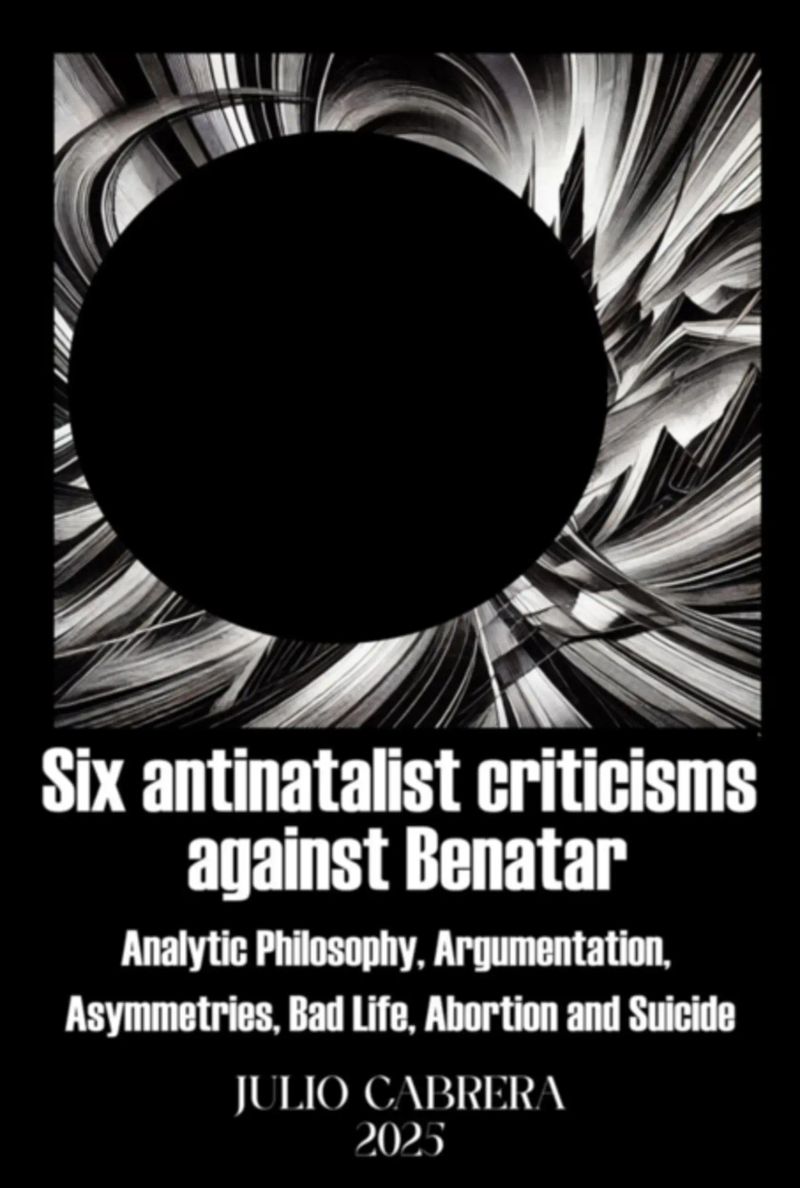
Six Antinatalist Criticisms Against Benatar
De Júlio Cabrera


Duração4h 37m
Sobre este audiolivro
Six Antinatalist Criticisms Against Benatar Analytic Philosophy, Argumentation, Asymmetries, Bad Life, Abortion, and Suicide Author: Julio Cabrera Philosopher Julio Cabrera presents a compelling critique of David Benatar's antinatalist arguments in Better Never to Have Been, offering six deep and thought-provoking analyses that challenge the foundations of analytic antinatalism. While acknowledging the ethical concerns surrounding procreation, Cabrera scrutinizes the logical structures and argumentative strategies used to justify antinatalist positions, revealing their philosophical limitations. 🔹 Can existence truly be subjected to philosophical analysis? 🔹 Does analytic antinatalism rely on an underlying optimism? 🔹 Is the asymmetry between suffering and pleasure as strong as claimed? 🔹 Do the world's horrors alone justify antinatalism? 🔹 What are the moral implications of abortion from an antinatalist perspective? 🔹 Should suicide be viewed differently within a pessimistic ethical framework? Based on a series of lectures delivered for the Ibero-American Society for Pessimism Studies, this book engages both supporters and critics of antinatalism with a fresh perspective that questions conventional assumptions. Philosophy enthusiasts, ethics scholars, and readers intrigued by the moral dilemmas of existence will find this work essential reading.
Detalhes do audiolivro
GêneroPhilosophy, Psychology
Duração4 h 37 min
Narrado porOuça com mais de 1.000 vozes
FormatoeBook com áudio
Data de publicação24 de mar. de 2025
IdiomaPortuguês
Sumário
1INTRODUCTION
2LECTURE NUMBER 1:
3CAN EXISTENCE BE SUBJECTED TO ANALYSIS?
4LECTURE NUMBER 2:
5THE LOGICAL OPTIMISM OF THE ANTINATALISTS
Mostrar todos os capítulosVer menos
6LECTURE NUMBER 3:
7SYMMETRIES RESTORED
8LECTURE NUMBER 4:
9THE TERRORS OF THE WORLD ARE ENOUGH
10LECTURE NUMBER 5:
11IMMORALITY OF ABORTION FROM ANTINATALISM
12LECTURE NUMBER 6:
13MORALITY OF SUICIDE FROM ANTINATALISM
14BIBLIOGRAPHICAL REFERENCES

Sobre a utilidade e a desvantagem da história para a vidaFriedrich Nietzsche4h 59min4.3 (16.6K)$7 · $0.00

Pecar e perdoarLeandro Karnal7h 57min4.4 (374)$8 · $0.00

Sobre a liberdadeStuart Mill8h 7min4.3 (4.9K)$7 · $0.00

Breve tratado de Deus, do homem e do seu bem-estarBaruch de Espinosa (Spinoza)3h 30min4.3 (332)$9 · $0.00

Vita contemplativa ou sobre a inatividadeByung-Chul Han3h 18min4.2 (2.1K)$10 · $0.00

A RepúblicaPlatão24h 6min4.1 (271.6K)$6 · $0.00

A Arte PoéticaAristóteles2h 45min4.1 (46.5K)$6 · $0.00

O PríncipeNiccolò Machiavelli5h 5min4.0 (464.4K)$6 · $0.00

Dissertação sobre as paixõesDavid Hume3h 5min4.3 (145)$6 · $0.00

Homo Sapiens Teknelogo - A Superficial Condição HumanaAna Paula Pinho9h 43min$17 · $0.00

Conversas sobre política para todos os temposRubem Alves3h 37min$4 · $0.00

Além Do Bem E Do MalFriedrich Nietzsche7h 26min4.2 (254.4K)$6 · $0.00

Sociedade do cansaçoByung-Chul Han2h 22min4.1 (51.2K)$6 · $0.00

Assim Falou ZaratustraFriedrich Nietzsche13h 32min4.1 (214.6K)$6 · $0.00

InfocraciaByung-Chul Han2h 3min4.1 (4K)$7 · $0.00

Falando sobre DeusByung-Chul Han2h 49min4.4 (36)$12 · $0.00

Sobre a éticaArthur Schopenhauer11h 9min4.3 (2.4K)$7 · $0.00

Ética – Edição bilíngueBaruch de Espinosa (Spinoza)19h 22min4.7 (2.1K)$19 · $0.00
Vocabulário de Foucault (Edição revista e ampliada)Edgardo Castro29h 39min4.7 (497)$11.99 · $0.00

O PeregrinoRafael2h 30min4.7 (666)$5 · $0.00

Negligência emocionalJonice Webb7h 46min4.3 (26.3K)$11 · $0.00

Crianças resilientesTovah P. Klein10h 23min4.3 (282)$11 · $0.00

Sem perder a raizNilma Lino Gomes16h 3min4.7 (296)$13 · $0.00

Racismo e antirracismo na educaçãoEliane Cavalleiro6h 21min4.7 (260)$9 · $0.00

Elementos para uma compreensão diagnóstica em psicoterapiaÊnio Brito Pinto4h 19min4.7 (447)$7 · $0.00

Gestalt-terapia com criançasLuciana Aguiar11h 36min4.7 (379)$6.99 · $0.00

A construção do pensamento e da linguagemLev Semionovich Vigotski18h 53min4.5 (4.4K)$13 · $0.00

Atrás Da MuralhaSol Soares3h 3min4.6 (2.5K)$5 · $0.00

O ciclo do contato (9ª edição revista e atualizada)Jorge Ponciano Ribeiro5h 57min4.6 (307)$9 · $0.00

Uma voz sem palavrasPeter A. Levine14h 16min4.5 (19.1K)$14 · $0.00

Exercícios de comunicação não violentaLucy Leu5h 41min4.6 (1.4K)$9 · $0.00

Três guinéusVirginia Woolf11h 21min4.6 (611)$12 · $0.00

O Que Todo Revolucionário Deve Saber Sobre A RepressãoVictor Serge - Tradução Thaelman Carlos3h 50min4.6 (281)$7 · $0.00

Psicologia Do EmagrecimentoEvandro Borges4h 18min4.6 (1.2K)$7 · $0.00

DescolonizarBoaventura de Sousa Santos3h 16min4.6 (268)$5.15 · $0.00

Meditação: Homem-perfeição Na Deus-satisfaçãoSri Chinmoy6h 44min4.6 (470)$13 · $0.00

Raios e trovõesBruno Capelas8h 27min4.6 (332)$5.99 · $0.00

O corpo educadoGuacira Lopes Louro6h 35min4.6 (460)$5.99 · $0.00

Amor, sexualidade, feminilidadeSigmund Freud, Maria Rita Salzano Moraes12h 4min4.5 (2.7K)$13 · $0.00
Exercícios de bioenergéticaAlexander Lowen, Leslie Lowen4h 27min4.5 (2.4K)$3.99 · $0.00
Você também pode gostar

Os sonetos completos de Anthero de QuentalAntero de Quental2h 19min4.0 (387)$2

Principais Estratégias Para Jogar Pôker Com SucessoNetopoker2h 38min$6 · $0.00

Às Vezes Fico PensandoMarco Antonio Gallo5min$6 · $0.00

A grande esmola e outros poemasAlberto de Oliveira17min$4 · $0.00

O Segredo Da Linguagem CorporalJoão V.b Do Carmo8min$7 · $0.00

Respirar Para CurarCláudia Mesquita25min$6 · $0.00

;Mateus Mattos15min$4 · $0.00

O Fim Da Libido.Fabio Fernando; Sophia Clark; Neuda Fernandes; Shark Blue; Beast; Fantasy; Fernando Moura; Amora ;2h 51min$6 · $0.00

Diário De Meditação De Um AmanteHedilberto Lindenberg Maximilianor21min$6 · $0.00

O Poeta É Um FingidorEvan Do Carmo - 180 Poetas4h 25min$7 · $0.00

Aos Espíritos Perdidos Na Metade Escura Da LuaDamnus Vobiscum51min$6 · $0.00

Escrever para criançasSilvia Adela Kohan2h 33min4.1 (32)$9 · $0.00
A Instabilidade Da Bondade HumanaSilvio Dutra34min$4 · $0.00

Mente DivididaCarlos A. S. Moura23min$5 · $0.00

Invísiveis OlharesFotógrafos Jandirenses6min$6 · $0.00

Apontamento e outros poemasÁlvaro de Campos27min$2 · $0.00

Vibrações e amarJoão do Rio17min$2 · $0.00

No Silêncio Dos VersosAna Karla Silva21min$5 · $0.00

Por Um Raio De SolSheila Ferraz9min$5 · $0.00

A Adaptação LiteráriaJosmar de Oliveira Reyes19h 8min$38 · $0.00