
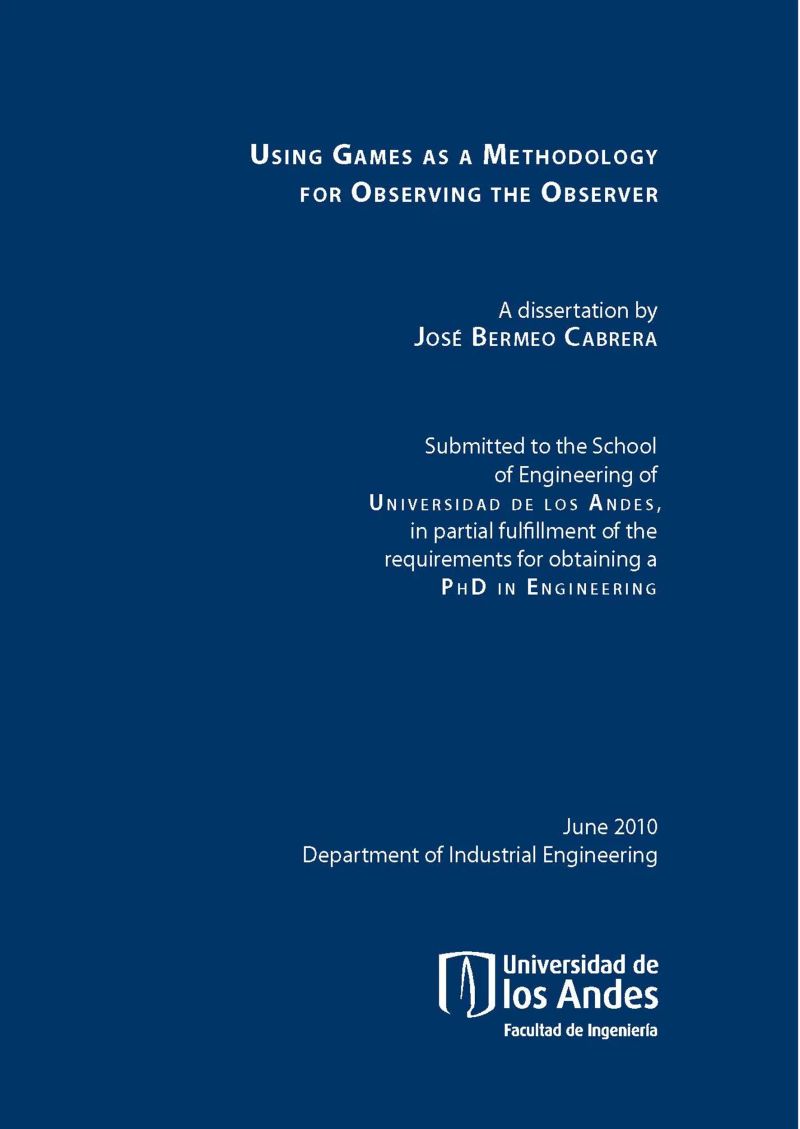
Using games as a methodology for observing the observer
By José Bermeo Cabrera


Length6h 51m
About this audiobook
Using Games as a Methodology for Observing the Observer constructs a methodology of active learning for observing the observer. The tool used is the construction of games. The basic questions are: What actions can be taken to allow the subject to observe him or herself? and How can learning activities be used to reconstruct the subject's experience during the observation? The basic reference framework for the qualitative research is constructivism. The conceptual and philosophical analysis of research is second-order cybernetics that gives relevance to the theory of the observer and to the relationship between the observer and what is observed. Games are the constitutive elements of a space of action wherein a world emerges. For the construction of the games the group is organised according to specific structures, which make up a work network within the proposed experimental scenario.Every reflexive discourse (conceptual, informational and descriptive) on the describer's properties system will be formed, at least, of the perspectives, dispositions and distinctions in the language of the observer. In this sense, to observe the observer does not constitute a representation of analysable, controllable and predictable process, but rather, to observe the observer will mean interpreting (or unveiling) the metaphors that constitute him or her in any proposed stage of experimentation. This dissertation contributes to the advancement of second-order cybernetics as a context for improving the effectiveness of learning. The usefulness of games as a methodology for observing the observer means that it is possible to propose a comparison between, on the one hand, the dynamics of the social system built by the methodology's application participants and, on the other, the networks that can be built in terms of the language used. This has been part of the research carried out in the Interdisciplinary Complex Systems Research Center - CeiBA.
Audiobook details
GenreTechnology
Length6 hrs 51 mins
Narrated byListen with 1,000+ voices
FormateBook with Audio
Publish dateJan 1, 2010
LanguageSpanish
Table of contents
1USING GAMES AS A METHODOLOGY FOR OBSERVING THE OBSERVER
2Using Games as a Methodology for Observing the Observer
3Using Games as a Methodology
4Descripci´on de la colecci´on
5Acknowledgments
Show all chaptersShow less
6Abstract
7General Overview
8Contents
91 Introduction
102 Interpreting the Observer
113 Research Strategy and Design
124 Applied Concepts
136 Reconstruction of the Observer
147 Summary, Results, Research Contributions
15Appendix
16List of Figures
17Learning Model
18Chapter1
192 Introduction
201.2 Research Interest 3
211.2. Research Interest
224 Introduction
231.4 Research Question 5
246 Introduction
251.4.1. Questions about the Experience of the Observer
261.4 Research Question 7
278 Introduction
281.4.2.1. Questions about the Game
29Chapter 2
3012 Interpreting the Observer
312.1 A Starting Point 13
3214 Interpreting the Observer
332.1 A Starting Point 15
3416 Interpreting the Observer
352.2. Early Cybernetics
3618 Interpreting the Observer
372.3 Second-Order Cybernetics 19
3820 Interpreting the Observer
392.4. The Impact of the Observer on the Observed
402.4 The Impact of the Observer on the Observed 21
4122 Interpreting the Observer
4224 Interpreting the Observer
4326 Interpreting the Observer
44Chapter3
45Research Strategy and Design
4630 Research Strategy and Design
473.1. Research Design
4832 Research Strategy and Design
4934 Research Strategy and Design
503.2 Research Strategy 35
You may also like

El malestar en la culturaSigmund Freud3h 11m4.1 (51.6K)$0.70 · $0.00

Ética a NicómanoAristóteles11h 22m4.2 (83.4K)$24 · $0.00

Esa ella que no existeSolana González Basso4h 29m$6 · $0.00

Discursos que atrapan cuerposGerardo Arenas3h 5m$7 · $0.00

Grafo-neuro-psicopatologiasRicardo Fernández5h 29m$11 · $0.00
Lenguaje en acciónAdriana Pérez1h 47m$4 · $0.00

Suena, somos, soyDiego Schapira5h 5m$8 · $0.00

Gran moralAristóteles4h 5m3.9 (194)$12 · $0.00

Tres concepciones medievales de la intencionalidadJulio César Vargas Bejarano8h 20m$13 · $0.00

Computación práctica para docentesGabriela Alfie, Claudio Veloso4h 56m$15 · $0.00

AdministraciónJorge Prieto, Ingrid Teherán9h 20m$19 · $0.00

Gestión y marketing de servicios turísticos y hotelerosManuel Izaguirre8h 58m$24 · $0.00

Aprendiendo a enseñar QuímicaBoris Fernando Candela9h 4m$10 · $0.00
Estilos de dirección y liderazgo en las organizacionesIván Darío Sánchez Manchola12h 47m$6 · $0.00

Economía Salud y DesarrolloWilmar de Jesús Briceño Rondón7h 9m$20 · $0.00

InteligenciaRoberto Colom5h 50m4.4 (77)$11 · $0.00

Administración y control de empresas agropecuarias - 2da EdiciónJosé Heber Aguirre Pérez9h 26m$12 · $0.00

Innovación en gestión de eventos organizacionalesMaria Ramírez2h 36m$14 · $0.00

Tres enfoques sobre la coerción: Austin, Hart, KelsenCarlos Vicente Pérez Giraldo3h 22m$3 · $0.00
Diseño, implementación y evaluación de unidades didácticas de matemáticas en MAD 3Pedro Gómez, Oscar José Becerra, Maritza Ruth Buitrago, Sonia Constanza Calderón18h 28m$19 · $0.00