
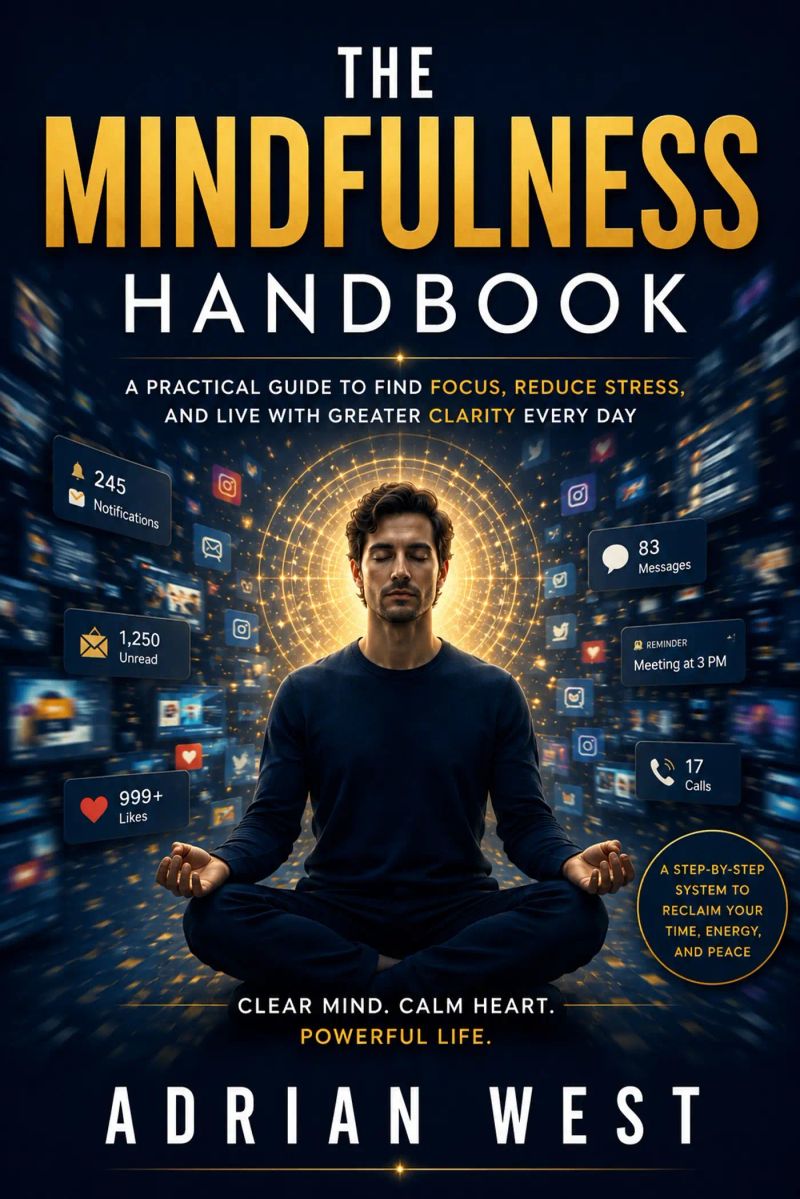
The Mindfulness Handbook
A Practical Guide to Find Focus, Reduce Stress, and Live with Greater Clarity Every DayBy Theodore Avila

Length10h 43m
About this audiobook
The Mindfulness Handbook: practical attention training, secular mindfulness, and a clear-eyed meditation guide for skeptics — no apps, no retreats, no subscription required. By a former attention researcher with twenty-five years of daily practice.
"If you have picked up this book, there is a fair chance you do not entirely trust the word mindfulness. I would not blame you." Theodore Avila spent fifteen years running academic studies on attention and meditation before leaving research — partly because the field was producing over-hyped claims he could not defend. This book is his honest account of what the practice actually is, stripped of the marketing and the billion-dollar wellness industry that has nearly destroyed the word.
The core is a three-part definition stated in the first chapter: attention, directed on purpose, to what is actually happening, with as little extra commentary as possible. Everything else — the sitting posture, the breath as anchor, the body scan, the difficult emotion practice that most readers quietly skip — is a refinement of that one capacity. Chapters apply the same attention training to conflict, conversation, parenting, driving, the phone, sleep, grief, and old age. A chapter on the science tells you honestly which research holds up, which findings have failed to replicate, and what twenty-five years of daily sitting actually changed — and did not change — in one person's life. Chapters on apps and retreats work like consumer reports. A chapter on teacher trainings names the patterns that indicate cult-adjacent danger. A chapter on trauma explains why the standard body scan is not safe for everyone.
Inside this secular mindfulness and attention training book:
• What mindfulness actually is — The precise three-part definition and a chapter on how the word was polluted by apps, corporate wellness, over-hyped science, and spiritual bypass
• The rep that is the entire practice — Why the wandering mind is the exercise and not the failure; the crucial distinction between mindfulness and concentration (samadhi)
• Sitting, standing, walking, eating — Every formal posture with practical instruction on duration, time of day, posture adjustments, and what to do when the practice surfaces difficult material
• The difficult emotion practice — Treated as "the entire point of everything else," with separate careful chapters on mindfulness and trauma, mindfulness and grief, and spiritual bypass
• The science, told honestly — Where the mindfulness research holds up (MBCT for depression relapse, stress reduction), where allegiance effects and weak controls inflated the findings, and what the replication crisis means for practitioners
• A consumer report on apps and retreats — Five categories of apps assessed honestly, guidance on when a silent retreat earns its cost, and red-flag patterns in teacher trainings that shade toward the cult-adjacent
• Practice across a whole life — Dedicated chapters on mindfulness and the phone, sleep, money, marriage, solitude, politics, old age, and a full day-in-the-life of an ordinary practitioner off the cushion
Every chapter ends with a short "Try this:" experiment that takes fifteen minutes or less and requires nothing but your attention — no audio downloads, no QR codes, no app, no subscription tier. This is practical attention training for the reasonably skeptical adult who wants to know what the practice actually does, not what the marketing says it does.
For readers of Joseph Goldstein's Mindfulness: A Practical Guide to…
Audiobook details
GenreSelf-Help, Health and Wellness, Psychology
Length10 hrs 43 mins
Narrated byListen with 1,000+ voices
FormateBook with Audio
LanguageEnglish
Table of contents
1Introduction: A Letter to the Skeptic
2Chapter 1: What Mindfulness Actually Is (And How It Got Polluted)
3Chapter 2: The Attention Training That’s the Actual Practice
4Chapter 3: Sitting — The Part That Scares People
5Chapter 4: Standing, Walking, Eating
Show all chaptersShow less
6Chapter 5: The Body Scan, Demystified
7Chapter 6: Mindfulness vs. Meditation (They’re Different)
8Chapter 7: The Breath as Anchor
9Chapter 8: When the Mind Won’t Stop (Which Is Always)
10Chapter 9: The Difficult Emotion Practice
11Chapter 10: Mindfulness in Conflict
12Chapter 11: Mindfulness in Conversation
13Chapter 12: Mindfulness While Parenting
14Chapter 13: Mindfulness While Driving, Working, Eating
15Chapter 14: Apps — What’s Useful, What’s Noise
16Chapter 15: Retreats — When They’re Worth It, When They’re Not
17Chapter 16: Teacher Trainings — The Legitimate, the Hasty, and the Cult-Adjacent
18Chapter 17: The Science, As Honestly As I Can Tell It
19Chapter 18: Mindfulness and Trauma — A Careful Conversation
20Chapter 19: Mindfulness and Grief
21Chapter 20: Mindfulness in Old Age
22Chapter 21: Twenty-Five Years of Practice — An Honest Report
23Chapter 22: The Long Quiet Practice
24Chapter 23: Mindfulness and the Phone
25Chapter 24: Mindfulness and Sleep
26Chapter 25: Mindfulness and Money
27Chapter 26: Mindfulness and Politics
28Chapter 27: Mindfulness and Marriage
29Chapter 28: The Practice and Solitude
30Chapter 29: A Day in the Life
31Chapter 30: A Brief Conclusion
32Appendix A: A One-Year Practice Curriculum
33Appendix B: Troubleshooting Common Difficulties
34Appendix C: Recommended Reading, Honestly Annotated
35Appendix D: A Glossary of Terms
36Appendix E: When to Seek Professional Help
37Appendix F: Community, Sangha, and the Question of Practicing With Others
38Appendix G: Letters to Specific Readers
39Acknowledgments
More from Theodore Avila
Learning to PrayJames Martin13h 24m4.5 (3.4K)$33 · $0.00
Truth Without ApologyAcharya Prashant6h 41m4.8 (2.2K)$18 · $0.00
Autism Out Loud: the instant New York Times Bestseller. Moving Stories and Parenting Lessons Learned from Three Mothers of Children with AutismKate Swenson, Carrie Cariello, Adrian Wood8h 41m4.8 (2.1K)$26 · $0.00
Swayam Ki AwaazPrem Rawat8h 34m4.7 (1.1K)$26 · $0.00
Forever BoyKate Swenson9h 27m4.7 (5K)$29 · $0.00

You Are Worth ItKyle Carpenter, Don Yaeger8h 53m4.7 (4.8K)$29 · $0.00

The Happiest Man on EarthEddie Jaku3h 48m4.6 (178K)$7 · $0.00

Finding MeViola Davis9h 15m4.6 (256.4K)$29 · $0.00

Spiritual AnatomyDaaji Kamlesh D. Patel9h 47m4.7 (319)$29 · $0.00

The Dangerous Truth about Today’s MarijuanaLaura Stack CSP, MBA9h 57m4.7 (385)$20 · $0.00
The Gospel according to Spiritualism (Translated)Allan Kardec14h 39m4.6 (3.9K)$5.70 · $0.00

Birdie & HarlowTaylor Wolfe7h 50m4.6 (6.5K)$26 · $0.00
CrossroadsKaleb Dahlgren7h 56m4.6 (4.9K)$26 · $0.00

Life on the BridgeKaelynn Partlow5h 40m4.6 (1.1K)$24 · $0.00

Keep Your Love OnDanny Silk9h 4m4.6 (8.1K)$10 · $0.00
The Tao of Joy Every DayDerek Lin10h 24m4.6 (762)$20 · $0.00
UndividedVicky Beeching9h 2m4.6 (1.3K)$29 · $0.00

HE CAN WHO THINKS HE CAN & OTHER BOOKS ON SUCCESSOrison Swett Marden5h 54m4.6 (1.2K)$1.99 · $0.00
Level UpRob Dial7h 42m4.6 (3.3K)$26 · $0.00
Burn the HaystackJennie Young, PhD9h 30m4.6 (543)$29 · $0.00

A Plague Upon Our HouseScott W. Atlas MD10h 37m4.5 (3.4K)$20 · $0.00

The Cancer CodeDr. Jason Fung10h 48m4.5 (5.3K)$29 · $0.00

The Gift of TherapyIrvin Yalom7h 39m4.5 (38.8K)$26 · $0.00

EarlySarah DiGregorio9h 47m4.5 (1.3K)$29 · $0.00

Bottle of LiesKatherine Eban14h 25m4.4 (12K)$33 · $0.00
The 36-Hour DayNancy L. Mace, Peter V. Rabins17h 13m4.4 (9.2K)$28 · $0.00

FlooredSara Reardon10h 36m4.5 (1K)$29 · $0.00
Radical RemissionKelly A. Turner9h 26m4.4 (8.1K)$29 · $0.00
The Sinatra SolutionStephen T. Sinatra MD9h4.5 (899)$20 · $0.00

The Songaminute ManSimon McDermott6h 12m4.5 (280)$24 · $0.00
Sometimes BrilliantLarry Brilliant12h 27m4.5 (954)$29 · $0.00

Live Your LifeAmanda Kloots, Anna Kloots10h 54m4.4 (13.7K)$29 · $0.00

All in Her HeadElizabeth Comen13h 25m4.4 (18.2K)$33 · $0.00
The Wisdom of Your BodyHillary McBride9h 14m4.4 (6.7K)$29 · $0.00

The Alzheimer's SolutionDean Sherzai, Ayesha Sherzai9h 47m4.4 (1.9K)$29 · $0.00
Rewire Your MindsetBrian Keane6h 49m4.5 (896)$23 · $0.00
Tuning The Human Biofield: Healing With Vibrational MedicineCENTER FOR SOUND THERAPY13h 28m4.4 (2.5K)$35 · $0.00

VaccinatedPaul A. Offit8h 30m4.4 (3.7K)$26 · $0.00

Hot and UnbotheredYana Tallon-Hicks10h 44m4.5 (600)$29 · $0.00

MetabolicalRobert H. Lustig12h 4m4.4 (12.8K)$29 · $0.00
What to Make of a LifeJim Collins13h 31m4.4 (794)$33 · $0.00

Matters of the HeartJacinta Nampijinpa Price9h 35m4.8 (359)$29 · $0.00

Black AF HistoryMichael Harriot15h 43m4.7 (14.6K)$33 · $0.00

Bad Fat Black GirlSesali Bowen6h 32m4.7 (2.8K)$24 · $0.00

Invisible StormJason Kander6h 48m4.7 (3.2K)$24 · $0.00

I Am The StormJanice Dean9h4.6 (1.5K)$8 · $0.00

On Democracies and Death CultsDouglas Murray10h 38m4.6 (6.5K)$29 · $0.00

TerraformPropaganda5h 39m4.7 (594)$24 · $0.00

Southern Horrors: Lynch Law in All Its Phases (Annotated)Ida B. Wells-Barnett2h 44m4.6 (1.3K)$2 · $0.00
Hour of the HeartIrvin D. Yalom, Benjamin Yalom8h 19m4.6 (2.3K)$26 · $0.00
Braving the TruthRachel Held Evans11h 31m4.7 (359)$29 · $0.00
Level UpRob Dial7h 42m4.6 (3.3K)$26 · $0.00

As a JewSarah Hurwitz8h 36m4.6 (1.2K)$26 · $0.00

Saint Joan (Annotated)George Bernard Shaw6h 20m4.6 (1.2K)$1.20 · $0.00
Burn the HaystackJennie Young, PhD9h 30m4.6 (543)$29 · $0.00

Woman and the New Race (Annotated)Margaret Sanger6h 30m4.6 (1K)$1.99 · $0.00

Good InsideBecky Kennedy9h 55m4.5 (59.3K)$29 · $0.00

The Mis-Education of the NegroCarter Godwin Woodson5h 4m4.5 (29.4K)$1.20 · $0.00

Du Bois: EssaysW.E.B. Du Bois6h 22m4.6 (1.5K)$1 · $0.00

The North American Indian (Illustrated Edition)Edward S. Curtis, Frederick Webb Hodge5h 59m4.6 (1.4K)$2 · $0.00
You may also like

The Science of Breath (translated)William Walker Atkinson2h 37m4.1 (3K)$4.60 · $0.00

The Power of Concentration (Unabridged)William Walker Atkinson4h 23m4.0 (4.3K)$1.99 · $0.00

The Articulate AdvocateBrian K. Johnson, Marsha Hunter7h 45m4.2 (341)$19.70 · $0.00

The EnchiridionEpictetus43m4.3 (52.1K)$6 · $0.00

The Essays of Arthur Schopenhauer (translated)Arthur Schopenhauer4h 55m4.3 (3.2K)$4.70 · $0.00
How to Live on 24 Hours a DayArnold Bennett2h 4m3.6 (10.2K)$2 · $0.00

Above Lifes TurmoilJames Allen2h 12m4.1 (1.3K)$2.30 · $0.00
ToastDr. Larry Iverson7h 34m$50
Switch CraftElaine Fox9h 13m4.0 (363)$29 · $0.00
The Saturday Morning MethodBryan Aldridge4h 15m$9 · $0.00
The Confidence BlueprintBianca Saavedra8h 35m$13 · $0.00
Daily MotivationRicardo Amorim10m$7 · $0.00
KEEPING FITOrison Swett Marden8h 41m3.6 (10)$1.99 · $0.00

Unlocking HappinessScientific American10h 33m3.9 (53)$20 · $0.00

What Your Psychologist Will Tell YouMatt Scar4h 10m$6 · $0.00
Overcome ProcrastinationFelix KauFmann8h 23m$9 · $0.00
Difficult Conversations at WorkEzra Whitcomb4h 45m$9 · $0.00

PEACE, POWER & PLENTYOrison Swett Marden7h 18m4.2 (22)$1.99 · $0.00
Holistic Fitness: Holistic Fitness: A Practical Plan to Achieve Spiritual Growth (A Comprehensive Approach to Embracing Balance and Wellness Through Natural Practices)Jeffery Howerton1h 50m$3.50 · $0.00
Relaxation Breath - Breath RelaxationRosalie Somogyi, Breathcomplex2h 18m$10 · $0.00