
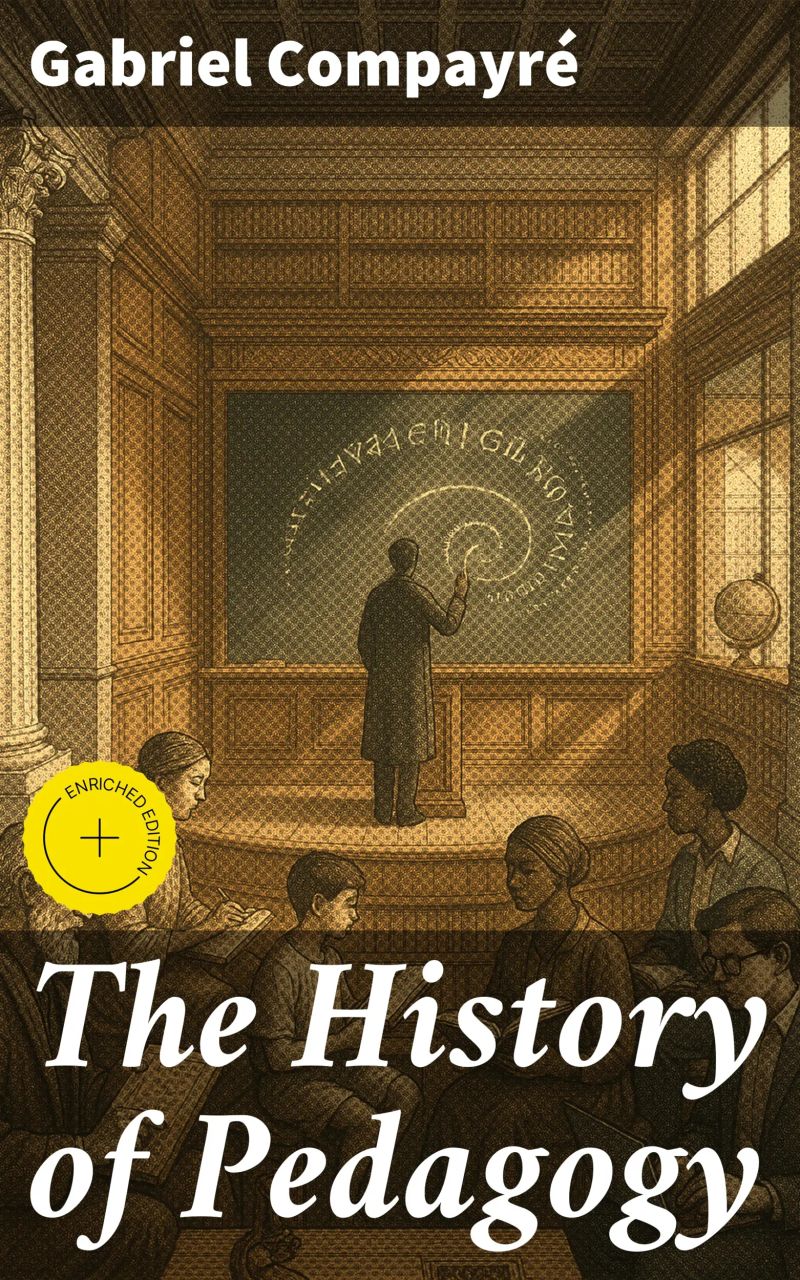
The History of Pedagogy
Enriched edition. Exploring the Evolution of Educational Philosophy and Teaching MethodsBy Gabriel Compayré


Length21h 52m
About this audiobook
In "The History of Pedagogy," Gabriel Compayré delves into the evolution of educational theories and practices, tracing their development from ancient civilizations to contemporary approaches. Compayré employs a scholarly yet accessible literary style, weaving comprehensive analyses with engaging narratives that highlight the social, political, and philosophical contexts influencing pedagogy throughout history. The text serves as both a historical account and a critical examination of the ideologies that have shaped educational systems, making it an essential read for educators, historians, and policymakers alike. Gabriel Compayré, a noted scholar in the field of education, draws upon his extensive background in philosophy and literature to articulate the complexities of pedagogical theories. His work reflects the intellectual currents of his time, including the influences of Enlightenment thinkers and the rise of formal educational institutions. Compayré's commitment to understanding the societal impacts of education underlies his motivation to document this crucial aspect of human development. This book is highly recommended for those interested in the philosophical underpinnings of education and anyone seeking a deeper understanding of how historical contexts shape pedagogical practices. Compayré's insightful analyses make "The History of Pedagogy" an invaluable resource for both scholars and practitioners committed to enhancing educational methods in today's diverse learning environments.
In this enriched edition, we have carefully created added value for your reading experience:
- A succinct Introduction situates the work's timeless appeal and themes.
- The Synopsis outlines the central plot, highlighting key developments without spoiling critical twists.
- A detailed Historical Context immerses you in the era's events and influences that shaped the writing.
- A thorough Analysis dissects symbols, motifs, and character arcs to unearth underlying meanings.
- Reflection questions prompt you to engage personally with the work's messages, connecting them to modern life.
- Hand‐picked Memorable Quotes shine a spotlight on moments of literary brilliance.
- Interactive footnotes clarify unusual references, historical allusions, and archaic phrases for an effortless, more informed read.
Audiobook details
GenreEducation and Learning
Length21 hrs 52 mins
Narrated byListen with 1,000+ voices
FormateBook with Audio
Publish dateNov 5, 2021
LanguageEnglish
Table of contents
1Introduction
2Introduction
3Synopsis
4Historical Context
5INTRODUCTION.
Show all chaptersShow less
6A SKETCH OF THE LIFE OF GABRIEL COMPAYRÉ.
7EDUCATION IN ANTIQUITY.
8EDUCATION AMONG THE GREEKS.
9CHAPTER III. EDUCATION AT ROME.
10THE EARLY CHRISTIANS AND THE MIDDLE AGE.
11THE RENAISSANCE AND THE THEORIES OF EDUCATION IN THE SIXTEENTH CENTURY.
12PROTESTANTISM AND PRIMARY INSTRUCTION. LUTHER AND COMENIUS.
13THE TEACHING CONGREGATIONS.—JESUITS AND JANSENISTS.
14CHAPTER VIII. FÉNELON.
15THE PHILOSOPHERS OF THE SEVENTEENTH CENTURY. DESCARTES, MALEBRANCHE, LOCKE.
16THE EDUCATION OF WOMEN IN THE SEVENTEENTH CENTURY.—JACQUELINE PASCAL AND MADAME DE MAINTENON.
17CHAPTER XI. ROLLIN.
18CATHOLICISM AND PRIMARY INSTRUCTION.—LA SALLE AND THE BRETHREN OF THE CHRISTIAN SCHOOLS.
19CHAPTER XIII. ROUSSEAU AND THE ÉMILE.
20THE PHILOSOPHERS OF THE EIGHTEENTH CENTURY.—CONDILLAC, DIDEROT, HELVETIUS, AND KANT.
21THE ORIGIN OF LAY AND NATIONAL INSTRUCTION.—LA CHALOTAIS AND ROLLAND.
22THE FRENCH REVOLUTION.—MIRABEAU, TALLEYRAND, CONDORCET.
23THE CONVENTION.—LEPELLETIER SAINT-FARGEAU, LAKANAL, DAUNOU.
24CHAPTER XVIII. PESTALOZZI.
25THE SUCCESSORS OF PESTALOZZI.—FRŒBEL AND THE PÈRE GIRARD.
26CHAPTER XX. WOMEN AS EDUCATORS.
27THE THEORY AND PRACTICE OF EDUCATION IN THE NINETEENTH CENTURY.
28THE SCIENCE OF EDUCATION.—HERBERT SPENCER AND ALEXANDER BAIN.
29APPENDIX.
30INDEX.
31Analysis
32Reflection
33Memorable Quotes

A Brief History of IntelligenceMax S. Bennett12h 18m4.6 (6.6K)$29 · $0.00

HomeschooledStefan Merrill Block7h 10m3.6 (18.5K)$28 · $0.00

WitnessAriel Burger8h 1m4.6 (1.3K)$20 · $0.00

EducationEllen G. White9h 41m4.6 (1.5K)$2 · $0.00

Parents and Children (Annotated)Charlotte Mason9h 23m4.6 (988)$2 · $0.00

Children Under FireJohn Woodrow Cox10h 17m4.5 (1.6K)$29 · $0.00

The State Must ProvideAdam Harris7h 15m4.5 (775)$24 · $0.00

The Call of the Wild and FreeAinsley Arment9h 7m4.4 (21.2K)$29 · $0.00
The Freelance WayRobert Vlach19h 48m4.5 (528)$40 · $0.00
Race to the BottomLuke Rosiak9h 20m4.5 (600)$29 · $0.00

They Came for the SchoolsMike Hixenbaugh9h 5m4.5 (2.6K)$8 · $0.00

Find Me UnafraidKennedy Odede, Jessica Posner11h 11m4.5 (2.7K)$29 · $0.00

Asking for ItKate Harding8h 55m4.4 (5.3K)$20 · $0.00
Defining Moments in Black HistoryDick Gregory7h 37m4.4 (6K)$26 · $0.00

The Emerald Tablets of Thoth the AtlanteanMaurice Doreal3h 4m4.4 (8.8K)$6 · $0.00

Learning AmericaLuma Mufleh6h 37m4.4 (564)$24 · $0.00
Math-ishJo Boaler7h 21m4.4 (588)$24 · $0.00

Daddy-Long-LegsJean Webster12h 18m4.2 (91K)$1.99 · $0.00
It Worked For MeColin Powell7h 42m4.3 (9.8K)$26 · $0.00

Little SoldiersLenora Chu11h 30m4.3 (3.1K)$29 · $0.00
You may also like

Bobby Fischer Goes to WarDavid Edmonds, John Eidinow11h 56m4.0 (3.5K)$29 · $0.00
The AnalectsConfucius3h 10m4.0 (31K)$1.20 · $0.00

ANNA KARENINA – Two Unabridged Translations in One Premium Edition (World Classics Series) (Annotated)Leo Tolstoy86h 35m4.2 (779.7K)$2 · $0.00

Tete-a-TeteHazel Rowley14h 14m4.1 (2.9K)$33 · $0.00
Without Saying a WordKasia Wezowski, Patryk Wezowski4h 44m3.9 (1K)$20

Sex ScandalAshley McGuire7h 9m4.0 (452)$20
The Four Books of Confucianism (Annotated)Mencius, Anonymous13h 47m4.3 (307)$2 · $0.00

Fathers and ChildrenIvan Turgenev7h 39m4.1 (186.3K)Free
The Analects of ConfuciusAnonymous4h 2m4.0 (35K)$1 · $0.00
The Roots of Obama’s RageDinesh D’Souza7h 59m4.0 (3.6K)$17 · $0.00

The Bush TragedyJacob Weisberg9h 28m3.9 (798)$20 · $0.00

The Unexpurgated Case Against Woman SuffrageAlmroth Edward Wright3h 51m$1 · $0.00
Dream Life and Real LifeOlive Schreiner0m3.5 (40)$2 · $0.00
Superiority and Subordination as Subject-Matter of SociologyGeorg Simmel3h 14m$1 · $0.00

A Crooked MileOliver Onions8h 2m$2 · $0.00
Woodrow Wilson and the World WarCharles Seymour6h 20m3.5 (11)$2 · $0.00

The Power of ConflictJon Taffer6h 6m3.9 (292)$24 · $0.00
Benjamin Franklin, Self-Revealed (Annotated)Wiliam Cabell Bruce40h 51m$2 · $0.00
The Essence of Hegel's PhilosophyGeorg Wilhelm Friedrich Hegel240h 53m$2 · $0.00

Education and the good lifeBertrand Russell8h 29m3.9 (80)$1 · $0.00