
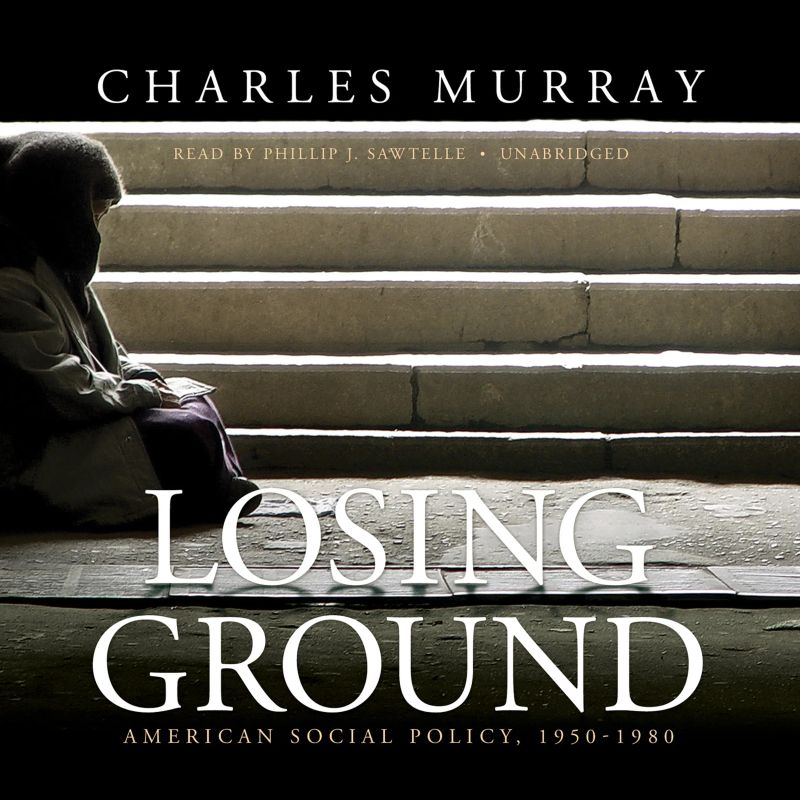
Audio only
Length9h 26m
About this audiobook
Beginning in the 1950s, America entered a period of unprecedented social reform. This remarkable book demonstrates how the social programs of the 1960s and ’70s had the unintended and perverse effect of slowing and even reversing earlier progress in reducing poverty, crime, ignorance, and discrimination. Using widely understood and accepted data, it conclusively demonstrates that the amalgam of reforms from 1965 to 1970 actually made matters worse. Why? Charles Murray’s tough-minded answers to this question will please neither radical liberals nor radical conservatives. He offers no easy solutions, but by forcing us to face fundamental intellectual and moral problems about whom we want to help and how, Losing Ground marks an important first step in rethinking social policy.
Audiobook details
Rating★★★★ 4.0 (1.2K)
Includes Goodreads, Amazon, LibraryThing
GenrePolitics and Government
Length9 hrs 26 mins
Narrated byRobert Morris
FormatAudiobook
Publish dateMar 19, 2012
LanguageEnglish
More from Charles Murray




Days of Love and Rage: A Story of RevolutionAnand Gopal22h 36m4.7 (584)$34 · $0.00

KrantikariSanjeev Sanyal11h 44m4.6 (1.3K)$16 · $0.00

Unbroken Bonds of BattleJohnny Joey Jones8h 31m4.6 (2.6K)$8 · $0.00

On Democracies and Death CultsDouglas Murray10h 38m4.6 (6.5K)$29 · $0.00

Balcony Over Jerusalem: A Middle East Memoir - Israel, Palestine and BeyondJohn Lyons12h 37m4.6 (1.4K)$33 · $0.00
RiggedMollie Hemingway12h 48m4.6 (4.2K)$23 · $0.00

SledgehammerDavid Friedman8h 21m4.7 (589)$26 · $0.00

Citizenship in a Republic (Annotated)Theodore Roosevelt2h 44m4.6 (1.4K)$2 · $0.00

No EscapeNury Turkel9h 30m4.6 (809)$28 · $0.00

Always FaithfulThomas Schueman, Zainullah Zaki12h 12m4.6 (977)$29 · $0.00

UnthinkableJamie Raskin15h 8m4.5 (9.3K)$8 · $0.00

My Fourth Time, We DrownedSally Hayden13h 59m4.6 (2.9K)$23 · $0.00

A Revolution of Common SenseScott Jennings9h 29m4.6 (528)$29 · $0.00

Statement From the Dock at the Rivonia TrialNelson Mandela2h 18m4.6 (1.3K)$1 · $0.00

Lessons from the EdgeMarie Yovanovitch17h 11m4.5 (5.9K)$40 · $0.00

To Rescue the American SpiritBret Baier10h 12m4.5 (2.7K)$8 · $0.00

StonewalledSharyl Attkisson15h 19m4.5 (4.3K)$33 · $0.00

The World According to Orwell: 1984 & Animal FarmGeorge Orwell15h 42m4.6 (1.1K)$1 · $0.00

Basic EconomicsThomas Sowell18h 32m4.5 (29.3K)$28 · $0.00

To Rescue the RepublicBret Baier, Catherine Whitney11h 42m4.5 (8.6K)$29 · $0.00
You may also like

TabooWilfred Reilly8h 43m4.1 (1.6K)$20

The Kantian Ethics: Metaphysics of MoralsImmanuel Kant23h 30m4.1 (5.1K)$1.99 · $0.00

Economic Facts and FallaciesThomas Sowell9h 46m4.3 (9.2K)$20

IntellectualsPaul Johnson18h 18m3.9 (9.1K)$28

Slouching towards GomorrahRobert H. Bork13h 8m3.9 (1.4K)$23 · $0.00

The Ten-Cent PlagueDavid Hajdu11h 50m4.1 (4.7K)$23 · $0.00

Anarchism and Other EssaysEmma Goldman4h 38m4.2 (9.8K)$2.30

Crazy TownRobyn Doolittle10h 54m3.9 (1.5K)$20

High PriceCarl Hart11h 49m4.3 (4.1K)$29 · $0.00
OpinionsRoxane Gay9h 59m4.1 (5.3K)$29 · $0.00

Drinking with the RepublicansMark Will-Weber5h 14m4.0 (48)$17

The Legal Subjection of Men (Annotated)E. Belfort Bax3h 11m3.5 (13)$2 · $0.00

Everybody's Business Is Nobody's BusinessDaniel Defoe48m3.0 (55)$2.30
Women's Sex-based OppressionAndreia Nobre12h 26m$7 · $0.00

Intellectual Frontiers in the Humanities and Applied Social SciencesRafael Alem4h 13m$27 · $0.00

Report of the Juvenile Delinquency CommitteeR. M. Algie1h 20m$2 · $0.00

Vanity Fair: February 2014 IssueVanity Fair4h 58m$7
Freakonomics Twentieth Anniversary EditionSteven D. Levitt, Stephen J. Dubner6h 45m4.3 (28)$24 · $0.00

An Unwanted Wife Walks Out on the Capo's BrotherSerafina Russo10h 17m$5

The Last Suspicious HoldoutLadee Hubbard7h 7m3.9 (927)$24 · $0.00