
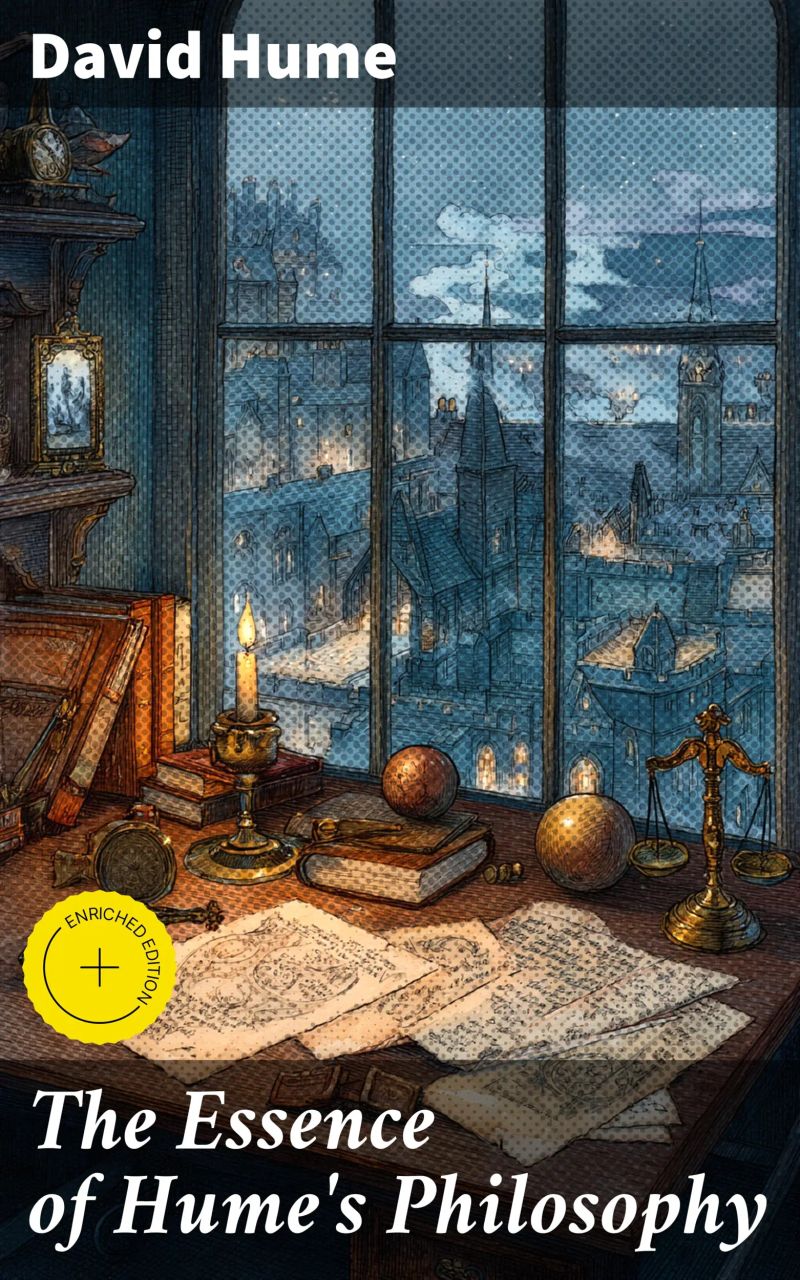
The Essence of Hume's Philosophy
Enriched edition. A Treatise of Human Nature, An Enquiry Concerning Human Understanding & An Enquiry Concerning the Principles of MoralsBy David Hume


Length37h 29m
About this audiobook
In "The Essence of Hume's Philosophy," David Hume presents an intricate tapestry of empiricism and skepticism that challenges the foundations of knowledge and belief. Written in Hume's trademark prose'—accessible yet profound'—the work delves into the relationships between human perception, experience, and the noumenal world. It explores key themes such as causation, the limits of reason, and the nature of the self, all while engaging with the metaphysics and epistemological currents of the 18th century. Hume's philosophical inquiry encourages readers to question their assumptions about reality, making the text a cornerstone of modern philosophy. David Hume (1711'Äì1776) was a Scottish philosopher and historian whose work laid the groundwork for contemporary philosophical thought, particularly in relation to empiricism and naturalism. Influenced by the Enlightenment ideals of reason and inquiry, Hume's experiences with religious and moral questions motivated him to critically examine the validity of human understanding. His writings reveal a profound awareness of the human condition, reflecting the doubts of a thinker deeply attuned to the limitations of rationality and experience. For readers seeking to engage with the nuances of Hume's thought and its relevance to contemporary philosophy, "The Essence of Hume's Philosophy" is highly recommended. This text provides a critical lens through which to explore fundamental questions of knowledge, ethics, and existence, inviting both scholars and novices alike to build upon Hume's legacy.
In this enriched edition, we have carefully created added value for your reading experience:
- A succinct Introduction situates the work's timeless appeal and themes.
- The Synopsis outlines the central plot, highlighting key developments without spoiling critical twists.
- A detailed Historical Context immerses you in the era's events and influences that shaped the writing.
- An Author Biography reveals milestones in the author's life, illuminating the personal insights behind the text.
- A thorough Analysis dissects symbols, motifs, and character arcs to unearth underlying meanings.
- Reflection questions prompt you to engage personally with the work's messages, connecting them to modern life.
- Hand‐picked Memorable Quotes shine a spotlight on moments of literary brilliance.
- Interactive footnotes clarify unusual references, historical allusions, and archaic phrases for an effortless, more informed read.
Audiobook details
GenrePhilosophy
Length37 hrs 29 mins
Narrated byListen with 1,000+ voices
FormateBook with Audio
Publish dateDec 3, 2023
LanguageEnglish
Table of contents
1Introduction
2Introduction
3Synopsis (Selection)
4Historical Context
5Author Biography
Show all chaptersShow less
6A Treatise of Human Nature
7Introduction
8BOOK I. OF THE UNDERSTANDING
9Part I. Of Ideas, Their Origin, Composition, Connexion, Abstraction, Etc.
10Section II. Division Of The Subject
11Section III. Of The Ideas Of The Memory And Imagination
12Section IV. Of The Connexion Or Association Of Ideas
13Section V. Of Relations
14Section VI. Of Modes And Substances
15Section VII. Of Abstract Ideas
16Part II. Of The Ideas Of Space And Time
17Section II. Of The Infinite Divisibility Of Space And Time
18Section III. Of The Other Qualities Of Our Idea Of Space And Time
19Section IV. Objections Answered
20Section V. The Same Subject Continued
21Section VI. Of The Idea Of Existence, And Of External Existence
22Part III. Of Knowledge And Probability
23Section II. Of Probability, And Of The Idea Of Cause And Effect
24Section III. Why A Cause Is Always Necessary
25Section IV. Of The Component Parts Of Our Reasonings Concerning Cause And Effect
26Section V. Of The Impressions Of The Senses And Memory
27Section VI. Of The Inference From The Impression To The Idea
28Section VII. Of The Nature Of The Idea Or Belief
29Section VIII. Of The Causes Of Belief
30Section IX. Of The Effects Of Other Relations And Other Habits
31Section X. Of The Influence Of Belief
32Section XI. Of The Probability Of Chances
33Section XII. Of The Probability Of Causes
34Section XIII. Of Unphilosophical Probability
35Section XIV. Of The Idea Of Necessary Connexion
36Section XV. Rules By Which To Judge Of Causes And Effects
37Section XVI. Of The Reason Of Animals
38Part IV. Of The Sceptical And Other Systems Of Philosophy
39Section II. Of Scepticism With Regard To The Senses
40Section III. Of The Antient Philosophy
41Section IV. Of The Modern Philosophy
42Section V. Of The Immateriality Of The Soul
43Section VI. Of Personal Identity
44Section VII. Conclusion Of This Book
45BOOK II. OF THE PASSIONS
46Part I. Of Pride And Humility
47Section II. Of Pride And Humility, Their Objects And Causes
48Section III. Whence These Objects And Causes Are Derived
49Section IV. Of The Relations Of Impressions And Ideas
50Section V. Of The Influence Of These Relations On Pride And Humility

50 citations de David HumeDavid Hume9m$3 · $0.00
David Hume: Eine Untersuchung über den menschlichen VerstandDavid Hume, Julius Heinrich von Kirchmann6h 32m4.1 (407)$1 · $0.00

El Tratado de la Naturaleza HumanaDavid Hume23h 49m4.1 (15.1K)$16 · $0.00

The History of England: All Six Volumes (Annotated)David Hume132h 34m4.3 (2.1K)$2 · $0.00

David Hume: Eine Untersuchung über den menschlichen Verstand (Kommentiert)David Hume, Julius Heinrich von Kirchmann7h 23m4.2 (46)$1.50 · $0.00

The History of England (Complete 6 Volumes) (Annotated)David Hume132h 22m4.3 (261)$2 · $0.00

Eine Untersuchung über den menschlichen Verstand (Kommentiert)David Hume8h 7m4.5 (12)$1 · $0.00

Cardby rettet Scotland Yard (Kommentiert)David Hume9h 51m$1 · $0.00

David Hume: The Collected Works (Annotated)David Hume37h 28m$2 · $0.00

Dialogues Concerning Natural ReligionDavid Hume5h 4m4.1 (9.9K)$1 · $0.00

The Natural History of ReligionDavid Hume4h4.1 (6.7K)$2 · $0.00

The History of England (Complete 6 Volumes)David Hume131h 50m4.3 (753)$1 · $0.00

An Enquiry Concerning Human UnderstandingDavid Hume6h 43m4.1 (28K)$2 · $0.00

David Hume: The Collected WorksDavid Hume37h 13m4.5 (261)$1 · $0.00

Of the Standard of Taste (Annotated)David Hume2h 30m$2 · $0.00

The History of England (Summarized Edition)David Hume25h 41m$2

An Enquiry Concerning Human UnderstandingDavid Hume7h 23m4.1 (24.2K)$1 · $0.00

The Complete Works of David HumeDavid Hume216h 9m4.5 (238)$1 · $0.00

The History of England: From Elizabeth to James IDavid Hume28h 13m4.4 (45)$2 · $0.00
The Magic PresenceGodfré Ray King10h 21m4.6 (307)$1.20 · $0.00

The Art of LivingThich Nhat Hanh5h 1m4.5 (14.2K)$24 · $0.00

Moral Letters to LuciliusLucius Annaeus Seneca24h 26m4.5 (71.7K)$0.99 · $0.00

Lessons in TruthH. Emilie Cady3h 50m4.5 (2.4K)$20 · $0.00

Letters from a StoicSeneca6h 5m4.4 (80.4K)$6 · $0.00
The Discourses of EpictetusP. E. MATHESOM12h 47m4.4 (17.7K)$1.20 · $0.00

IlluminationsWalter Benjamin10h 12m4.4 (16.2K)$20 · $0.00

That Bird Has My WingsJarvis Jay Masters9h 49m4.4 (13.7K)$29 · $0.00

Tâo Teh KingLaozi2h 34m4.4 (230.9K)$2 · $0.00
SymposiumPlato3h 26m4.4 (97.9K)$1.20 · $0.00

Buddhist Boot CampTimber Hawkeye2h 39m4.4 (8.4K)$18 · $0.00
Enchiridion & The Discourses of Epictetus (Annotated)Arrian Epictetus18h 9m4.4 (3.5K)$2 · $0.00

The Meditations of the Emperor Marcus Aurelius AntoninusEmperor of Rome Marcus Aurelius5h 41m4.4 (1.8M)$1 · $0.00

Crime and PunishmentFyodor Dostoevsky23h 11m4.4 (1.3M)$12 · $0.00

MeditationsMarcus Aurelius5h 52m4.4 (433.7K)$1 · $0.00

Everyday DharmaSuneel Gupta5h 2m4.5 (761)$20 · $0.00

The Joyful Wisdom ("La Gaya Scienza")Friedrich Wilhelm Nietzsche11h 37m4.4 (26.6K)$1 · $0.00
The Art of LivingEpictetus, Sharon Lebell3h 16m4.4 (50.1K)$18 · $0.00
MeditationsEmperor Of Rome Marcus Aurelius7h 23m4.3 (477.5K)$1.20 · $0.00

The Imitation of ChristThomas à Kempis6h 27m4.3 (84.6K)$21 · $0.00
You may also like

Matter & MemoryHenri Bergson10h 46m4.2 (3.9K)$1.99 · $0.00

The Complete Poetry (Annotated)Robert Browning72h 52m4.4 (316)$2 · $0.00

UnthinkableHelen Thomson7h 19m4.1 (6.4K)$24 · $0.00

An Essay Concerning Human UnderstandingJohn Locke30h 12m4.0 (18K)$1.20 · $0.00

Memory: How to Develop, Train, and Use ItWilliam Walker Atkinson4h 9m3.9 (1.4K)$0.99 · $0.00

A WRITER'S DIARY (Annotated)Virginia Woolf14h 33m4.3 (8.8K)$1.99 · $0.00

On the Improvement of the UnderstandingBenedictus de Spinoza1m4.0 (1.1K)$2.30

The Analysis of MindBertrand Russell9h 38m4.0 (1K)Free

Your Mind and How to Use It: A Manual of Practical Psychology (Unabridged)William Walker Atkinson5h 55m4.2 (1.8K)$2 · $0.00
The ShallowsNicholas Carr10h 6m4.0 (43.2K)$20

The Evil HoursDavid J. Morris11h 36m4.2 (1.7K)$29 · $0.00
David Hume: The Collected WorksDavid Hume37h 13m4.5 (261)$1 · $0.00

A Treatise of Human NatureDavid Hume24h 50m4.1 (20.1K)$2.30
Time and Free WillHenri Bergson8h 31m4.1 (1.8K)$1.99 · $0.00
EncounterMilan Kundera4h 21m3.8 (2.1K)$20 · $0.00
Thinking fast and SlowJereship1h 43m5.0 (6)Free
ListenMichel Faber12h 49m3.5 (534)$33 · $0.00

Children and Their BooksJames Hosmer Penniman40m$2 · $0.00

A Compendium on the SoulAvicenna3h 25m3.5 (28)$1.99 · $0.00

THE UNSEENAmir Ahmed 1h 12m4.8 (18)Free