
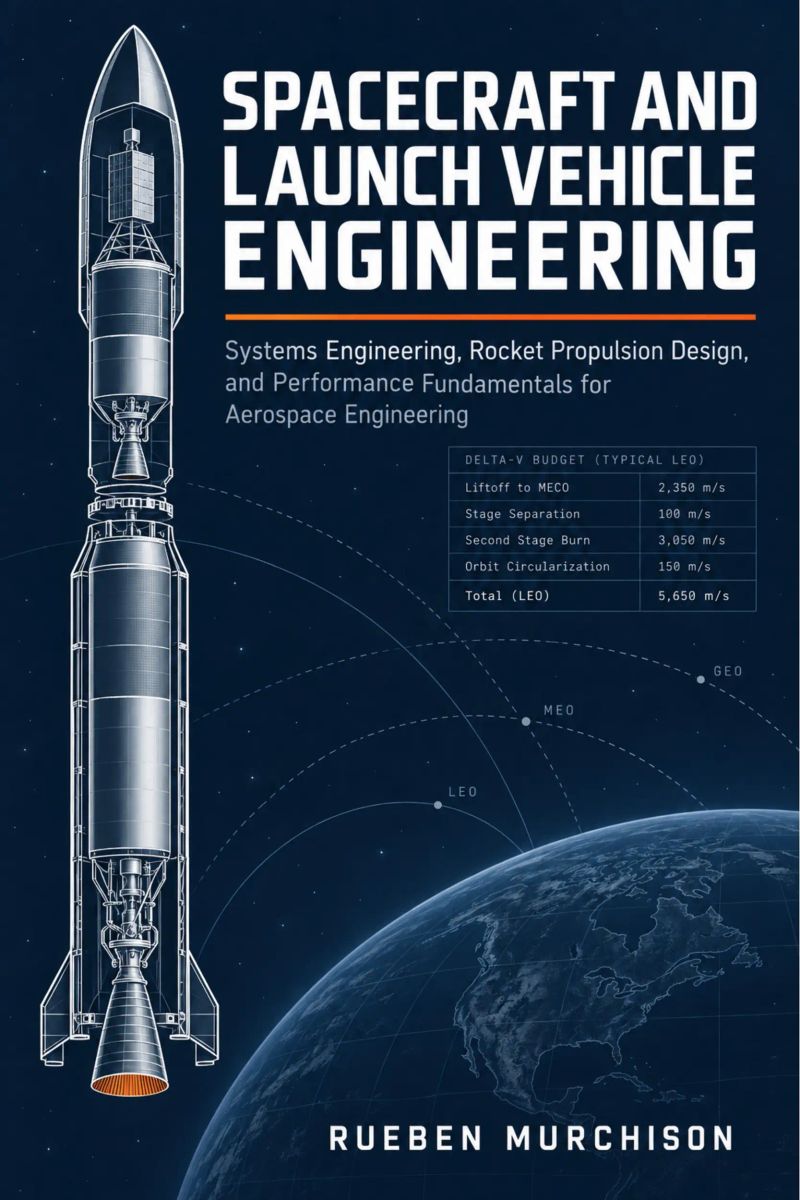
Spacecraft and Launch Vehicle Engineering
Systems Engineering, Rocket Propulsion Design, and Performance Fundamentals for Aerospace EngineeringBy Rueben Murchison


Length15h 13m
About this audiobook
Pass your exams—then learn to actually design the vehicle.
You can pass every aerospace course and still not know how a vehicle actually gets designed. This book joins the two halves. It begins with the requirements and review gates that shape every space programme, then hands you the hardware to size yourself: stage mass fractions from a delta-v budget, a regeneratively cooled chamber, a nozzle area ratio, an ascent load case at max-q, a radiator, a solar array against eclipse, a momentum wheel, a downlink budget.
One example mission runs through the whole book, so you watch its mass, power and propellant budgets close chapter by chapter. The final chapter takes it through vibration, acoustic and thermal-vacuum qualification. Rather than treating systems engineering as paperwork and propulsion as isolated equations, this text keeps them coupled—because in real programmes, a change in chamber pressure ripples into tank mass, ascent loads, thermal margins and schedule.
What you will learn:
• Translate a mission need into requirements, concept of operations and review-gate deliverables
• Apply the systems engineering lifecycle to real spacecraft and launch vehicle programmes
• Build a delta-v budget and derive stage mass fractions with the rocket equation
• Design liquid propulsion systems, including regeneratively cooled chambers and nozzle area ratios
• Analyse solid motors, nozzle flow and ascent trajectories with max-q flight loads
• Size structures, mechanisms and mass properties while tracking margins
• Design thermal control, electrical power and solar arrays against eclipse
• Develop attitude determination and control, including momentum wheels
• Close communications and data handling links with a downlink budget
• Plan on-orbit propulsion, environmental verification and qualification testing
Who it is for: Aerospace undergraduates, graduate students and early-career engineers moving from coursework to real design work. If you need the analytical tools and the programme context in one place, this book is written for you.
Audiobook details
GenreTechnology
Length15 hrs 13 mins
Narrated byListen with 1,000+ voices
FormateBook with Audio
Publish dateSep 27, 2026
LanguageEnglish
Table of contents
1Spacecraft and Launch Vehicle Engineering
2Foreword
3Preface
4About This Book
5Chapter 1: Missions, Requirements and Concept of Operations
Show all chaptersShow less
61.1 From Mission Objectives to Verifiable Requirements
71.2 The Concept of Operations
81.3 The Example Mission: Definition and Ground Rules
91.4 Stakeholders, Constraints and the Design Envelope
101.5 Requirement Traceability and Verification Planning
11Chapter 2: The Systems Engineering Lifecycle
122.1 Project Phases and the Review Gates
132.2 The V-Model and Decomposition
142.3 Trade Studies and Decision Methods
152.4 Technical Budgets and Margin Management
162.5 Interface Management and Configuration Control
17Chapter 3: The Rocket Equation and Staging
183.1 The Rocket Equation Derived
193.2 Delta-v Budgets and Losses
203.3 Stage Mass Fractions and Structural Ratios
213.4 Optimal Staging
223.5 The Example Mission Delta-v and Mass Budget
23Chapter 4: Liquid Propulsion Systems
244.1 Pressure-Fed and Pump-Fed Cycles
254.2 Injector Design and Mixture Ratio
264.3 Regenerative Cooling and Wall Temperature
274.4 Combustion Stability
284.5 The Example Mission Liquid Engine Sizing
29Chapter 5: Solid Motors and Nozzle Flow
305.1 Grain Geometry and Burn Area
315.2 Burn Rate Laws and Pressure
325.3 Nozzle Flow and Area Ratio
335.4 Thrust Coefficient and Characteristic Velocity
345.5 The Example Mission Solid Upper Stage
35Chapter 6: Ascent Trajectories and Flight Loads
366.1 The Gravity Turn and Pitch Program
376.2 Dynamic Pressure and Max-q
386.3 Load Relief and Throttling
396.4 Payload Capability Curves
406.5 The Example Mission Ascent Load Case
41Chapter 7: Structures, Mechanisms and Mass Properties
427.1 Load Paths and Structural Architecture
437.2 Thin-Shell Buckling
447.3 Materials, Factors of Safety and Margins
457.4 Mechanisms and Separation Systems
467.5 Mass Properties and the Example Mission Mass Roll-Up
47Chapter 8: Spacecraft Thermal Control
488.1 The Spacecraft Energy Balance
498.2 Coatings, Multilayer Insulation and Heat Pipes
508.3 Radiator Sizing for Hot and Cold Cases

The Honey BusMeredith May9h 31m4.4 (16.6K)$25 · $0.00

Collected Writings of Nikola TeslaThomas Commerford Martin, Nikola Tesla19h 42m4.4 (2.8K)$1.99 · $0.00

Operation PedestalMax Hastings12h 29m4.4 (5.2K)$29 · $0.00

When the Heavens Went on SaleAshlee Vance18h 20m4.4 (3K)$40 · $0.00

Everybody Has a Podcast (Except You)Justin McElroy, Travis McElroy, Griffin McElroy5h 9m4.3 (2.3K)$24 · $0.00

Hands of TimeRebecca Struthers8h 8m4.4 (1.3K)$26 · $0.00

Never Lost AgainBill Kilday10h 1m4.4 (805)$29 · $0.00

How the Internet HappenedBrian McCullough13h 28m4.3 (2.7K)$23 · $0.00

Collected Writings of Nikola TeslaNikola Tesla, Thomas Commerford Martin21h 50m4.3 (1.7K)$1 · $0.00

Just AspireAjai Chowdhry9h 13m4.4 (260)$29 · $0.00

The Little Book of AliensAdam Frank8h 20m4.3 (1.3K)$26 · $0.00

The inventions, researches and writings of Nikola Tesla (Annotated)Thomas Commerford Martin16h 59m4.3 (1.3K)$2 · $0.00

KargilV.P. Malik15h 18m4.3 (2K)$24 · $0.00

Experiments with Alternating CurrentsNikola Tesla9h 16m4.3 (874)$1.99 · $0.00

Fire on the HorizonTom Shroder, John Konrad8h 23m4.3 (858)$26 · $0.00

The Smell of Kerosene (Annotated)National Aeronautics and Space Administration, Donald L. Mallick, Peter W. Merlin11h 32m4.3 (523)$2 · $0.00

The Boy Who Harnessed the WindWilliam Kamkwamba, Bryan Mealer10h 5m4.2 (78.9K)$29 · $0.00

Across the Airless WildsEarl Swift10h 8m4.3 (1.3K)$29 · $0.00

Console WarsBlake J. Harris20h 41m4.2 (13.7K)$46 · $0.00

Improvised Munitions HandbookU.S. Department of Defense4h 49m4.3 (1.6K)$1.99 · $0.00
You may also like
Across the Airless WildsEarl Swift10h 8m4.3 (1.3K)$29 · $0.00

One ClickRichard L. Brandt5h 36m3.8 (8.7K)$14 · $0.00

There Are (No) Stupid Questions … in ScienceLeah Elson MS, MPH5h 34m4.2 (389)$17

Galaxy GirlsLibby Jackson3h 8m4.4 (870)$18 · $0.00

LiftoffEric Berger9h 4m4.6 (9.5K)$29 · $0.00
All Around the MoonJules Verne11h 27m3.8 (10K)$1.20 · $0.00
The First Men in the MoonH. G. Wells7h 32m3.8 (29.1K)$1.20 · $0.00
The First Men in the MoonH. G. Wells7h 33m3.8 (23.7K)$2.30

The Moon-VoyageJules Verne12h 41m3.8 (40.4K)$2.30 · $0.00
Orbital Mechanics and Spacecraft NavigationRasmus Kjeldgaard13h 16m$65
Graphic Films Collection - woman in the moon – act 2G. B. Royer7m$11 · $0.00
Astrodynamics and Spaceflight for EngineersTomás Ferreira12h 9m$70
Aircraft and Spacecraft Engineering FundamentalsTomas Berenguer12h 45m$75
Atomic Rocket Engines and Fission PowerYuri Petrossian12h 28m$70
Rocket Launch (Annotated)Cyril M. Kornbluth7h 48m$2 · $0.00
Microgravity Engineering and Off-World ResourcesInês Cardoso12h 33m$70
Graphic Films Collection - woman in the moon – act 1G. B. Royer7m$11 · $0.00
Thinking An Warp DriveEdson Schenkel1h 11m$30 · $0.00

Strange New WorldsRay Jayawardhana6h 39m3.9 (489)$20

Celestial ReverieSocialuser4m$7 · $0.00