
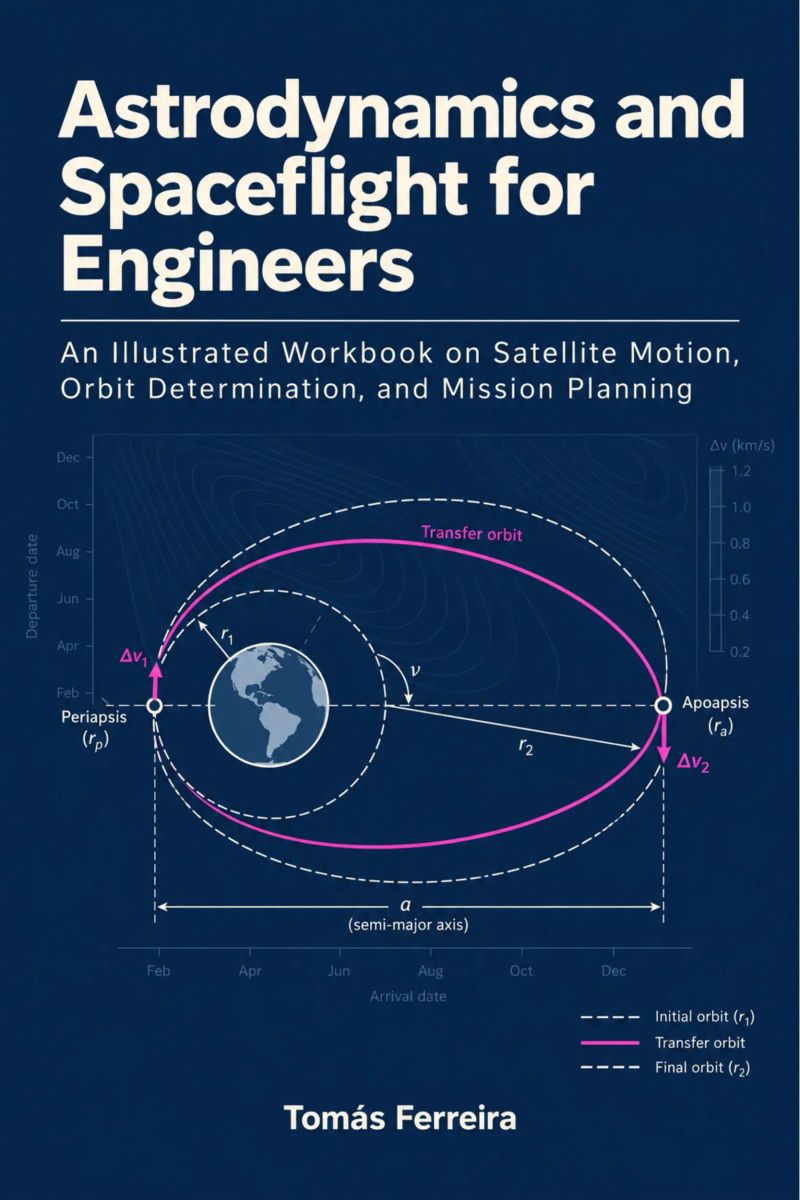
Astrodynamics and Spaceflight for Engineers
An Illustrated Workbook on Satellite Motion, Orbit Determination, and Mission PlanningBy Tomás Ferreira


Length12h 9m
About this audiobook
Astrodynamics is not hard because the ideas are strange; it is hard because one skipped substitution wrecks the answer. This workbook shows every step.
You set up frames and time systems properly, derive the two-body result, convert state vectors to elements and back, solve Kepler's equation by iteration, and build a delta-v budget from Hohmann transfers and plane changes. Then you take on rendezvous with Clohessy-Wiltshire, Lambert targeting with porkchop plots, gravity assists by patched conics, J2 drift used deliberately to design a sun-synchronous orbit, and orbit determination from real observation types. Four full mission case studies close the book.
Written for aerospace students, self-taught mission analysts and engineers preparing for spaceflight design work, this illustrated workbook treats every derivation as a sequence of checkable steps. Each chapter pairs the governing equations with worked numerical examples, so you can follow the algebra from first principles to a final answer and see exactly where a sign error or a unit slip would change the result. The mission case studies tie the individual techniques together into end-to-end design exercises.
What you will learn:
• Set up reference frames and time systems correctly before any orbit calculation
• Derive the two-body problem and convert between state vectors and orbital elements
• Solve Kepler's equation by iteration and compute time of flight for elliptic, parabolic and hyperbolic orbits
• Build delta-v budgets from impulsive manoeuvres, Hohmann transfers and plane changes
• Analyse rendezvous and relative motion using the Clohessy-Wiltshire equations
• Solve Lambert's problem and read porkchop plots for interplanetary transfer
• Apply patched conics and gravity assists to design planetary flybys
• Use J2 drift deliberately to design sun-synchronous and other special orbits
• Perform orbit determination from real observation types and close the loop with four full mission case studies
This book is for aerospace engineering students taking a first or second course in orbital mechanics, for self-taught mission analysts who need the missing steps, and for practising engineers moving into spaceflight design work who want a single illustrated reference that connects theory to mission planning.
Audiobook details
GenreTechnology, Science and Nature
Length12 hrs 9 mins
Narrated byListen with 1,000+ voices
FormateBook with Audio
Publish dateSep 27, 2026
LanguageEnglish
Table of contents
1Astrodynamics and Spaceflight for Engineers
2Foreword
3Preface
4About This Book
5Chapter 1: Reference Frames and Time Systems
Show all chaptersShow less
61.1 Why Frames and Clocks Come First
71.2 Rotation Matrices and Frame Transformations
81.3 Julian Dates and the Calendar
91.4 Sidereal Time and Earth Rotation Angle
101.5 Epochs, State Vectors and the Standard Frame Convention
11Chapter 2: The Two-Body Problem
122.1 Newtonian Gravitation and the Equation of Motion
132.2 Angular Momentum and the Orbital Plane
142.3 The Orbit Equation and Conic Sections
152.4 Energy and the Vis-Viva Equation
162.5 Kepler’s Laws and the Period
17Chapter 3: Orbital Elements and Geometry
183.1 The Classical Orbital Elements
193.2 State Vector to Elements
203.3 Elements to State Vector
213.4 Orbit Geometry and Ground Tracks
223.5 Special Geometry: Circular, Equatorial and Sun-Synchronous Orbits
23Chapter 4: Kepler’s Problem and Time of Flight
244.1 Eccentric Anomaly and the Ellipse
254.2 Kepler’s Equation and Mean Anomaly
264.3 Solving Kepler’s Equation by Newton Iteration
274.4 Hyperbolic Motion and Hyperbolic Anomaly
284.5 Parabolic Motion and the Barker Equation
29Chapter 5: Impulsive Manoeuvres
305.1 The Impulsive Burn Model and Delta-v
315.2 Hohmann Transfer
325.3 Bi-Elliptic Transfer and When It Wins
335.4 Plane Changes and Combined Burns
345.5 Building a Delta-v Budget
35Chapter 6: Rendezvous and Relative Motion
366.1 The Clohessy-Wiltshire Equations
376.2 Closed-Form Relative Motion and Safety Ellipses
386.3 Phasing Orbits and Ground-Track Control
396.4 Approach Corridors and Hold Points
40Chapter 7: Lambert’s Problem and Interplanetary Transfer
417.1 Statement of Lambert’s Problem
427.2 Solving Lambert by the Universal Variable Method
437.3 Porkchop Plots and Launch Windows
447.4 Sphere of Influence and Patched Conic Departure
45Chapter 8: Patched Conics and Gravity Assists
468.1 Spheres of Influence and the Patched Conic Method
478.2 Hyperbolic Excess Velocity and Turning Angle
488.3 Gravity Assist Energy Change and Design
498.4 Capture, Arrival and Orbit Insertion
50Chapter 9: Orbit Perturbations

LiftoffEric Berger9h 4m4.6 (9.5K)$29 · $0.00

The Honey BusMeredith May9h 31m4.4 (16.6K)$25 · $0.00
Collected Writings of Nikola TeslaThomas Commerford Martin, Nikola Tesla19h 42m4.4 (2.8K)$1.99 · $0.00

Operation PedestalMax Hastings12h 29m4.4 (5.2K)$29 · $0.00

When the Heavens Went on SaleAshlee Vance18h 20m4.4 (3K)$40 · $0.00

Everybody Has a Podcast (Except You)Justin McElroy, Travis McElroy, Griffin McElroy5h 9m4.3 (2.3K)$24 · $0.00

Hands of TimeRebecca Struthers8h 8m4.4 (1.3K)$26 · $0.00

Never Lost AgainBill Kilday10h 1m4.4 (805)$29 · $0.00

How the Internet HappenedBrian McCullough13h 28m4.3 (2.7K)$23 · $0.00

Collected Writings of Nikola TeslaNikola Tesla, Thomas Commerford Martin21h 50m4.3 (1.7K)$1 · $0.00

Just AspireAjai Chowdhry9h 13m4.4 (260)$29 · $0.00

The Little Book of AliensAdam Frank8h 20m4.3 (1.3K)$26 · $0.00
The inventions, researches and writings of Nikola Tesla (Annotated)Thomas Commerford Martin16h 59m4.3 (1.3K)$2 · $0.00

KargilV.P. Malik15h 18m4.3 (2K)$24 · $0.00
Experiments with Alternating CurrentsNikola Tesla9h 16m4.3 (874)$1.99 · $0.00

Fire on the HorizonTom Shroder, John Konrad8h 23m4.3 (858)$26 · $0.00

The Smell of Kerosene (Annotated)National Aeronautics and Space Administration, Donald L. Mallick, Peter W. Merlin11h 32m4.3 (523)$2 · $0.00

The Boy Who Harnessed the WindWilliam Kamkwamba, Bryan Mealer10h 5m4.2 (78.9K)$29 · $0.00

Across the Airless WildsEarl Swift10h 8m4.3 (1.3K)$29 · $0.00

Console WarsBlake J. Harris20h 41m4.2 (13.7K)$46 · $0.00

A Brief History of IntelligenceMax S. Bennett12h 18m4.6 (6.6K)$29 · $0.00

The Story of BirdsSteve Brusatte11h 49m4.6 (401)$29 · $0.00

Life On Earth 40th Anniversary EditionSir David Attenborough12h 27m4.6 (6.5K)$29 · $0.00

BeyondStephen Walker15h 39m4.6 (3.2K)$33 · $0.00
LiftoffEric Berger9h 4m4.6 (9.5K)$29 · $0.00

Black Earth WisdomLeah Penniman11h 54m4.6 (577)$8 · $0.00

Total Cat MojoJackson Galaxy10h 13m4.5 (8.4K)$23 · $0.00

My Life Among the UnderdogsTia Torres5h 51m4.5 (4K)$24 · $0.00

What It Takes to Save a LifeKwane Stewart6h4.6 (556)$24 · $0.00

Pastoral SongJames Rebanks8h 35m4.5 (12K)$26 · $0.00

How Stella Learned to TalkChristina Hunger7h4.5 (10.9K)$24 · $0.00

Craig & FredCraig Grossi8h 6m4.5 (9.6K)$26 · $0.00

Celebrating BirdsNatalia Rojas, Ana Maria Martinez6h 47m4.6 (330)$24 · $0.00

Saving JemimaJulie Zickefoose4h 59m4.5 (749)$20 · $0.00

Will's Red CoatTom Ryan8h 23m4.5 (2.3K)$26 · $0.00

Of Time and TurtlesSy Montgomery10h 34m4.5 (5K)$29 · $0.00

THE WOLF TRILOGY: Call of the Wild, White Fang & The Son of the WolfJack London17h 31m4.5 (2.4K)$1.99 · $0.00

Zen and the Art of Saving the PlanetThich Nhat Hanh9h 20m4.5 (3.9K)$29 · $0.00

BLACK BEAUTY (With Original Illustrations)Anna Sewell7h 31m4.5 (1.3K)$1.99 · $0.00

Bottle of LiesKatherine Eban14h 25m4.4 (12K)$33 · $0.00
You may also like
Across the Airless WildsEarl Swift10h 8m4.3 (1.3K)$29 · $0.00
LiftoffEric Berger9h 4m4.6 (9.5K)$29 · $0.00
The First Men in the MoonH. G. Wells7h 32m3.8 (29.1K)$1.20 · $0.00

All Around the MoonJules Verne11h 27m3.8 (10K)$1.20 · $0.00

The Moon-VoyageJules Verne12h 41m3.8 (40.4K)$2.30 · $0.00

The First Men in the MoonH. G. Wells7h 33m3.8 (23.7K)$2.30

Mission to MarsBuzz Aldrin4h 47m3.9 (1.7K)$17

The First Men in the MoonH.G. Wells6h 28m3.8 (25.3K)$6 · $0.00

The First Men in the MoonH. G. Wells7h 47m3.9 (22.9K)$6 · $0.00

Galaxy GirlsLibby Jackson3h 8m4.4 (870)$18 · $0.00
The Theory of RelativityAlbert Einstein5h 6m4.2 (28.5K)$1.99 · $0.00

The MissionDavid W. Brown15h 17m4.1 (1.2K)$33 · $0.00
Graphic Films Collection - woman in the moon – act 1G. B. Royer7m$11 · $0.00

Celestial VoyageSocialuser4m$7 · $0.00

Graphic Films Collection - woman in the moon – act 2G. B. Royer7m$11 · $0.00

Strange New WorldsRay Jayawardhana6h 39m3.9 (489)$20

Relativity: The Special and General Theory (Summarized Edition)Albert Einstein1h 52m4.4 (12)$2

Across the Zodiac (Annotated)Percy Greg18h 16m4.1 (11)$1.49 · $0.00
The ElevatorsHarold M.Stevens2h 9m$16.50 · $0.00

Chronicles Of The Cosmic VoyagerSocialuser4m$7 · $0.00