
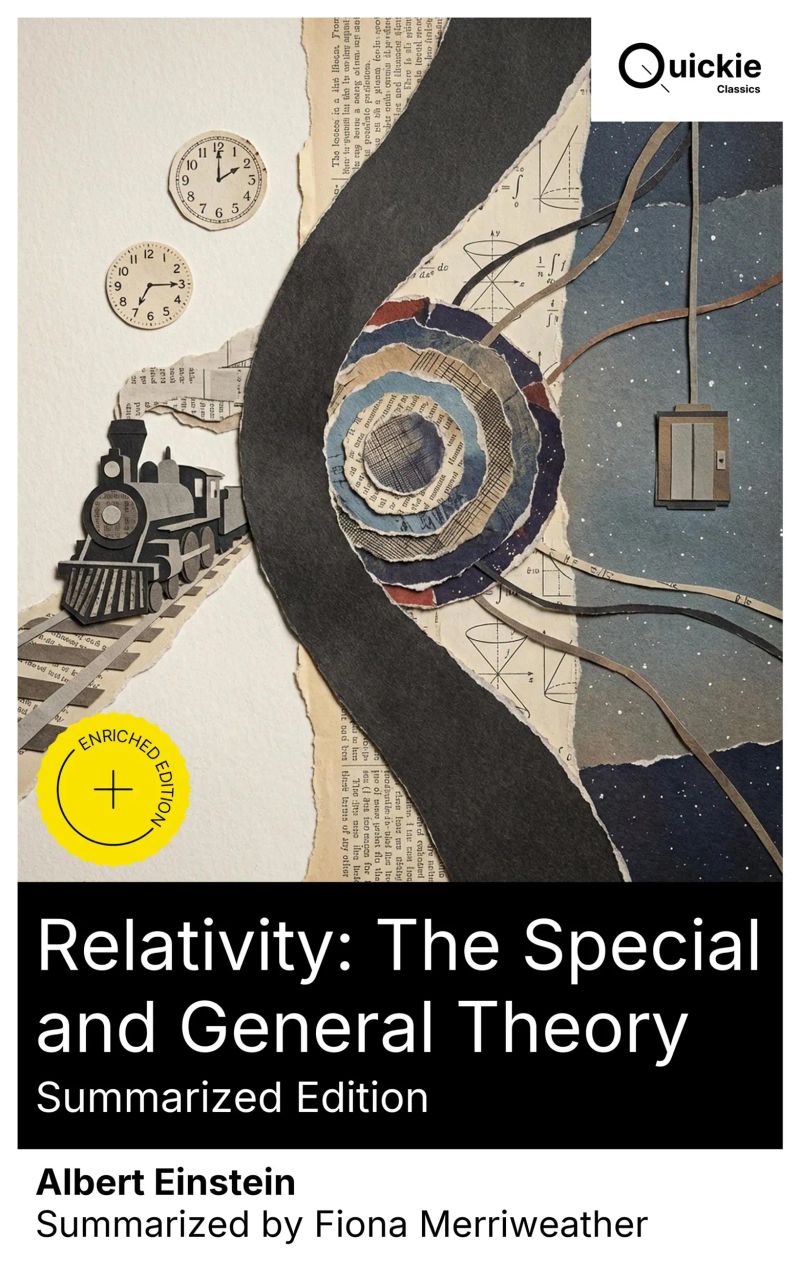
Relativity: The Special and General Theory (Summarized Edition)
Enriched edition. A Clear Guide to Space-Time, Gravity, and Thought Experiments Shaping Modern Physics and Quantum InsightsBy Albert Einstein


Length1h 51m
About this audiobook
Relativity: The Special and General Theory distills Einstein's revolutionary ideas for the informed lay reader, proceeding from the principle of relativity and the constancy of light to simultaneity, time dilation, and length contraction, then to the equivalence principle and the geometric theory of gravitation. With lucid, economical prose and memorable analogies—trains, clocks, and elevators—it frames Newtonian mechanics and Maxwellian electrodynamics as precursors while replacing absolute space-time with curved spacetime. Minimal mathematics, historical asides, and appendices situate the text within early twentieth‑century debates and the popular-science tradition following Galileo and Mach. Einstein, fresh from his 1905 annus mirabilis and the 1915 completion of general relativity, wrote to clarify his ideas for non-specialists amid swelling public interest after Eddington's 1919 eclipse. Influenced by Mach's critique of inertia, Riemannian geometry via Marcel Grossmann, and a lifelong philosophical bent, he balances conceptual rigor with pedagogical patience, correcting widespread misconceptions about simultaneity, gravitation, and inertial frames. Readers seeking a precise, historically grounded entry into modern physics will find this classic indispensable. It rewards physicists, philosophers, and curious generalists alike, offering not a textbook but a master's map of concepts that still organize contemporary cosmology, GPS technology, and the language of spacetime.
Quickie Classics summarizes timeless works with precision, preserving the author's voice and keeping the prose clear, fast, and readable—distilled, never diluted. Enriched Edition extras: Introduction · Synopsis · Historical Context · Author Biography · Brief Analysis · 4 Reflection Q&As · Editorial Footnotes.
Audiobook details
Rating★★★★ 4.4 (12)
Includes Amazon
GenreScience and Nature
Length1 hr 51 mins
Narrated byListen with 1,000+ voices
FormateBook with Audio
Publish dateJan 10, 2026
LanguageEnglish
Table of contents
1Introduction
5Author Biography
2Introduction
6Relativity: The Special and General Theory
3Synopsis
7Analysis
4Historical Context
8Reflection
Warum Krieg?Albert Einstein, Sigmund Freud2h 49m3.9 (4.4K)$2 · $0.00
Relativity: The Special and General Theory (Annotated)Albert Einstein5h 10m4.4 (1.1K)$2 · $0.00
The Principle of RelativityAlbert Einstein, H. Minkowski7h 43m4.4 (1.4K)$1 · $0.00

Wie ich die Welt seheAlbert Einstein5h 1m4.3 (5.9K)$1 · $0.00
Albert Einstein - Gesammelte WerkeAlbert Einstein28h 34m4.4 (35)$1 · $0.00
The Theory of RelativityAlbert Einstein5h 6m4.2 (28.5K)$1.99 · $0.00

3500 ultimes citazioniAlbert Einstein, Platon, Baruch Spinoza, Arthur Schopenhauer, Fyodor Dostoievski, Cicero, Confucius, Socrate, Friedrich Nietzsche, Immanuel Kant, Bouddha, Laozi, Leonardo da Vinci, Gandhi, Marcus Aurelius, Martin Luther King, William Shakespeare, Marcel Proust, Jane Austen, Anne Frank, Antoine de Saint Exupéry, Napoleon Bonaparte, Winston Churchill, Abraham Lincoln, Charles de Gaulle, Oscar Wilde, Charles Louis de Montesquieu, Soren Kierkegaard, Ralph Waldo Emerson, Henry-David Thoreau, Denis Diderot, Georg Christoph Lichtenberg, Nicolas de Chamfort, Pierre Augustin Caron de Beaumarchais, Voltaire14h 43m4.3 (11)$24 · $0.00

3500 citações ultimesAlbert Einstein, Platon, Baruch Spinoza, Arthur Schopenhauer, Fyodor Dostoievski, Cicero, Confucius, Socrate, Friedrich Nietzsche, Immanuel Kant, Bouddha, Laozi, Leonardo da Vinci, GandhiMarcus Aurelius, Martin Luther King, William Shakespeare, Marcel Proust, Jane Austen, Anne Frank, Antoine de Saint Exupéry, Napoleon Bonaparte, Winston Churchill, Abraham Lincoln, Charles de Gaulle, Oscar Wilde, Charles Louis de Montesquieu, Soren Kierkegaard, Ralph Waldo Emerson, Henry-David Thoreau, Denis Diderot, Georg Christoph Lichtenberg, Pierre Augustin Caron de Beaumarchais, Nicolas de Chamfort, Voltaire14h 10m4.1 (11)$24 · $0.00

500 citaten om de creativiteit te stimulerenAlbert Einstein, Léonardo da Vinci, Antoine de Saint Exupéry, Oscar Wilde, William Shakespeare, Léonardo Vinci, Antoine Saint Exupéry1h 59m$8 · $0.00

100 citat från Albert EinsteinAlbert Einstein24m$5 · $0.00

Warum Krieg?Albert Einstein, Sigmund Freud43m4.0 (3.7K)$6 · $0.00

3500 ultimat citatAlbert Einstein, Platon, Baruch Spinoza, Arthur Schopenhauer, Fyodor Dostoievski, Cicero, Confucius, Socrate, Friedrich Nietzsche, Immanuel Kant, Bouddha, Laozi, Leonardo da Vinci, GandhiMarcus Aurelius, Martin Luther King, William Shakespeare, Marcel Proust, Jane Austen, Anne Frank, Antoine de Saint Exupéry, Napoleon Bonaparte, Winston Churchill, Abraham Lincoln, Charles de Gaulle, Oscar Wilde, Voltaire, Charles Louis de Montesquieu, Soren Kierkegaard, Ralph Waldo Emerson, Henry-David Thoreau, Denis Diderot, Georg Christoph Lichtenberg, Nicolas de Chamfort, Pierre Augustin Caron de Beaumarchais14h 17m$24 · $0.00

500 citas para estimular la creatividadAlbert Einstein, Léonardo da Vinci, Antoine de Saint Exupéry, Oscar Wilde, William Shakespeare1h 51m$8 · $0.00

100 Citazioni sulla scienzaAlbert Einstein, Nikola Tesla, Isaac Asimov, Friedrich Nietzsche, Isaac Newton, Charles Darwin, Walt Whitman, Stephen Hawking, Claude Lévi-Strauss35m$5 · $0.00

100 citazioni umoristicheAlbert Einstein, Frank Zappa, Groucho Marx, Steve Martin, Mark Twain, Charles M. Schulz, Woody Allen, Charles Bukowski24m$5 · $0.00

Mein WeltbildAlbert Einstein7h 22m4.0 (10.1K)$15 · $0.00

100 citações de Albert EinsteinAlbert Einstein25m4.6 (11)$5 · $0.00

3500 citas ultimasAlbert Einstein, Carl Jung, Baruch Spinoza, Arthur Schopenhauer, Anton Chekov, Cicero, Confucius, Emil Cioran, Friedrich Nietzsche, Immanuel Kant, Bouddha, Laozi, Leonardo da Vinci, Gandhi, Marcus Aurelius, Johann Wolfgang von Goethe, William Shakespeare, Marcel Proust, Jane Austen, Anne Frank, Antoine de Saint Exupéry, Napoleon Bonaparte, Winston Churchill, Abraham Lincoln, Charles de Gaulle, Oscar Wilde, Voltaire, Charles Louis de Montesquieu, Soren Kierkegaard, Ralph Waldo Emerson, Henry-David Thoreau, Denis Diderot, Georg Christoph Lichtenberg, Nicolas de Chamfort, Pierre Augustin Caron de Beaumarchais14h 37m$24 · $0.00

100 citações humorísticasAlbert Einstein, Frank Zappa, Groucho Marx, Steve Martin, Mark Twain, Charles M. Schulz, Woody Allen, Charles Bukowski26m$5 · $0.00

A Brief History of IntelligenceMax S. Bennett12h 18m4.6 (6.6K)$29 · $0.00
The Story of BirdsSteve Brusatte11h 49m4.6 (401)$29 · $0.00

Black Earth WisdomLeah Penniman11h 54m4.6 (577)$8 · $0.00

Total Cat MojoJackson Galaxy10h 13m4.5 (8.4K)$23 · $0.00

My Life Among the UnderdogsTia Torres5h 51m4.5 (4K)$24 · $0.00

What It Takes to Save a LifeKwane Stewart6h4.6 (556)$24 · $0.00

Pastoral SongJames Rebanks8h 35m4.5 (12K)$26 · $0.00

How Stella Learned to TalkChristina Hunger7h4.5 (10.9K)$24 · $0.00

Craig & FredCraig Grossi8h 6m4.5 (9.6K)$26 · $0.00

Celebrating BirdsNatalia Rojas, Ana Maria Martinez6h 47m4.6 (330)$24 · $0.00

Saving JemimaJulie Zickefoose4h 59m4.5 (749)$20 · $0.00

Will's Red CoatTom Ryan8h 23m4.5 (2.3K)$26 · $0.00

Of Time and TurtlesSy Montgomery10h 34m4.5 (5K)$29 · $0.00

THE WOLF TRILOGY: Call of the Wild, White Fang & The Son of the WolfJack London17h 31m4.5 (2.4K)$1.99 · $0.00

Zen and the Art of Saving the PlanetThich Nhat Hanh9h 20m4.5 (3.9K)$29 · $0.00

BLACK BEAUTY (With Original Illustrations)Anna Sewell7h 31m4.5 (1.3K)$1.99 · $0.00

Bottle of LiesKatherine Eban14h 25m4.4 (12K)$33 · $0.00
IngrainedCallum Robinson8h 10m4.5 (1.1K)$26 · $0.00

The Lion Tracker's Guide To LifeBoyd Varty3h 1m4.4 (4.8K)$18 · $0.00

Born for LoveBruce D. Perry, Maia Szalavitz11h 42m4.4 (4K)$29 · $0.00
You may also like
The Theory of RelativityAlbert Einstein5h 6m4.2 (28.5K)$1.99 · $0.00
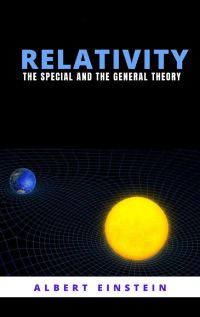
Relativity: The special and the general theoryAlbert Einstein3h 23m4.2 (41.4K)$3.50 · $0.00
The Principle of RelativityAlbert Einstein7h 12m4.4 (1.2K)$2.30
The Experience Economy, Updated EditionB. Joseph Pine II, James H. Gilmore12h 13m3.9 (3.4K)$20

One ClickRichard L. Brandt5h 36m3.8 (8.7K)$14 · $0.00

Across the Airless WildsEarl Swift10h 8m4.3 (1.3K)$29 · $0.00

The Time MachineH.G. Wells3h 20m4.0 (651.1K) · 3000Free
Astrophysics for Young People in a HurryNeil deGrasse Tyson3h 32m4.3 (15.1K)$15
Crossing the ChasmGeoffrey A. Moore9h 45m4.1 (37.9K)$29 · $0.00
Thinking An Warp DriveEdson Schenkel1h 11m$30 · $0.00

Graphic Films Collection - woman in the moon – act 2G. B. Royer7m$11 · $0.00

Build RESTful Web APIs with ASP.NET CoreTessa Ibarra8h 29m$5 · $0.00

Discoveries and Inventions of the Nineteenth CenturyRobert Routledge43h 30m4.2 (38)$1 · $0.00

Async Python for BeginnersAdrian Okafor7h 26m$5

The history of money and bankingKidsChoice54m$12 · $0.00
Object-Oriented C++ You Can Build OnFelix Ibarra7h 52m$5 · $0.00

From Zero to Job-Ready Web DeveloperDesmond Abara7h 33m$5 · $0.00

The Recent Revolution in Organ BuildingGeorge Laing Miller4h 27m$2 · $0.00

Pegi-Online Eine Ergänzung Des Pegi-Systems Für Online-SpieleGrit Stephan16m$4 · $0.00

Remarks on the Proposed Railway Between Birmingham and LondonAnonymous57m$2 · $0.00