
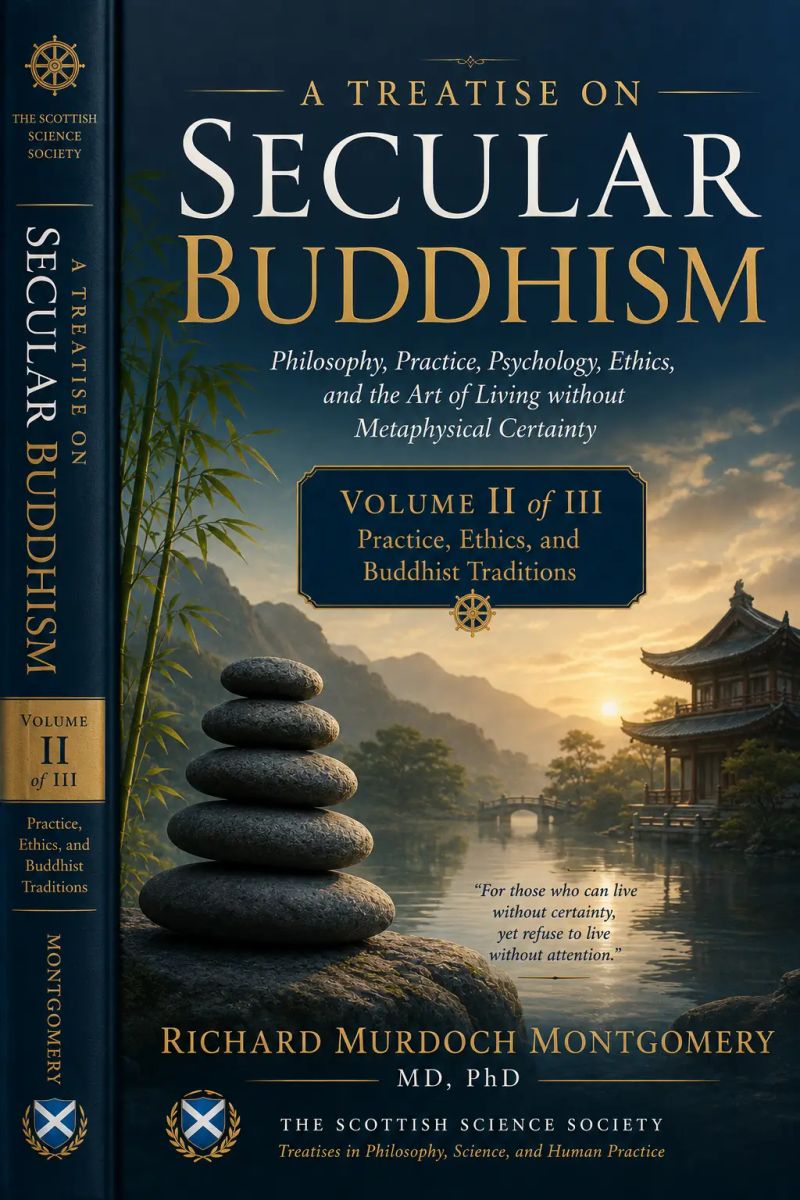
Secular Buddhism Volume II of III
Practice, Ethics, and Buddhist TraditionsBy Richard Murdoch Montgomery, MD, PhD


Length20h 47m
About this audiobook
A Treatise on Secular Buddhism, Volume II of III: Practice, Ethics, and Buddhist Traditions carries the inquiry from meditation into the practical and ethical life. Richard Murdoch Montgomery examines mindfulness of breathing, the four foundations of mindfulness, concentration and the jhānas, insight practice, loving-kindness, contemplative obstacles, adverse effects, and meditation safety. The volume then turns to ethics, speech, livelihood, sexuality, remorse, and moral repair before exploring Theravāda, Mahāyāna, Madhyamaka, Yogācāra, Chan and Zen, Pure Land, Vajrayāna, Buddhist modernism, and dialogue with Western philosophy. Scholarly yet accessible, it respects Buddhist traditions while distinguishing historical evidence, philosophical interpretation, contemplative experience, and modern scientific claims.
Audiobook details
GenrePhilosophy, Science and Nature
Length20 hrs 47 mins
Narrated byListen with 1,000+ voices
FormateBook with Audio
Publish dateAug 22, 2026
LanguageEnglish
Table of contents
1Copyright and Publication Information: Preface to Volume II
2Chapter 25 - Mindfulness of Breathing
325.1. The early textual foundations
425.2. Attention to the breath
525.3. Whole-body breathing: Applied example: from point to field
Show all chaptersShow less
625.4. Calming bodily formation
725.5. Distraction and return
825.6. Subtle breath and concentrated awareness
925.7. A progressive eight-week practice sequence: Worked case: revising the sequence
10Exercises
111. Text and modern use. Why is breathing practice not adequately described as a relaxation technique?
122. Choosing an anchor. The nostrils are too faint, but abdominal movement is clear. What should you do?
133. Control. You notice yourself manufacturing slow breaths. Resolve the problem.
144. Whole-body breathing. Distinguish whole-body breathing from imagining air in the limbs.
155. Calming. What does calming bodily formation mean operationally?
166. Distraction. You spend nine minutes planning and notice only in the final minute. Was the session useless?
177. Subtle breath. The breath becomes almost imperceptible and anxiety arises. What is the prudent response?
188. Eight-week course. You miss four days in week five. Must you repeat or compensate with a long sitting?
19Direction check
20Chapter 26 - The Four Foundations of Mindfulness
2126.1. Mindfulness of the body: Applied example: the body before the explanation
2226.2. Mindfulness of feeling tone
2326.3. Mindfulness of mind
2426.4. Mindfulness of phenomena
2526.5. Observation, interpretation, and reactivity
2626.6. Ardent, clearly knowing, and mindful
2726.7. Applying the four foundations in ordinary life
28Worked examples
29Exercises
301. Body. During an argument, you notice a clenched jaw. What does body mindfulness add?
312. Feeling tone. A pleasant notification arrives during work. How can feeling-tone mindfulness be practised?
323. Mind. You think, “I am an anxious person.” Reframe it.
334. Phenomena. What makes a category such as craving useful rather than merely labelling?
345. Interpretation. Someone does not answer your message. Separate event from inference.
356. Ardour and clarity. How can effort become unhelpful strain?
367. Ordinary life. Give a three-second practice for a difficult conversation.
378. Boundaries. Does understanding another person’s conditions require tolerating harm?
38Direction check
39Chapter 27 - Concentration and the Jhānas
4027.1. Collectedness of mind
4127.2. Access concentration
4227.3. The classical absorptions
4327.4. Pleasure, joy, equanimity, and unification
4427.5. Competing interpretations of jhāna
4527.6. Benefits and risks of intensive concentration
4627.7. A secular understanding of altered contemplative states
47Worked examples
48Exercises
491. Collectedness. What distinguishes collectedness from mere suppression of thought?
502. Access. Why should “access concentration” be used cautiously?
More from Richard Murdoch Montgomery, MD, PhD

ADHDRichard Murdoch Montgomery, MD, PhD23h 51m Only with Ultra

A TREATISE ON SECULAR BUDDHISM Volume III of III.Richard Murdoch Montgomery, MD, PhD19h 49m$9.99
A TREATISE ON SECULAR BUDDHISM VOLUME I OF IIIRichard Murdoch Montgomery9h 31m$9.99

São Paulo: A Social and Environmental History of the City That Transformed BrazilRichard Murdoch Montgomery39h 10m$14.99

China, Five Thousands Years of Power, Culture and Reinvention.Richard Murdoch Montgomery, MD, PhD17h 49m$14.99
That Bird Has My WingsJarvis Jay Masters9h 49m4.4 (13.7K)$29 · $0.00

Tâo Teh KingLaozi2h 34m4.4 (230.9K)$2 · $0.00

SymposiumPlato3h 26m4.4 (97.9K)$1.20 · $0.00

Buddhist Boot CampTimber Hawkeye2h 39m4.4 (8.4K)$18 · $0.00
Enchiridion & The Discourses of Epictetus (Annotated)Arrian Epictetus18h 9m4.4 (3.5K)$2 · $0.00

The Meditations of the Emperor Marcus Aurelius AntoninusEmperor of Rome Marcus Aurelius5h 41m4.4 (1.8M)$1 · $0.00

Crime and PunishmentFyodor Dostoevsky23h 11m4.4 (1.3M)$12 · $0.00

MeditationsMarcus Aurelius5h 52m4.4 (433.7K)$1 · $0.00
Everyday DharmaSuneel Gupta5h 2m4.5 (761)$20 · $0.00

The Joyful Wisdom ("La Gaya Scienza")Friedrich Wilhelm Nietzsche11h 37m4.4 (26.6K)$1 · $0.00
The Art of LivingEpictetus, Sharon Lebell3h 16m4.4 (50.1K)$18 · $0.00
MeditationsEmperor Of Rome Marcus Aurelius7h 23m4.3 (477.5K)$1.20 · $0.00

The Imitation of ChristThomas à Kempis6h 27m4.3 (84.6K)$21 · $0.00

Sadhana: the realisation of lifeRabindranath Tagore3h 49m4.4 (8.6K)$6 · $0.00
SapiensYuval Noah Harari15h 18m4.3 (1.4M) · 1205$33 · $0.00
You BelongSebene Selassie8h 35m4.4 (2.7K)$26 · $0.00

The Song Celestial; Or, Bhagavad-Gîtâ (from the Mahâbhârata)Anonymous2h 18m4.4 (3.2K)$2 · $0.00
The KybalionThe Three Initiates3h 47m4.3 (58.7K)$20 · $0.00

Chuang Tzu: Mystic, Moralist, and Social ReformerZhuangzi14h 42m4.4 (1.2K)$1 · $0.00

High-RisersBen Austen13h 33m4.4 (2.8K)$33 · $0.00

A Brief History of IntelligenceMax S. Bennett12h 18m4.6 (6.6K)$29 · $0.00
The Story of BirdsSteve Brusatte11h 49m4.6 (401)$29 · $0.00

Craig & FredCraig Grossi8h 6m4.5 (9.6K)$26 · $0.00

Celebrating BirdsNatalia Rojas, Ana Maria Martinez6h 47m4.6 (330)$24 · $0.00

Saving JemimaJulie Zickefoose4h 59m4.5 (749)$20 · $0.00

Will's Red CoatTom Ryan8h 23m4.5 (2.3K)$26 · $0.00

Of Time and TurtlesSy Montgomery10h 34m4.5 (5K)$29 · $0.00
Zen and the Art of Saving the PlanetThich Nhat Hanh9h 20m4.5 (3.9K)$29 · $0.00

BLACK BEAUTY (With Original Illustrations)Anna Sewell7h 31m4.5 (1.3K)$1.99 · $0.00

Bottle of LiesKatherine Eban14h 25m4.4 (12K)$33 · $0.00

IngrainedCallum Robinson8h 10m4.5 (1.1K)$26 · $0.00

The Lion Tracker's Guide To LifeBoyd Varty3h 1m4.4 (4.8K)$18 · $0.00

Born for LoveBruce D. Perry, Maia Szalavitz11h 42m4.4 (4K)$29 · $0.00

The Mountains of California (With Original Drawings & Photographs) (Annotated)John Muir11h 35m4.5 (1.1K)$2 · $0.00

The New GuysMeredith Bagby16h 50m4.4 (1.2K)$40 · $0.00

Blue PasturesMary Oliver3h 23m4.4 (3.8K)$18 · $0.00
The Rise and Reign of the MammalsSteve Brusatte13h 26m4.4 (11.1K)$33 · $0.00

VaccinatedPaul A. Offit8h 30m4.4 (3.7K)$26 · $0.00

The Light EatersZoë Schlanger10h 57m4.4 (22.8K)$29 · $0.00

Where the Lost Dogs GoSusannah Charleson11h 7m4.5 (699)$23 · $0.00
You may also like

How to Write Non-FictionJoanna Penn5h 30m4.5 (1.9K) Only with Ultra

Above Lifes TurmoilJames Allen2h 12m4.1 (1.3K)$2.30 · $0.00

The Science of Breath (translated)William Walker Atkinson2h 37m4.1 (3K)$4.60 · $0.00

A Series of Lessons in Raja YogaWilliam Walker Atkinson8h 53m4.1 (559)$2 · $0.00
The Wakeful BodyWilla Blythe Baker5h 34m4.4 (555)$17

The Hormone Balance BibleShawn Tassone15h 38m4.0 (646)$33 · $0.00
Self-Coaching for LeadersAndrew Tallents4h 37m$16 · $0.00
Step I Emptiness of MindFalco Wisskirchen30m$18 · $0.00
The Code of High ProductivitySara Melo3h 34m$5.80 · $0.00
ALIGN AND RECEIVEKenneth C. Spears5h 41m$6
Unraveling HabitsUnknown Author59m$17 · $0.00
The Intelligent Prosperity MethodDanniel Silva3h 42m$1.80 · $0.00

Mindfulness in Your Everyday LifeAdrian Tanase6h 24m$14 · $0.00

Endomorph Diet Cookbook For BeginnersYvonne Stanton1h 44m$8.50 · $0.00
Your Subconscious PowerCharles M. Simmons8h 23m4.2 (87)$4 · $0.00
Step I TemperanceFalco Wisskirchen30m$18 · $0.00

The 28 Mental LawsSara Melo4h 47m$1.80 · $0.00
Dopamine Fasting: A Journey to Reclaiming Your Focus and Well-BeingMei Lin Zhang6h 9m$3.50 · $0.00
Becoming A Badass MeditatorRenu Khetan 4h 32m4.7 (22)$9.99 · $0.00

Easy Everyday Meditations, Mindfulness, and PranayamasSue Fuller3h 46m$15