
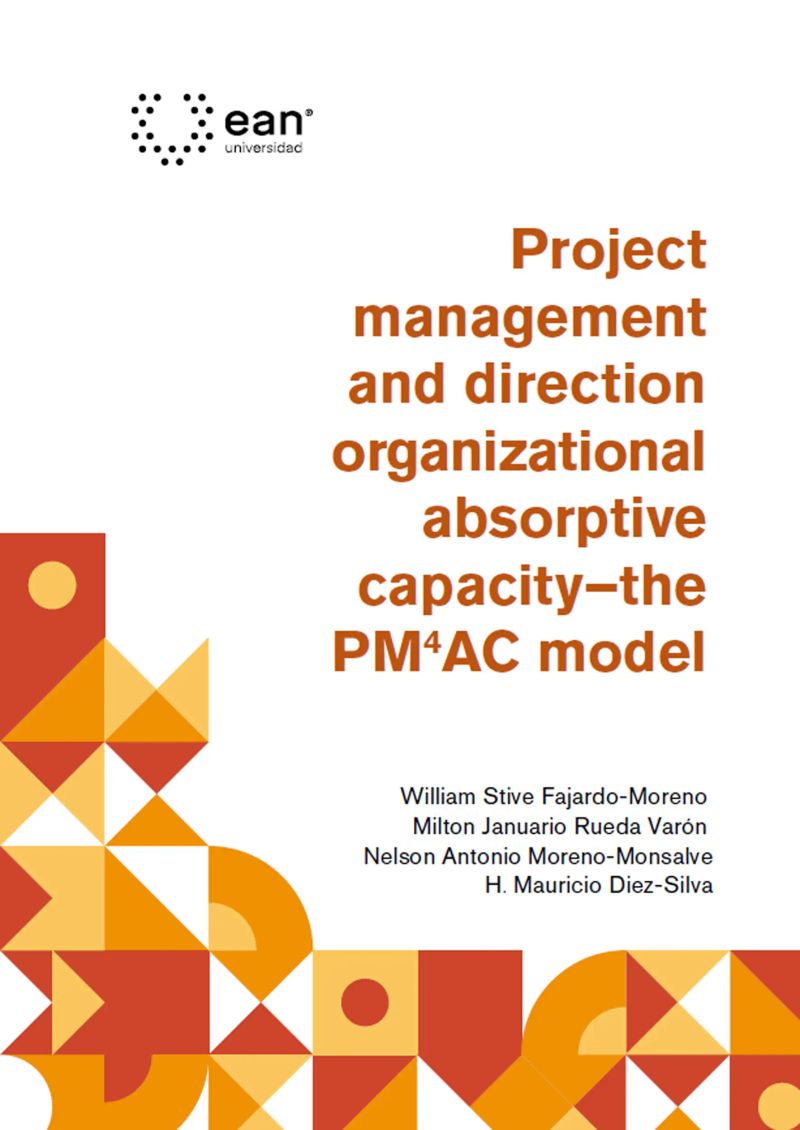
Project management and direction organizational absorptive capacity – the PM4AC model
By William Stive Fajardo-Moreno, Milton Januario Rueda-Varón, Nelson Antonio Moreno-Monsalve, Henry Mauricio Diez-Silva


Length4h 47m
About this audiobook
This book gathers an important research process in the field of project management, addressing a current issue for the challenges posed by highly competitive environments, such as the relationship of projects with knowledge, more specifically with external knowledge. For this purpose, it uses the dynamic absorptive capacity, a concept widely used in the scientific literature but little explored in project management. The book also presents a practical tool to determine the magnitude of the dynamic absorptive capacity. This makes it possible to establish a baseline to initiate a process of continuous improvement, which provides the opportunity to improve the competitiveness of the organization based on proper knowledge management. In this same sense, the model presented in this document contains a series of intervals that offer the possibility for the organization to catalog its results qualitatively.
Audiobook details
GenrePolitics and Government
Length4 hrs 47 mins
Narrated byListen with 1,000+ voices
FormateBook with Audio
Publish dateNov 24, 2023
LanguageSpanish
Table of contents
1l
2» William Stive
3Fajardo-Moreno, William Stive
4II. Moreno-Monsalve, Nelson Antonio
5Catalogación en la fuente: Biblioteca Universidad EAN
Show all chaptersShow less
6Prologue
7Presentation
8Introduction
9Chapter 1: Background
10and performance in organizations
11Omeno & Sang (2018); Blixt & Kirytopoulos (2017).
12(Helfat & Martin, 2015)
13T. Flatten, Adams, & Brettel (2015)
14Potential absorptive capacity
15Antecedents
161.5. Measurement of dynamic absorptive capacity
171.6. Dynamic absorptive capacity in project management
18Chapter 1: Background
19Determinant n
202.1. Description of the model domain
21Source. Zahra & George (2002).
22Competitive advantage
232.2. Model overview
24Potential absorptive capacity
25Background
26Bluedorn & Denhardt (1988); Belout (1998); Hyväri (2016); Clarke (1999).
27Result
28N of Items
29Petroleum and natural gas extraction.
301 to 5 people
3110 to 20 people
326 to 10 people
33Education
34Figure 15. Distribution of project control tools
35Kaise-Meyer-Olkin Measure of Sampling Adequacy
36Sig.
37PAS13
38Project success (PS)
39ACQ
40Q C A
412 Cluster_ACQ
42Figure 16. Box diagram for the variable Acquisition (ACQ)
43ASS
442 Cluster_ASS
45RTR
462 Cluster_RTR
47Figure 18. Box diagram for the variable Transformation (TRA)
48EXT
49P X E
502 Cluster_EXP

Crónica RojaRodrigo Fluxá11h 44m4.5 (262)$15 · $0.00

Allende: Cómo la Casa Blanca provocó su muertePatricia Verdugo6h 1m4.5 (142)$8 · $0.00

Cazando a El ChapoAndrew Hogan, Douglas Century11h4.2 (6.8K)$29 · $0.00

Los archivos del cardenalDaniel Arrieta, Daniel Arrieta, Mónica González, Alejandra: Matus, Javiera Matus, Juan Cristóbal Peña, Ana María Sanhueza, Francisca. Editores: Insunza, Andrea Skoknic, Javier Ortega9h 30m4.5 (65)$14 · $0.00

En vez del optimismoJuan Pablo Luna5h 49m4.4 (37)$10 · $0.00

Empresarios zombis. La mayor elusión tributaria de la elite chilenaJuan Andrés Guzmán, Juan Andrés Guzmán, Jorge Rojas5h 56m4.0 (58)$13 · $0.00

Historias desconocidas de ChileFelipe Portales7h 21m3.9 (97)$12 · $0.00

La fronda. Cómo la elite secuestró la democraciaRenato Garin5h 22m4.0 (45)$9 · $0.00

Veinte años después, Neoliberalismo con rostro humanoFernando Atria11h 26m4.1 (19)$12 · $0.00

Autopsia. ¿De qué murió la elite?Alberto Mayol14h 30m3.6 (22)$14 · $0.00

Los archivos del cardenal 2. Casos realesAndrea Insunza, Andrea Insunza, Javier Ortega12h 49m$27 · $0.00

El Chile que se vieneRicardo Lagos, Ricardo Lagos, Oscar Landerretche18h 14m$18 · $0.00

Hijas de GeneralRocío Montes5h 33m$11 · $0.00
Yo, Presidente/aPaula Escobar Chavarría5h 51m$14 · $0.00

Lo mejor de CIPER 3CIPER14h 36m$17 · $0.00

La solución constitucional. Plebiscitos, asambleas, congresos, sorteos y mecanismos híbridosClaudio Fuentes, Claudio Fuentes, Alfredo Joignant12h 25m$18 · $0.00

1925Arturo Fontaine, Arturo Fontaine, Juan Luis Ossa, Aldo Mascareño, Renato Cristi, Hugo Herrera, Joaquín Trujillo9h 31m$16 · $0.00

El cardenal Raúl Silva Henríquez y los Derechos HumanosReinaldo Sapag5h 24m$5 · $0.00

Lo mejor de CIPER 2Mónica González9h 1m4.5 (11)$14 · $0.00

Goles y autogoles: Historia política del fútbol chilenoDaniel Matamala11h 26m4.1 (64)$10 · $0.00
You may also like

Auditoría Administrativa. Con base en la innovación organizaciónHéctor Murcia Cabra6h 45m$5 · $0.00

Gestión de la cadena de suministroKnowledge Flow55m$4 · $0.00

Administración estratégicaMario Enrique Uribe Macías5h 26m$8 · $0.00

Estoy aprendiendo el tagalog (filipinos)JM Gardner4h 20m$18 · $0.00

El funcionamiento de las edificacionesLuis Humberto Casas Figueroa12h 19m$13 · $0.00

El infoconocimientoMarisleidy Alba Cabañas3h 24m$6 · $0.00

Planeación estratégicaAlejandro Eugenio Lerma y Kirchner, Sergio Bárcena Juárez12h 44m4.6 (13)$17 · $0.00

Gestión de clusters en Colombia: una herramienta para la competitividadMartha Cecilia Rodríguez Delgado18h 4m$12 · $0.00

Realidades, perspectivas y desafíos de las microempresas en Colombia. Análisis estratégico para su desarrolloÉdgar Julián Gálvez Albarracin, Carlos Alberto Restrepo Rivillas, Lissette Hernández Fernández11h 24m$6 · $0.00

Dirección financiera: inversión y financiación, Volumen 1; Segunda ediciónLeonardo Cazorla Papis23h 57m$21 · $0.00

Contra viento y mareaVicente Donato, María Inés Barbero18h 10m$10 · $0.00

Calidad y servicioMartha Elena Vargas Quiñones15h 32m$15 · $0.00

Marketing al desnudoNacho Muñoz Campano4h 24m$12 · $0.00

Estoy aprendiendo el finlandésJM Gardner4h 14m$18 · $0.00

Dirección estratégica - 2da ediciónLuis Carlos Palacios Acero7h 1m$18 · $0.00

Viajar en rusoJM Gardner1h 11m$7 · $0.00

Gerente De RestaurantesGonzalo Eduardo Juliani Suances3h 57m$8 · $0.00
Arriostramientos de pandeo restringidoJuan Andrés Oviedo, Juan Carlos Reyes Ortíz6h 56m$15 · $0.00

Riesgos físicos IIFernando Hernao Robledo2h 58m$3 · $0.00

Trauma maxilofacialUnknown Author8h 54m$17 · $0.00