
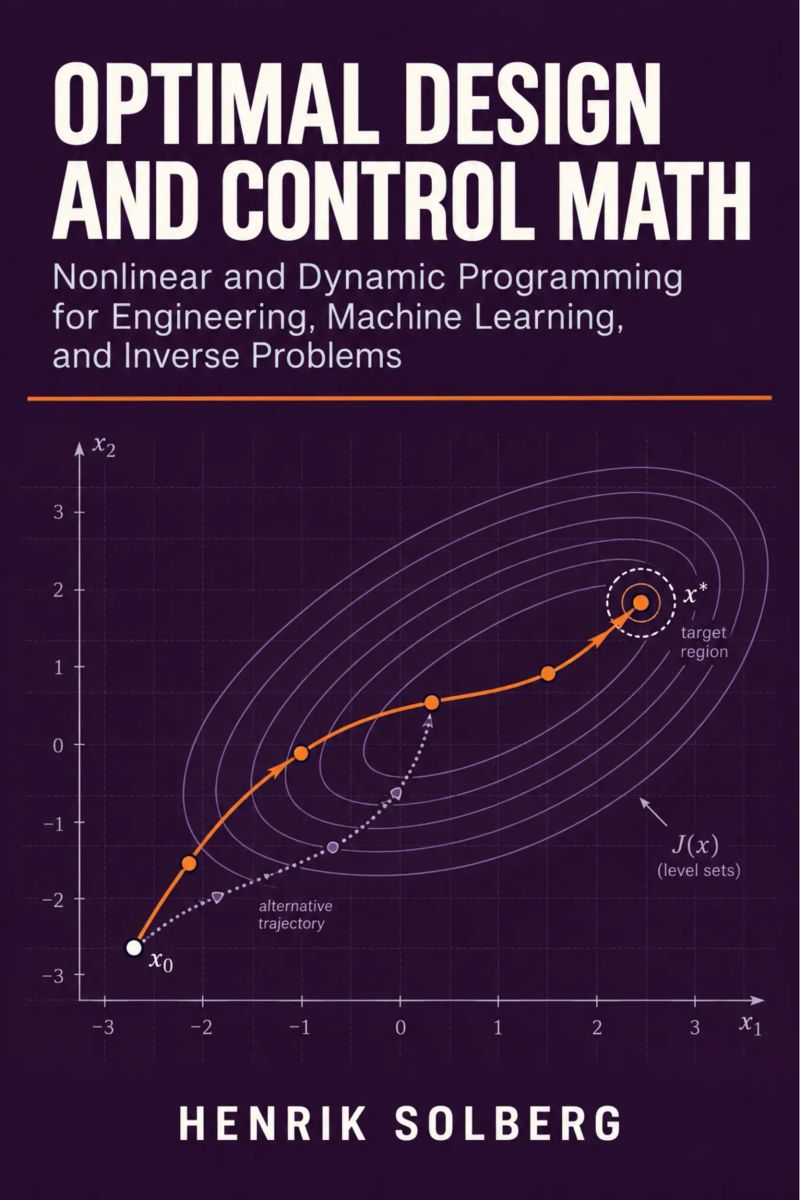
Optimal Design and Control Math
Nonlinear and Dynamic Programming for Engineering, Machine Learning, and Inverse ProblemsBy Henrik Solberg


Length14h 47m
About this audiobook
Stop blaming your solver. Start understanding why it fails.
A solver that converges on the textbook problem and stalls on yours is the usual experience. This book explains why and what to do. You will see how conditioning wrecks steepest descent, how quasi-Newton updates recover curvature without a Hessian, and when a trust region beats a line search. You will compute derivatives by finite differences, complex-step, automatic differentiation and adjoints, then move into constrained problems through the Karush-Kuhn-Tucker conditions, duality, augmented Lagrangians, sequential quadratic programming and interior-point methods. Later chapters cover surrogate and Bayesian search, Pareto trade-offs, structural and topology optimisation, dynamic programming, the linear quadratic regulator and model predictive control, and close on regularised inverse problems and the stochastic gradient methods behind modern learning.
Written for engineers, applied mathematicians and graduate students who build and tune solvers, this book connects numerical optimisation theory to the practical decisions that determine whether an algorithm converges, how fast, and to what. Each method is motivated by the failure mode it addresses, so you learn not just the update formula but the diagnostic reasoning that tells you which tool fits the problem in front of you.
What you will learn:
• Formulate optimisation problems with clear objectives, constraints and scaling
• Diagnose conditioning and choose between line search, Newton and quasi-Newton updates
• Apply conjugate gradient and trust-region methods to large and ill-behaved problems
• Compute derivatives by finite differences, complex-step, automatic differentiation and adjoints
• Solve constrained problems with KKT conditions, duality, SQP and interior-point methods
• Use derivative-free, stochastic and surrogate methods, including Bayesian search
• Optimise engineering designs, including structural and topology optimisation
• Apply dynamic programming, LQR and model predictive control to optimal control
• Regularise inverse problems and understand stochastic gradient methods for machine learning
This book is for engineers, applied mathematicians, quantitative scientists and graduate students who need to build, tune and trust optimisation solvers in real applications. If you work at the boundary of numerical methods, engineering design, control and machine learning, the chapters give you the theory and the practical judgement to move from a method that almost works to one that reliably does.
Audiobook details
GenreScience and Nature, Technology
Length14 hrs 47 mins
Narrated byListen with 1,000+ voices
FormateBook with Audio
Publish dateSep 28, 2026
LanguageEnglish
Table of contents
1Optimal Design and Control Math
2Foreword
3Preface
4About This Book
5Chapter 1: Formulating Optimisation Problems
Show all chaptersShow less
61.1 Objectives, Design Variables and Constraints
71.2 Convex Sets, Convex Functions and Their Consequences
81.3 Local and Global Minima
91.4 First-Order Optimality Conditions
101.5 Second-Order Conditions and the Geometry of Stationary Points
111.6 Scaling, Units and Well-Posed Formulations
12Chapter 2: Line Search Methods
132.1 Descent Directions and the Generic Line Search Framework
142.2 Steepest Descent and Its Scaling Weakness
152.3 Armijo Backtracking and Sufficient Decrease
162.4 Wolfe and Strong Wolfe Conditions
172.5 Global Convergence of Line Search Methods
182.6 Practical Step-Length Strategies and Iteration Counts
19Chapter 3: Newton and Quasi-Newton Methods
203.1 Newton’s Method and the Newton Step
213.2 Hessian Modification and Modified Cholesky
223.3 Secant Conditions and the BFGS Update
233.4 DFP, Broyden Class and Update Properties
243.5 Limited-Memory BFGS for Large Problems
253.6 Superlinear Convergence and Practical Performance
26Chapter 4: Conjugate Gradient and Large Linear Systems
274.1 The Linear Conjugate Gradient Method
284.2 Preconditioning and Convergence Bounds
294.3 Nonlinear Conjugate Gradient Methods
304.4 Krylov Subspaces and Matrix-Free Implementation
31Chapter 5: Trust-Region Methods
325.1 The Trust-Region Subproblem
335.2 The Cauchy Point and Sufficient Reduction
345.3 Dogleg and Steihaug–CG Solutions
355.4 Radius Update Rules and Convergence
365.5 When Trust Regions Beat Line Searches
37Chapter 6: Computing Derivatives
386.1 Finite Differences: Truncation and Cancellation Error
396.2 Complex-Step Differentiation
406.3 Forward and Reverse Mode Automatic Differentiation
416.4 Adjoint Methods for Many-Variable Design
426.5 Choosing a Derivative Method
43Chapter 7: Nonlinear Least Squares and Data Fitting
447.1 The Least-Squares Problem and Residual Formulation
457.2 Gauss-Newton and Its Convergence
467.3 Levenberg–Marquardt Damping
477.4 Separable Problems and Robust Loss Functions
487.5 Parameter Confidence and Covariance
49Chapter 8: Linear and Quadratic Programming
508.1 Standard Forms and Geometry of Linear Programs
A Brief History of IntelligenceMax S. Bennett12h 18m4.6 (6.6K)$29 · $0.00
The Story of BirdsSteve Brusatte11h 49m4.6 (401)$29 · $0.00

Black Earth WisdomLeah Penniman11h 54m4.6 (577)$8 · $0.00

Total Cat MojoJackson Galaxy10h 13m4.5 (8.4K)$23 · $0.00

My Life Among the UnderdogsTia Torres5h 51m4.5 (4K)$24 · $0.00

What It Takes to Save a LifeKwane Stewart6h4.6 (556)$24 · $0.00

Pastoral SongJames Rebanks8h 35m4.5 (12K)$26 · $0.00
How Stella Learned to TalkChristina Hunger7h4.5 (10.9K)$24 · $0.00

Craig & FredCraig Grossi8h 6m4.5 (9.6K)$26 · $0.00

Celebrating BirdsNatalia Rojas, Ana Maria Martinez6h 47m4.6 (330)$24 · $0.00

Saving JemimaJulie Zickefoose4h 59m4.5 (749)$20 · $0.00

Will's Red CoatTom Ryan8h 23m4.5 (2.3K)$26 · $0.00

Of Time and TurtlesSy Montgomery10h 34m4.5 (5K)$29 · $0.00

THE WOLF TRILOGY: Call of the Wild, White Fang & The Son of the WolfJack London17h 31m4.5 (2.4K)$1.99 · $0.00

Zen and the Art of Saving the PlanetThich Nhat Hanh9h 20m4.5 (3.9K)$29 · $0.00

BLACK BEAUTY (With Original Illustrations)Anna Sewell7h 31m4.5 (1.3K)$1.99 · $0.00

Bottle of LiesKatherine Eban14h 25m4.4 (12K)$33 · $0.00
IngrainedCallum Robinson8h 10m4.5 (1.1K)$26 · $0.00

The Lion Tracker's Guide To LifeBoyd Varty3h 1m4.4 (4.8K)$18 · $0.00

Born for LoveBruce D. Perry, Maia Szalavitz11h 42m4.4 (4K)$29 · $0.00

Operation PedestalMax Hastings12h 29m4.4 (5.2K)$29 · $0.00

When the Heavens Went on SaleAshlee Vance18h 20m4.4 (3K)$40 · $0.00

Everybody Has a Podcast (Except You)Justin McElroy, Travis McElroy, Griffin McElroy5h 9m4.3 (2.3K)$24 · $0.00

Hands of TimeRebecca Struthers8h 8m4.4 (1.3K)$26 · $0.00
Never Lost AgainBill Kilday10h 1m4.4 (805)$29 · $0.00

How the Internet HappenedBrian McCullough13h 28m4.3 (2.7K)$23 · $0.00

Collected Writings of Nikola TeslaNikola Tesla, Thomas Commerford Martin21h 50m4.3 (1.7K)$1 · $0.00

Just AspireAjai Chowdhry9h 13m4.4 (260)$29 · $0.00

The Little Book of AliensAdam Frank8h 20m4.3 (1.3K)$26 · $0.00
The inventions, researches and writings of Nikola Tesla (Annotated)Thomas Commerford Martin16h 59m4.3 (1.3K)$2 · $0.00

KargilV.P. Malik15h 18m4.3 (2K)$24 · $0.00
Experiments with Alternating CurrentsNikola Tesla9h 16m4.3 (874)$1.99 · $0.00

Fire on the HorizonTom Shroder, John Konrad8h 23m4.3 (858)$26 · $0.00

The Smell of Kerosene (Annotated)National Aeronautics and Space Administration, Donald L. Mallick, Peter W. Merlin11h 32m4.3 (523)$2 · $0.00

The Boy Who Harnessed the WindWilliam Kamkwamba, Bryan Mealer10h 5m4.2 (78.9K)$29 · $0.00

Across the Airless WildsEarl Swift10h 8m4.3 (1.3K)$29 · $0.00

Console WarsBlake J. Harris20h 41m4.2 (13.7K)$46 · $0.00

Improvised Munitions HandbookU.S. Department of Defense4h 49m4.3 (1.6K)$0.99 · $0.00
Escaping GravityLori Garver10h 54m4.2 (2.2K)$20 · $0.00

Wireless WarsJonathan Pelson8h 2m4.3 (418)$20 · $0.00
You may also like
Collected Writings of Nikola TeslaThomas Commerford Martin, Nikola Tesla19h 42m4.4 (2.8K)$1.99 · $0.00
Day Trading AttentionGary Vaynerchuk8h 25m4.3 (1.8K)$28 · $0.00
Modern Data EngineeringOwen Fletcher7h 33m$6.50 · $0.00

Optical Transceivers and Photonic CircuitsAmara Okonkwo13h 9m$75
Deep Learning on the JVMSofia Halloran7h 31m$5 · $0.00
Claude Code for Modern DevelopersLeon Grant8h 21m$6.50 · $0.00
How To Code For Quantum ComputersNivio Dos Santos2h 19m$46 · $0.00

The Definitive Guide To The World's Leading Artificial IntelligenceKael Novera6h 51m$8 · $0.00

Monday.com Made SimpleRuth Callender4h 25m$7

The Evolution of Technologythe Speech Resource Company9h 30m$20
From Model Building to MLOpsNadia Ferreiro13h 33m$65

The AI Advantage for Data AnalystsMiles Draper4h 16m$8

Introduction manual to S&OPCristina Peña1h 34m4.4 (15)$23 · $0.00

Artificial Intelligence for Web DevelopmentJaxen Holt, Nadia Valentine4h 5m$6

Fair GameRob Collie9h 39m3.9 (32)$20 · $0.00
AI Tools for TeachersProf. Angelina Joel Adams2h 25m$6.50 · $0.00

The AI Advantage for Physical TherapistsMiles Draper4h 24m$8

Home Assistant Made SimpleWalter Hemsley4h 12m$11

Artificial IntelligenceJ.C.Lesko2h 43m$15 · $0.00

Build Augmented Reality Apps Without CodeAdrian Vasquez7h 11m$5 · $0.00