
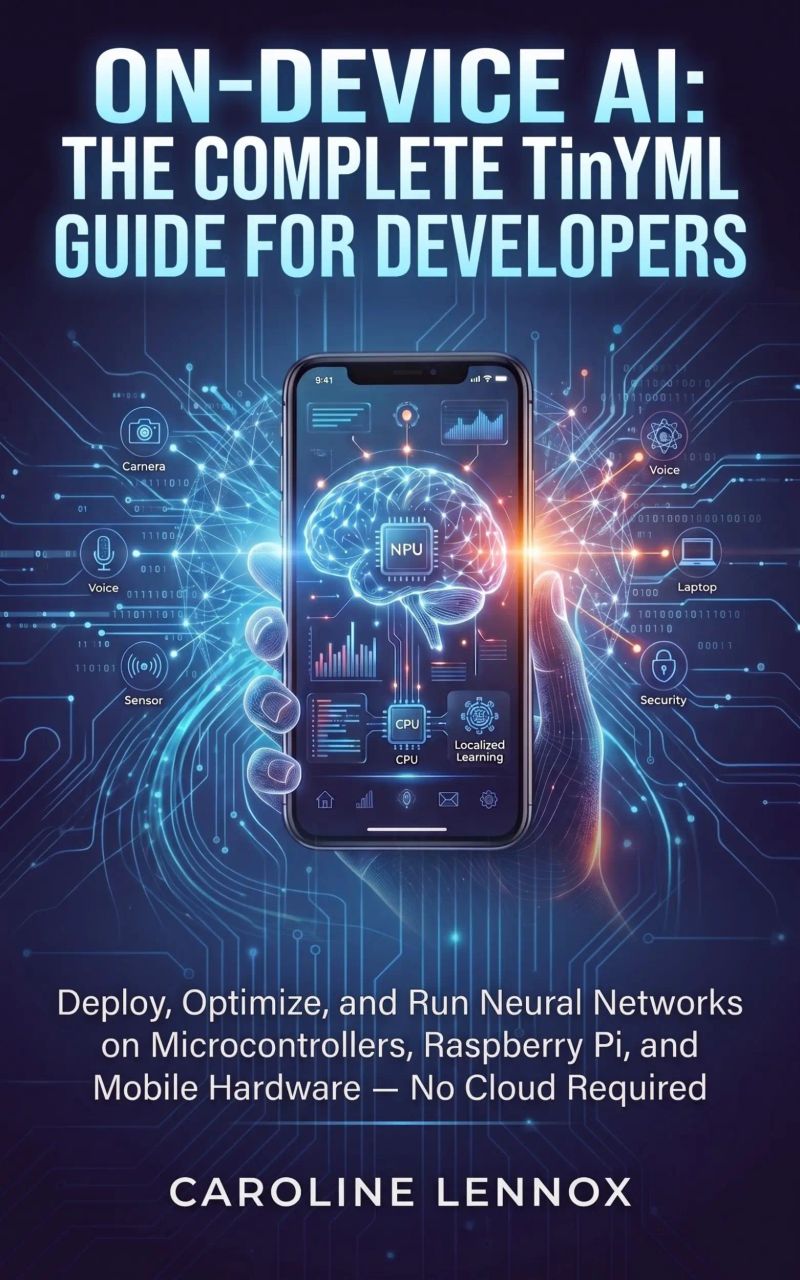
On-Device AI: The Complete TinyML Guide for Developers
Deploy, Optimize, and Run Neural Networks on Microcontrollers, Raspberry Pi, and Mobile Hardware — No Cloud RequiredBy Caroline Lennox


Length3h 22m
About this audiobook
Run Real AI on Tiny Hardware — No Cloud, No Latency, No Data Leaving the Device
Every cloud inference call costs money, leaks data, and stalls the moment the network drops. What if your models ran directly on a $10 microcontroller instead?
On-Device AI: The Complete TinyML Guide for Developers is a hands-on, code-first roadmap to deploying neural networks on microcontrollers, Raspberry Pi, and mobile hardware. Written for developers who understand the basics of machine learning but have never squeezed a model into kilobytes of RAM, it takes you from core concepts all the way to shipping a production system — one you can build and run yourself.
You won't just read about TinyML. You'll train models, quantize them to a fraction of their size, deploy them to real boards, and debug the failures that only happen on constrained hardware.
Inside the book, you'll learn how to:
Choose the right hardware for your workload — MCUs, DSPs, NPUs, and FPGAs — using a clear decision framework
Shrink models to fit with INT8/INT4 quantization, pruning, and knowledge distillation
Convert and deploy models to TensorFlow Lite and TensorFlow Lite Micro on Raspberry Pi, Arduino, and ESP32
Build real projects: image classification, person detection, wake-word spotting, and sensor anomaly detection
Optimize for production — balancing power, memory, and speed, with duty-cycling that stretches battery life from hours to months
Ship to mobile with TensorFlow Lite on Android and Core ML on iOS from a single model
Run a complete end-to-end system with over-the-air firmware updates and in-field quality monitoring
Every chapter is code-first, followed by clear explanations and exercises designed to break your assumptions and force you to debug real problems — the way you actually learn.
This book is for you if:
You write C, C++, or Python and have shipped (or want to ship) software to embedded systems
You know training, inference, and overfitting — but have never deployed a model to a microcontroller
You care about privacy, offline reliability, real-time response, and zero per-inference cost
Stop renting intelligence from the cloud. Start building AI that works anywhere — in tunnels, on factory floors, in the field, and off the grid.
Audiobook details
GenreTechnology
Length3 hrs 22 mins
Narrated byListen with 1,000+ voices
FormateBook with Audio
LanguageEnglish
Table of contents
1On-Device AI: The Complete TinyML Guide for Developers
2Chapter 1: Why On-Device AI Changes Everything
3Cloud AI vs Edge AI: The Real Cost
4The TinyML Hardware Landscape
5Latency, Privacy, and Offline Reliability
Show all chaptersShow less
6Who This Book Is For and How to Use It
7Chapter 2: Setting Up Your TinyML Development Environment
8Python Environment and Dependencies
9Raspberry Pi 4 Setup for ML
10Arduino IDE and Board Support Packages
11Edge Impulse CLI Quickstart
12Exercises
13Chapter 3: Neural Network Fundamentals for Constrained Hardware
14Why Standard Deep Learning Models Are Too Big
15Quantization: INT8 and INT4
16Pruning, Knowledge Distillation, and Architecture Search
17MobileNet, SqueezeNet, and MCU-Friendly Architectures
18Chapter 4: Training Your First TinyML Model
19Dataset Preparation and Augmentation
20Building and Training with Keras
21Exporting to TFLite Flatbuffer
22Post-Training Quantization in Practice
23Chapter 5: Deploying Models on Raspberry Pi
24TFLite Python Interpreter: Load, Allocate, Infer
25Real-Time Camera Inference Pipeline
26Coral USB Accelerator and Edge TPU Compilation
27Profiling with perf and TFLite Benchmark Tool
28Chapter 6: Deploying Models on Arduino and ESP32
29TFLite Micro Architecture and Memory Model
30Arduino Nano 33 BLE Sense: IMU Gesture Recognition
31ESP32 Deployment with ESP-IDF and Arduino Core
32Debugging Inference Failures on MCUs
33Chapter 7: On-Device Computer Vision
34Image Classification vs Object Detection at the Edge
35Person Detection with MobileNet V2 SSD
36Camera Capture and Preprocessing Pipeline
37Handling False Positives and Confidence Thresholds
38Chapter 8: On-Device Audio and Keyword Spotting
39PDM Microphone Capture on Arduino
40MFCC Feature Extraction on MCU
41Wake-Word Model: Training to Deployment
42Chapter 9: Anomaly Detection on Sensor Data
43Anomaly Detection Patterns: Autoencoder vs Statistical
44Building and Training the Autoencoder
45Deployment on ESP32 with FreeRTOS
46Chapter 10: Optimizing for Production: Power, Memory, and Speed
47Memory Layout: ROM vs RAM Trade-offs on MCUs
48Model Surgery: Removing Layers, Reducing Filters
49Duty-Cycling and Sleep Modes for Battery Life
50Profiling with ARM Keil and GCC Toolchain
More from Caroline Lennox


LiftoffEric Berger9h 4m4.6 (9.5K)$29 · $0.00

The Honey BusMeredith May9h 31m4.4 (16.6K)$25 · $0.00

Collected Writings of Nikola TeslaThomas Commerford Martin, Nikola Tesla19h 42m4.4 (2.8K)$1.99 · $0.00

Operation PedestalMax Hastings12h 29m4.4 (5.2K)$29 · $0.00

When the Heavens Went on SaleAshlee Vance18h 20m4.4 (3K)$40 · $0.00

Everybody Has a Podcast (Except You)Justin McElroy, Travis McElroy, Griffin McElroy5h 9m4.3 (2.3K)$24 · $0.00

Hands of TimeRebecca Struthers8h 8m4.4 (1.3K)$26 · $0.00
Never Lost AgainBill Kilday10h 1m4.4 (805)$29 · $0.00
How the Internet HappenedBrian McCullough13h 28m4.3 (2.7K)$23 · $0.00

Collected Writings of Nikola TeslaNikola Tesla, Thomas Commerford Martin21h 50m4.3 (1.7K)$1 · $0.00

Just AspireAjai Chowdhry9h 13m4.4 (260)$29 · $0.00

The Little Book of AliensAdam Frank8h 20m4.3 (1.3K)$26 · $0.00

The inventions, researches and writings of Nikola Tesla (Annotated)Thomas Commerford Martin16h 59m4.3 (1.3K)$2 · $0.00

KargilV.P. Malik15h 18m4.3 (2K)$24 · $0.00
Experiments with Alternating CurrentsNikola Tesla9h 16m4.3 (874)$1.99 · $0.00

Fire on the HorizonTom Shroder, John Konrad8h 23m4.3 (858)$26 · $0.00

The Smell of Kerosene (Annotated)National Aeronautics and Space Administration, Donald L. Mallick, Peter W. Merlin11h 32m4.3 (523)$2 · $0.00

The Boy Who Harnessed the WindWilliam Kamkwamba, Bryan Mealer10h 5m4.2 (78.9K)$29 · $0.00

Across the Airless WildsEarl Swift10h 8m4.3 (1.3K)$29 · $0.00

Console WarsBlake J. Harris20h 41m4.2 (13.7K)$46 · $0.00
You may also like

AngelJason Calacanis8h 20m4.4 (4.4K)$26 · $0.00

12 BytesJeanette Winterson9h4.0 (2.5K)$20
Collected Writings of Nikola TeslaThomas Commerford Martin, Nikola Tesla19h 42m4.4 (2.8K)$1.99 · $0.00
AutonomyLawrence D. Burns, Christopher Shulgan11h 21m4.1 (1.1K)$29 · $0.00

12 Smart-Device AI ProjectsDesmond Whitlock7h 52m$5
Fair GameRob Collie9h 39m3.9 (32)$20 · $0.00

Signal Processing for Electrical EngineersHelen Marchetti12h 6m$80
Build AI Agents with FlowiseCyrus Fontaine8h 1m$5
Neural Networks Without PythonPaloma Iqbal7h 29m$5 · $0.00

Eft Investing: A Comprehensive Guide to Researching and Investing (The Intelligent Investor's Guide to Using Free Online Stock Screeners to Find Winning Stocks)Matthew Nagel2h 7m$3.50 · $0.00
The Future Ready OrganizationGyan Nagpal7h 44m4.3 (35)$26 · $0.00

Artificial Intelligence for Web DevelopmentJaxen Holt, Nadia Valentine4h 5m$6

The Definitive Guide To The World's Leading Artificial IntelligenceKael Novera6h 51m$8 · $0.00

Automate Real Work with AILena Devlin7h 30m$5 · $0.00

Artificial IntelligenceJ.C.Lesko2h 43m$15 · $0.00

How To Code For Quantum ComputersNivio Dos Santos2h 19m$46 · $0.00

The Evolution of Technologythe Speech Resource Company9h 30m$20

Introduction manual to S&OPCristina Peña1h 34m4.4 (15)$23 · $0.00
From Model Building to MLOpsNadia Ferreiro13h 33m$65
Deep Learning on the JVMSofia Halloran7h 31m$5 · $0.00