
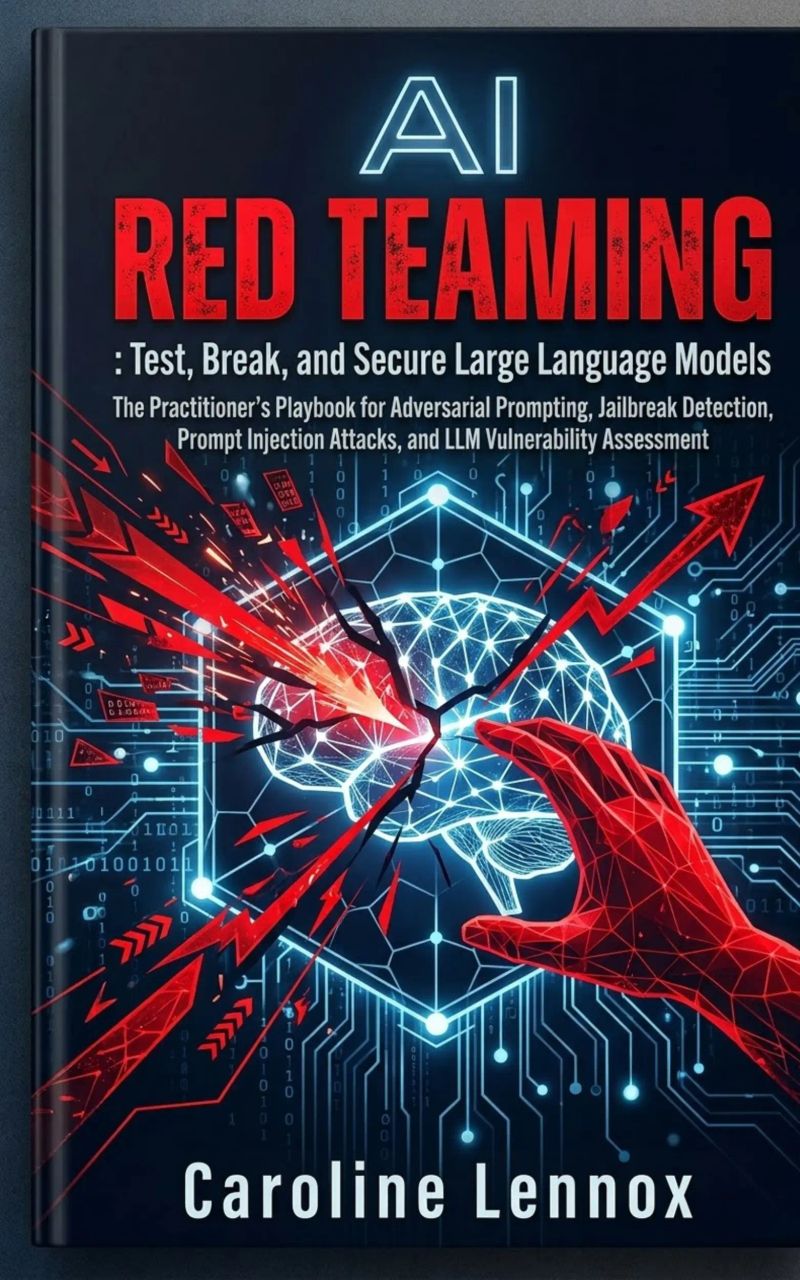
AI Red Teaming: Test, Break, and Secure Large Language Models
The Practitioner's Playbook for Adversarial Prompting, Jailbreak Detection, Prompt Injection Attacks, and LLM Vulnerability AssessmentBy Caroline Lennox


Length3h 53m
About this audiobook
Your AI application is one clever prompt away from being compromised. Do you know how to stop it?
Large language models don't break like traditional software. They can be jailbroken with a roleplay, tricked into leaking their system prompt, poisoned through the data they read, and manipulated into leaking training data or executing dangerous tool calls — and none of it looks like a normal attack.
AI Red Teaming is the hands-on playbook for security professionals, ML engineers, and developers who need to test and defend LLM systems in the real world. No hand-waving, no theory dumps — just the techniques attackers actually use, and the defenses that actually work.
Inside, you'll learn how to:
Exploit prompt injection — the "SQL injection of AI" — and detect it before attackers do
Bypass safety guardrails with jailbreak techniques like DAN, encoding attacks, and many-shot framing
Extract system prompts, training data, and PII through targeted probing
Attack multimodal models and LLM agents that use tools, APIs, and code execution
Automate red teaming at scale with Garak, PyRIT, and custom Python harnesses
Build defense-in-depth with Llama Guard, NeMo Guardrails, input validation, and output filtering
Map your findings to the NIST AI RMF and EU AI Act — and write red-team reports that hold up
Every chapter is built around working code, real tools, and a local lab you set up yourself. Whether you're securing a production LLM, building an enterprise red-team program, or breaking into AI security, this is the field manual you'll keep coming back to.
Stop hoping your AI is secure. Start proving it.
Audiobook details
GenreTechnology
Length3 hrs 53 mins
Narrated byListen with 1,000+ voices
FormateBook with Audio
LanguageEnglish
Table of contents
1AI Red Teaming: Test, Break, and Secure Large Language Models
2CHAPTER 1 Why LLMs Break Differently Than Everything Else
3The New Attack Surface
4Classical Vuln vs LLM Vuln: A Side-by-Side
5The Four Failure Modes: Hallucination, Injection, Extraction, Misuse
Show all chaptersShow less
6Threat Modeling an LLM Application
7CHAPTER 2 Red Teaming Fundamentals and Lab Setup
8Lab Architecture: Local vs API-Based Testing
9Installing Ollama and Running Llama 3 Locally
10Garak and PyRIT: Automated LLM Vulnerability Scanners
11Rules of Engagement and Responsible Disclosure
12CHAPTER 3 Prompt Injection: The SQL Injection of AI
13Direct Injection: Overriding the System Prompt
14Indirect Injection: Poisoning External Data Sources
15Role Confusion and Persona Hijacking Techniques
16Detection: Signature-Based and Semantic Classifiers
17CHAPTER 4 Jailbreaking: Bypassing Safety Guardrails
18Taxonomy of Jailbreaks: Persona, Encoding, Framing, Many-Shot
19DAN, AIM, and Roleplay-Based Bypasses
20Encoding Attacks: Base64, ROT13, Token Smuggling
21Code: Base64 and Token-Smuggling Payload Generator
22Code: Jailbreak Benchmark Harness
23Why Safety Training Fails: Competing Objectives
24CHAPTER 5 System Prompt Extraction and Leakage
25How System Prompts Work and Why They Leak
26Extraction Techniques: Repeat, Summarize, Translate
27Detecting System Prompt Presence from Response Patterns
28Hardening: What Works and What Doesn't
29CHAPTER 6 Model Inversion and Training Data Extraction
30Memorization in LLMs: Why Models Remember Verbatim Text
31Prefix Attacks for Training Data Extraction
32Membership Inference: Did This Text Train the Model?
33PII Leakage Assessment and Mitigation
34CHAPTER 7 Adversarial Inputs for Multimodal Models
35Vision-Language Models: New Attack Surface
36Adversarial Patches and Pixel-Level Attacks
37Text-in-Image Prompt Injection (Visual Injection)
38Cross-Modal Consistency Testing
39CHAPTER 8 LLM Agent and Tool-Use Attacks
40How LLM Agents Use Tools and Why That's Dangerous
41Tool Output Injection: Hijacking the Agent's Next Action
42SSRF, Command Injection, and Path Traversal via Agent Tools
43Multi-Agent Attack Chains: Privilege Escalation Across Agents
44CHAPTER 9 Automated Red Teaming at Scale
45Garak Deep Dive: Probes, Generators, and Detectors
46LLM-as-Attacker: Using One LLM to Red-Team Another
47Building a Custom Attack Harness with Python
48Triage Framework: Severity Scoring for LLM Vulnerabilities
49CHAPTER 10 Defenses: Guardrails, Input Validation, and Output Filtering
50Defense-in-Depth Architecture for LLM Applications
More from Caroline Lennox


LiftoffEric Berger9h 4m4.6 (9.5K)$29 · $0.00

The Honey BusMeredith May9h 31m4.4 (16.6K)$25 · $0.00

Collected Writings of Nikola TeslaThomas Commerford Martin, Nikola Tesla19h 42m4.4 (2.8K)$1.99 · $0.00

Operation PedestalMax Hastings12h 29m4.4 (5.2K)$29 · $0.00

When the Heavens Went on SaleAshlee Vance18h 20m4.4 (3K)$40 · $0.00

Everybody Has a Podcast (Except You)Justin McElroy, Travis McElroy, Griffin McElroy5h 9m4.3 (2.3K)$24 · $0.00

Hands of TimeRebecca Struthers8h 8m4.4 (1.3K)$26 · $0.00

Never Lost AgainBill Kilday10h 1m4.4 (805)$29 · $0.00

How the Internet HappenedBrian McCullough13h 28m4.3 (2.7K)$23 · $0.00

Collected Writings of Nikola TeslaNikola Tesla, Thomas Commerford Martin21h 50m4.3 (1.7K)$1 · $0.00

Just AspireAjai Chowdhry9h 13m4.4 (260)$29 · $0.00

The Little Book of AliensAdam Frank8h 20m4.3 (1.3K)$26 · $0.00

The inventions, researches and writings of Nikola Tesla (Annotated)Thomas Commerford Martin16h 59m4.3 (1.3K)$2 · $0.00

KargilV.P. Malik15h 18m4.3 (2K)$24 · $0.00

Experiments with Alternating CurrentsNikola Tesla9h 16m4.3 (874)$1.99 · $0.00

Fire on the HorizonTom Shroder, John Konrad8h 23m4.3 (858)$26 · $0.00

The Smell of Kerosene (Annotated)National Aeronautics and Space Administration, Donald L. Mallick, Peter W. Merlin11h 32m4.3 (523)$2 · $0.00

The Boy Who Harnessed the WindWilliam Kamkwamba, Bryan Mealer10h 5m4.2 (78.9K)$29 · $0.00

Across the Airless WildsEarl Swift10h 8m4.3 (1.3K)$29 · $0.00

Console WarsBlake J. Harris20h 41m4.2 (13.7K)$46 · $0.00
You may also like
The Return of VamanJayant V. Narlikar6h 27m4.0 (351)$17
AutonomyLawrence D. Burns, Christopher Shulgan11h 21m4.1 (1.1K)$29 · $0.00

The Highway Code UKDepartment for Transport3h 33m4.2 (36.6K)$11 · $0.00

12 BytesJeanette Winterson9h4.0 (2.5K)$20
Collected Writings of Nikola TeslaThomas Commerford Martin, Nikola Tesla19h 42m4.4 (2.8K)$1.99 · $0.00
The Problem of Increasing Human Energy (Annotated)Nikola Tesla6h 44m4.2 (3.2K)$2 · $0.00

Knowing What We KnowSimon Winchester14h 19m3.9 (2.5K)$33 · $0.00

Tesla: The Problem of Increasing Human EnergyNikola Tesla5h 38m4.2 (1.9K)$1.99 · $0.00
The Creativity CodeMarcus du Sautoy9h 54m4.0 (2.2K)$20 · $0.00

Master AiHenrique Xavier Oliveira2h 5m$6 · $0.00

The Evolution Of AIJasper Livingstone10h 56m$9

Build with Agentic AIDaria Quill7h 21m$5

Artificial Intelligence Without PanicFelipe Neves3h 11m$5 · $0.00

Digital HumanitiesUnknown Author15h 31m3.7 (170)$8 · $0.00

Understanding AI For Everyday ImpactJasper Livingstone4h 7m$9

F.e.r.o.x. - Operation X Robotic Special ForcesGuilherme Lima9m$15 · $0.00

Business-Englisch lernen Audio - FolgetelefonateSpotlight Verlag1h 14m$19

Giant Brains, or, Machines That ThinkEdmund Callis Berkeley9h 21m$2.30
Code to ScreenTheo Vantage3h 49m$9

Artificial Intelligence Business ApplicationsBob Mather2h 50m3.8 (133)$4.99