
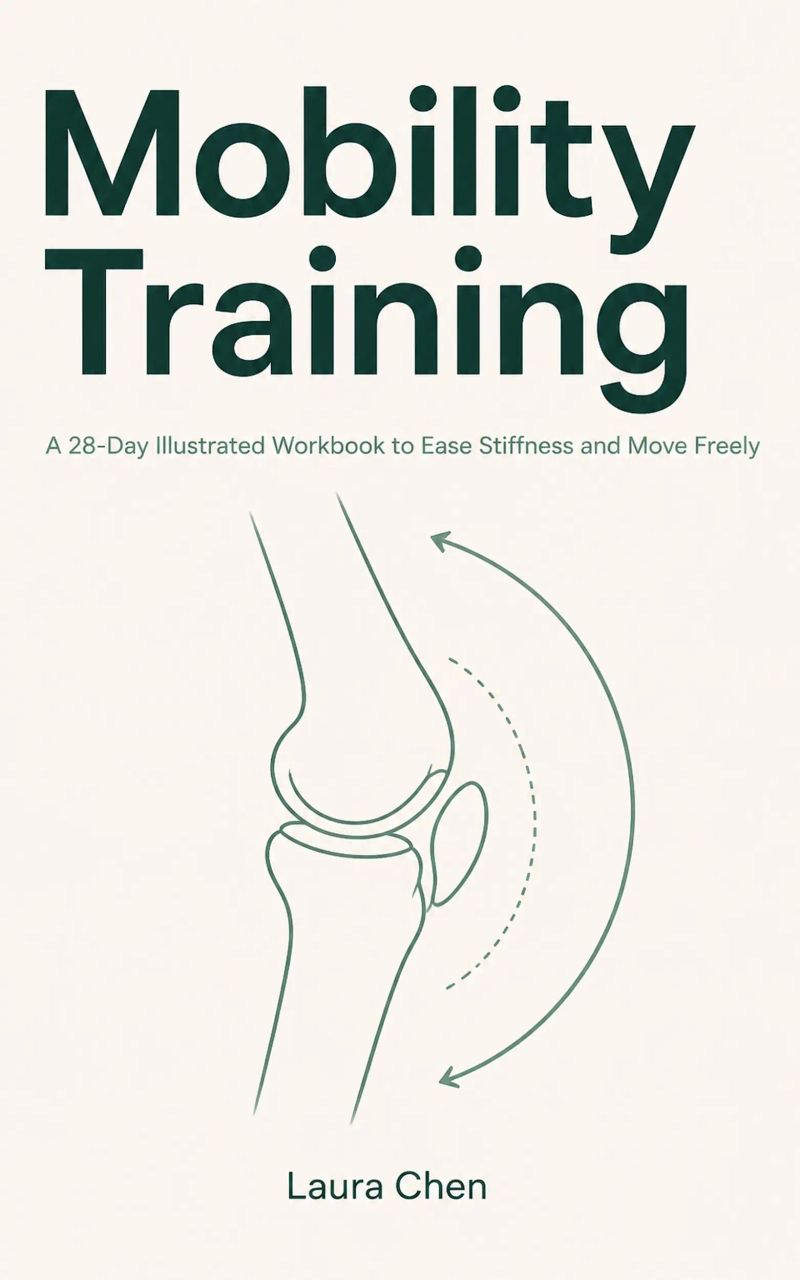
Mobility Training
A 28-Day Illustrated Workbook to Ease Stiffness and Move FreelyBy Laura Chen


Length5h 40m
About this audiobook
Most fitness programmes emphasise some mix of cardio and strength. Those matter. What usually gets skipped, or reduced to a rushed thirty-second toe-touch, is mobility.
Mobility is not the same thing as passive flexibility. Flexibility is how far a tissue can go when something pulls on it. Mobility is how far you can take a joint while staying organised — breath available, joints tracking kindly, balance intact.
That distinction is the reason this workbook favours slow controlled articulations, supported positions, and coaching notes about what you should actually feel rather than how far you should get.
What readers usually report is not dramatic. Less morning stiffness after sitting or sleeping. Easier transitions — getting out of a chair, reaching a high shelf, turning to look behind while driving. More confidence in strength or walking sessions because the joints feel prepared for them. Those are functional outcomes, and the book is careful to present them as functional outcomes rather than medical promises.
The structure is twenty-eight days, one page per day, each page built the same way so that you stop having to decode the format by about day four. Before any of that there is a self-check chapter that is explicitly not a diagnosis, a joint-by-joint basics chapter, and a short chapter on safety and pacing that introduces the distinction the whole book runs on: good ache versus bad pain, and what to do when you are not sure which one you are feeling.
There are chapters most workbooks leave out. One on space, shoes and session hygiene. One on the principles you will keep using for years after the twenty-eight days are finished. One on how to coach yourself from a page, which is a genuine skill and is not the same as following instructions.
Every movement is illustrated and described in plain language, with regressions for people who need less and progressions for people who need more, presented side by side rather than buried.
Written for adults who sit too much, who are returning to movement after a gap, or who have been told to stretch more and have never been told what that is supposed to mean.
Audiobook details
GenreHealth and Wellness, Self-Help
Length5 hrs 40 mins
Narrated byListen with 1,000+ voices
FormateBook with Audio
Publish dateSep 15, 2026
LanguageEnglish
Table of contents
1Mobility Training
26Cool-down
2How every session works
27Week 3 coaching theme
3Joint warm-up
28Myth vs Fact
4What this book will not claim
29Cool-down
5Environment
30Cool-down
Show all chaptersShow less
6Traffic-light pacing
31Myth vs Fact
7Ready Stance
32Cool-down
8Pairing with heat or cold
33Cool-down
9A note on strength and cardio
34Cool-down
10What “deeper” practice means here
35Week 4 coaching theme
11Week 1 coaching theme
36Myth vs Fact
12Myth vs Fact
37Cool-down
13Cool-down
38Cool-down
14Myth vs Fact
39Cool-down
15Cool-down
40Myth vs Fact
16Cool-down
41Cool-down
17Myth vs Fact
42Myth vs Fact
18Cool-down
43Pairing with other training
19Week 2 coaching theme
44How to talk about this program with a clinician
20Cool-down
45Do I need a yoga mat?
21Myth vs Fact
46Closing reminder
22Cool-down
47After Week 4 (Day 28)
23Cool-down
48Closing form for the month (optional write-in)
24Myth vs Fact
49Quick-Reference Move Index
25Cool-down
50Citations
More from Laura Chen
The Easy Qi Gong Book for SeniorsLaura Chen5h 26m$5
10-Minute Tai Chi for Better BalanceLaura Chen5h 47m$5
Simple Qi Gong for Weight LossLaura Chen5h 37m$5
Walking for FitnessLaura Chen5h 49m$5
Tai Chi for Arthritis ReliefLaura Chen6h 33m$5

The Yoga Sutras of PatanjaliPatanjali4h 8m4.5 (18.5K)$6 · $0.00

The Lost VoiceGreta Morgan8h 30m4.7 (285)$26 · $0.00

Healthy Kids, Happy KidsElisa Song14h 18m4.6 (760)$33 · $0.00
Eat It!Jordan Syatt, Michael Vacanti4h 40m4.6 (1.5K)$20 · $0.00

Consent Laid BareChanel Contos7h 11m4.5 (1.7K)$24 · $0.00

How to Make Disease DisappearRangan Chatterjee5h 26m4.5 (3.5K)$24 · $0.00

The Complete Herbal (Annotated)Nicholas Culpeper29h 8m4.5 (1.4K)$2 · $0.00

A Plague Upon Our HouseScott W. Atlas MD10h 37m4.5 (3.4K)$20 · $0.00

The Cancer CodeDr. Jason Fung10h 48m4.5 (5.3K)$29 · $0.00

The Gift of TherapyIrvin Yalom7h 39m4.5 (38.8K)$26 · $0.00

EarlySarah DiGregorio9h 47m4.5 (1.3K)$29 · $0.00

Bottle of LiesKatherine Eban14h 25m4.4 (12K)$33 · $0.00
The 36-Hour DayNancy L. Mace, Peter V. Rabins17h 13m4.4 (9.2K)$28 · $0.00

FlooredSara Reardon10h 36m4.5 (1K)$29 · $0.00
Radical RemissionKelly A. Turner9h 26m4.4 (8.1K)$29 · $0.00
The Sinatra SolutionStephen T. Sinatra MD9h4.5 (899)$20 · $0.00

The Songaminute ManSimon McDermott6h 12m4.5 (280)$24 · $0.00
Sometimes BrilliantLarry Brilliant12h 27m4.5 (954)$29 · $0.00

Live Your LifeAmanda Kloots, Anna Kloots10h 54m4.4 (13.7K)$29 · $0.00

All in Her HeadElizabeth Comen13h 25m4.4 (18.2K)$33 · $0.00
Learning to PrayJames Martin13h 24m4.5 (3.4K)$33 · $0.00
Swayam Ki AwaazPrem Rawat8h 34m4.7 (1.1K)$26 · $0.00

Forever BoyKate Swenson9h 27m4.7 (5K)$29 · $0.00

You Are Worth ItKyle Carpenter, Don Yaeger8h 53m4.7 (4.8K)$29 · $0.00

The Happiest Man on EarthEddie Jaku3h 48m4.6 (178K)$7 · $0.00

Finding MeViola Davis9h 15m4.6 (256.4K)$29 · $0.00

Spiritual AnatomyDaaji Kamlesh D. Patel9h 47m4.7 (319)$29 · $0.00

The Dangerous Truth about Today’s MarijuanaLaura Stack CSP, MBA9h 57m4.7 (385)$20 · $0.00
The Gospel according to Spiritualism (Translated)Allan Kardec14h 39m4.6 (3.9K)$5.70 · $0.00

Birdie & HarlowTaylor Wolfe7h 50m4.6 (6.5K)$26 · $0.00

CrossroadsKaleb Dahlgren7h 56m4.6 (4.9K)$26 · $0.00

Life on the BridgeKaelynn Partlow5h 40m4.6 (1.1K)$24 · $0.00

Keep Your Love OnDanny Silk9h 4m4.6 (8.1K)$10 · $0.00
The Tao of Joy Every DayDerek Lin10h 24m4.6 (762)$20 · $0.00
UndividedVicky Beeching9h 2m4.6 (1.3K)$29 · $0.00

HE CAN WHO THINKS HE CAN & OTHER BOOKS ON SUCCESSOrison Swett Marden5h 54m4.6 (1.2K)$1.99 · $0.00
Level UpRob Dial7h 42m4.6 (3.3K)$26 · $0.00
Burn the HaystackJennie Young, PhD9h 30m4.6 (543)$29 · $0.00

ACRES OF DIAMONDS: Our Every-day Opportunities (Wisdom & Empowerment Series) (Annotated)Russell Conwell2h 26m4.6 (1K)$2 · $0.00

Good InsideBecky Kennedy9h 55m4.5 (59.3K)$29 · $0.00
You may also like
I Decide Who Pushes My ButtonsKarin Kuschik6h 46m4.3 (2.3K)$24 · $0.00

Calm, Cool, DecisiveMason U. Delaney8h 50m$4.10 · $0.00

Personal Development And Career In BusinessEdivaldo Ascaneo1h 35m$6 · $0.00
How to Build ConfidenceLidiya K22m$9 · $0.00
The Success MasterclassNathan Cole1h 27m$7.90 · $0.00
KEEPING FITOrison Swett Marden8h 41m3.6 (10)$1.99 · $0.00
Holistic Fitness: Holistic Fitness: A Practical Plan to Achieve Spiritual Growth (A Comprehensive Approach to Embracing Balance and Wellness Through Natural Practices)Jeffery Howerton1h 50m$3.50 · $0.00
Relaxation Breath - Breath RelaxationRosalie Somogyi, Breathcomplex2h 18m$10 · $0.00

Becoming slim through hypnosisMichael Bauer52m3.8 (12)$35 · $0.00

Mega LivingJasper Livingstone3h 18m$9

The Mindfulness HandbookTheodore Avila10h 43m$13.50 · $0.00
Being EssentialDain Dunston4h 13m4.9 (38)$15 · $0.00
The Saturday Morning MethodBryan Aldridge9h 43m$10
The Pursuit of Happiness: A Book of Studies and StrowingsDaniel G. Brinton7h 53m3.6 (33)$1.50 · $0.00
Weight Loss Hypnosis: Affirmations Meditation to Help You Lose Weight While You Sleep (How to get emotionally and mentally free from food, body, and weight...for good)Ben Poulin3h 1m$3.50 · $0.00

Achieve Harmony with Cosmic LawHenry Thomas Hamblin8h 41m$2 · $0.00
I Want to Quit Everything for Three Months - How to Take a Break from Work Without Blowing Up Your LifeMax Paradox7h 1m$7.70 · $0.00
Switch CraftElaine Fox9h 13m4.0 (363)$29 · $0.00
High-Performance HabitsLaura Sthephane1h 50m$5.30 · $0.00
Dollars Want MeHenry Harrison Brown54m4.4 (231)$1.20 · $0.00