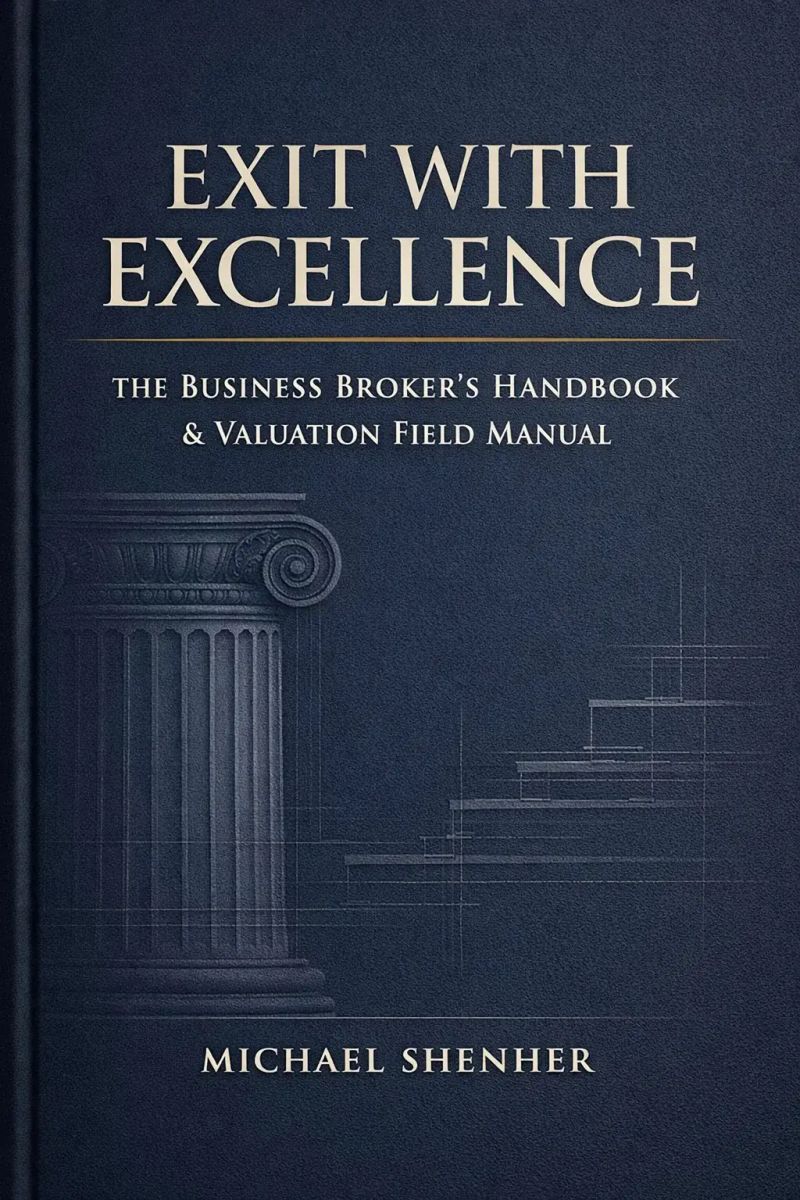
EXIT WITH EXCELLENCE The Business Broker’s Handbook & Valuation Field Manual
Business Broker as Career By Michael ShenherLength3h 41m
About this audiobook
EXIT WITH EXCELLENCE: The Business Broker's Handbook & Valuation Field Manual
Most business deals don't fail during negotiation. They fail months earlier — during preparation, valuation, and expectation-setting. And most brokers never find out why.
Exit With Excellence is the definitive field manual for business brokers who want to operate with the disciplined process that closes deals cleanly, protects seller leverage, and builds a reputation that compounds over time. Written by British Columbia's foremost expert in business exit strategy, it covers the complete transaction lifecycle with the authority and practical depth that working brokers actually need.
This is not a motivational book. It is a professional standard.
Audiobook details
GenreBusiness and Economics
Length3 hrs 41 mins
Narrated byListen with 1,000+ voices
FormateBook with Audio
Publish dateJun 25, 2026
LanguageEnglish
Table of contents
1Introduction
180Practitioner Reference
2The Role You Are Preparing For
181I. Indication of Interest (IOI) — Broker-Shaped Language
3Why Valuation Is the Foundation
182Purpose of the IOI (Context for the Reader)
4Why Buyers Think Differently Than Owners
183Sample IOI Language (Broker-Approved)
5How This Handbook Is Organized
184Indication of Interest (Non-Binding)
Show all chaptersShow less
6Reflection for Professional Development
185Proposed Valuation Range
7Chapter One
186Proposed Transaction Structure
8Chapter 1: The Broker’s Deal Map: Intake, Triage, and the First 72 Hours
187Financing Assumptions
9Most deals are won or lost before the business is ever marketed.
188Due Diligence Scope
10The Deal Map: One Lifecycle, Predictable Failure Points
189Timing
11Triage Begins with Judgment, Not Numbers
190Broker Commentary (For Chapter 7)
12Is it sellable?
191IOI Red Flags (Teach the Reader to Spot These)
13Is it financeable?
192IOI Section Summary (Point Form for the Handbook)
14Is it transferable?
193II. Letter of Intent (LOI) — Broker-Protective Language
15The Intake Conversation: What You’re Really Listening For
194Purpose of the LOI (Context for the Reader)
16The Reality Scan: What Must Be Assessed Before Anything Else
195Sample LOI Language (Broker-Centered)
17Engagement Comes Before Valuation — and for Good Reason
196Letter of Intent (Non-Binding Except Where Noted)
18The Retainer Rule: Why Professionals Are Paid Before They Price
197Purchase Price
19No retainer, no normalization.
198Working Capital
20No normalization, no comparables.
199Financing
21No comparables, no valuation discussion.
200Due Diligence
22The First 72 Hours: How Senior Brokers Impose Order
201Exclusivity
23Where Deals Die at This Stage (And Why): The Broker’s Rule Moving Forward
202Non-Binding Nature
24Your job is not to sell the business.
203Broker Commentary (For Chapter 7)
25Your job is to make the business ready to be bought.
204LOI Clauses Brokers Should Push For (Teach Judgment)
26Chapter Two
205LOI Section Summary (Point Form for the Handbook)
27Chapter 2
206III. Final Teaching Note for Chapter 7: Chapter 8
28Engagement Creates an Agency Relationship — Not a Casual Advisory Role
207Chapter Eight
29Authority Shifts at Engagement — And the Broker Must Accept It
208Chapter 8
30The Single Source of Truth: Why This File Is the Deal
209How do you allow scrutiny without surrendering leverage?
31Normalization: Revealing Economic Reality, Not “Fixing” the Numbers
210Why Financing and Due Diligence Are the Same Battle
32Normalization is the act of stripping away the owner’s personal behavior to reveal the business’s true economic performance.
211Section Summary — Why This Phase Is Critical
33Why Owners’ Tax Choices Must Be Neutralized
212The Broker’s Mandate During Due Diligence
34Case Example: Same Business, Three Owners, Three Realities
213Section Summary — Broker Role in Diligence
35The Discipline of Defensible Add-Backs
214Financing Reality Check: Re-Underwriting the Deal: Section Summary — Financing Re-Underwriting
36If this adjustment were challenged by a skeptical buyer and a conservative lender at the same time, could I defend it without hedging?
215Managing the Data Room: Precision Over Volume: Section Summary — Data Room Discipline
37Documentation Discipline: Editing Reality, Not Archiving Chaos
216Scope Creep: The Silent Deal Killer: Section Summary — Managing Scope
38Risk Flags and the Broker’s Duty to Disclose
217Case Study: The Diligence That Almost Never Ended: Section Summary — Case Insight
39Early Valuation Construction: Building Something That Survives Contact
218Handling Diligence Discoveries Without Triggering Retrades: Section Summary — Managing Discoveries
40The Seller Alignment Test (Again): Chapter 2 Close: Professional Brokerage in One Sentence
219The Anatomy of a Retrade—and How to Prevent It: Section Summary — Retrade Prevention
41Normalize behavior.
220Keeping the Seller Grounded During Scrutiny: Section Summary — Seller Psychology
42Document reality.
221When Financing Becomes the Constraint—and How to Respond
43Disclose risk.
222Section Summary — Financing Constraints
44Defend truth.
223Chapter 8 Close: Control Under Scrutiny
45Chapter Three
224Final Summary — Chapter 8
46Chapter 3
225Chapter Nine
47Valuation for Brokers: Separating Market Price, Buyer Value, and Lender Reality
226Chapter 9
48Why Valuation Is Context, Not Conclusion: Section Summary — Why Valuation Is Context
227Definitive Agreements, Closing Mechanics, and Transition Planning: Ensuring Execution Matches Intent
49Market Price: What the Market Is Likely to Pay
228Why Deals Still Die After LOI
50Section Summary — Market Price
229Section Summary — Why This Phase Is Dangerous
51Section Summary — Buyer Value
230The Broker’s Role Once Lawyers Take Over
52Lender Reality: What Capital Will Actually Support: Section Summary — Lender Reality
231Section Summary — Broker Role During Definitives
53Why These Three Lenses Must Remain Separate: Section Summary — Separation of Lenses
232Definitive Agreements: Where Intent Meets Obligation: Section Summary — Definitive Agreement Discipline
54From Valuation to Pricing Strategy: Section Summary — Pricing Strategy
233Working Capital Adjustments: The Most Common Closing Dispute: Section Summary — Working Capital Management
55Legal and Reputational Survivability: Section Summary — Survivability
234Financing Conditions and Funds Flow
56A Deal That Survived Everything
235Case Study: The Deal That Almost Fell Apart at Closing: Section Summary — Case Insight
57Section Summary — Case Outcome
236The Closing Itself: Precision, Not Celebration: Section Summary — Closing Discipline
58The Broker’s Valuation Creed
237Transition Planning: Where Reputation Is Cemented: Section Summary — Transition Planning
59Final Summary — Chapter 3
238When Things Go Wrong—and How Brokers Respond
60Chapter 4
239Section Summary — Managing Post-LOI Friction
61Why Asking Price Is Not the Same as Value
240Chapter 9 Close: Execution Is the Test of Professionalism
62Section Summary — Why Asking Price ≠ Value
241Final Summary — Chapter 9
63The Broker’s Three Versions of Valuation (The Internal Pricing Stack)
242Chapter Ten
64Section Summary — Three Valuation Versions
243Chapter 10
65Building From the Ground Up: Income-Producing Ability First: Section Summary — Ground-Up Value
244Post-Closing Review, Broker Ethics, and the Professional Standard: Reputation Is the Asset That Never Sells
66The Comparable Sales Layer: Multiples of SDE and What They Really Mean: Section Summary — Comparable Sales and SDE Multiples
245Your long-term value as a broker is not determined by the deals you close, but by how those deals hold up after you are no longer in the room.
67The Ask: Anchoring, Signaling, and Controlling the Negotiation Field: Section Summary — Ask Construction
246Why Post-Closing Review Is a Professional Obligation, Not a Courtesy: Section Summary — Post-Closing Review
68Translating the Ask Into an Offer Field: Preventing the “Lowball Circus”: Section Summary — Controlling the Offer Field
247Conducting a Meaningful Post-Closing Review: Section Summary — How to Review
69Case Study: The “High Ask” That Closed Faster Than the “Reasonable Ask”: Section Summary — Case Insight
248Ethics in Brokerage: Beyond Compliance: Section Summary — Ethics Defined
70The Banker Test: If It Can’t Be Financed, It Isn’t Real: Section Summary — The Banker Test
249The Temptations That Test Brokers Most: Section Summary — Ethical Pressure Points
71How Professional Brokers Explain Pricing to Sellers Without Creating War: Section Summary — Seller Communication
250Case Study: The Listing That Should Have Been Declined: Section Summary — Case Insight
72Chapter Four
251Conflicts of Interest: The Broker’s Quiet Test
73Chapter 4 Close: The Ask Is a Controlled Promise
252Section Summary — Managing Conflicts
74Final Summary — Chapter 4
253The Broker’s Duty to Both Sides—Without False Neutrality
75Chapter 5
254Section Summary — Fairness and Representation
76Preparation for Market: Deal Readiness Engineering
255Reputation as a Strategic Asset: Section Summary — Reputation Economics
77Why Preparation Is the Highest-ROI Work a Broker Does
256The Professional Standard: What This Handbook Ultimately Teaches: Section Summary — The Standard Defined
78Every unresolved issue before market becomes leverage against the seller later.: Section Summary — Why Preparation Matters
257Teaching the Next Generation
79Deal Readiness as an Engineering Discipline
258Section Summary — Leadership by Example
80Strengthening Earnings Credibility Before Buyers See the File
259Chapter 10 Close: Exit With Excellence—Defined
81Case Study: The Add-Back That Was Removed—and Increased Value: Section Summary — Earnings Credibility
260Final Summary — Chapter 10
82Engineering Transferability: Making the Business Moveable
261Final Note to the Reader
83Buyers forgive problems. They do not forgive surprises.
262That is what it means to exit with excellence.
84Case Study: The Lease That Almost Killed the Deal—Until It Didn’t: Section Summary — Transferability Engineering
263Chapter Eleven
85Strengthening Bankability Before Financing Is Requested: Section Summary — Bankability Preparation
264Chapter 11
86Reducing Buyer Friction Before Buyers Exist: Section Summary — Friction Reduction
265Marketing and Positioning Yourself as a Professional Business Broker
87Timing the Market Without Trying to Time the Market: Section Summary — Timing Discipline
266Authority Is Established Long Before the First Deal Conversation
88Case Study: The Three-Month Delay That Added Seven Figures: Section Summary — Case Insight
267You are always being evaluated as a professional advisor, whether you are actively marketing or not.
89Preparation as Reputation Management
268Why Marketing for Brokers Is Really About Positioning: Section Summary — Positioning Over Promotion
90Section Summary — Reputation Effects
269The One Positioning Question Every Broker Must Answer
91Chapter 5 Close: Readiness Is Leverage
270Why should this seller trust me with the most consequential financial transaction of their life?: Section Summary — The Core Positioning Question
92Final Summary — Chapter 5
271Language as a Signal of Professional Identity: Section Summary — Language as Positioning
93Chapter Five
272Your Website Is a Credential, Not a Sales Tool: Section Summary — Website as Filter
94Chapter 6
273Content as Authority, Not Attention: Section Summary — Authority Content
95Why Go-to-Market Is a Discipline, Not a Broadcast: Section Summary — Why Controlled Marketing Matters
274How You Talk About Fees Is How You Position Yourself: Section Summary — Fee Positioning
96The Architecture of Confidential Marketing
275Marketing to Buyers Without Becoming a Marketplace: Section Summary — Buyer-Facing Positioning
97Information is leverage. Once released, it cannot be retrieved.
276Case Study: Two Brokers, Same Market, Opposite Trajectories: Section Summary — Case Insight
98The Blind Profile: Attracting Interest Without Exposure: Section Summary — Blind Profile Discipline
277Personal Brand Versus Professional Reputation
99Buyer Inquiry Handling: Where Most Brokers Lose Control: Section Summary — Buyer Screening
278Section Summary — Brand vs. Reputation
100The NDA: Not a Formality, a Gate: Section Summary — NDA Enforcement
279The Broker as the First Product Sold
101The CIM: From Persuasion to Confirmation: Section Summary — CIM Purpose
280Section Summary — The Core Truth
102Managing Buyer Flow: Scarcity Without Chaos: Section Summary — Flow Control
281Chapter 11 Close: Authority Is Earned in Advance
103From Interest to Indication: Shaping IOIs and LOIs: Section Summary — Offer Shaping
282Final Summary — Chapter 11
104Case Study: The Deal That Stayed Confidential—and Closed Strong: Section Summary — Case Insight
283Five Practical Positioning Actions to Take This Week
105The Psychological Component: Protecting Seller Confidence
2841. Write Your Professional Positioning Statement
106Section Summary — Seller Psychology
2852. Audit Your Website Against the Pre-Qualify Standard
107Chapter 6 Close: Exposure Without Loss of Control
2863. Rewrite One Client-Facing Email Using Professional Language
108Expose the opportunity, not the seller.
2874. Create One Piece of Authority Content
109Invite interest, not chaos.
2885. Define Your Engagement Standard in Writing
110Release information in exchange for commitment.: Final Summary — Chapter 6
289Conclusion
111BizBuySell — Widely Recognized Business Marketplace
290Conclusion
112Pros
291The Complete Cycle of Exit With Excellence
113Cons
292Why Process, Judgment, and Discipline Outperform Talent
114Summary Points
293The Intake Phase: Where Outcomes Are Quietly Decided: Section Summary — Intake
115BusinessesForSale.com — Global Audience
294Engagement and Authority: Establishing Control Early: Section Summary — Engagement
116Pros
295File Build and Normalization: Revealing the Business as It Truly Is: Section Summary — File Build
117Cons
296Valuation and Pricing: Converting Truth into Strategy: Section Summary — Valuation
118Summary Points
297Preparation for Market: Engineering Readiness: Section Summary — Preparation
119BusinessBroker.net — Solid Middle Ground
298Go-to-Market Execution: Controlled Exposure: Section Summary — Go-to-Market
120Pros
299Offer Management: Turning Interest into Commitment: Section Summary — Offer Management
121Cons
300Financing and Due Diligence: Surviving Scrutiny: Section Summary — Diligence
122Summary Points
301Definitive Agreements and Closing: Making Intent Real: Section Summary — Closing
123SMERGERS — Free Listing With Finder’s Fee
302Transition and Post-Closing Review: Where Reputation Is Built: Section Summary — Post-Closing
124Pros
303The Professional Standard: What This Handbook Ultimately Teaches
125Cons
304Excellence in brokerage is not accidental. It is designed.: Final Summary — The Complete Cycle
126Summary Points
305Final Reflection: Appendix A
127GlobalBX — Free Global Listings
306Indications of Interest (IOI) and Letters of Intent (LOI): Broker-Suggested Language
128Pros
307Purpose of This Appendix
129Cons
308Offers are leverage instruments, not paperwork.
130Summary Points
309A.1 Indication of Interest (IOI) — Broker-Shaped Template
131MicroAcquire / SaaS-Focused Platforms — Free to List Digital Assets
310Use Case:
132Pros
311Key Broker Principle:
133Cons
312Core IOI Elements (Narrative Form)
134Summary Points
313Common Broker Red Flags
135Pros
314Broker Guidance
136Cons
315A.2 Letter of Intent (LOI) — Broker-Protective Template
137Summary Points
316Use Case:
138Local Classifieds + Community Boards
317Key Broker Principle:
139Pros
318LOI Must Address Explicitly
140Cons
319Broker Guidance
141Summary Points
320Appendix A Summary
142Chapter Six
321Appendix B
143Chapter 6
322Low-Cost and Effective Business-for-Sale Listing Platforms (CIM-Compatible)
144Why Go-to-Market Is a Discipline, Not a Broadcast: Section Summary — Why Controlled Marketing Matters
323Purpose of This Appendix
145The Architecture of Confidential Marketing
324B.1 Professional Marketplaces (Paid / Low Cost)
146Information is leverage. Once released, it cannot be retrieved.
325B.2 Free or Low-Cost Alternatives
147The Blind Profile: Attracting Interest Without Exposure: Section Summary — Blind Profile Discipline
326B.3 Broker Discipline Reminder
148Buyer Inquiry Handling: Where Most Brokers Lose Control: Section Summary — Buyer Screening
327Never post full financials or CIMs publicly.
149The NDA: Not a Formality, a Gate: Section Summary — NDA Enforcement
328Appendix B Summary
150The CIM: From Persuasion to Confirmation: Section Summary — CIM Purpose
329Appendix C
151Managing Buyer Flow: Scarcity Without Chaos: Section Summary — Flow Control
330The Business Brokerage Lifecycle Diagram
152From Interest to Indication: Shaping IOIs and LOIs: Section Summary — Offer Shaping
331Diagram Purpose
153Case Study: The Deal That Stayed Confidential—and Closed Strong: Section Summary — Case Insight
332Business brokerage is a continuous, disciplined cycle—not a linear checklist.
154The Psychological Component: Protecting Seller Confidence
333Broker Use
155Section Summary — Seller Psychology
334Appendix C Summary
156Chapter 6 Close: Exposure Without Loss of Control
335Appendix D
157Expose the opportunity, not the seller.
336Normalization Schedules, Valuation Worksheets, and Field Checklists
158Invite interest, not chaos.
337Purpose of This Appendix
159Release information in exchange for commitment.: Final Summary — Chapter 6
338D.1 Normalization Schedule Framework
160Chapter Seven
339Broker Reminder:
161Chapter 7
340D.2 Valuation Worksheets
162Offer Management, IOIs, and LOIs: Engineering Competitive Tension Without Losing Control
341D.3 Field Checklists
163Interest is cheap. Offers are not.
342Appendix D Summary
164Why Offers Are Where Deals Quietly Die: Section Summary — Why Offer Management Matters
343Appendix E
165Understanding the Role of IOIs vs. LOIs: Section Summary — IOIs vs. LOIs
344Professional Broker Code of Conduct
166Shaping the Offer Field Before Offers Arrive: Section Summary — Shaping the Field
345Purpose of This Appendix
167Creating Competitive Tension Without Creating Chaos: Section Summary — Competitive Tension
346E.1 Core Principles
168Evaluating Offers: Price Is Only the First Filter: Section Summary — Offer Evaluation
347E.2 Ethical Commitments
169Case Study: The “Best” Offer That Wasn’t
348E.3 Professional Conduct: Appendix E Summary
170The best offer is the one most likely to close.: Section Summary — Case Insight
349Final Appendix Note
171Managing Exclusivity: The Broker’s Most Dangerous Decision: Section Summary — Exclusivity Discipline
350Appendix C
172Using LOIs to Lock Structure, Not Just Price: Section Summary — LOI Quality
351Diagram Purpose
173Seller Management During the Offer Phase: Section Summary — Seller Psychology
352The Complete Lifecycle
174When to Walk Away—and Why It Builds Credibility
353How to Use This Diagram
175Section Summary — Knowing When to Walk
354Appendix D
176Chapter 7 Close: Control Is the Outcome
355D.1 Normalization Schedule Framework
177Interest is not commitment.
356D.2 Valuation Worksheets
178Price is not certainty.
357D.3 Field Checklists
179Structure is destiny.: Final Summary — Chapter 7
358Accessing the Complete Tool Library