
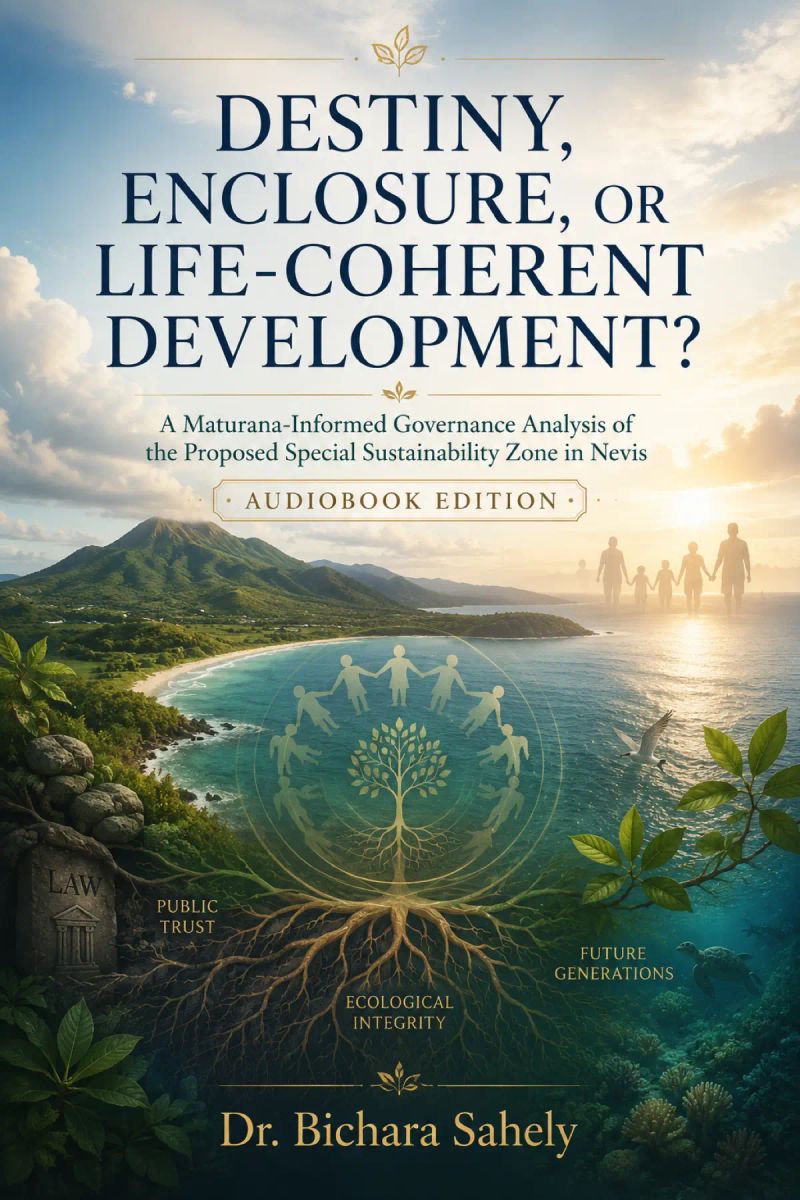
Destiny, Enclosure, or Life-Coherent Development?
A Maturana-Informed Governance Analysis of the Proposed Special Sustainability Zone in NevisBy Dr. Bichara Sahely


Length5h 29m
About this audiobook
Destiny, Enclosure, or Life-Coherent Development? examines the proposed Destiny Special Sustainability Zone in Nevis through a Maturana-informed life-coherent framework.
Rather than treating the project only as a question of investment, jobs, tourism, or infrastructure, Dr. Bichara Sahely asks what any development must protect in order to be truly developmental: land, water, law, ecology, culture, public trust, democratic participation, local ownership, public health, and future generations.
This audiobook does not reject development. It calls for development to be transparent, lawful, ecologically grounded, democratically deliberated, locally beneficial, and intergenerationally accountable.
At its heart, it asks: who authors the destiny of Nevis?
Audiobook details
GenrePolitics and Government
Length5 hrs 29 mins
Narrated byListen with 1,000+ voices
FormateBook with Audio
Publish dateJun 6, 2026
LanguageEnglish
Table of contents
1Chapter 1
2About This Audio Edition
3A Note to the Listener
4Preface
51. Introduction: Destiny as a Test Case for Small-Island Futures
Show all chaptersShow less
62. Methodology and Source Limitations
73. The Public Record: What Is Known, Claimed, and Still Undisclosed
83.1 The legislative framework
93.2 Official government and Nevis Island Administration representations
103.3 Developer representations
113.4 Civil-society and professional concerns
123.5 Media reporting and comparative interpretation
133.6 What remains undisclosed
143.7 Provisional finding
154. The Special Sustainability Zone Framework in Law and Governance
164.1 Development Agreements as the core legal instrument
174.2 The breadth of “Zone Governance”
184.3 The “notwithstanding anything contained in any enactment” clause
194.4 Conditions precedent: useful but insufficient
204.5 Exclusive development rights and transferability
214.6 Concessions, exemptions, and hidden fiscal cost
224.7 Dispute resolution, investment protection, and democratic policy space
234.8 Courts, public authority, and constitutional non-transferability
244.9 Environmental approval and adjacent seabed leasing
254.10 Oversight bodies and the limits of discretionary review
264.11 Ratification and democratic timing
274.12 Life-coherent legal interpretation
284.13 Provisional finding
295. Maturana, Autopoiesis, and the Biology of Governance
305.1 Autopoiesis: the self-production of a living system
315.2 Structural coupling: development as relationship, not insertion
325.3 Cognition and world-bringing
335.4 Emotion as the ground of political action
345.5 Love as recognition of the legitimate other
355.6 Boundary: the living distinction between openness and enclosure
365.7 Consent as recurrent coordination, not one-time approval
375.8 From development approval to covenant
385.9 The life-coherent governance test
396. Life-Coherence as an Evaluation Framework
406.1 The life-ground as the primary standard
416.2 The twelve domains of life-coherent evaluation
426.3 Constitutional and legal coherence
436.4 Democratic legitimacy and public participation
446.5 Land, belonging, and cultural continuity
456.6 Water security and hydrological integrity
466.7 Coastal, marine, and terrestrial ecology
476.8 Climate resilience and disaster risk
486.9 Energy, waste, and circular metabolism
496.10 Economy, labour, and local ownership
506.11 Fiscal prudence and public financial risk
Preserving Life, Transforming Power in GazaDr Bichara Sahely1h 42mFree

Preserving Life, Transforming PowerDr. Bichara Sahely1h 4mFree
Putting the Missing Bridge to WorkDr. Bichara Sahely2h 12mFree

The Missing BridgeDr. Bichara Sahely1h 5mFree
Transformational Laboratories ProtocolDr. Bichara Sahely2h 33mFree
Artificial Intelligence and the Epistemic CommonsDr Bichara Sahely3h 12mFree
Conflict, Repair, and Non-DominationDr Bichara Sahely2h 21mFree
Institutions of Reflexive TransformationDr Bichara Sahely1h 51mFree
The Politics of Civilizational HealingDr. Bichara Sahely2h 13mFree

The Missing Grammar of Modern CivilizationDr. Bichara Sahely2h 8mFree
Civilizational Healing Research ArchitectureDr. Bichara Sahely1h 24mFree
How Does a Civilization Learn to Heal?Dr. Bichara Sahely1h 16mFree

From Competent Physicians to Healing SocietiesDr. Bichara Sahely2h 20mFree
Competence Is Necessary, but Not SufficientDr. Bichara Sahely1h 15mFree

Life-Grounding CanMEDSDr. Bichara Sahely1h 13mFree
The Dynamic Architecture of ViabilityDr Bichara Sahely2h 1mFree
Completing the Life-Value Onto-Axiology ProgramDr. Bichara Sahely1h 9m5.0 (1)Free
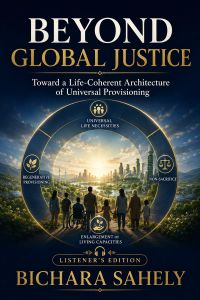
BEYOND GLOBAL JUSTICEDr. Bichara Sahely1h 25mFree

The Sweetness That Consumed the WorldBichara Sahely16h 14mFree
THE SOVEREIGNTY OF CREDITDr. Bichara Sahely3h 56mFree

Balcony Over Jerusalem: A Middle East Memoir - Israel, Palestine and BeyondJohn Lyons12h 37m4.6 (1.4K)$33 · $0.00
RiggedMollie Hemingway12h 48m4.6 (4.2K)$23 · $0.00

SledgehammerDavid Friedman8h 21m4.7 (589)$26 · $0.00

Citizenship in a Republic (Annotated)Theodore Roosevelt2h 44m4.6 (1.4K)$2 · $0.00
No EscapeNury Turkel9h 30m4.6 (809)$28 · $0.00

Always FaithfulThomas Schueman, Zainullah Zaki12h 12m4.6 (977)$29 · $0.00
UnthinkableJamie Raskin15h 8m4.5 (9.3K)$8 · $0.00
My Fourth Time, We DrownedSally Hayden13h 59m4.6 (2.9K)$23 · $0.00
A Revolution of Common SenseScott Jennings9h 29m4.6 (528)$29 · $0.00
Statement From the Dock at the Rivonia TrialNelson Mandela2h 18m4.6 (1.3K)$1 · $0.00

Lessons from the EdgeMarie Yovanovitch17h 11m4.5 (5.9K)$40 · $0.00

To Rescue the American SpiritBret Baier10h 12m4.5 (2.7K)$8 · $0.00

StonewalledSharyl Attkisson15h 19m4.5 (4.3K)$33 · $0.00
The World According to Orwell: 1984 & Animal FarmGeorge Orwell15h 42m4.6 (1.1K)$1 · $0.00
Basic EconomicsThomas Sowell18h 32m4.5 (29.3K)$28 · $0.00
To Rescue the RepublicBret Baier, Catherine Whitney11h 42m4.5 (8.6K)$29 · $0.00

Modern WarriorsPete Hegseth7h 10m4.5 (4.7K)$24 · $0.00
Philosophy and Opinions of Marcus Garvey (Annotated)Marcus Mosiah Garvey4h 42m4.5 (1.7K)$1.99 · $0.00

A Plague Upon Our HouseScott W. Atlas MD10h 37m4.5 (3.4K)$20 · $0.00

One Bright MoonAndrew Kwong12h 21m4.5 (813)$29 · $0.00
You may also like

Federalist & Anti-Federalist Papers - Complete EditionAlexander Hamilton, James Madison, John Jay, Samuel Bryan, Patrick Henry22h 28m4.3 (3K)$1.99 · $0.00

Trickle Up PovertyMichael Savage12h 23m4.0 (1.6K)$29 · $0.00

Marked for DeathGeert Wilders8h 22m4.5 (530)$20 · $0.00
Empire of MudJ. D. Dickey9h 21m3.7 (1K)$20

AzadiArundhati Roy6h 15m4.2 (5.1K)$17 · $0.00
CapitalismAyn Rand14h 16m4.0 (5.2K)$25 · $0.00

China UnboundJoanna Chiu10h 7m4.2 (912)$20 · $0.00

Noli me tangereJosé Rizal19h 35m4.3 (29.4K)$4 · $0.00

It’s Even Worse Than It LooksThomas E. Mann, Norman J. Ornstein6h 43m4.0 (4.6K)$18 · $0.00

The Federalist Papers & Anti-Federalist Papers: Complete Edition of the Pivotal Constitution DebateAlexander Hamilton, James Madison, John Jay, Patrick Henry, Samuel Bryan22h 14m4.4 (7.7K)$2 · $0.00

Open SeasonBen Crump7h 57m4.4 (1.2K)$26 · $0.00

DawnSevgi Soysal8h 25m4.3 (650)$20

The Man Who Sold AmericaJoy-Ann Reid9h 26m$29 · $0.00
To Save AmericaNewt Gingrich9h 43m3.7 (407)$20 · $0.00
The Alternative: A Separate Nationality; or, The Africanization of the SouthWilliam H. Holcombe33m$2 · $0.00

The West’s Last ChanceTony Blankley6h 25m3.6 (259)$14 · $0.00

English Society in the Eighteenth CenturyRoy Porter16h3.9 (651)$28
LibertyRebecca Belliston15h 3m4.5 (198)$23
An Uncivil WarGreg Sargent5h 41m3.6 (217)$24 · $0.00

Between Politics and Finance: Hong Kong's "Infinity War"?Alessia Amighini4h 27m$7