
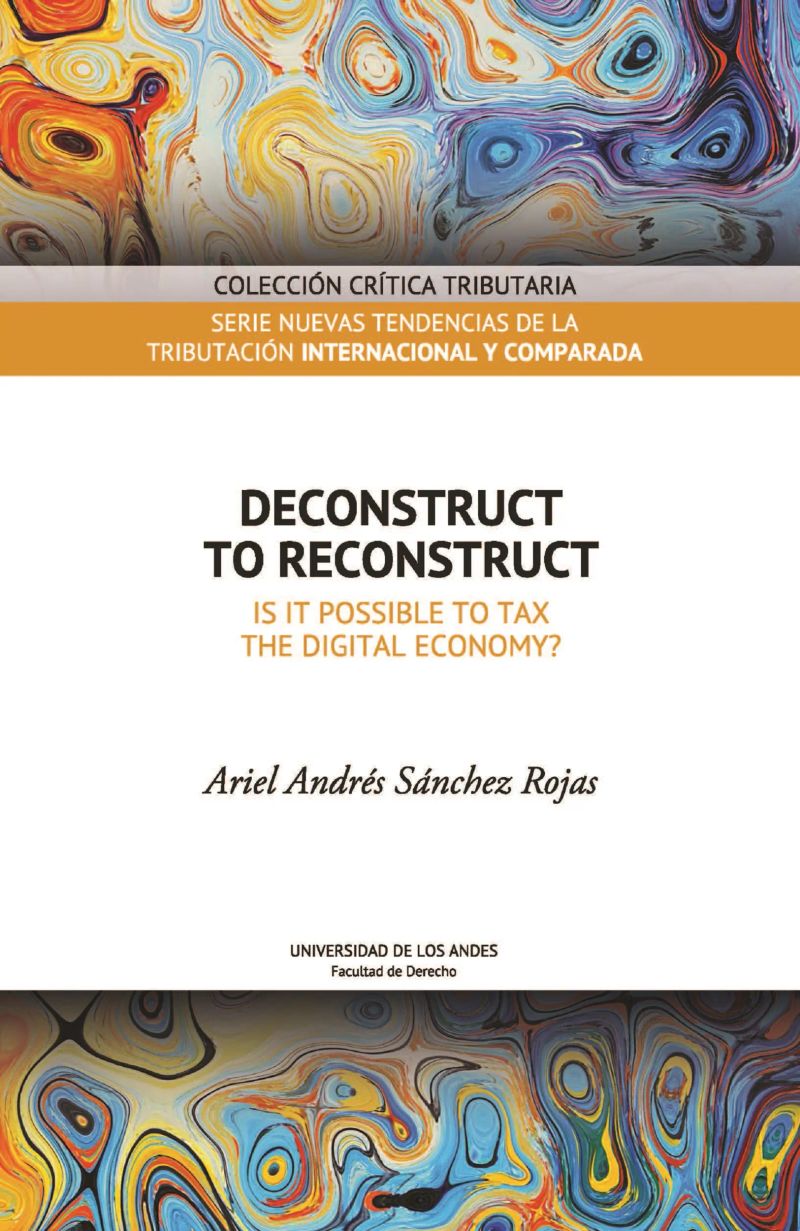
Deconstruct to reconstruct
Is it possible to tax the digital economy?By Ariel Andrés Sánchez Rojas


Length2h
About this audiobook
Deconstruct to reconstruct seeks to use a modern benefit principle theory that will allow tax authorities to tax companies in the digital economy, assuring they pay taxes in the countries in which they operate. The emergence of a new business models such as app stores, online advertising, cloud computing, participative network platforms, high-speed trading, and online payment services has reshaped the global economy and made it difficult for tax authorities to determine what and where to tax. Technologies in the new digital economy make it possible for companies to operate in countries without being physically present. While companies such as Netflix, Google, and AirBnB provide services and earn profits in different countries, tax loopholes and intricate tax planning enable them to pay little-to-no taxes in many of these countries. For example, Netflix earned more than US$100 billion in Colombia in 2016, but it did not pay any direct or indirect taxes in the country. The absence of a specific tax or legal rule that targets digital companies has prevented Colombian tax authorities from taxing Netflix or any other company of the sort. Many tax authorities around the world have similar experiences.
Audiobook details
GenreBusiness and Economics
Length2 hrs
Narrated byListen with 1,000+ voices
FormateBook with Audio
Publish dateJan 1, 2020
LanguageSpanish
Table of contents
1DECONSTRUCT TO RECONSTRUCT
2COLECCIÓN CRÍTICA TRIBUTARIA
3Introduction: Deconstruct to Reconstruct
41 Historical Overview: The Benefit Principle or Exchange Theory
5DECONSTRUCT TO RECONSTRUCT
Show all chaptersShow less
62 The Digital Economy and Its Core: Big Data and E-Commerce
7DECONSTRUCT TO RECONSTRUCT
81 OECD, “Action 1: Addressing the Tax Challenges of the Digital
92 OECD, “Action 1: Addressing the Tax Challenges of the Digital
103 OECD, “Action 1: Addressing the Tax Challenges of the Digital
11DECONSTRUCT TO RECONSTRUCT
1210 Dirección Nacional de Planeación (DNP), Documento CONPES
133 Is It Possible to Tax Digital Economy Companies?
14DECONSTRUCT TO RECONSTRUCT
155 The Treaty on European Union (TEU Post-Lisbon: European
166 The Treaty on European Union (TEU Post-Lisbon) European
1714 European Commission, Common Consolidated Corporate Tax
18Germany
19Slovakia
2015 European Commission, Common Consolidated Corporate Tax
2120 Richard A. Westin, International Taxation of Electronic Commerce
2221 National Bellas Hess v. Department of Revenue, 386 US 753
2325 EY, Worldwide VAT, GST and Sales Tax Guide (London: Ed.
2426 EY, Worldwide VAT, GST and Sales Tax Guide (London: Ed.
2527 EY, Worldwide VAT, GST and Sales Tax Guide (London: Ed.
2628 EY, Worldwide VAT, GST and Sales Tax Guide (London: Ed.
2729 EY, Worldwide VAT, GST and Sales Tax Guide (London: Ed.
2830 Congress of the Republic of Chile, Proyecto de Ley Moderni-
294 How to Tax Digital Economy Companies
3035 Raffaele Russo ed., Fundamentals of International Tax Planning
3136 Following OECD Commentaries on Article 5(1) of the OECD
32Indirect Taxes
33How Does Transfer Pricing Work?
3456 Professor Francesco Parlatore (conference, International Tax
3557 OECD MC, Commentaries on article 9.6 “Corresponding adjust-
3661 Development, Enhancement, Maintenance, Protection, Ex-
3767 Maintenance and repairs, salary and wages, and amortiza-
3868 Brian J. Arnold, International Tax Primer (The Netherlands:
3973 More on OECD Discussion Drafts, Chapter VI. Special Consid-
40DECONSTRUCT TO RECONSTRUCT
4174 GlaxoSmithKline Holdings (America) Inc v. Commissioner, 117
42Conclusions
43DECONSTRUCT TO RECONSTRUCT
44BIBLIOgRAPHY

Lecciones en estrategia: Hacia una gestión de excelenciaArnoldo Hax, Nicolás Majluf3h 30m4.6 (15)$7 · $0.00

#Tsunami Digital: El nuevo poder de las audiencias en las redes socialesEduardo Arriagada4h 26m3.9 (32)$10 · $0.00

Líderes destacados de los 2000 años de Iglesia CatólicaJavier Fernández Aguado4h 37m$28 · $0.00

How to Grow Your Small Business \ Cómo hacer crecer tu negocio (Sp. ed.) Unabr.Donald Miller5h 42m$24 · $0.00

Claves para el liderazgo: La extraordinaria recuperación de Chile después del desastreMichael Useem, Howard Kunreuther10h 27m3.7 (30)$20 · $0.00

Pensiones a la chilenaAndrés Solimano4h 35m3.9 (15)$8 · $0.00

Cueste lo que cueste: La batalla por salvar el euro y EuropaYan Carrière-Swallow, Sebastián Claro10h 46m$14 · $0.00

Pensiones: Del descontento a las solucionesSalvador Valdés Prieto13h 24m$9 · $0.00

Capitalismo a la chilenaAndrés Solimano6h 40m3.7 (13)$10 · $0.00

Everyday Dharma \ Dharma para la vida diariaSuneel Gupta5h 46m4.3 (990)$24 · $0.00

Detalles Que Enamoran: Cómo Derretir a los Clientes para Que No Quieran Comprarle a Nadie MásDavid Gómez5h 35m4.6 (541)$12 · $0.00

El Efecto CompuestoDarren Hardy5h 45m4.4 (80.2K)$14 · $0.00

Capitalismo solidarioRich DeVos16h 8m4.6 (291)$14 · $0.00

El mapa maestroCharles F. Hannel7h 8m4.4 (26.5K)$14 · $0.00

La mañana milagrosa para emprendedoresHal Elrod, Cameron Herold8h 13m4.4 (1.9K)$14 · $0.00

Acres de diamantesRussell Conwell2h 9m4.4 (10.6K)$14 · $0.00

Liderazgo AsertivoFrank Slootman6h 16m4.4 (12.4K)$11 · $0.00

La magia de pensar en grandeDavid J. Schwartz10h 22m4.3 (111.7K)$14 · $0.00

Psicotrading y gestión de riesgoFernando Arias7h 29m4.5 (473)$12 · $0.00

Piense como un millonarioCamilo Cruz, Brian Tracy3h 6m4.4 (2.2K)$14 · $0.00
You may also like

La cuarta revoluciónGino Roncaglia13h 40m4.2 (453)$10 · $0.00

Innovación y emprendimiento en la educación superiorNofal Nagles García, John Jairo Gil Toledo, Handrix García Durán, Celso Miguel Melo Melo, Rogelio Daniel Vélez García, Octavio Reyes López, Juan Carlos Romero Rincón4h 10m$3 · $0.00

La filosofía del daño y su reparaciónOsvaldo R. Burgos10h 30m$19 · $0.00

El Prácticum en contextos de enseñanza no presencialesAna Ma Martín, Laura Méndez, Raúl González9h 5m$21 · $0.00

Big Data los Secretos para Facturar Como Empresa de Alto NivelValentín López57m$19 · $0.00

Social mediaJosé Carballar8h 31m$14 · $0.00

Dispositivos digitales móviles en educaciónUnknown Author7h 45m$21 · $0.00

Sistematización de conceptos de marketing con realidad aumentadaFabio Camargo, Jhonn Angarita, Olga Najar13h 8m$21 · $0.00

Medios informáticos en la educaciónDiego S. Levis16h 28m$7 · $0.00

Laboratorio virtual de opticaMaria Luisa Calvo6h 33m$19 · $0.00

Aprendizaje-Servicio virtualJuan García-Gutiérrez, Marta Ruiz-Corbella8h 40m$21 · $0.00

¿Dónde debo buscar trabajo?Elsa Ivonne Vargas Hernández45m$6 · $0.00

Derecho económicoMaría Alexandra Ortiz Cabrera13h 39m$10 · $0.00

Breve biblioteca de bibliologíaFernando Cruz Quintana4h 22m$12 · $0.00

Perspectivas de una reforma estudios de derecho administrativo a partir de la obra de eberhard schmidt assmannJaime Orlando Santofimio Gamboa, Javier Barnés Vásquez, Mónica Liliana Ibagón27h 1m$15 · $0.00

Derecho Internacional de los Negocios. Alcances. T. IIIAdriana Zapata de Arbeláez33h 38m$10 · $0.00

Responsabilidad civil en la era digitalDaniel Peña Valenzuela7h 34m$6 · $0.00

Compendio de Derecho Administrativo. Segunda ediciónJaime Orlando Santofimio Gamboa91h 41m$32 · $0.00

Fundamentos del turismoJosé Luis Feijoó, Mariana Celina Fabbroni, Mariana Pérez Marquez, Marlene Pedetti, Alice Bonomi, Patricio Castro Pacheco, Rodrigo Báez, Melina Magalí Romero, Lila Somma, Mayra Lorena Coppa13h 22m$16 · $0.00

Disrupción tecnológica, transformación y sociedadUnknown Author42h 49m$19 · $0.00