
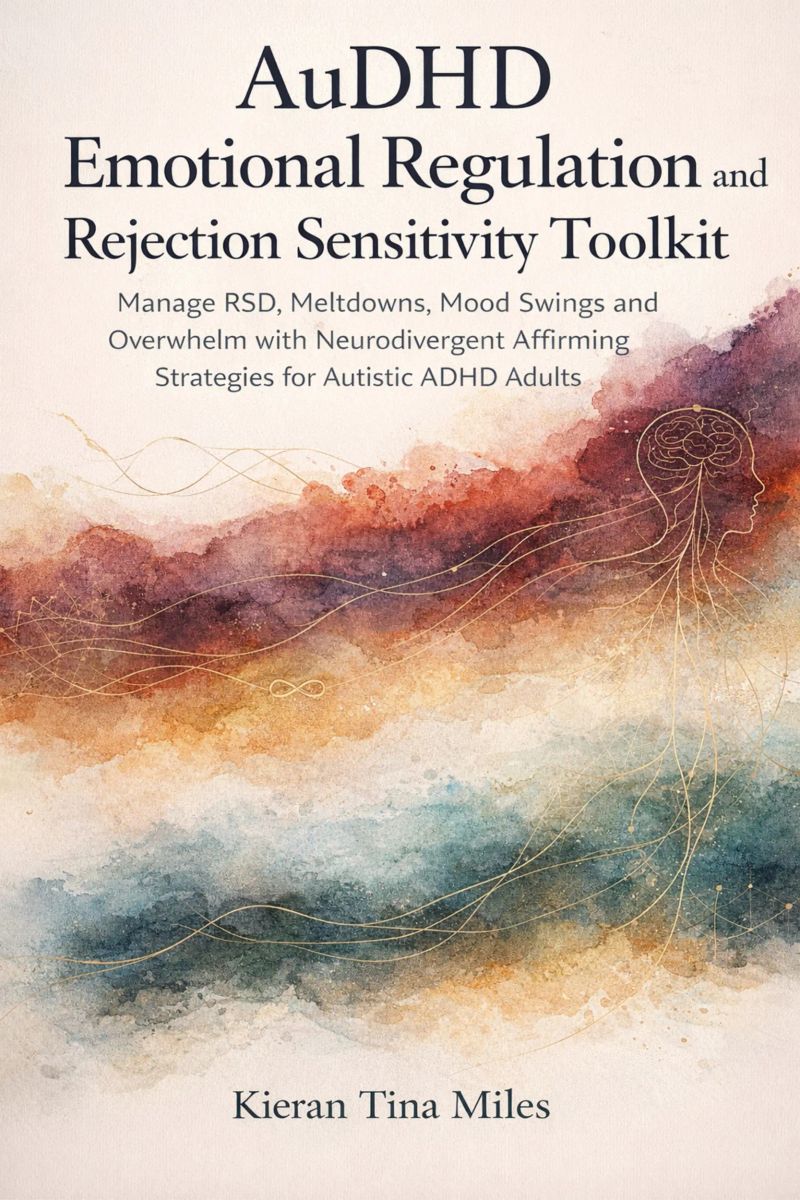
AuDHD Emotional Regulation and Rejection Sensitivity Toolkit
Manage RSD, Meltdowns, Mood Swings and Overwhelm with Neurodivergent Affirming Strategies for Autistic ADHD AdultsBy Kieran Tina Miles


Length7h 45m
About this audiobook
Living with both autism and ADHD means your brain runs two operating systems that often work against each other. One demands predictability while the other craves novelty. One needs sensory calm while the other chases stimulation. When these systems collide, the result is emotional overload that most resources never address because they were built for one condition, not both.
A Toolkit Built for the AuDHD Brain
This comprehensive guide delivers practical, evidence-based strategies designed specifically for adults navigating the unique emotional challenges of combined autism and ADHD. Every tool inside has been adapted for how AuDHD brains actually process emotions, sensory input, and social demands. No generic advice. No strategies that assume a neurotypical nervous system. Every chapter addresses the specific ways autism and ADHD amplify each other to create emotional responses that feel overwhelming, unpredictable, and impossible to control.
Understand and Manage Rejection Sensitive Dysphoria
RSD in AuDHD adults hits harder than in ADHD alone. The autistic tendency toward pattern recognition combines with ADHD emotional intensity to create a rejection response that feels physical, immediate, and all-consuming. Learn what happens in your nervous system during an RSD episode and how to interrupt the cascade before it takes over your thinking, your relationships, and your sense of self-worth.
Navigate Meltdowns, Shutdowns, and Emotional Flooding
Meltdowns and shutdowns are not choices. They are involuntary neurological events with specific warning signs and specific recovery needs. This book provides a three-phase response framework covering prevention, survival during an active episode, and structured recovery afterward. Includes crisis communication scripts, sensory regulation tools, and a personalized early warning system you can build around your own patterns.
Practical Tools Grounded in Neuroscience
Inside you will find body-based regulation techniques for moments when thinking strategies fail, a polyvagal framework adapted for AuDHD nervous systems, energy budgeting and burnout prevention systems, relationship communication strategies for partners and support networks, schema therapy and self-compassion approaches for the deep shame that often accompanies emotional dysregulation, and a complete guide to building a personalized regulation toolkit that fits your specific brain. Every strategy is grounded in published, peer-reviewed research from polyvagal theory, schema therapy, DBT, ACT, and current neuroscience. All citations are real, verifiable, and listed by chapter. This is not a book of platitudes or motivational quotes. It is a clinical-grade resource written in accessible language for the adults who need it most.
Audiobook details
GenrePsychology, Self-Help
Length7 hrs 45 mins
Narrated byListen with 1,000+ voices
FormateBook with Audio
Publish dateFeb 3, 2026
LanguageEnglish
Table of contents
1AuDHD Emotional Regulation and Rejection Sensitivity Toolkit
2Preface
3Introduction: The Two Operating System Brain
4Chapter 1: Your AuDHD Emotional Blueprint
5Chapter 2: The Body Keeps the Score Card
Show all chaptersShow less
6Chapter 3: Naming What You Feel
7Chapter Conclusions
8Chapter 4: The Sensory Emotion Highway
9Chapter 5: Rejection Sensitivity Decoded
10Chapter 6: Brain Emergency Protocols
11Chapter 7: The Mood Weather System
12Chapter 8: Rewiring Your Inner Critic
13Chapter Synthesis
14Chapter 9: Emotions in Relationships
15Chapter 10: Burnout Proofing Your Emotions
16Chapter 11: Building Your Personal Toolkit
17Chapter 12: When You Need More Support
18Appendix A: Tool Index
19Appendix B: Toolkit
20Chapter 1: Two Operating Systems
21Day 1 — Date: _______________
22Day 2 — Date: _______________
23Day 3 — Date: _______________
24Day 4 — Date: _______________
25Day 5 — Date: _______________
26Day 6 — Date: _______________
27Day 7 — Date: _______________
28Chapter 2: Your Nervous System Has Three Gears
29Chapter 3: The Feeling That Has No Name
30Day 1 — Date: __________
31Day 2 — Date: __________
32Day 3 — Date: __________
33Day 4 — Date: __________
34Day 5 — Date: __________
35Day 6 — Date: __________
36Day 7 — Date: __________
37Chapter 4: When The World Is Too Loud To Feel
38Day 1 — Date: __________
39Day 2 — Date: __________
40Day 3 — Date: __________
41Day 4 — Date: __________
42Day 5 — Date: __________
43Day 6 — Date: __________
44Day 7 — Date: __________
45Chapter 5: The Rejection Earthquake
46Chapter 6: Brain Emergency Protocols
47Chapter 7: The Mood Weather System
48Day 1 — Date: __________
49Day 2 — Date: __________
50Day 3 — Date: __________
More from Kieran Tina Miles


What to Make of a LifeJim Collins13h 31m4.4 (793)$33 · $0.00

TerraformPropaganda5h 39m4.7 (594)$24 · $0.00

Southern Horrors: Lynch Law in All Its Phases (Annotated)Ida B. Wells-Barnett2h 44m4.6 (1.3K)$2 · $0.00

Hour of the HeartIrvin D. Yalom, Benjamin Yalom8h 19m4.6 (2.3K)$26 · $0.00

Braving the TruthRachel Held Evans11h 31m4.7 (359)$29 · $0.00
Level UpRob Dial7h 42m4.6 (3.3K)$26 · $0.00

As a JewSarah Hurwitz8h 36m4.6 (1.2K)$26 · $0.00

Burn the HaystackJennie Young, PhD9h 30m4.6 (543)$29 · $0.00

Woman and the New Race (Annotated)Margaret Sanger6h 30m4.6 (1K)$1.99 · $0.00

Good InsideBecky Kennedy9h 55m4.5 (59.3K)$29 · $0.00

Du Bois: EssaysW.E.B. Du Bois6h 22m4.6 (1.5K)$1 · $0.00

The North American Indian (Illustrated Edition)Edward S. Curtis, Frederick Webb Hodge5h 59m4.6 (1.4K)$2 · $0.00

Valley of the BirdtailAndrew Stobo Sniderman, Douglas Sanderson10h 1m4.6 (2.4K)$29 · $0.00

Lies My Therapist Told MeGreg E. Gifford9h 3m4.6 (503)$29 · $0.00

Disturbed in Their NestsAlephonsion Deng, Judy A. Bernstein11h 22m4.6 (595)$23 · $0.00

No Name in the StreetJames Baldwin5h4.5 (8.5K)$20 · $0.00

Magic SeasonWade Rouse6h 41m4.6 (855)$24 · $0.00

Consent Laid BareChanel Contos7h 11m4.5 (1.7K)$24 · $0.00

The Big RevealSasha Velour6h 15m4.5 (2.1K)$24 · $0.00

Pastoral SongJames Rebanks8h 35m4.5 (12K)$26 · $0.00
Learning to PrayJames Martin13h 24m4.5 (3.4K)$33 · $0.00

Finding MeViola Davis9h 15m4.6 (256.4K)$29 · $0.00

Spiritual AnatomyDaaji Kamlesh D. Patel9h 47m4.7 (319)$29 · $0.00

The Dangerous Truth about Today’s MarijuanaLaura Stack CSP, MBA9h 57m4.7 (384)$20 · $0.00

Birdie & HarlowTaylor Wolfe7h 50m4.6 (6.5K)$26 · $0.00

CrossroadsKaleb Dahlgren7h 56m4.6 (4.9K)$26 · $0.00

Life on the BridgeKaelynn Partlow5h 40m4.6 (1.1K)$24 · $0.00

Keep Your Love OnDanny Silk9h 4m4.6 (8.1K)$10 · $0.00

The Tao of Joy Every DayDerek Lin10h 24m4.6 (762)$20 · $0.00

UndividedVicky Beeching9h 2m4.6 (1.3K)$29 · $0.00
Level UpRob Dial7h 42m4.6 (3.3K)$26 · $0.00
Burn the HaystackJennie Young, PhD9h 30m4.6 (543)$29 · $0.00

ACRES OF DIAMONDS: Our Every-day Opportunities (Wisdom & Empowerment Series) (Annotated)Russell Conwell2h 26m4.6 (1K)$2 · $0.00
Good InsideBecky Kennedy9h 55m4.5 (59.3K)$29 · $0.00

The Lost VoiceGreta Morgan8h 30m4.7 (285)$26 · $0.00

Stripped DownBunnie Xo8h 25m4.5 (32.9K)$26 · $0.00

UnthinkableJamie Raskin15h 8m4.5 (9.3K)$8 · $0.00

Wallace D. Wattles Ultimate Collection Wallace D. Wattles16h 53m4.6 (1.3K)$1 · $0.00

Inquire WithinIn-Q2h 18m4.6 (993)$16 · $0.00

Under His WingsEmily Compagno7h 16m4.6 (848)$22 · $0.00
You may also like

From Poverty to PowerJames Allen3h 56m4.1 (2.4K)$2.30 · $0.00

The Existentialist's Survival GuideGordon Marino6h 2m3.8 (1.6K)$24 · $0.00

Love, Medicine and MiraclesBernie S. Siegel2h 50m4.3 (6.7K)$18 · $0.00
Master of ChangeBrad Stulberg6h 44m4.1 (3.1K)$24 · $0.00

Unf*ck Your BrainFaith G. Harper PhD3h 39m3.8 (30.4K)$15

Not That BadRoxane Gay8h 42m4.4 (26.6K)$27 · $0.00

EnchiridionArrian Epictetus18h 5m4.3 (49.2K)$1 · $0.00

The F*ck It DietCaroline Dooner7h 38m4.1 (14.6K)$26 · $0.00

Wise as Fu*kGary John Bishop4h 5m3.9 (3.2K)$7 · $0.00

The Subtle Art Of Not Giving A F*ck (Gujarati)Mark Manson, Jatin Vora7h 29m4.4 (3.8K)$13 · $0.00

Let Your Life SpeakParker J. Palmer2h 57m4.3 (17.4K)$12

Feel It AllCasey Tanner6h 20m4.3 (1.1K)$24 · $0.00

13 Things Mentally Strong People Don't DoAmy Morin6h 36m4.0 (42.7K)$7 · $0.00

The Mindful DayLaurie J. Cameron8h 15m4.1 (2.8K)$20

EpictetusAlex Omberg4h 34m4.6 (21) Only with Ultra

If Cancer is a Gift, Can I Return It?Agalia Baker5h 13m$18 · $0.00

Letting GO, Living LightJacob James55m5.0 (34) Only with Ultra

WHAT A LIFEJackson Michael45m4.9 (43) Only with Ultra

The First 30 DaysAriane de Bonvoisin5h 49m3.9 (279)$24 · $0.00

The Space Between DecisionsJacob James51m5.0 (33) Only with Ultra