
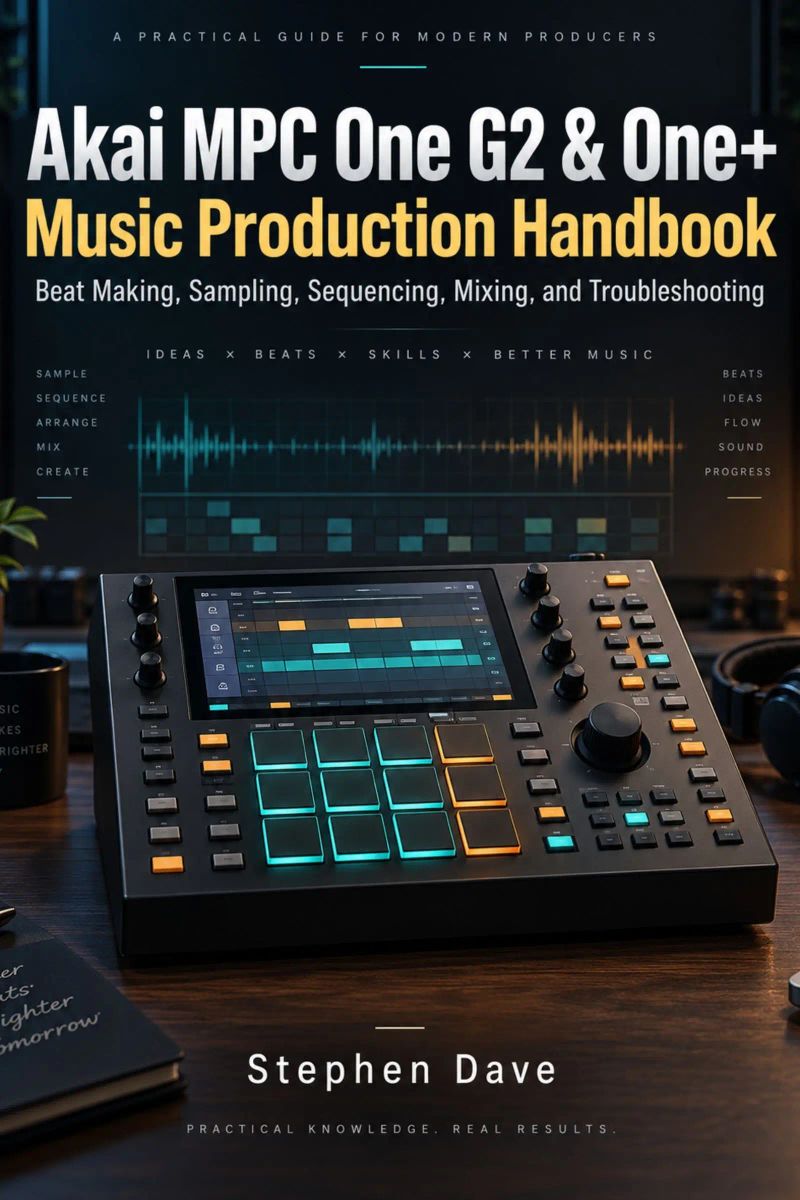
Akai MPC One G2 & One+ Music Production Handbook
Beat Making, Sampling, Sequencing, Mixing, and TroubleshootingBy Stephen Dave


Length15h 51m
About this audiobook
A powerful standalone workstation can still feel fragmented when pads, tracks, programs, sequences, samples, audio routing, storage, computer integration, and performance preparation are learned as isolated features.
This handbook replaces feature-by-feature guessing with a connected workflow. A project-centered operating handbook that connects setup, sampling, sequencing, arrangement, mixing, live use, troubleshooting, backup, and delivery into one repeatable production system. It begins with the operating foundation, then shows how each decision affects the next stage of the project. The result is a guide that can be read in sequence by a newcomer or opened by task when a real session stops behaving as expected.
Coverage includes physical setup and signal flow; registration, firmware, storage, and project safety; first-beat creation; expressive pad performance; original recording; sample editing and chopping; drum programming; bass, chords, and keygroups; arrangement; instruments; audio takes; routing, equalization, dynamics, and space; automation; external MIDI and control voltage; computer workflows; backup, live performance, diagnosis, export, and handoff. The emphasis stays on cause and effect: what the operator is trying to accomplish, which layer controls the result, what evidence confirms success, and what should remain unchanged while a fault is isolated.
Readers learn not only which control to use, but how to trace a result through performance data, sound source, routing, storage, and export so that creative work remains editable and recoverable. That approach is especially useful when a session must be reopened later, transferred to another workstation, explained to a collaborator, recovered after an update, or operated under time pressure.
The intended audience includes new and experienced beatmakers, producers, performers, and home-studio users who want a dependable start-to-finish hardware production workflow. The progression gives newer readers a route from fundamentals to complete work while allowing experienced users to move directly to advanced integration, diagnostics, preservation, and delivery.
Readers learn not only which control to use, but how to trace a result through performance data, sound source, routing, storage, and export so that creative work remains editable and recoverable. The goal is not memorizing every option. It is gaining a durable mental model, a reliable sequence of checks, and the confidence to make deliberate choices without sacrificing earlier work.
Specific menus, content entitlements, software behavior, limits, and compatibility can change; readers should verify the installed version and their exact hardware before applying model-dependent steps. No workflow can replace current documentation, competent safety practice, or verification on the reader's own system. This handbook is designed to make that verification clearer, faster, and easier to preserve.
Build a complete beat from a clean project through arrangement and export
Record, edit, chop, organize, and preserve original samples
Program drums, bass, chords, instruments, audio tracks, and automation with intent
Route, mix, back up, troubleshoot, and recover projects methodically
Prepare dependable studio, computer-connected, and live-performance workflows
Audiobook details
Rating★★★★ 4.4 (16)
Includes Amazon
GenreOther, Technology
Length15 hrs 51 mins
Narrated byListen with 1,000+ voices
FormateBook with Audio
Publish dateOct 2, 2026
LanguageEnglish
Table of contents
1Publisher and Trademark Notice
2How to Use This Handbook
3Version and Feature Status
4Chapter 1 — Working Across the MPC One G2 and One+
51.1 Start with the machine you actually own
Show all chaptersShow less
61.2 Understand what standalone does and does not promise
71.3 Separate events, sound sources, recorded audio, and files
81.4 Read MPC 3 as a track-based workstation
91.5 Interpret track limits as planning constraints
101.6 Distinguish bundled, supported, paid, and unsupported features
111.7 Pick the correct path when the computer enters the session
121.8 Plan the first project before touching a sound browser
131.9 Know which state will remain editable
141.10 Follow a signal from intention to result
151.11 Run a low-risk orientation exercise
161.12 Use a diagnostic question instead of a guessed fix
171.13 Three decisions in realistic production situations
181.14 What this chapter has established
19Chapter 2 — Build a Reliable Hardware and Listening Setup
202.1 Begin with a physical setup that can be repeated
212.2 Use the correct power arrangement
222.3 Identify audio sockets before inserting a cable
232.4 Build a first listening path with headphones
242.5 Connect powered studio monitors without feedback or surprises
252.6 Read a mixer or audio interface as another signal stage
262.7 Prepare a suitable external sound source
272.8 Choose cables for the function, not their appearance
282.9 Establish source level before changing processing
292.10 Monitor without accidentally recording a feedback loop
302.12 Treat G2 USB audio and analog main outputs as different destinations
312.13 Diagnose hum, buzz, crackle and channel imbalance
322.14 Commission the desk with a controlled sound check
332.15 A compact setup for travel, collaboration or a small desk
342.16 Troubleshooting cases: identify the failed link
352.17 The chapter-two studio verification exercise
362.18 What the setup must now accomplish
37Chapter 3 — Register, Update, Activate, and Organize Content
383.1 Treat registration as part of ownership, not as a formality
393.2 Know the version position before pressing update
403.3 Update firmware safely and verify the outcome
413.4 Redeem software, instruments, and purchased features with clear expectations
423.5 Prepare internal and external storage with a long-term mindset
433.6 Build a project and backup discipline before you need recovery
443.7 Confirm content visibility and plugin readiness before the first serious session
453.8 Keep a simple version and asset log
463.9 Diagnose registration, update, and content problems without making them worse
473.10 Register the correct model and prove account ownership
483.11 Select a firmware update method deliberately
493.12 Control desktop compatibility without confusing it with firmware
503.13 Classify included, optional and separately licensed content
More from Stephen Dave
Akai MPC One G2 & One+ MusikproduktionshandbuchStephen Dave18h 58m$9
Akai MPC One G2 & One+ Manuel de la production musicaleStephen Dave18h 52m$9
DEEPSKYSTACKER 6 Astrophotography HandbookStephen Dave7h 57m$9

FL Studio HANDBUCH FÜR MUSIKPRODUKTION 2027Stephen Dave25h 48m$9
CHAMSYS MAGICQ LICHTSTEUERUNGSHANDBUCHStephen Dave21h 29m$9
FL STUDIO MUSIC PRODUCTION HANDBOOK 2027Stephen Dave21h 10m$9
DEEPSKYSTACKER 6 Manuel d'astrophotographieStephen Dave10h 7m$9

DEEPSKYSTACKER 6 Handbuch der AstrofotografieStephen Dave9h 52m$9
CHAMSYS MAGICQ MANUEL DE CONTRÔLE DE L'ÉCLAIRAGEStephen Dave21h 30m$9

Bluebeam revu 21 Baustart & SchätzungshandbuchStephen Dave21h 40m$10
Bluebeam Revu 21 Décollage en construction & Manuel d'estimationStephen Dave21h 56m$10
Bluebeam revu 21 Construction Takeoff & Estimating HandbookStephen Dave18h 31m$10

ABLETON LIVE 12 HANDBUCH DER MUSIKPRODUKTIONStephen Dave26h 42m$10
ABLETON LIVE 12 MUSIC PRODUCTION HANDBOOKStephen Dave21h 55m$10
ABLETON LIVE 12 MANUEL DE PRODUCTION MUSICALEStephen Dave26h 22m4.8 (12)$10

Mere ChristianityC. S. Lewis7h 7m4.4 (519.7K)$24 · $0.00

Her Daily BreadKate Wood12h 57m4.6 (153)$33 · $0.00
The Holy Bible - 1 SamuelKing James2h 13m4.8 (1.6K)$3 · $0.00

The American Standard Bible — The Gospel of MatthewMatthew3h 56m4.7 (3K)$2 · $0.00

Bad Fat Black GirlSesali Bowen6h 32m4.7 (2.8K)$24 · $0.00

The King James Audio Bible New Testament CompleteChristopher Glyn20h 2m4.7 (2.6K)$12 · $0.00

Faiths CheckbookCharles Spurgeon12h 44m4.7 (3.2K)$11 · $0.00

Ten Things I Wish You Knew About Your Child's Mental HealthDr. Billy Garvey4h 53m4.7 (2.4K)$20 · $0.00
Designing Terry Pratchett’s DiscworldPaul Kidby3h 52m4.7 (343)$20 · $0.00

The Chosen Book OneAmanda Jenkins, Kristen Hendricks, Dallas Jenkins3h 8m4.6 (4.9K)$10 · $0.00
The Lives of BrianBrian Johnson9h 45m4.6 (3.5K)$29 · $0.00
Expository Thoughts on the Gospel of LukeJ.C. Ryle27h 13m4.7 (536)$18 · $0.00

CrossroadsKaleb Dahlgren7h 56m4.6 (4.9K)$26 · $0.00

Across the RiverKent Babb11h 40m4.6 (927)$29 · $0.00

Brain Training for RidersAndrea Monsarrat Waldo5h 56m4.7 (550)$19 · $0.00

My Effin' LifeGeddy Lee17h 11m4.6 (13.1K)$40 · $0.00

Kings and PawnsHoward Bryant10h 9m4.6 (678)$29 · $0.00

The Elementia Chronicles #2: The New OrderSean Fay Wolfe11h 17m4.6 (841)$29 · $0.00

The ActsLuke2h 55m4.6 (19.7K)$12 · $0.00

New Testament - Easy NavigationWorld English Bible19h 35m4.6 (1.3K)$1.30 · $0.00

The Honey BusMeredith May9h 31m4.4 (16.6K)$25 · $0.00

Collected Writings of Nikola TeslaThomas Commerford Martin, Nikola Tesla19h 42m4.4 (2.8K)$1.99 · $0.00

Operation PedestalMax Hastings12h 29m4.4 (5.2K)$29 · $0.00

When the Heavens Went on SaleAshlee Vance18h 20m4.4 (3K)$40 · $0.00

Everybody Has a Podcast (Except You)Justin McElroy, Travis McElroy, Griffin McElroy5h 9m4.3 (2.3K)$24 · $0.00

Hands of TimeRebecca Struthers8h 8m4.4 (1.3K)$26 · $0.00

Never Lost AgainBill Kilday10h 1m4.4 (805)$29 · $0.00

How the Internet HappenedBrian McCullough13h 28m4.3 (2.7K)$23 · $0.00

Collected Writings of Nikola TeslaNikola Tesla, Thomas Commerford Martin21h 50m4.3 (1.7K)$1 · $0.00

Just AspireAjai Chowdhry9h 13m4.4 (260)$29 · $0.00

The Little Book of AliensAdam Frank8h 20m4.3 (1.3K)$26 · $0.00

The inventions, researches and writings of Nikola Tesla (Annotated)Thomas Commerford Martin16h 59m4.3 (1.3K)$2 · $0.00

KargilV.P. Malik15h 18m4.3 (2K)$24 · $0.00

Experiments with Alternating CurrentsNikola Tesla9h 16m4.3 (874)$1.99 · $0.00

Fire on the HorizonTom Shroder, John Konrad8h 23m4.3 (858)$26 · $0.00

The Smell of Kerosene (Annotated)National Aeronautics and Space Administration, Donald L. Mallick, Peter W. Merlin11h 32m4.3 (523)$2 · $0.00

The Boy Who Harnessed the WindWilliam Kamkwamba, Bryan Mealer10h 5m4.2 (78.9K)$29 · $0.00

Across the Airless WildsEarl Swift10h 8m4.3 (1.3K)$29 · $0.00

Console WarsBlake J. Harris20h 41m4.2 (13.7K)$46 · $0.00

Improvised Munitions HandbookU.S. Department of Defense4h 49m4.3 (1.6K)$1.99 · $0.00
You may also like

Michigan NMLS SAFE MLO Exam Study Guide 2026/2027Ignatius Farrow15h 27m$30

Mastering the FE Reference HandbookAmara Idoko12h 7m$85

The Principles of Mathematical PhysicsHenri Poincaré2h 4m$2 · $0.00

Colorado Journeyman Electrician License Exam Prep 2026/2027Thaddeus Brennick19h 51m$30
DEEPSKYSTACKER 6 Astrophotography HandbookStephen Dave7h 57m$9

Florence (Vol. 1&2)Grant Allen10h 3m3.9 (13)$1.99 · $0.00

Rapid Spanish (European), Vols. 1–3Earworms Learning3h 41m$25

Florida CDL Permit and Endorsement Test Prep 2026/2027Wendell Tollgard15h 4m$20
C++ for the Confident BeginnerLydia Tanaka7h 22m$5 · $0.00

Massachusetts Journeyman Electrician License Exam Prep 2026/2027Thaddeus Brennick20h 25m$30

Maryland RBT Certification Exam Prep 2026/2027Mireille Oyelaran16h 33m$22

Latin for BeginnersBenjamin L. D'Ooge12h 38m3.5 (68)$2 · $0.00

AP World History Exam Study GuideMarie Peterson8h 47m$10

A Short History Of ArchitectureArthur Lyman Tuckerman4h 30m$2.40

AfghansSpool Cotton Co.33m$1 · $0.00

Argentina from a British Point of View, and Notes on Argentine LifeVarious, Campbell Patrick Ogilvie6h 43m$1 · $0.00

The Little Girl's Sewing BookVarious2h 41m$1 · $0.00

Soldering, Brazing and WeldingVarious2h 49m$3 · $0.00

The New Guide to Knitting & CrochetMarie Jane Cooper1h 10m$2 · $0.00

In MacaoCharles A. Gunnison0m$2 · $0.00