
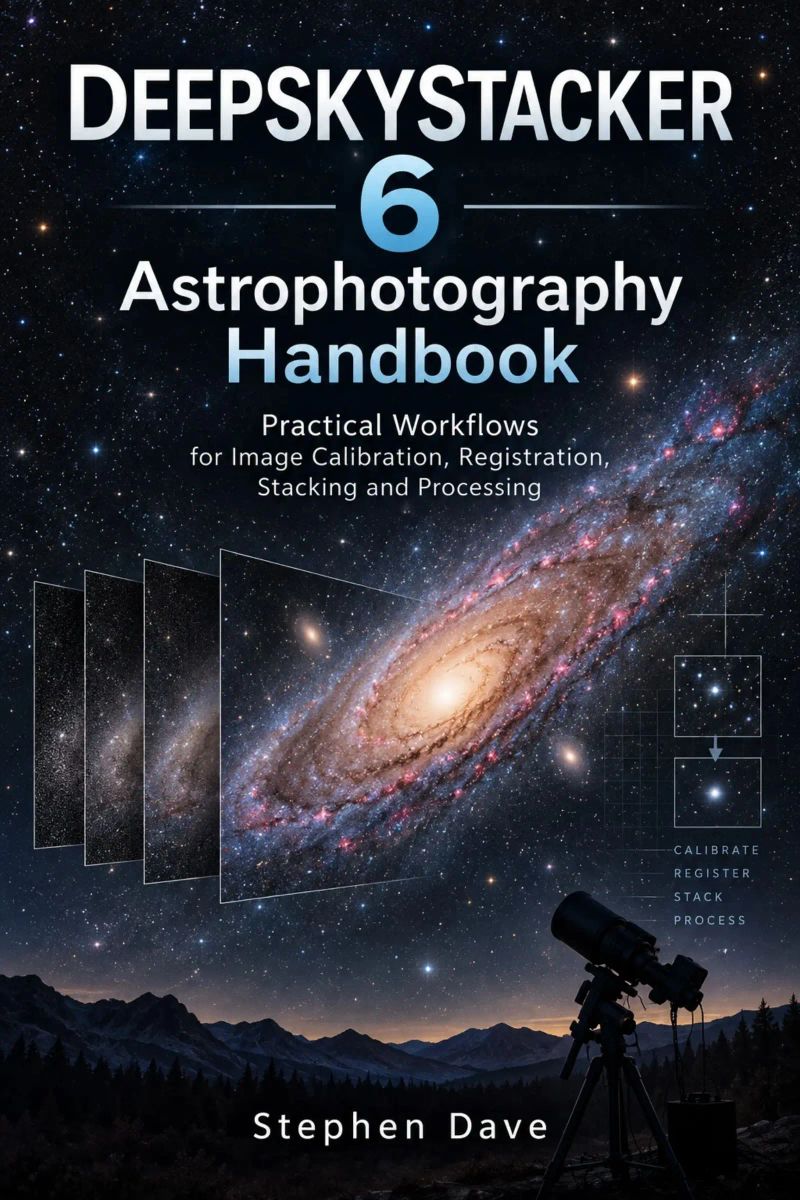
DEEPSKYSTACKER 6 Astrophotography Handbook
Practical Workflows for Image Calibration, Registration, Stacking and ProcessingBy Stephen Dave


Length7h 57m
About this audiobook
A stack can complete successfully and still be scientifically or visually compromised when input files, calibration matches, color interpretation, registration quality, rejection settings, crop geometry, multi-night groups, and output states are not verified.
This handbook replaces feature-by-feature guessing with a connected workflow. An evidence-based processing handbook that turns calibration, registration, stacking, quality control, multi-session organization, color preparation, comet work, output handling, and troubleshooting into repeatable tests. It begins with the operating foundation, then shows how each decision affects the next stage of the project. The result is a guide that can be read in sequence by a newcomer or opened by task when a real session stops behaving as expected.
Coverage includes installation and workstation preparation; dataset integrity; light, dark, flat, bias, and flat-dark frames; RAW, FITS, monochrome, and color-filter-array interpretation; registration and star detection; reference-frame choice; stacking and rejection methods; background calibration; multi-night groups; crop modes and drizzle; color and stretching handoff; comet processing; output files, storage, diagnostics, and reproducible issue reporting. The emphasis stays on cause and effect: what the operator is trying to accomplish, which layer controls the result, what evidence confirms success, and what should remain unchanged while a fault is isolated.
Readers learn to separate capture defects, decoding errors, calibration mismatches, alignment problems, statistical rejection, output geometry, and later artistic processing instead of changing many settings at once. That approach is especially useful when a session must be reopened later, transferred to another workstation, explained to a collaborator, recovered after an update, or operated under time pressure.
The intended audience includes beginning and intermediate deep-sky imagers, DSLR and astronomy-camera users, and experienced photographers who want a more auditable stacking workflow. The progression gives newer readers a route from fundamentals to complete work while allowing experienced users to move directly to advanced integration, diagnostics, preservation, and delivery.
Readers learn to separate capture defects, decoding errors, calibration mismatches, alignment problems, statistical rejection, output geometry, and later artistic processing instead of changing many settings at once. The goal is not memorizing every option. It is gaining a durable mental model, a reliable sequence of checks, and the confidence to make deliberate choices without sacrificing earlier work.
Results depend on capture quality, camera state, optics, file integrity, operating system, available memory and storage, and software version. The book teaches diagnosis and processing choices, not guaranteed image quality. No workflow can replace current documentation, competent safety practice, or verification on the reader's own system. This handbook is designed to make that verification clearer, faster, and easier to preserve.
Build trustworthy datasets and match calibration files to the correct capture state
Register stars, evaluate frames, choose references, and interpret failures with evidence
Compare integration and rejection methods without changing several variables at once
Combine multi-night sessions, manage output geometry, and preserve reproducible results
Diagnose gradients, trails, color problems, calibration artifacts, and failed stacks methodically
Audiobook details
GenreOther, Technology
Length7 hrs 57 mins
Narrated byListen with 1,000+ voices
FormateBook with Audio
Publish dateOct 2, 2026
LanguageEnglish
Table of contents
1The stack is not the photograph
2The sequence that matters
3What each frame contributes
4Decide what is actually recoverable
5A first-session scenario
Show all chaptersShow less
6Run one small comparison before committing hours
7Read version 6 on its own terms
8The acceptance test you can repeat
9Know when one project must become several
10What comes next
11Chapter 2 — Installing Version 6 and Preparing the Workstation
12Make the release choice before downloading
13A clean Windows installation
14Installing on macOS without borrowing Windows instructions
15Linux: installer, launch, and dependency evidence
16Design the storage layout around the actual job
17Permission failures masquerading as software faults
18Estimate a real job before using the entire library
19Establish a baseline that can be reproduced
20Avoid an upgrade that destroys a working setup
21Verify that the installation survives realistic paths and file sizes
22A first-run acceptance test
23Chapter 3 — Building a Trustworthy Image Dataset
24The first processing error may happen during copying
25Build folders that explain the session
26Treat the DeepSkyStacker file list as an executable map
27Sort by evidence, not by one score
28Use a consistent inspection pass
29Read provenance before mixing camera data
30Build a quick integrity check for large sessions
31Interpret the sequence as an observing log
32Detect image-format and naming traps during import
33Make a selection policy that can survive a second reviewer
34A worked ingest and acceptance record
35Keep the handoff narrow and observable
36Chapter 4 — Calibration Without Accidental Damage
37Calibration is a measurement, not an enhancement filter
38Begin with an exposure-and-camera-state matrix
39Understand the master-frame dependency
40Why dark-frame subtraction sometimes makes an image worse
41Flat correction: the dust-donut test
42Bias versus flat darks: make one coherent choice
43Build a small calibration proof before the main stack
44Examine flat exposure quality before making a master
45Diagnose calibration through preserved intermediates
46When the correction set is incomplete
47Recognize when a master itself is the problem
48Control the light source used for flat frames
49A calibration acceptance decision
50Chapter 5 — Reading RAW, FITS, and Mono Camera Data
More from Stephen Dave

Akai MPC One G2 & One+ MusikproduktionshandbuchStephen Dave18h 58m$9

Akai MPC One G2 & One+ Manuel de la production musicaleStephen Dave18h 52m$9

FL Studio HANDBUCH FÜR MUSIKPRODUKTION 2027Stephen Dave25h 48m$9

CHAMSYS MAGICQ LICHTSTEUERUNGSHANDBUCHStephen Dave21h 29m$9

FL STUDIO MUSIC PRODUCTION HANDBOOK 2027Stephen Dave21h 10m$9
DEEPSKYSTACKER 6 Manuel d'astrophotographieStephen Dave10h 7m$9

DEEPSKYSTACKER 6 Handbuch der AstrofotografieStephen Dave9h 52m$9

CHAMSYS MAGICQ MANUEL DE CONTRÔLE DE L'ÉCLAIRAGEStephen Dave21h 30m$9

Bluebeam revu 21 Baustart & SchätzungshandbuchStephen Dave21h 40m$10

Bluebeam Revu 21 Décollage en construction & Manuel d'estimationStephen Dave21h 56m$10

Bluebeam revu 21 Construction Takeoff & Estimating HandbookStephen Dave18h 31m$10

ABLETON LIVE 12 HANDBUCH DER MUSIKPRODUKTIONStephen Dave26h 42m$10
ABLETON LIVE 12 MUSIC PRODUCTION HANDBOOKStephen Dave21h 55m$10
ABLETON LIVE 12 MANUEL DE PRODUCTION MUSICALEStephen Dave26h 22m4.8 (12)$10

Mere ChristianityC. S. Lewis7h 7m4.4 (519.7K)$24 · $0.00

Her Daily BreadKate Wood12h 57m4.6 (153)$33 · $0.00

The Holy Bible - 1 SamuelKing James2h 13m4.8 (1.6K)$3 · $0.00

The American Standard Bible — The Gospel of MatthewMatthew3h 56m4.7 (3K)$2 · $0.00

Bad Fat Black GirlSesali Bowen6h 32m4.7 (2.8K)$24 · $0.00

The King James Audio Bible New Testament CompleteChristopher Glyn20h 2m4.7 (2.6K)$12 · $0.00

Faiths CheckbookCharles Spurgeon12h 44m4.7 (3.2K)$11 · $0.00

Ten Things I Wish You Knew About Your Child's Mental HealthDr. Billy Garvey4h 53m4.7 (2.4K)$20 · $0.00

Designing Terry Pratchett’s DiscworldPaul Kidby3h 52m4.7 (343)$20 · $0.00

The Chosen Book OneAmanda Jenkins, Kristen Hendricks, Dallas Jenkins3h 8m4.6 (4.9K)$10 · $0.00

The Lives of BrianBrian Johnson9h 45m4.6 (3.5K)$29 · $0.00
Expository Thoughts on the Gospel of LukeJ.C. Ryle27h 13m4.7 (536)$18 · $0.00

CrossroadsKaleb Dahlgren7h 56m4.6 (4.9K)$26 · $0.00

Across the RiverKent Babb11h 40m4.6 (927)$29 · $0.00

Brain Training for RidersAndrea Monsarrat Waldo5h 56m4.7 (550)$19 · $0.00

My Effin' LifeGeddy Lee17h 11m4.6 (13.1K)$40 · $0.00

Kings and PawnsHoward Bryant10h 9m4.6 (678)$29 · $0.00

The Elementia Chronicles #2: The New OrderSean Fay Wolfe11h 17m4.6 (841)$29 · $0.00

The ActsLuke2h 55m4.6 (19.7K)$12 · $0.00

New Testament - Easy NavigationWorld English Bible19h 35m4.6 (1.3K)$1.30 · $0.00

The Honey BusMeredith May9h 31m4.4 (16.6K)$25 · $0.00

Collected Writings of Nikola TeslaThomas Commerford Martin, Nikola Tesla19h 42m4.4 (2.8K)$1.99 · $0.00

Operation PedestalMax Hastings12h 29m4.4 (5.2K)$29 · $0.00

When the Heavens Went on SaleAshlee Vance18h 20m4.4 (3K)$40 · $0.00

Everybody Has a Podcast (Except You)Justin McElroy, Travis McElroy, Griffin McElroy5h 9m4.3 (2.3K)$24 · $0.00

Hands of TimeRebecca Struthers8h 8m4.4 (1.3K)$26 · $0.00

Never Lost AgainBill Kilday10h 1m4.4 (805)$29 · $0.00

How the Internet HappenedBrian McCullough13h 28m4.3 (2.7K)$23 · $0.00

Collected Writings of Nikola TeslaNikola Tesla, Thomas Commerford Martin21h 50m4.3 (1.7K)$1 · $0.00

Just AspireAjai Chowdhry9h 13m4.4 (260)$29 · $0.00

The Little Book of AliensAdam Frank8h 20m4.3 (1.3K)$26 · $0.00

The inventions, researches and writings of Nikola Tesla (Annotated)Thomas Commerford Martin16h 59m4.3 (1.3K)$2 · $0.00

KargilV.P. Malik15h 18m4.3 (2K)$24 · $0.00

Experiments with Alternating CurrentsNikola Tesla9h 16m4.3 (874)$1.99 · $0.00

Fire on the HorizonTom Shroder, John Konrad8h 23m4.3 (858)$26 · $0.00

The Smell of Kerosene (Annotated)National Aeronautics and Space Administration, Donald L. Mallick, Peter W. Merlin11h 32m4.3 (523)$2 · $0.00

The Boy Who Harnessed the WindWilliam Kamkwamba, Bryan Mealer10h 5m4.2 (78.9K)$29 · $0.00

Across the Airless WildsEarl Swift10h 8m4.3 (1.3K)$29 · $0.00

Console WarsBlake J. Harris20h 41m4.2 (13.7K)$46 · $0.00

Improvised Munitions HandbookU.S. Department of Defense4h 49m4.3 (1.6K)$1.99 · $0.00
You may also like

Elements of ChemistryAntoine Lavoisier12h 24m4.1 (685)$9.10 · $0.00

DesperadoBill Brown Jr.52m4.8 (12)$5

Rapid Mandarin, Vol. 1Earworms Learning1h 15m3.9 (167)$15

Be Thou My VisionBill Brown Jr.41m4.6 (12)$4

AP World History Exam Study GuideMarie Peterson8h 47m$10

Learn German for Beginners - Lesson 2Jasmin Voges38m$12 · $0.00

Why You Should Ditch the Rice Cereal- Alternative First FoodsAurora Brooks1h 8m$3.50 · $0.00

Shame the DevilBill Brown Jr.51m$5

AfghansSpool Cotton Co.33m$1 · $0.00

Tequila - VenturesBill Brown Jr.45m$4

I am learning HungarianJM Gardner4h 17m$18 · $0.00

Soldering, Brazing and WeldingVarious2h 49m$3 · $0.00

Maple Leaf RagBill Brown Jr.1h 29m$10

LloroBill Brown Jr.1h 11m$10

PatienceBill Brown Jr.2h 13m$10
REST APIs, Endpoint by EndpointOmar Brandt7h 36m$5 · $0.00

The Little Girl's Sewing BookVarious2h 41m$1 · $0.00

Chemical Process Design PrinciplesMarguerite Lindqvist15h 2m$95

How to Make Money Reselling Clothes - How to Source, Photograph, Price, and Sell Secondhand Fashion OnlineJACK FLIPWELL5h 4m$7.70 · $0.00

Maryland RBT Certification Exam Prep 2026/2027Mireille Oyelaran16h 33m$22