
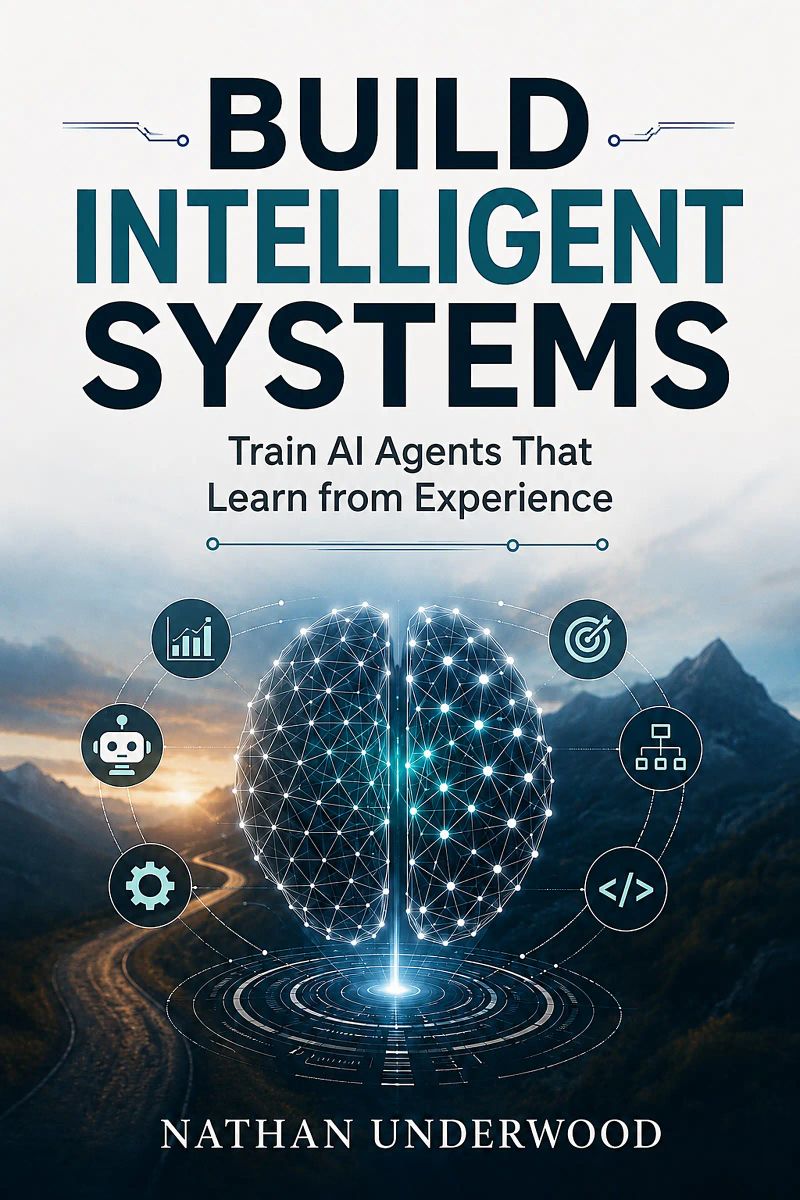
Build Intelligent Systems
Train AI Agents That Learn from ExperienceBy Nathan Underwood


Length7h 14m
About this audiobook
Are you ready to build intelligent systems from the ground up? This practical guide takes you from search algorithms and logic to machine learning and neural networks, with step-by-step projects that turn theory into working code. Whether you're a beginner or a pro, you'll gain the skills to create real AI applications. Unlike The Other Wes Moore: One Name, Two Fates (One World Essentials) or The Other Emily, this book is your hands-on path to mastering AI—no fluff, just results.
What You'll Build
Search engines and game-playing agents
Logic-based reasoning systems
Machine learning models for prediction
Neural networks for image and text
End-to-end intelligent systems
Each chapter includes code examples, exercises, and a final project that ties everything together. You'll learn by doing, not just reading. Nathan Underwood's approach ensures you understand the 'why' behind each algorithm, so you can adapt and innovate.
Why This Book?
Clear explanations for complex topics
Real-world examples and datasets
Progressive difficulty from basics to advanced
Focus on building, not just theory
Start your journey today and create systems that think, learn, and adapt. Perfect for students, developers, and AI enthusiasts.
This hands-on Other guide is written to be used at the keyboard: every concept is paired with something you can run, adapt, and keep. You move from first principles to real, working results, with the common errors and fixes called out along the way so you are never stuck for long.
Audiobook details
GenreTechnology
Length7 hrs 14 mins
Narrated byListen with 1,000+ voices
FormateBook with Audio
LanguageEnglish
Table of contents
1Preface
2Chapter 1 — Your First AI Agent in Ten Lines
3Chapter 2 — The Grid World: Defining the Environment Your Agent Will Master
4Chapter 3 — State Representation: How the Agent Sees the World
5Chapter 4 — Reward Engineering: Shaping Behavior Without Hard-Coding Rules
Show all chaptersShow less
6Chapter 5 — Tabular Q-Learning: The Agent Learns Its First Policy
7Chapter 6 — Policy Evaluation and Improvement: How to Know the Agent Is Getting Smarter
8Chapter 7 — Scaling Up with Function Approximation: Neural Networks Replace the Table
9Chapter 8 — Experience Replay: Learning from Past Mistakes
10Chapter 9 — Target Networks: Preventing the Moving Target Problem
11Chapter 10 — Double DQN and Dueling Networks: Two Proven Enhancements
12Chapter 11 — Policy Gradients: Learning Actions Directly
13Chapter 12 — Actor-Critic: Combining Value and Policy for Faster Learning
14Chapter 13 — Hyperparameter Tuning: Finding the Sweet Spot
15Chapter 14 — Multi-Environment Training: Speeding Up with Parallel Agents
16Chapter 15 — Saving, Loading, and Resuming Training
17Chapter 16 — Deploying the Agent as a Web App
18Chapter 17 — Testing and Debugging in Production
19Chapter 18 — Extending to New Environments: From Grid World to Real-World Problems
20About the Author

The Honey BusMeredith May9h 31m4.4 (16.6K)$25 · $0.00

Collected Writings of Nikola TeslaThomas Commerford Martin, Nikola Tesla19h 42m4.4 (2.8K)$1.99 · $0.00

Operation PedestalMax Hastings12h 29m4.4 (5.2K)$29 · $0.00

When the Heavens Went on SaleAshlee Vance18h 20m4.4 (3K)$40 · $0.00
Everybody Has a Podcast (Except You)Justin McElroy, Travis McElroy, Griffin McElroy5h 9m4.3 (2.3K)$24 · $0.00

Hands of TimeRebecca Struthers8h 8m4.4 (1.3K)$26 · $0.00
Never Lost AgainBill Kilday10h 1m4.4 (805)$29 · $0.00

How the Internet HappenedBrian McCullough13h 28m4.3 (2.7K)$23 · $0.00
Collected Writings of Nikola TeslaNikola Tesla, Thomas Commerford Martin21h 50m4.3 (1.7K)$1 · $0.00

Just AspireAjai Chowdhry9h 13m4.4 (260)$29 · $0.00

The Little Book of AliensAdam Frank8h 20m4.3 (1.3K)$26 · $0.00
The inventions, researches and writings of Nikola Tesla (Annotated)Thomas Commerford Martin16h 59m4.3 (1.3K)$2 · $0.00

KargilV.P. Malik15h 18m4.3 (2K)$24 · $0.00
Experiments with Alternating CurrentsNikola Tesla9h 16m4.3 (874)$1.99 · $0.00

Fire on the HorizonTom Shroder, John Konrad8h 23m4.3 (858)$26 · $0.00

The Smell of Kerosene (Annotated)National Aeronautics and Space Administration, Donald L. Mallick, Peter W. Merlin11h 32m4.3 (523)$2 · $0.00

The Boy Who Harnessed the WindWilliam Kamkwamba, Bryan Mealer10h 5m4.2 (78.9K)$29 · $0.00

Across the Airless WildsEarl Swift10h 8m4.3 (1.3K)$29 · $0.00

Console WarsBlake J. Harris20h 41m4.2 (13.7K)$46 · $0.00

Improvised Munitions HandbookU.S. Department of Defense4h 49m4.3 (1.6K)$0.99 · $0.00
You may also like

12 BytesJeanette Winterson9h4.0 (2.5K)$20

Build with Agentic AIDaria Quill7h 21m$5

Tech of TomorrowJulie Murray18m$3
Code to ScreenTheo Vantage3h 49m$9

Automate Real Work with AILena Devlin7h 30m$5 · $0.00

Giant Brains, or, Machines That ThinkEdmund Callis Berkeley9h 21m$2.30
The Evolution Of AIJasper Livingstone10h 56m$9

Build Augmented Reality Apps Without CodeAdrian Vasquez7h 11m$5 · $0.00

Augmented Reality und Computer Vision Wie AR-Anwendungen die reale Welt verstehen, um virtuelle Objekte nahtlos zu integrierenSloane Garrett8h 50m$14 · $0.00

Master AiHenrique Xavier Oliveira2h 5m$6 · $0.00

Artificial IntelligenceAxel Mammitzsch53m$10 · $0.00

The Physics of EvidenceShannon W. Bray6h 10m4.3 (11)$19.99
AI, Consciousness, and the SelfSaraban K. K. 50m4.9 (12) Only with Ultra
Signal Processing for Electrical EngineersHelen Marchetti12h 6m$80

Gamification (Audiobook)Unknown Author1h 30m$18 · $0.00

Meet Me in the MiddleGary Vaynerchuk9m3.6 (26)$4 · $0.00

The History of PhotographyKidsChoice40m$12 · $0.00
Tiktok: How Tiktokers Make Money and Influence Trends (The Ultimate Guide to Building a Successful Tiktok Strategy With a Faceless Profile)Johnny Nelson38m$3.50 · $0.00
Eft Investing: A Comprehensive Guide to Researching and Investing (The Intelligent Investor's Guide to Using Free Online Stock Screeners to Find Winning Stocks)Matthew Nagel2h 7m$3.50 · $0.00

How to create an exceptional B2B CX for success in a versatile market (Audiobook)Unknown Author1h 24m$18 · $0.00