
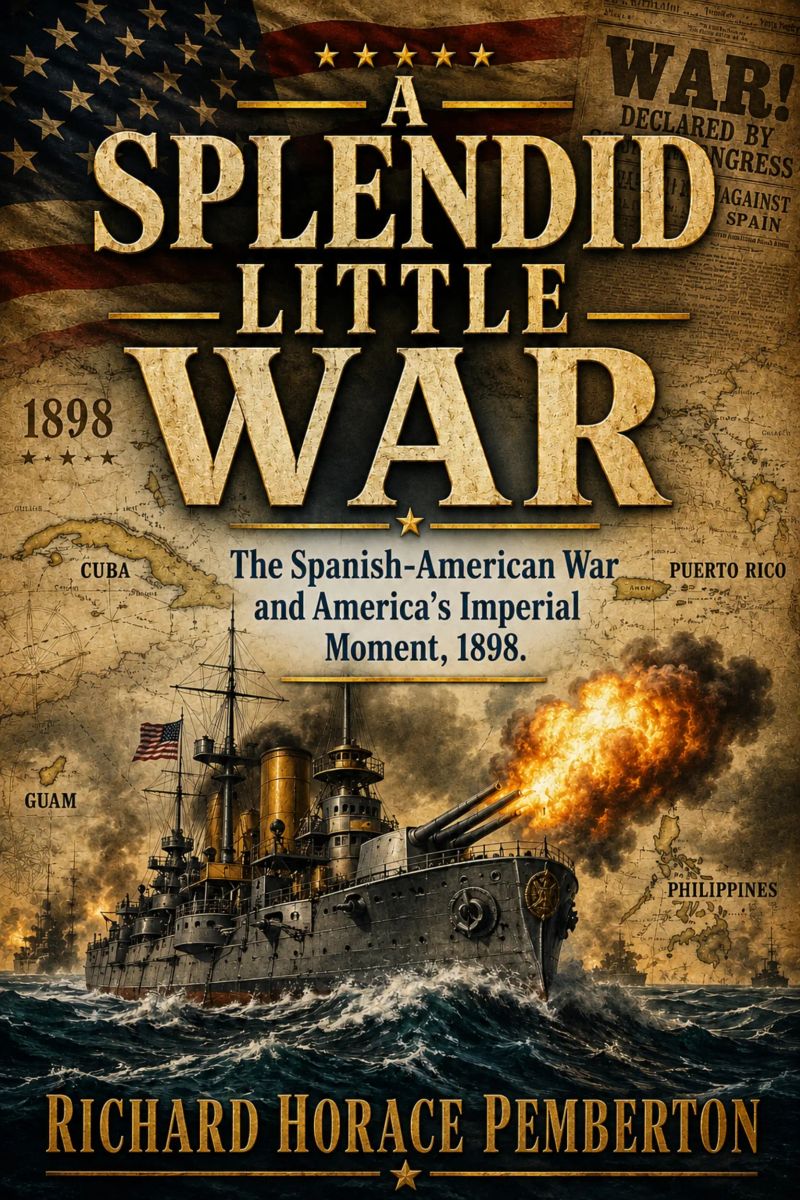
A SPLENDID LITTLE WAR
The Spanish-American War and America's Imperial Moment, 1898By Richard Horace Pemberton


Length5h 59m
About this audiobook
In the spring of 1898, America went to war for just ten weeks — and woke up an empire.
Most people know two things about the Spanish-American War: "Remember the Maine," and Teddy Roosevelt charging up San Juan Hill. But the real story — how one explosion in Havana harbor, a newspaper war between Hearst and Pulitzer, and a few months of fighting handed the United States the Philippines, Cuba, Puerto Rico, and Guam — has been all but forgotten.
If 1898 has always felt like a blank spot in your grasp of American history, A Splendid Little War fills it in with pace, color, and unforgettable characters. This is the Spanish-American War as it actually unfolded — the moment a young republic stepped onto the world stage as an imperial power.
Inside, you'll discover:
* **How "yellow journalism"** by Hearst and Pulitzer stampeded a nation into war — a media playbook still used today.
* **The truth about the USS Maine** — the explosion, the mystery, and the war cry it ignited.
* **Dewey at Manila Bay and the Rough Riders at San Juan Hill** — the battles of 1898 that made Theodore Roosevelt a president.
* **The real cost of empire** — the Philippine-American War, the Buffalo Soldiers, and anti-imperialists like Mark Twain who fought back.
This isn't dry textbook history. It's a fast-moving, you-are-there account of the Spanish-American War and the imperial moment that changed America forever.
If you love narrative history that reads like a thriller, A Splendid Little War belongs on your shelf.
Scroll up, click "Buy Now," and discover the splendid little war that built an American empire.
Audiobook details
GenreFantasy, Other, Action and Adventure
Length5 hrs 59 mins
Narrated byListen with 1,000+ voices
FormateBook with Audio
LanguageEnglish
Table of contents
1Introduction
2Author’s Note
3Prologue: Remember the Maine
4PART ONE: THE ROAD TO WAR (1890-1898)
5Chapter 1: Cuba Libre — The Cuban Independence Struggle and American Interest
Show all chaptersShow less
6Chapter 2: Yellow Journalism — Hearst, Pulitzer, and the Press That Made a War
7Chapter 3: The USS Maine — Explosion, Mystery, and the War Cry
8Chapter 4: McKinley's Decision — The President and the Path to Conflict
9PART TWO: THE WAR IN CUBA (1898)
10Chapter 5: The Naval War — Dewey at Manila Bay and Cervera at Santiago
11Chapter 6: The Rough Riders — Roosevelt, Wood, and the Charge at San Juan Hill
12Chapter 7: The Siege of Santiago — Victory and the Spanish Surrender
13Chapter 8: The Fever — Disease, Death, and the Army's Medical Crisis
14PART THREE: THE PACIFIC WAR
15Chapter 9: Dewey's Victory — The Battle of Manila Bay, May 1, 1898
16Chapter 10: The Philippine Revolution — Aguinaldo, American Allies, and Betrayal
17Chapter 11: Puerto Rico — The Southern Campaign and Acquisition
18Chapter 12: Guam and Wake — Acquiring the Pacific Island Chain
19PART FOUR: THE IMPERIAL RECKONING
20Chapter 13: The Treaty of Paris — The Terms of American Empire
21Chapter 14: The Philippine-American War — Suppressing the Insurrection, 1899-1902
22Chapter 15: The Anti-Imperialists — Mark Twain, Carnegie, and the Opposition
23Chapter 16: Cuba as Protectorate — The Platt Amendment and American Control
24PART FIVE: THE WAR'S PEOPLE
25Chapter 17: Theodore Roosevelt — The War That Made a President
26Chapter 18: William Randolph Hearst — The Publisher and His War
27Chapter 19: The Buffalo Soldiers — Black Troops in Cuba and the Philippines
28Chapter 20: The Filipino Perspective — Independence, Betrayal, and Resistance
29PART SIX: LEGACIES
30Chapter 21: American Empire — The Philippines, Guam, Puerto Rico, and the New Role
31Chapter 22: The Open Door Policy — China, Trade, and American Commercial Ambition
32Chapter 23: The Anti-Imperial Tradition — Dissent and Its Limits in American Foreign Policy
33Chapter 24: 1898 and American Power — The Splendid Little War's Long Shadow
34Epilogue: An Empire Acquired
35Acknowledgments
36Selected Bibliography
37About the Author
More from Richard Horace Pemberton



Demon CopperheadBarbara Kingsolver21h 3m4.5 (949.4K)$46 · $0.00

Remarkably Bright CreaturesShelby Van Pelt11h 17m4.4 (1.7M)$29 · $0.00

Before the Coffee Gets Cold: A Toshikazu Kawaguchi Book SetToshikazu Kawaguchi18h 55m4.5 (1.4K)$40 · $0.00
The Song of AchillesMadeline Miller11h 15m4.3 (2.3M)$29 · $0.00
The Left and the LuckyWilly Vlautin6h 40m4.4 (1.1K)$24 · $0.00

Hunt of the DragonJuliette Cross9h 46m4.4 (736)$20

Deadly GameChristine Feehan13h 20m4.3 (15.8K)$30

A Tree Grows in BrooklynBetty Smith14h 55m4.4 (577.6K)$33 · $0.00
Dark GuardianChristine Feehan12h 32m4.5 (26.3K)$33 · $0.00

The Neil Gaiman ReaderNeil Gaiman27h 3m4.5 (3.2K)$53 · $0.00

The HobbitJ. R. R. Tolkien10h 51m4.4 (4.9M)$12 · $0.00

Bad HabitAlana S. Portero5h 37m4.4 (52.3K)$24 · $0.00

Science Fiction & Fantasy CollectionH. P. Lovecraft16h 32m4.5 (2.7K)$2 · $0.00

The Undead PoolKim Harrison16h 13m4.4 (34.6K)$33 · $0.00

The Edge of DawnBeverly Jenkins10h 15m4.5 (1.1K)$29 · $0.00

The Tapestry of FateShannon Chakraborty20h 2m4.4 (3.4K)$46 · $0.00

The Lack of LightNino Haratischwili26h 20m4.4 (9.2K)$53 · $0.00

My Dear HamiltonStephanie Dray, Laura Kamoie23h 7m4.4 (63.6K)$46 · $0.00

A Broken People's PlaylistChimeka Garricks6h 40m4.4 (3.7K)$24 · $0.00

Wicked BiteJeaniene Frost8h 56m4.4 (14.6K)$29 · $0.00

Mere ChristianityC. S. Lewis7h 7m4.4 (519.7K)$24 · $0.00

Her Daily BreadKate Wood12h 57m4.6 (153)$33 · $0.00
The Holy Bible - 1 SamuelKing James2h 13m4.8 (1.6K)$3 · $0.00

The American Standard Bible — The Gospel of MatthewMatthew3h 56m4.7 (3K)$2 · $0.00

Bad Fat Black GirlSesali Bowen6h 32m4.7 (2.8K)$24 · $0.00
The King James Audio Bible New Testament CompleteChristopher Glyn20h 2m4.7 (2.6K)$12 · $0.00
Faiths CheckbookCharles Spurgeon12h 44m4.7 (3.2K)$11 · $0.00

Ten Things I Wish You Knew About Your Child's Mental HealthDr. Billy Garvey4h 53m4.7 (2.4K)$20 · $0.00

Designing Terry Pratchett’s DiscworldPaul Kidby3h 52m4.7 (343)$20 · $0.00
The Chosen Book OneAmanda Jenkins, Kristen Hendricks, Dallas Jenkins3h 8m4.6 (4.9K)$10 · $0.00
The Lives of BrianBrian Johnson9h 45m4.6 (3.5K)$29 · $0.00
Expository Thoughts on the Gospel of LukeJ.C. Ryle27h 13m4.7 (536)$18 · $0.00

CrossroadsKaleb Dahlgren7h 56m4.6 (4.9K)$26 · $0.00

Across the RiverKent Babb11h 40m4.6 (927)$29 · $0.00

Brain Training for RidersAndrea Monsarrat Waldo5h 56m4.7 (550)$19 · $0.00

My Effin' LifeGeddy Lee17h 11m4.6 (13.1K)$40 · $0.00
Kings and PawnsHoward Bryant10h 9m4.6 (678)$29 · $0.00

The Elementia Chronicles #2: The New OrderSean Fay Wolfe11h 17m4.6 (841)$29 · $0.00

The ActsLuke2h 55m4.6 (19.7K)$12 · $0.00

New Testament - Easy NavigationWorld English Bible19h 35m4.6 (1.3K)$1.30 · $0.00
An Inside JobDaniel Silva9h 28m4.4 (26.3K)$29 · $0.00

The CommodoreP. T. Deutermann11h 53m4.5 (2.4K)$20 · $0.00

A Closed and Common OrbitBecky Chambers11h 30m4.4 (140.7K)$29 · $0.00

Thud!Terry Pratchett10h 31m4.4 (112.6K)$8 · $0.00

All Quiet on the Western Front (Annotated)Erich Maria Remarque8h 34m4.4 (12.9K)$1.99 · $0.00

Crime and punishmentFyodor Dostoevsky22h 34m4.4 (1.3M)$3 · $0.00

Exit FeeBrad Taylor3h 16m4.5 (1.9K)$18 · $0.00

The Alice NetworkKate Quinn15h 7m4.4 (887.1K)$33 · $0.00

The Ohio River Trilogy: Betty Zane, The Spirit of the Border & The Last TrailZane Grey29h 8m4.4 (1.8K)$1 · $0.00
A Darkness ReturnsRaymond E. Feist19h 29m4.4 (1.9K)$40 · $0.00

THE VALLEY OF SILENT MEN (Annotated)James Oliver Curwood8h 25m4.5 (420)$2 · $0.00
West of the TularosaLouis L’Amour5h 53m4.4 (3.6K)$20 · $0.00

The Emperor's FistJay Allan8h 37m4.5 (272)$26 · $0.00

The Amazing Interlude (Annotated)Mary Roberts Rinehart8h 42m4.5 (365)$1.99 · $0.00

Hornblower and the Hotspur (Annotated)C. S. Forester14h 7m4.4 (17.3K)$2 · $0.00

Shades of WickedJeaniene Frost8h 51m4.4 (19.5K)$29 · $0.00

The Log of a Cowboy (Annotated)Andy Adams9h 47m4.4 (1.1K)$2 · $0.00

Everything She WantedJennifer Ryan9h 9m4.4 (1.3K)$29 · $0.00

The Ballad of the White HorseG. K. Chesterton2h 43m4.4 (3.8K)$1.20 · $0.00

The Complete Huckleberry Finn & Tom Sawyer Adventures (Unabridged) (Annotated)Mark Twain26h 21m4.3 (16.7K)$2 · $0.00
You may also like
Some Principles of Maritime Strategy (Annotated)Julian Stafford Corbett11h 14m4.1 (385)$1.99 · $0.00
The Influence of Sea Power Upon History, 1660-1783Alfred Thayer Mahan22h 4m4.1 (1.5K)$2.30

The Naval War of 1812 (Complete Edition)Theodore Roosevelt16h 56m4.0 (1.3K)$2 · $0.00

The Art of War in the Middle Ages (378-1515) (Summarized Edition)Charles Oman2h 20m4.1 (1.5K)$2

The Art of War in the Middle Ages: Military History of Europe (378-1515) (Annotated)Charles Oman6h 12m4.1 (812)$2 · $0.00

The Art of WarAntoine Henri baron de Jomini13h 57m4.0 (1.3K)$1 · $0.00
Some Principles of Maritime StrategyJulian Stafford Corbett9h 25m4.2 (988)Free

Some Principles of Maritime StrategyJulian Stafford Corbett11h 19m4.2 (385)$1 · $0.00

The Iraq WarJohn Keegan8h 6m3.7 (1.3K)$17
HellenicaXenophon15h 2m4.2 (4.4K)$1 · $0.00

CrusadeRick Atkinson24h 32m4.3 (2K)$35

The Russo-Turkish War 1877; A Strategical SketchMajor F. Maurice8h 43m$20

Saarbrück to Paris, 1870: A Strategical SketchLt. Col. Sisson C. Pratt5h 12m$15

Naval WarfareJames R. Thursfield2h 33m$2 · $0.00

The Battle of Stone RiverHenry Myron Kendall25m$2 · $0.00

Sea Power in its Relations to the War of 1812 (Annotated)Alfred Thayer Mahan33h 20m4.5 (12)$2 · $0.00

SANDS OF WARGerald Thomas Whitaker5h 44m$7

Battle Of Alerheim, 1645, In The Thirty Years' WarAndré Geraque Kiffer2h 10m$5 · $0.00

Cyberdeterrence and CyberwarMartin C. Libicki6h 9m3.5 (115)$14 · $0.00

The Emancipation of South AmericaBartolomé Mitre17h 45m$1 · $0.00