
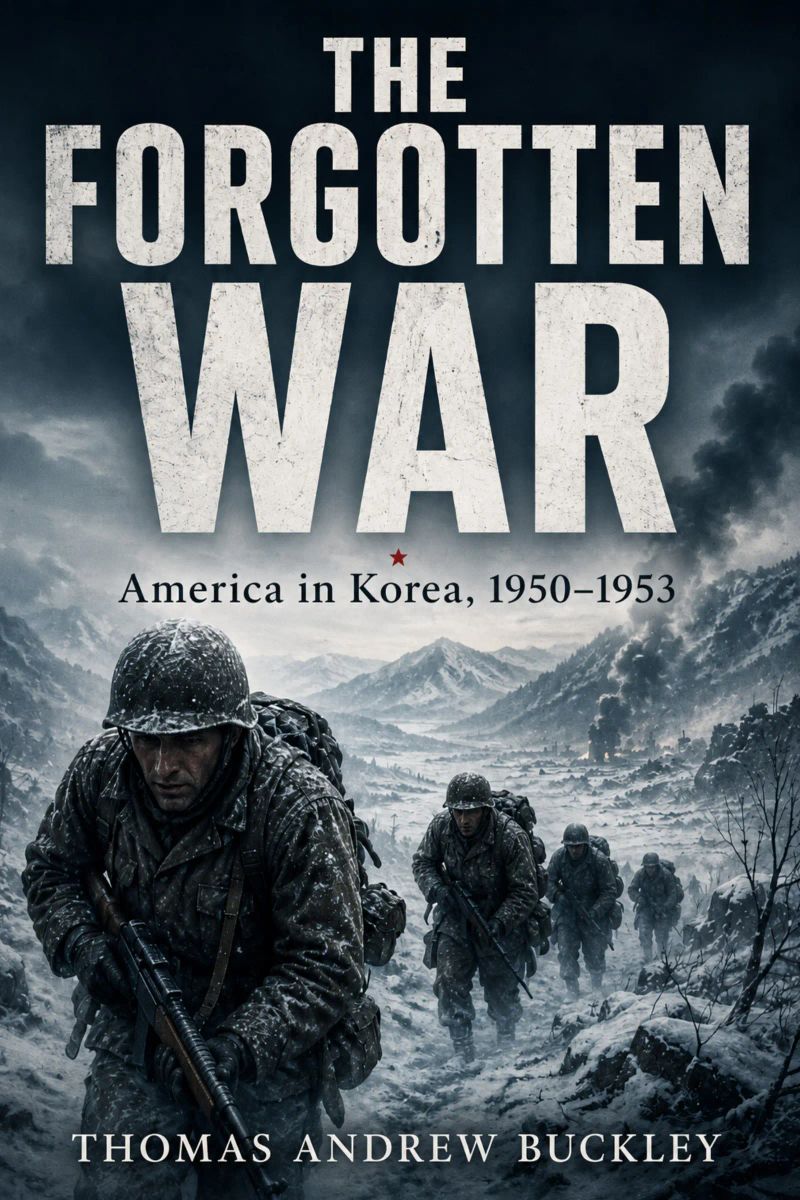
THE FORGOTTEN WAR
America in Korea, 1950-1953By Thomas Andrew Buckley


Length5h 39m
About this audiobook
The complete narrative history of the Korean War — Truman, MacArthur, Inchon, the Chosin Reservoir, military integration, and America's first limited war of the nuclear age, 1950-1953.
President Truman called it a police action, and the phrase stuck in the craw of every soldier who fought it. Police actions did not kill 36,500 Americans. Police actions did not end without victory in a permanent division enforced by an armistice that never became peace. The Korean War was America's first limited war of the nuclear age — the first time the United States fought not for unconditional surrender but to restore a status quo, establishing the template for every limited conflict that followed.
Across twenty-four chapters, historian Thomas Andrew Buckley traces the Korean War from its origins — two Army colonels drawing the 38th parallel in thirty minutes on a National Geographic map — through MacArthur's Inchon masterstroke, the catastrophic Chinese intervention of November 1950, and the long stalemate on bloody hills. Along the way, Buckley examines Task Force Smith's disaster at Osan, the Pusan Perimeter's last stand, Truman's firing of MacArthur, military integration under Executive Order 9981, and the POW brainwashing controversy.
Inside this Korean War history:
• The 38th parallel — how Dean Rusk and Charles Bonesteel drew the line that defined seven decades in thirty minutes with a National Geographic map (Chapter 1)
• Task Force Smith — 540 men at Osan on July 5, 1950, their artillery bouncing off Soviet T-34 tanks, 180 casualties in the first engagement (Chapter 3)
• Inchon and the drive to the Yalu — MacArthur's masterstroke, Seoul's liberation, and the hubris that brought 300,000 Chinese troops across the Yalu (Chapters 6-7)
• Truman fires MacArthur — the general's letter to Joseph Martin and one of the clearest affirmations of civilian control in American history (Chapter 10)
• Military integration — Truman's Executive Order 9981 tested in combat, and what Thurgood Marshall found investigating Black soldiers' courts-martial (Chapter 14)
• The brainwashing controversy — 21 Americans who refused repatriation, the origins of SERE training, and the Code of Conduct (Chapter 15)
• Two Koreas — South Korea's economic miracle and the Kim dynasty's frozen state, and why the armistice has never legally ended (Chapters 22-23)
The Korean War was forgotten not because it didn't happen but because America had no category for a war that was neither victorious nor shameful — simply difficult, costly, and unresolved. Buckley restores it to its place as the conflict that militarized NATO, rebuilt Japan's economy, desegregated the American military, and established the limited-war template the United States has used ever since.
For readers of David Halberstam's THE COLDEST WINTER and Max Hastings's THE KOREAN WAR.
Audiobook details
GenreHistory
Length5 hrs 39 mins
Narrated byListen with 1,000+ voices
FormateBook with Audio
Publish dateJun 2, 2026
LanguageEnglish
Table of contents
1Introduction
2Prologue: A Police Action
3PART ONE: THE ROAD TO WAR (1945-1950)
4Chapter 1: Korea Divided — The 38th Parallel and the Cold War in Asia
5Chapter 2: The People's Republic and the Nationalist Defeat — China Falls, 1949
Show all chaptersShow less
6Chapter 3: June 25, 1950 — North Korea Crosses the Parallel
7Chapter 4: Truman's Decision — The United States Commits to Korea
8PART TWO: FROM DISASTER TO VICTORY TO DISASTER (1950)
9Chapter 5: The Pusan Perimeter — The Last Stand in the South
10Chapter 6: Inchon — MacArthur's Masterstroke
11Chapter 7: The Drive to the Yalu — Hubris and the Chinese Warning
12Chapter 8: China Enters — The November 1950 Catastrophe
13PART THREE: THE LONG STALEMATE (1951-1953)
14Chapter 9: Ridgway's War — Restoring the Line After the Chinese Offensive
15Chapter 10: MacArthur's Dismissal — Civilian Control and Military Insubordination
16Chapter 11: The Truce Talks — Panmunjom and the Prisoner Exchange Debate
17Chapter 12: The Final Battles — Hills, Bunkers, and the War's Last Year
18PART FOUR: THE SOLDIERS' WAR
19Chapter 13: The American GI in Korea — Combat in Extreme Cold
20Chapter 14: Integration — Truman's Executive Order and the Desegregated Military
21Chapter 15: POWs — Captivity, Collaboration, and the Brainwashing Controversy
22Chapter 16: The Korean People — Civilian Experience in a Divided Nation
23PART FIVE: KOREA AT HOME AND ABROAD
24Chapter 17: The Home Front — Korea and the American Public
25Chapter 18: NATO and Collective Security — Korea's Impact on Western Alliance
26Chapter 19: The Korean War and McCarthyism — Fear, Loyalty, and the Red Scare
27Chapter 20: Eisenhower's Election and the War's End — 1952 and the Armistice
28PART SIX: LEGACIES
29Chapter 21: The Armistice — A War That Never Legally Ended
30Chapter 22: South Korea's Miracle — Economic Development After the War
31Chapter 23: North Korea — The Kim Dynasty and the Frozen Conflict
32Chapter 24: Korea's Place in American Memory — Why the War Was Forgotten
33Epilogue: The Armistice That Never Ends
34Acknowledgments
35Selected Bibliography
36About the Author
More from Thomas Andrew Buckley
A Brief History of IntelligenceMax S. Bennett12h 18m4.6 (6.6K)$29 · $0.00
The Happiest Man on EarthEddie Jaku3h 48m4.6 (178K)$7 · $0.00
MotherlandJulia Ioffe17h 52m4.7 (2.5K)$40 · $0.00

Where Cowards Go to DieBenjamin Sledge8h 42m4.7 (351)$20 · $0.00
RevolutionariesSanjeev Sanyal11h 23m4.6 (2.6K)$29 · $0.00
Days of Love and Rage: A Story of RevolutionAnand Gopal22h 36m4.7 (584)$34 · $0.00

We Crossed a Bridge and It TrembledWendy Pearlman6h4.6 (5.2K)$24 · $0.00
Unbroken Bonds of BattleJohnny Joey Jones8h 31m4.6 (2.6K)$8 · $0.00
The Daughter of AuschwitzTova Friedman, Malcolm Brabant7h 54m4.6 (16.7K)$26 · $0.00
Lily's PromiseLily Ebert, Dov Forman8h 54m4.6 (16.1K)$29 · $0.00
On Democracies and Death CultsDouglas Murray10h 38m4.6 (6.5K)$29 · $0.00

Across the RiverKent Babb11h 40m4.6 (927)$29 · $0.00
Balcony Over Jerusalem: A Middle East Memoir - Israel, Palestine and BeyondJohn Lyons12h 37m4.6 (1.4K)$33 · $0.00

BeyondStephen Walker15h 39m4.6 (3.2K)$33 · $0.00
Kings and PawnsHoward Bryant10h 9m4.6 (678)$29 · $0.00
No EscapeNury Turkel9h 30m4.6 (809)$28 · $0.00
Jubal Stone: U.S. Marshal: Blood Trail To Hell: A Western Adventure NovelCasey Nash3h 42m4.6 (3.2K)$18 · $0.00
Fall and RiseMitchell Zuckoff17h 23m4.6 (9.8K)$40 · $0.00
The SurvivorJosef Lewkowicz, Michael Calvin9h 22m4.6 (2.5K)$29 · $0.00
Always FaithfulThomas Schueman, Zainullah Zaki12h 12m4.6 (977)$29 · $0.00
You may also like
American WarlordsJonathan W. Jordan19h 46m4.5 (780)$30
The Politically Incorrect Guide to the Vietnam WarPhillip Jennings6h 30m4.0 (575)$14
The Second World WarMartin Gilbert42h 59m4.3 (5.3K)$30
The Six-Day WarGuy Laron15h 26m4.1 (370)$23
140 Days to HiroshimaDavid Dean Barrett13h 8m4.5 (548)$23
But Not in ShameJohn Toland18h 20m4.3 (473)$30
Hanoi’s WarLien-Hang T. Nguyen15h 13m4.2 (407)$23 · $0.00
The Korean WarSir Max Hastings17h 35m4.3 (14.5K)$28
The Great WarRobert Livesey2h 3m$8 · $0.00
THE WAR TO END ALL WARSMargaret Elspeth Holbrook7h 9m$6
Reporting America at WarMichelle Ferrari, James Tobin7h 40m3.6 (24)$22 · $0.00
THE WAR TO END ALL WARSMargaret Elspeth Holbrook6h 30m$11 · $0.00
Wars & Treaties, 1815 to 1914Arthur Ponsonby Baron Ponsonby3h 32m$2 · $0.00
The Diary of Adam GurowskiAdam Gurowski17h 32m4.3 (11)$1.99 · $0.00
The Story of the Great War (Vol. 1-8) (Annotated)Various Authors155h 1m$2 · $0.00
Europe at WarSantiago Machain7h 4m$25 · $0.00
My Recollections of the Civil WarCharles Anderson Dana9h 39m3.9 (266)$1.99 · $0.00
Project Trinity, 1945-1946Carl R. Maag, Steve Rohrer7m$2 · $0.00
The Bourbons, The Napoleonic Crisis & The Loss of EmpireSantiago Machain5h 45m$21 · $0.00
SANDS OF WARGerald Thomas Whitaker5h 57m$6 · $0.00