
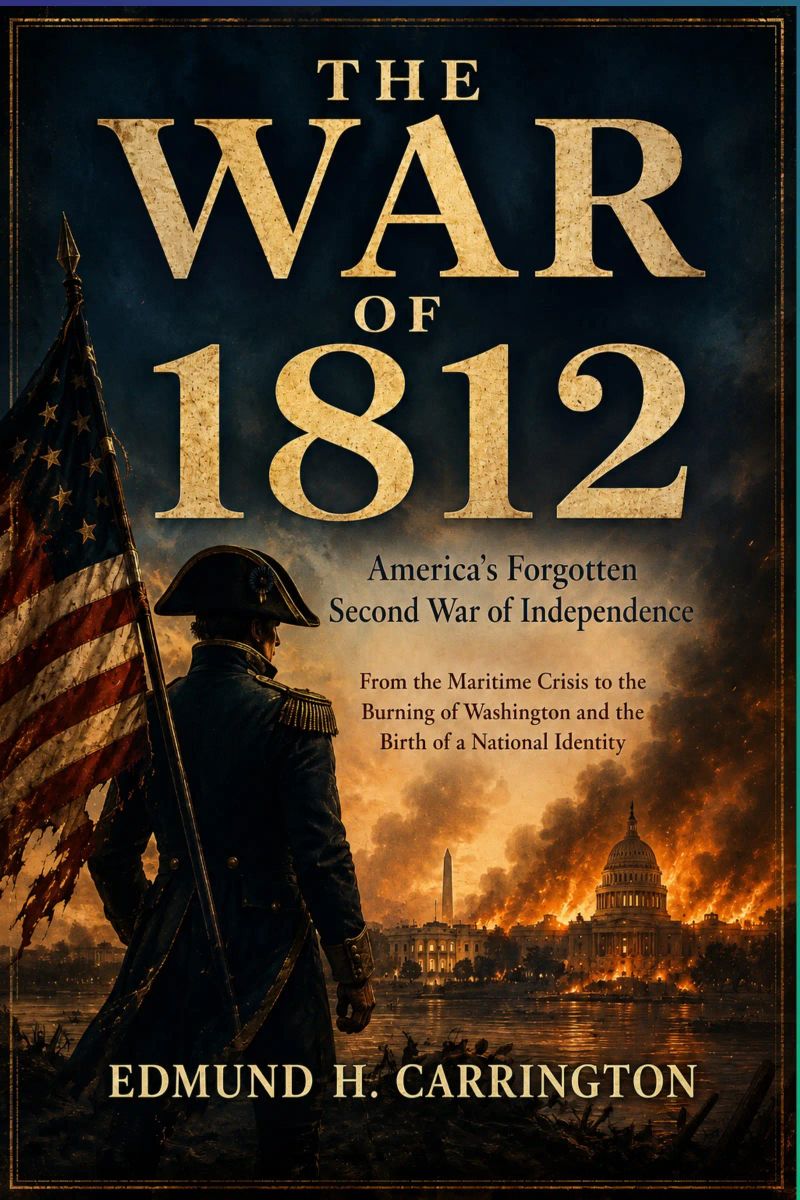
THE WAR OF 1812
America's Forgotten Second War of Independence From the Maritime Crisis to the Burning of Washington and the Birth of a National IdentityBy Edmund H. Carrington


Length6h 47m
About this audiobook
War of 1812 history — America's forgotten second war of independence: Tecumseh's confederacy, the burning of Washington, Fort McHenry, the Battle of New Orleans, and how a three-year conflict forged the American national identity.
On the evening of August 24, 1814, British soldiers marched up Maryland Avenue into the capital of the United States. The streets were empty. President Madison had fled. Cabinet officers were scattered across Virginia. The Capitol — its congressional library of 3,000 volumes soaked in oil and lit — burned through the night. The flames were visible from Baltimore, forty miles away. It was the only time before or since that a foreign army has occupied Washington. And it was not the end of the war. It was the moment that changed it.
This is the War of 1812 history that most Americans never fully encounter: not merely the rockets' red glare and the national anthem, but the nine years of maritime crisis that preceded the declaration, the 9,000 American sailors impressed into British service, and the Native nations whose destruction was the war's most consequential outcome. James Madison, Henry Clay, Tecumseh, Andrew Jackson, Oliver Hazard Perry, Thomas Macdonough, Francis Scott Key, and Dolley Madison cross twenty-six chapters tracing the full arc from the Chesapeake-Leopard affair of 1807 through the Treaty of Ghent's restoration of the antebellum status quo — and the long reckoning with what that status quo had cost.
Inside this War of 1812 history:
• The burning of Washington — British officers eating Dolley Madison's dinner, pocketing a copy of The Federalist Papers, then soaking the President's House furniture in oil and lighting the fire that gutted the building (Chapter 13)
• Fort McHenry and the anthem — Francis Scott Key watching 1,500 mortar shells arc toward Mary Pickersgill's 30x42-foot flag, searching at dawn for proof the fort still held (Chapter 14)
• Tecumseh's confederacy — the Shawnee leader uniting dozens of Native nations, the British alliance that sustained the effort, and its collapse at the Battle of the Thames in October 1813 (Chapter 11)
• Plattsburgh's turning point — Macdonough's pivot maneuver on September 11, 1814 that destroyed the British fleet, forced Prevost's 11,000-man army back to Canada, and eliminated Britain's leverage at Ghent (Chapter 15)
• Horseshoe Bend and Jackson's rise — March 1814: ~800 Red Stick Creek warriors killed at a cost of 47 American dead; Andrew Jackson launched toward the presidency; Alabama and Mississippi opened to the cotton kingdom (Chapters 17-18)
Carrington's War of 1812 history delivers the complete causal story: the nine-year maritime crisis that produced the war, the campaigns that fought it, and the transformations — the national anthem, Jackson's presidency, eastern Native sovereignty's annihilation — that its outcome produced.
Audiobook details
GenreHistory
Length6 hrs 47 mins
Narrated byListen with 1,000+ voices
FormateBook with Audio
Publish dateJun 1, 2026
LanguageEnglish
Table of contents
1Introduction
2Author’s Note
3Prologue: The Capital in Flames
4PART ONE: ROAD TO WAR (1803–1812)
5Chapter 1: The Maritime Crisis — Britain, France, and Neutral Trade
Show all chaptersShow less
6Chapter 2: Impressment and the Chesapeake Affair
7Chapter 3: The Embargo and Its Failure
8Chapter 4: Tecumseh and the Western Confederacy
9Chapter 5: The War Hawks and Henry Clay
10Chapter 6: James Madison and the Decision for War
11PART TWO: THE FIRST CAMPAIGNS (1812–1813)
12Chapter 7: Hull's Surrender at Detroit
13Chapter 8: The Niagara Campaign and Queenston Heights
14Chapter 9: Frenchtown and the River Raisin
15Chapter 10: Perry's Victory on Lake Erie
16Chapter 11: The Thames and the Death of Tecumseh
17PART THREE: THE BRITISH OFFENSIVE (1814)
18Chapter 12: The Chesapeake Campaign and Cockburn's Raids
19Chapter 13: Bladensburg and the Burning of Washington
20Chapter 14: Baltimore, Fort McHenry, and Francis Scott Key
21Chapter 15: Plattsburgh and the Defense of the North
22PART FOUR: THE SOUTHERN WAR (1813–1815)
23Chapter 16: The Creek War and the Red Sticks
24Chapter 17: Horseshoe Bend and the Rise of Andrew Jackson
25Chapter 18: The Gulf Coast Campaign
26Chapter 19: The Battle of New Orleans
27PART FIVE: WAR AT SEA
28Chapter 20: The Navy's Frigates and the Frigate Duels
29Chapter 21: Privateers and the Atlantic Commerce War
30Chapter 22: The British Blockade and Its Consequences
31PART SIX: PEACE AND CONSEQUENCE
32Chapter 23: The Hartford Convention and New England's Dissent
33Chapter 24: The Treaty of Ghent
34Chapter 25: Native America's Catastrophe
35Chapter 26: The War in American Memory
36Epilogue: What the Smoke Left Behind
37Acknowledgments
38Selected Bibliography
39About the Author
More from Edmund H. Carrington


A Brief History of IntelligenceMax S. Bennett12h 18m4.6 (6.6K)$29 · $0.00

Black AF HistoryMichael Harriot15h 43m4.7 (14.6K)$33 · $0.00

The Gulag Archipelago Volume 3Aleksandr I. Solzhenitsyn21h 56m4.7 (8.9K)$46 · $0.00

Pearl of Great PriceJoseph Smith3h 8m4.7 (7.2K)$1.20 · $0.00

The Happiest Man on EarthEddie Jaku3h 48m4.6 (178K)$7 · $0.00

MotherlandJulia Ioffe17h 52m4.7 (2.5K)$40 · $0.00

Where Cowards Go to DieBenjamin Sledge8h 42m4.7 (351)$20 · $0.00

RevolutionariesSanjeev Sanyal11h 23m4.6 (2.6K)$29 · $0.00

We Crossed a Bridge and It TrembledWendy Pearlman6h4.6 (5.2K)$24 · $0.00

Unbroken Bonds of BattleJohnny Joey Jones8h 31m4.6 (2.6K)$8 · $0.00

The Daughter of AuschwitzTova Friedman, Malcolm Brabant7h 54m4.6 (16.7K)$26 · $0.00

Lily's PromiseLily Ebert, Dov Forman8h 54m4.6 (16.1K)$29 · $0.00

On Democracies and Death CultsDouglas Murray10h 38m4.6 (6.5K)$29 · $0.00

Across the RiverKent Babb11h 40m4.6 (927)$29 · $0.00

Balcony Over Jerusalem: A Middle East Memoir - Israel, Palestine and BeyondJohn Lyons12h 37m4.6 (1.4K)$33 · $0.00

BeyondStephen Walker15h 39m4.6 (3.2K)$33 · $0.00
Kings and PawnsHoward Bryant10h 9m4.6 (678)$29 · $0.00

No EscapeNury Turkel9h 30m4.6 (809)$28 · $0.00
Jubal Stone: U.S. Marshal: Blood Trail To Hell: A Western Adventure NovelCasey Nash3h 42m4.6 (3.2K)$18 · $0.00

Fall and RiseMitchell Zuckoff17h 23m4.6 (9.8K)$40 · $0.00
You may also like

The Politically Incorrect Guide to the South (and Why It Will Rise Again)Clint Johnson8h 47m4.0 (770)$20

Geronimo's Story of His Life (Annotated)Geronimo5h 23m4.1 (8.2K)$2 · $0.00
The Life of George Washington (Annotated)John Marshall67h 49m4.1 (378)$2 · $0.00

The Greatest Indian Heroes and ChieftainsCharles A. Eastman OhiyeS'a5h 1m4.1 (605)$1.99 · $0.00
Geronimo's Story of His LifeGeronimo3h 50m4.1 (6.3K)$2.30

The Naval War of 1812 (Complete Edition)Theodore Roosevelt18h 19m4.0 (735)$1 · $0.00

Geronimo's Story of His Life (Illustrated Edition) (Annotated)Geronimo5h 30m4.2 (5.4K)$0.99 · $0.00

History of the Civil WarJames Ford Rhodes16h 1m4.1 (874)$1.99 · $0.00

The True Life Stories of the Declaration of Independence SignersCharles Augustus Goodrich18h 48m4.3 (301)$1.99 · $0.00

ThermopylaePaul Cartledge7h3.9 (1.9K)$17
Recollections of a Confederate Staff OfficerG. Moxley Sorrel8h 37m4.3 (563)$0.99 · $0.00
The Black PhalanxJoseph T. Wilson18h 33m4.4 (364)$1 · $0.00
Recollections of a Confederate Staff OfficerGilbert Moxley Sorrel9h 39m4.4 (1.4K)$1 · $0.00
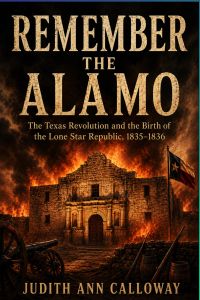
Remember The AlamoJudith Ann Calloway5h 23m$7
The AlamoJohn Myers Myers7h 13m3.6 (198)$17

The History of the Confederate War, Its Causes and Its Conduct (Vol.1&2) (Annotated)George Cary Eggleston22h 57m4.4 (18)$0.99 · $0.00
The Colored Patriots of the American Revolution (Annotated)William Cooper Nell, Harriet Beecher Stowe12h 17m4.3 (175)$2 · $0.00

Addresses: by John A. MartinJohn Alexander Martin10h 45m$1 · $0.00
History of the Black Hawk War (Annotated)Black Hawk, Charles M. Scanlan9h 6m$2 · $0.00

Tablet commemorative of Joan van der Capellen tot den PolThe Holland Society of New York1h$1 · $0.00