
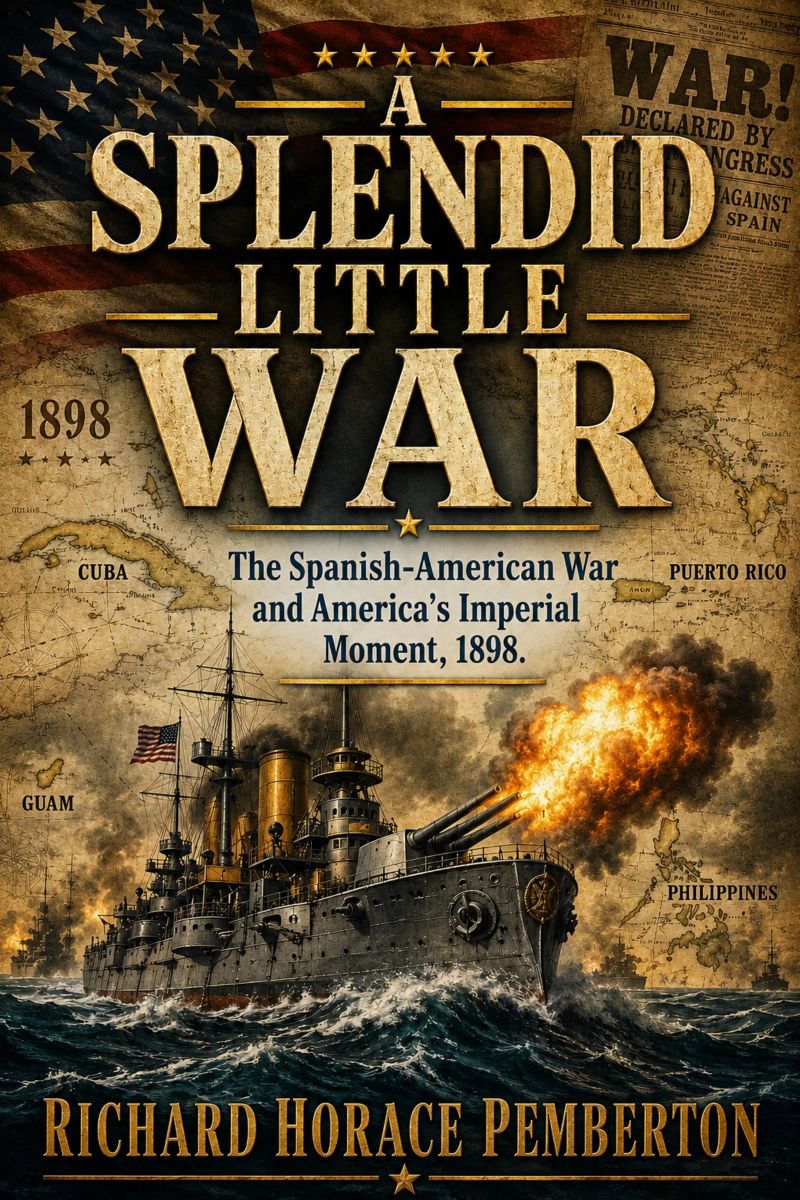
A SPLENDID LITTLE WAR
The Spanish-American War and America's Imperial Moment, 1898By Richard Horace Pemberton


Length5h 47m
About this audiobook
The complete narrative history of the Spanish-American War — Theodore Roosevelt, Dewey at Manila Bay, the Rough Riders, the Filipino betrayal, and the untold story of America's imperial moment, 1898.
On February 15, 1898, the battleship Maine exploded in Havana Harbor — 266 men killed, cause never definitively established. In 1898, neither the press nor the public was in the mood for ambiguity. "Remember the Maine, to Hell with Spain" became the rallying cry of a nation building toward war for a decade, and Secretary of State John Hay's four-month conflict produced something neither Spain nor America expected: an empire.
In this Spanish-American War history, historian Richard Horace Pemberton follows the full arc of America's imperial moment — from José Martí's Cuban independence struggle and Hearst's yellow journalism machine, through Dewey's destruction of the Spanish Pacific fleet at Manila Bay and the Rough Riders' charge up Kettle Hill, to the Philippine-American War that followed. Central figures include Theodore Roosevelt, Commodore George Dewey, Emilio Aguinaldo, the Buffalo Soldiers of the Ninth and Tenth Cavalry, and the Filipino independence movement that won a revolution and lost a country in the same year.
Inside this Spanish-American War history:
• The yellow journalism machine — how Hearst's New York Journal manufactured the moral case for war: the Evangelina Cisneros rescue staged for circulation, banner headlines declaring Spanish treachery before any evidence was gathered (Chapter 2)
• Dewey's seven-hour victory — at 5:41 a.m. on May 1, 1898, Dewey ordered "You may fire when you are ready, Gridley." Seven hours later, 381 Spanish sailors were dead, the Pacific fleet destroyed, and not a single American life lost in battle (Chapter 9)
• The Rough Riders at Kettle Hill — Roosevelt on Little Texas, leading 490 men across an open meadow under Mauser fire, 86 casualties in one afternoon — the war's defining image and the launch of a presidential career (Chapter 6)
• The betrayal of Aguinaldo — Dewey returned the Philippine revolutionary to his homeland, encouraged him to believe independence was coming, then watched the Treaty of Paris sell ten million Filipinos to the United States for twenty million dollars (Chapters 10, 13)
• The Buffalo Soldiers' forgotten war — the Black regulars of the Ninth and Tenth Cavalry who fought alongside the Rough Riders at San Juan Heights, whose performance was decisive, and who received a fraction of the glory (Chapter 19)
The splendid little war lasted four months. The empire it produced — the Philippines, Guam, Puerto Rico, a protectorate over Cuba — lasted for decades. The questions it raised about American power, imperial responsibility, and the distance between proclaimed values and practiced interests have never been fully answered.
For readers of David Traxel's 1898: THE BIRTH OF THE AMERICAN CENTURY and Ivan Musicant's EMPIRE BY DEFAULT.
Audiobook details
GenreHistory
Length5 hrs 47 mins
Narrated byListen with 1,000+ voices
FormateBook with Audio
Publish dateJun 3, 2026
LanguageEnglish
Table of contents
1Introduction
2Prologue: Remember the Maine
3PART ONE: THE ROAD TO WAR (1890-1898)
4Chapter 1: Cuba Libre — The Cuban Independence Struggle and American Interest
5Chapter 2: Yellow Journalism — Hearst, Pulitzer, and the Press That Made a War
Show all chaptersShow less
6Chapter 3: The USS Maine — Explosion, Mystery, and the War Cry
7Chapter 4: McKinley's Decision — The President and the Path to Conflict
8PART TWO: THE WAR IN CUBA (1898)
9Chapter 5: The Naval War — Dewey at Manila Bay and Cervera at Santiago
10Chapter 6: The Rough Riders — Roosevelt, Wood, and the Charge at San Juan Hill
11Chapter 7: The Siege of Santiago — Victory and the Spanish Surrender
12Chapter 8: The Fever — Disease, Death, and the Army's Medical Crisis
13PART THREE: THE PACIFIC WAR
14Chapter 9: Dewey's Victory — The Battle of Manila Bay, May 1, 1898
15Chapter 10: The Philippine Revolution — Aguinaldo, American Allies, and Betrayal
16Chapter 11: Puerto Rico — The Southern Campaign and Acquisition
17Chapter 12: Guam and Wake — Acquiring the Pacific Island Chain
18PART FOUR: THE IMPERIAL RECKONING
19Chapter 13: The Treaty of Paris — The Terms of American Empire
20Chapter 14: The Philippine-American War — Suppressing the Insurrection, 1899-1902
21Chapter 15: The Anti-Imperialists — Mark Twain, Carnegie, and the Opposition
22Chapter 16: Cuba as Protectorate — The Platt Amendment and American Control
23PART FIVE: THE WAR'S PEOPLE
24Chapter 17: Theodore Roosevelt — The War That Made a President
25Chapter 18: William Randolph Hearst — The Publisher and His War
26Chapter 19: The Buffalo Soldiers — Black Troops in Cuba and the Philippines
27Chapter 20: The Filipino Perspective — Independence, Betrayal, and Resistance
28PART SIX: LEGACIES
29Chapter 21: American Empire — The Philippines, Guam, Puerto Rico, and the New Role
30Chapter 22: The Open Door Policy — China, Trade, and American Commercial Ambition
31Chapter 23: The Anti-Imperial Tradition — Dissent and Its Limits in American Foreign Policy
32Chapter 24: 1898 and American Power — The Splendid Little War's Long Shadow
33Epilogue: An Empire Acquired
34Acknowledgments
35Selected Bibliography
36About the Author
More from Richard Horace Pemberton

A Brief History of IntelligenceMax S. Bennett12h 18m4.6 (6.6K)$29 · $0.00

The Daughter of AuschwitzTova Friedman, Malcolm Brabant7h 54m4.6 (16.7K)$26 · $0.00
Lily's PromiseLily Ebert, Dov Forman8h 54m4.6 (16.1K)$29 · $0.00
On Democracies and Death CultsDouglas Murray10h 38m4.6 (6.5K)$29 · $0.00

Across the RiverKent Babb11h 40m4.6 (927)$29 · $0.00

Balcony Over Jerusalem: A Middle East Memoir - Israel, Palestine and BeyondJohn Lyons12h 37m4.6 (1.4K)$33 · $0.00

BeyondStephen Walker15h 39m4.6 (3.2K)$33 · $0.00
Kings and PawnsHoward Bryant10h 9m4.6 (678)$29 · $0.00

No EscapeNury Turkel9h 30m4.6 (809)$28 · $0.00
Jubal Stone: U.S. Marshal: Blood Trail To Hell: A Western Adventure NovelCasey Nash3h 42m4.6 (3.2K)$18 · $0.00

Fall and RiseMitchell Zuckoff17h 23m4.6 (9.8K)$40 · $0.00
The SurvivorJosef Lewkowicz, Michael Calvin9h 22m4.6 (2.5K)$29 · $0.00

Always FaithfulThomas Schueman, Zainullah Zaki12h 12m4.6 (977)$29 · $0.00

The State of Society in France Before the Revolution of 1789 (Annotated)Alexis de Tocqueville17h 25m4.6 (1.2K)$2 · $0.00
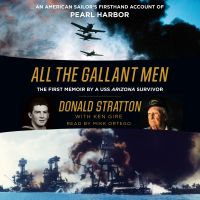
All the Gallant MenDonald Stratton, Ken Gire5h 55m4.6 (11.8K)$24 · $0.00
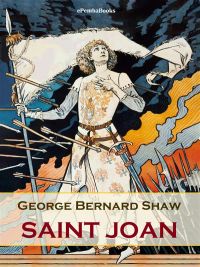
Saint Joan (Annotated)George Bernard Shaw6h 20m4.6 (1.2K)$1.20 · $0.00

Medgar and MyrlieJoy-Ann Reid10h 52m4.5 (27.8K)$29 · $0.00

The History of the Peloponnesian War (Annotated)Thucydides24h 3m4.6 (1.1K)$2 · $0.00
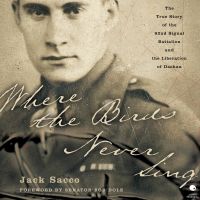
Where the Birds Never SingJack Sacco10h 31m4.6 (3.8K)$29 · $0.00

Serviceman J: The Untold Story of an NZSAS SoldierJamie Pennell5h 51m4.6 (452)$24 · $0.00
You may also like

Destruction and Reconstruction: / Personal Experiences of the Late WarRichard Taylor10h 51m4.1 (440)$2.30

Wages, Price and ProfitKarl Marx2h 18m4.3 (3.8K)$2 · $0.00
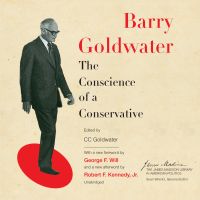
The Conscience of a ConservativeBarry Goldwater, CC Goldwater4h 7m4.0 (14.7K)$20
The History of the Peloponnesian WarThucydides22h 10m4.2 (54.2K)$2.30

The Art of War in the Middle Ages A.D. 378-1515C. W. C. Oman4h 57m4.0 (614)$2.30
The Anatomy of FascismRobert O. Paxton11h 1m4.3 (7.7K)$23

History of the Civil War, 1861-1865James Ford Rhodes15h 13m4.0 (2.5K)$2 · $0.00

The Communist ManifestoKarl Marx1h 13m3.9 (240.6K)$3 · $0.00
The River WarWinston Churchill14h 9m4.1 (1.5K)$2 · $0.00
Small Wars ManualUnited States Marine Corps20h 27m4.2 (355)$2 · $0.00

The Capital (Vol. 1-3) (Annotated)Karl Marx103h 44m4.4 (3.4K)$2 · $0.00
The PriceArmen Keteyian, John Talty13h 53m4.3 (825)$33 · $0.00

The Iraq WarJohn Keegan8h 6m3.7 (1.3K)$17

GettysburgStephen W. Sears20h 59m4.4 (8.1K)$46 · $0.00
The "City Guard"George Filmer, William D. O'Brien, A. McCulloch, W. J. Hayes, Irving B. Cook9h 37m$1 · $0.00
THE LONG STANDOFFCatherine Emerson Gallagher7h 16m$8
History of the Mexican-American WarJustin Harvey Smith58h 20m4.2 (140)$2 · $0.00
The U.S.-Mexican War (Vol. 1&2) (Annotated)Justin H. Smith55h 51m3.9 (26)$2 · $0.00

The Balkan TrailFrederick F. Moore8h 4m$2.30
The Major Operations of the Navies in the War of American IndependenceA. T. Mahan7h 59m4.1 (20)$2 · $0.00