
Audio only
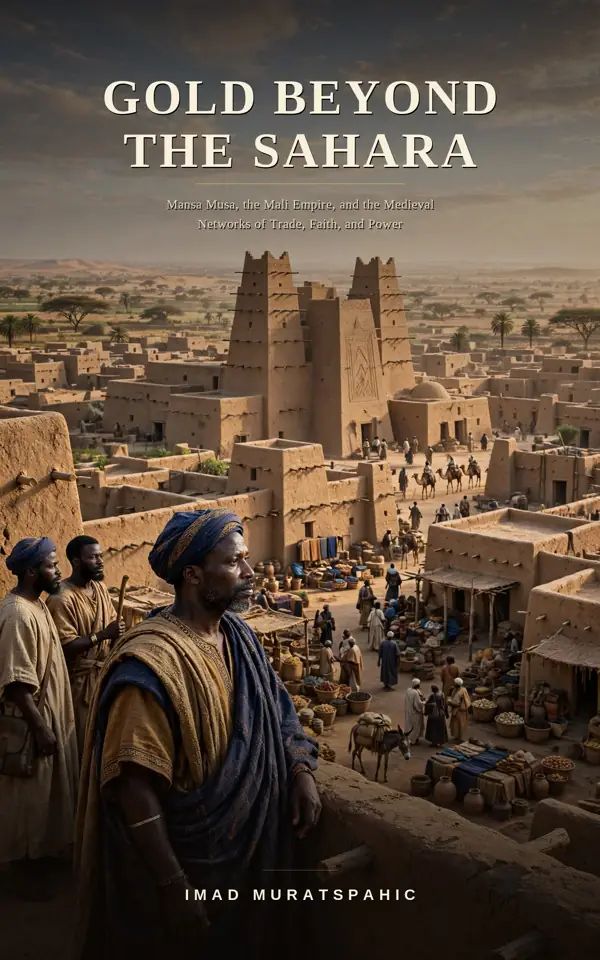
Gold Beyond the Sahara
Mansa Musa, the Mali Empire, and the Medieval Networks of Trade, Faith, and PowerBy Imad Muratspahic


Length1h 29m
About this audiobook
Mansa Musa ruled one of medieval Africa's most influential empires, a state whose wealth, political institutions, and commercial connections linked West Africa with the wider world.
Gold Beyond the Sahara explores the rise of the Mali Empire, the gold and salt trade, the famous pilgrimage to Mecca in 1324–1325, and the development of trans-Saharan commercial and cultural networks. It examines the roles of merchants, scholars, political institutions, and regional communities in sustaining Mali's influence, while separating historical evidence from popular myths about Musa's extraordinary wealth.
Discover the empire behind the legend and the wider medieval world connected by its trade routes.
Audiobook details
GenreHistory
Length1 hr 29 mins
Narrated byListen with 1,000+ voices
FormateBook with Audio
Publish dateOct 10, 2026
LanguageEnglish
Table of contents
1Dedication
2Introduction: Wealth Without a Balance Sheet
31. Reconstructing a Medieval African Empire
42. The Sahel: A Borderland That Connected Worlds
53. Before Musa: The Making of Mali
Mostrar todos os capítulosVer menos
64. What an Empire Held Together
75. Gold: The Resource Behind the Reputation
86. Salt, Caravans, and the Work of Distance
97. Rivers, Markets, and the Cities of the Sahel
108. Musa Comes to the Throne
119. The Pilgrimage of 1324–1325
1210. What Cairo Saw—and What It Could Not See
1311. Islam, Kingship, and Local Traditions
1412. Learning, Mosques, and the Long History of Timbuktu
1513. The People Behind the Royal Spectacle
1614. Trade, Power, and the Limits of Central Control
1715. After Musa: Successors and the Test of Time
1816. Musa on the Map: Reputation Becomes History
1917. Separating Evidence from Legend
2018. What Wealth Could Build—and What It Could Not
21Conclusion: Beyond the Gold
22Chronology: Dates and Turning Points
23A Note on the Evidence
24Selected Reading and Research Sources
25About the Author

The Woman God Says You AreImad Muratspahic2h 11m$9 · $0.00
A King Against the WorldImad Muratspahic1h 45m$7.90 · $0.00

SafeImad Muratspahic1h 3m$11 · $0.00

The Society of Cursed NamesImad Muratspahic1h 52m$7.30 · $0.00

The Blackwood CovenantImad Muratspahic44m$7.30 · $0.00

The Hollows of Blackwood CountyImad Muratspahic1h 21m$7.30 · $0.00

The Parish WatchImad Muratspahic2h 12m4.7 (16)$7.30 · $0.00

No Time Like The End TimesImad Muratspahic2h$5.10 · $0.00

Don't Let One Mistake Ruin the GameImad Muratspahic1h 39m$11 · $0.00

Built to HoldImad Muratspahic2h 31m$11 · $0.00

Freedom's Unfinished RepublicImad Muratspahic2h 50m$9 · $0.00

Seguridad para NiñosImad Muratspahic3h 16m$12 · $0.00

Anxious Attachment ResetImad Muratspahic3h 50m$5.10 · $0.00

Retirement Gift for MenImad Muratspahic1h 6m$11 · $0.00

Forgiving Someone Who Hurt YouImad Muratspahic3h 37m$7.90 · $0.00

Biblia Explicada Libro por LibroImad Muratspahic5h 7m$12 · $0.00

The Purified MindImad Muratspahic1h 38m$7.30 · $0.00

Devotional for TeachersImad Muratspahic3h 2m$12 · $0.00
Monsoon and SteelImad Muratspahic1h 35m$7.90 · $0.00

A Brief History of IntelligenceMax S. Bennett12h 18m4.6 (6.6K)$29 · $0.00

The Happiest Man on EarthEddie Jaku3h 48m4.6 (178K)$7 · $0.00

MotherlandJulia Ioffe17h 52m4.7 (2.5K)$40 · $0.00

Where Cowards Go to DieBenjamin Sledge8h 42m4.7 (351)$20 · $0.00

RevolutionariesSanjeev Sanyal11h 23m4.6 (2.6K)$29 · $0.00

We Crossed a Bridge and It TrembledWendy Pearlman6h4.6 (5.2K)$24 · $0.00

Unbroken Bonds of BattleJohnny Joey Jones8h 31m4.6 (2.6K)$8 · $0.00

The Daughter of AuschwitzTova Friedman, Malcolm Brabant7h 54m4.6 (16.7K)$26 · $0.00

Lily's PromiseLily Ebert, Dov Forman8h 54m4.6 (16.1K)$29 · $0.00
On Democracies and Death CultsDouglas Murray10h 38m4.6 (6.5K)$29 · $0.00

Across the RiverKent Babb11h 40m4.6 (927)$29 · $0.00

Balcony Over Jerusalem: A Middle East Memoir - Israel, Palestine and BeyondJohn Lyons12h 37m4.6 (1.4K)$33 · $0.00

BeyondStephen Walker15h 39m4.6 (3.2K)$33 · $0.00
Kings and PawnsHoward Bryant10h 9m4.6 (678)$29 · $0.00

No EscapeNury Turkel9h 30m4.6 (809)$28 · $0.00

Jubal Stone: U.S. Marshal: Blood Trail To Hell: A Western Adventure NovelCasey Nash3h 42m4.6 (3.2K)$18 · $0.00

Fall and RiseMitchell Zuckoff17h 23m4.6 (9.8K)$40 · $0.00

The SurvivorJosef Lewkowicz, Michael Calvin9h 22m4.6 (2.5K)$29 · $0.00

Always FaithfulThomas Schueman, Zainullah Zaki12h 12m4.6 (977)$29 · $0.00

The State of Society in France Before the Revolution of 1789 (Annotated)Alexis de Tocqueville17h 25m4.6 (1.2K)$2 · $0.00
You may also like
An Account of EgyptHerodotus5h 4m4.0 (1.1K)$1 · $0.00

In the South SeasRobert Louis Stevenson10h 43m3.8 (1.1K)$1.20 · $0.00

Chief Seattle and the Town That Took His NameDavid M. Buerge11h 43m4.2 (704)$20

IrelandFrank Delaney19h 29m4.1 (16.7K)$40 · $0.00
Persian MiniaturesVladimir Loukonin, Anatoli Ivanov1h 42m4.2 (30)$13.50 · $0.00

Korean BuddhismFrederick Starr2h 4m$2 · $0.00
Savage Island: An Account of a Sojourn in Niué and TongaBasil Thomson5h 41m$2 · $0.00

At Home In FijiC. F. Gordon Cumming17h 29m3.8 (25)$2.40

A Literary and Historical Atlas of AsiaJ. G. Bartholomew9h 57m$2 · $0.00

The Russian painters of water 1750-1950Sutherland Lyall2h 7m$16 · $0.00

Chinese ArtStephen W. Bushell5h 34m4.2 (31)$18 · $0.00
Persian ArtVladimir Lukonin, Anatoly Ivanov10h 31m3.8 (14)$18 · $0.00
Septuagint - ObadiahScriptural Research Institute29m$3.50 · $0.00
Ancient Media (Annotated)George Rawlinson6h 32m$2 · $0.00

Western European Illuminated ManuscriptsAnrdei Sterligov, Tamara Voronova6h 34m$18 · $0.00

History of the FanG. Woolliscroft Rhead9h 22m4.3 (10)$1 · $0.00

History of the Kingdom of China (Vol. 1&2)Juan González de Mendoza20h 47m3.7 (16)$1.99 · $0.00

Constantinople Old and NewH. G. Dwight14h 34m4.2 (24)$2.30

From Sea to Sea, Letters of TravelRudyard Kipling22h 28m$2.30
In Quest of El DoradoStephen Graham9h 3m$2.30