
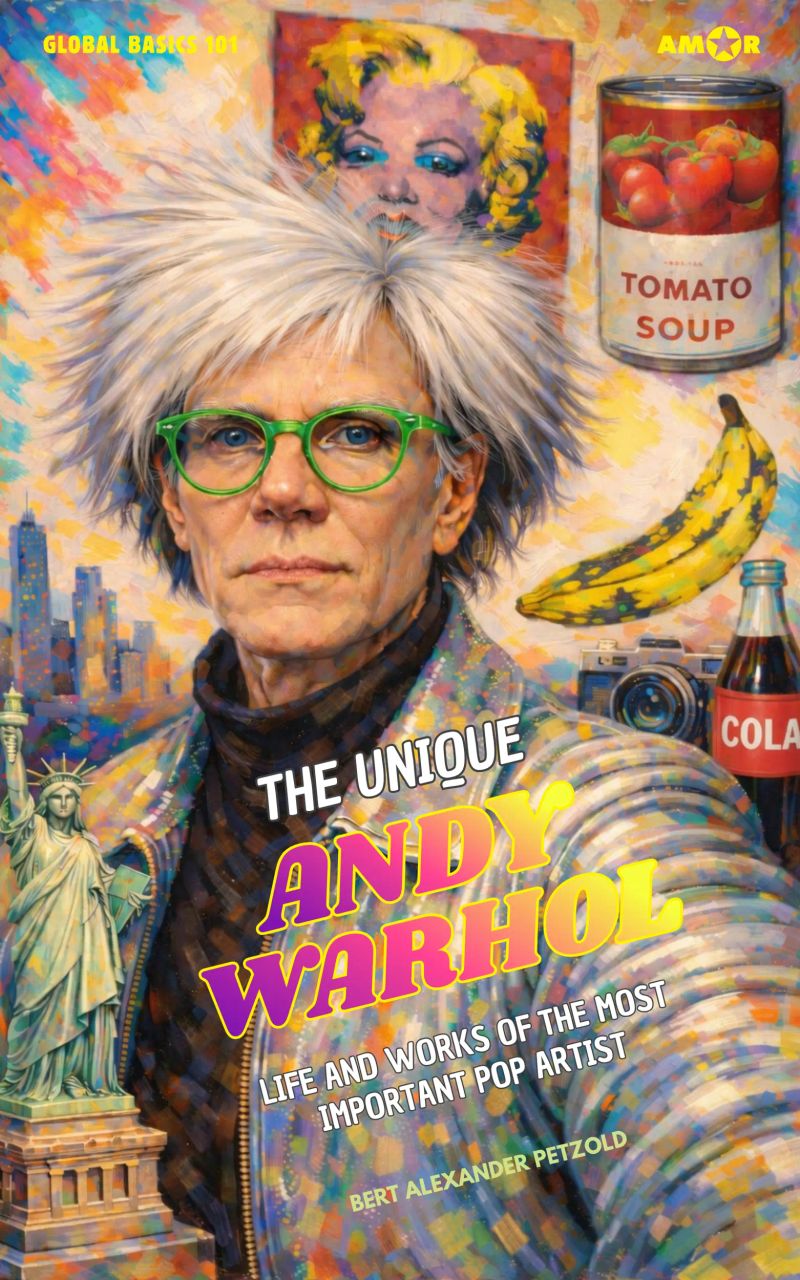
The Unique Andy Warhol
The Life and Works of the Most Important Pop ArtistBy Bert Alexander Petzold


Length1h 24m
About this audiobook
Why does a soup can feel like a work of art? Why does a starlet’s pose become an icon? And why does our present sometimes feel like an endless repetition of images? If you understand Andy Warhol, you understand the mechanics of pop culture, media and fame right up to our own day. This non-fiction book opens the door to an artist who turned advertising into art – and art into a brand: cool, razor-sharp in observation and, surprisingly, deeply human.
Andy Warhol (1928–1987) did not begin as a myth, but as Andrej Warhola, the son of an immigrant family from what is now Slovakia – shaped by illness, withdrawal and an early passion for images. Out of that childhood grew a way of seeing that would later change the world. After studying commercial art in Pittsburgh, he moved to New York, to the place where style, consumption and attention ruled. In the 1950s he became successful as a commercial illustrator – and this is the key to his later upheaval. Warhol understood how images work: how they seduce, how they imprint themselves, and how to design them so they will not let you go.
When he opened his legendary studio, ‘The Factory’, in 1962, it became a laboratory of modernity. Warhol perfected screen printing and made reproduction the principle. Suddenly, everyday products and press photographs could appear like holy icons. ‘Campbell’s Soup Cans’, ‘Coca-Cola Bottles’ and the portrait series of ‘Marilyn’, ‘Elvis’ or ‘Mao’ became symbols of a new era. Yet beneath the smooth surface lay a precise way of thinking about original and copy, about staging and power – about what we accept as real simply because it appears often enough before our eyes. Series such as ‘Brillo Boxes’ or ‘Death and Disaster’ revealed how closely consumer gloss and shock imagery sit together, and how ruthlessly the media shapes our perception.
This book also takes you into Warhol’s radical boundary-crossings. He shot hundreds of experimental films, worked with the band The Velvet Underground, staged light shows under the title ‘Exploding Plastic Inevitable’, and turned ‘The Factory’ into a magnet for music, fashion, film and the art market. Then came the 1968 shooting by Valerie Solanas – an rupture that permanently changed Warhol’s body and life. The glittering centre became an artist who cultivated distance even more deliberately, and yet mirrored society more sharply than ever.
In the 1970s he produced his famous commissioned portraits of celebrities: Polaroids, the magazine ‘Interview’, stage designs and record sleeves. Warhol’s belief that ‘business art’ was an art form became the blueprint for a present in which attention has become a currency. In the 1980s he sought dialogue with younger artists such as Jean-Michel Basquiat and turned to themes of religion and mortality – crosses, skulls and ‘Last Supper’ motifs. In 1987 he created a haunting ‘self-portrait’. Shortly afterwards he died in New York following complications from surgery. His estate – films, screen prints, photographs and the ‘Time Capsules’ – shows the extraordinary range of an artist who newly connected advertising, media and high art.
In this non-fiction book, Bert Alexander Petzold takes you on a richly factual cultural journey – accessible, entertaining and clearly structured. You gain solid basics that stay with you, and connections that illuminate. Ideal for students preparing for the university entrance qualification, and just as valuable for undergraduates and art lovers who do not want to know Warhol as a poster, but as a thinking machine of modernity.
Order your copy now and discover Andy Warhol beyond the clichés. Understand why his images still shape our ideas of fame, consumption and identity – and why this book is the fastest way to truly grasp Pop Art.
Audiobook details
GenreBiography and Memoir, Other
Length1 hr 24 mins
Narrated byListen with 1,000+ voices
FormateBook with Audio
Publish dateFeb 20, 2026
LanguageEnglish
Table of contents
1The Unique Andy Warhol
2The Life and Works of the Most Important Pop Artist: The Life and Works of the Most Important Pop Artist
3Chapter 1. Childhood, Adolescence and Studies in Pittsburgh (1928–1949)
4Chapter 2. Commercial Illustrator in New York (1949–1956)
5Chapter 3. Highly Paid Commercial Illustrator in the Art Capital New York (1956–1963)
Show all chaptersShow less
6Chapter 4. A Hat Factory Becomes the ‘Factory’ (1963–1964)
7Chapter 5. Moving Images, Films Take Shape (1964–1968)
8Chapter 6. Assassination Attempt in the ‘Factory’ (3 June 1968)
9Chapter 7. Andy Warhol Enterprises, Commercial Art (1969–1987)
10Chapter 8. How Pop Art Changed the Art World (from 1950)
11Chapter 9. New York as an Art Metropolis since the 1970s (1970 to the present)
12Chapter 10. Andy Warhol’s Major Works and Exhibitions, Artist Peers (1956–1987)
13Chapter 11. Sudden Death and Worldwide Recognition (1987)
14Chapter 12. Summary
15Chapter 13. Timeline
16Chapter 14. Author’s Biography

Die Geschichte BrasiliensBert Alexander Petzold2h 44m$3

The History of the United Kingdom of Great Britain and Northern Ireland (UK)Bert Alexander Petzold3h 57m$3

The History of the United States of AmericaBert Alexander Petzold2h 59m$3

The History of FranceBert Alexander Petzold4h 51m$3

The History of ChinaBert Alexander Petzold2h 34m$3
Sigmund Freud, Neurologist and PsychologistBert Alexander Petzold2h 31m$3

The History of GermanyBert Alexander Petzold2h 58m$3

Die Geschichte DeutschlandsBert Alexander Petzold3h 1m$3

Die Geschichte IndiensBert Alexander Petzold4h 38m$3

Die Geschichte PalästinasBert Alexander Petzold3h 37m$3

Die Geschichte SpaniensBert Alexander Petzold5h 17m$3
The Physicist Albert EinsteinBert Alexander Petzold2h 4m$3

Die Geschichte FrankreichsBert Alexander Petzold5h 10m$3

Die Geschichte ItaliensBert Alexander Petzold6h 18m$3

Die Geschichte der SchweizBert Alexander Petzold3h 25m$3

Die Geschichte des Vereinigten Königreichs Großbritannien und Nordirland (UK)Bert Alexander Petzold4h 20m$3

Der Komponist Wolfgang Amadeus MozartBert Alexander Petzold2h$3

Die Geschichte IsraelsBert Alexander Petzold2h 29m$3

Die Geschichte der Vereinigten Staaten von Amerika (USA)Bert Alexander Petzold3h 9m$3

Der Komponist Joseph HaydnBert Alexander Petzold1h 44m$3

Matters of the HeartJacinta Nampijinpa Price9h 35m4.8 (359)$29 · $0.00
The StepsSylvester Stallone9h 4m4.8 (635)$29 · $0.00

How to Test Negative for StupidJohn Kennedy8h 13m4.7 (9.7K)$28 · $0.00

Bad Fat Black GirlSesali Bowen6h 32m4.7 (2.8K)$24 · $0.00

Send MeMarty Skovlund, Joe Kent8h 10m4.7 (1.6K)$26 · $0.00

John Muir: The Story of My Boyhood and Youth & Letters to a Friend (Annotated)John Muir10h 13m4.7 (1.1K)$0.99 · $0.00

Invisible StormJason Kander6h 48m4.7 (3.2K)$24 · $0.00

Forever BoyKate Swenson9h 27m4.7 (5K)$29 · $0.00

You Are Worth ItKyle Carpenter, Don Yaeger8h 53m4.7 (4.8K)$29 · $0.00

The Happiest Man on EarthEddie Jaku3h 48m4.6 (178K)$7 · $0.00
MotherlandJulia Ioffe17h 52m4.7 (2.5K)$40 · $0.00

Evidence Not SeenDarlene Deibler Rose11h 11m4.6 (11.9K)$29 · $0.00

Where Cowards Go to DieBenjamin Sledge8h 42m4.7 (351)$20 · $0.00

Will You Love Me?Cathy Glass9h 5m4.6 (9.3K)$29 · $0.00
Designing Terry Pratchett’s DiscworldPaul Kidby3h 52m4.7 (343)$20 · $0.00

HostageEli Sharabi5h 25m4.6 (10.8K)$24 · $0.00

Finding MeViola Davis9h 15m4.6 (256.4K)$29 · $0.00

The Dangerous Truth about Today’s MarijuanaLaura Stack CSP, MBA9h 57m4.7 (385)$20 · $0.00

Birdie & HarlowTaylor Wolfe7h 50m4.6 (6.5K)$26 · $0.00
The Lives of BrianBrian Johnson9h 45m4.6 (3.5K)$29 · $0.00
Mere ChristianityC. S. Lewis7h 7m4.4 (519.7K)$24 · $0.00

Her Daily BreadKate Wood12h 57m4.6 (153)$33 · $0.00
The Holy Bible - 1 SamuelKing James2h 13m4.8 (1.6K)$3 · $0.00

The American Standard Bible — The Gospel of MatthewMatthew3h 56m4.7 (3K)$2 · $0.00
Bad Fat Black GirlSesali Bowen6h 32m4.7 (2.8K)$24 · $0.00

The King James Audio Bible New Testament CompleteChristopher Glyn20h 2m4.7 (2.6K)$12 · $0.00

Faiths CheckbookCharles Spurgeon12h 44m4.7 (3.2K)$11 · $0.00

Ten Things I Wish You Knew About Your Child's Mental HealthDr. Billy Garvey4h 53m4.7 (2.4K)$20 · $0.00
Designing Terry Pratchett’s DiscworldPaul Kidby3h 52m4.7 (343)$20 · $0.00
The Chosen Book OneAmanda Jenkins, Kristen Hendricks, Dallas Jenkins3h 8m4.6 (4.9K)$10 · $0.00
The Lives of BrianBrian Johnson9h 45m4.6 (3.5K)$29 · $0.00
Expository Thoughts on the Gospel of LukeJ.C. Ryle27h 13m4.7 (536)$18 · $0.00

CrossroadsKaleb Dahlgren7h 56m4.6 (4.9K)$26 · $0.00

Across the RiverKent Babb11h 40m4.6 (927)$29 · $0.00

Brain Training for RidersAndrea Monsarrat Waldo5h 56m4.7 (550)$19 · $0.00

My Effin' LifeGeddy Lee17h 11m4.6 (13.1K)$40 · $0.00
Kings and PawnsHoward Bryant10h 9m4.6 (678)$29 · $0.00

The Elementia Chronicles #2: The New OrderSean Fay Wolfe11h 17m4.6 (841)$29 · $0.00

The ActsLuke2h 55m4.6 (19.7K)$12 · $0.00

New Testament - Easy NavigationWorld English Bible19h 35m4.6 (1.3K)$1.30 · $0.00